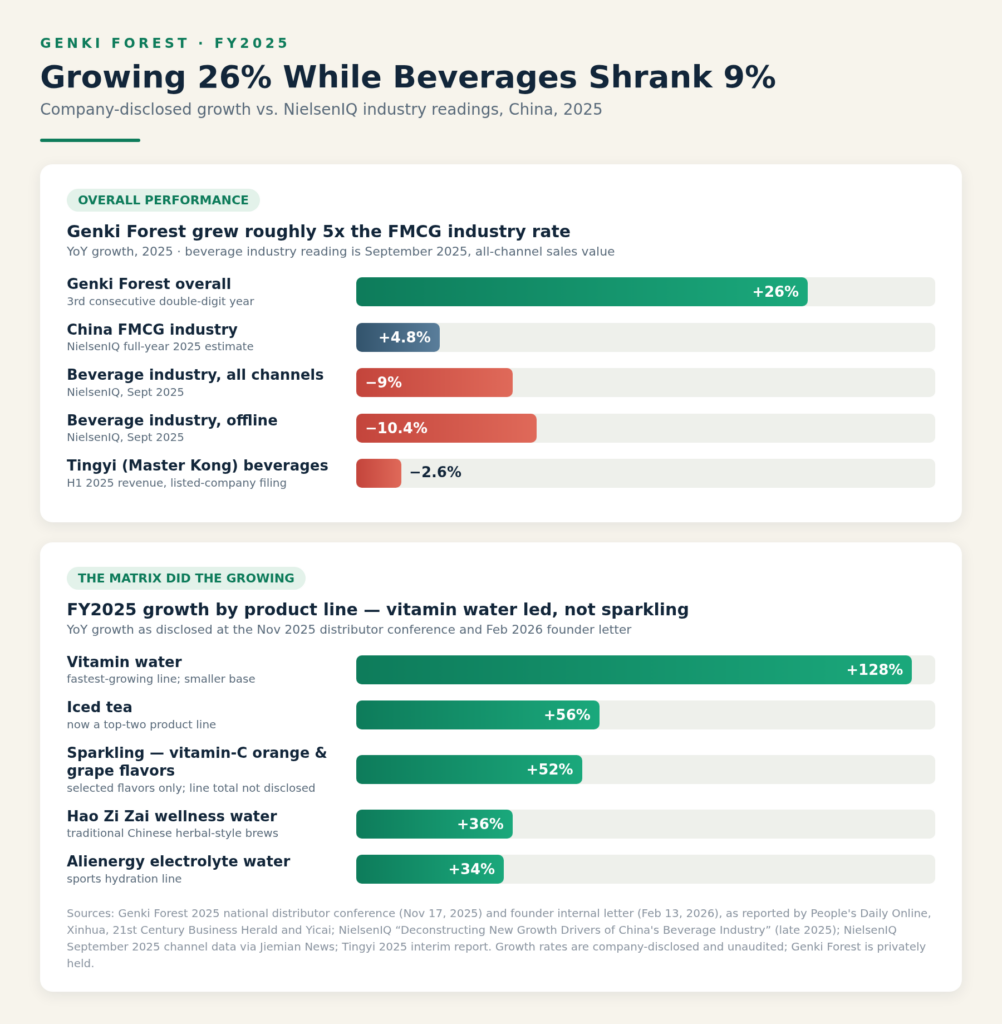
Here’s the thing most people get wrong about Genki Forest: they still think it’s a sparkling water company. It isn’t — not anymore. The zero-sugar bottle that took China’s convenience stores by storm was the entry ticket, not the business. The real story is a two-act transformation: an internet brand that rode a viral hit, hit a wall, and then did something almost nobody in the new-consumption class of 2016–2021 managed to do. It learned the boring stuff. Factories. Distributors. Price discipline. And it worked: the company disclosed 26% overall growth for 2025 — its third consecutive double-digit year, roughly five times the 4.8% growth rate NielsenIQ measured for China’s FMCG industry — in a year when the beverage market itself was shrinking. Vitamin water, not sparkling, was the fastest-growing line at 128%. The hit opened the door. The system is what keeps the lights on.
Act One: The Internet Brand That Crashed the Beverage Aisle
A gaming founder walks into a supermarket
Genki Forest was founded in 2016 by Tang Binsen, and his résumé was, on paper, absurd for beverages. He’d built Elex, the mobile gaming company behind Clash of Kings, a strategy game that quietly conquered overseas markets. Gaming taught him something beverage incumbents didn’t know: how to test fast, read data obsessively, and treat a product launch like a software release.
So when he looked at the drink aisle, he didn’t see heritage brands. He saw an unexploited user need — young Chinese consumers who wanted sweet drinks without the sugar guilt — and a category nobody had claimed. Zero-sugar, zero-fat, zero-calorie sparkling water, wrapped in Japanese-inspired minimalist packaging, priced above the incumbents. Category creation, textbook style.
The hit engine: seeding, screens, and cold shelves
The playbook was pure internet marketing. Seed content on Xiaohongshu and Douyin until the bottle became a lifestyle prop. Blitz convenience stores in tier-one cities, where the target demographic actually shopped. Let the clean label — zero sugar, zero fat, zero calories — do the persuading at the shelf. For a few years, growth ran at triple-digit rates, and Genki Forest became the poster child of China’s “new consumption” wave, alongside names like Perfect Diary.
The blind spots that forced a rethink
Then reality sent its invoices. The company had under-invested in supply chain, leaning on contract manufacturers while demand exploded. It had neglected the traditional offline channel — the millions of mom-and-pop stores, wholesalers, and lower-tier-city outlets where most Chinese beverages are actually sold. And in April 2021, it stumbled publicly: its milk tea label said “zero sucrose,” which consumers reasonably read as “zero sugar.” It wasn’t — milk contains sugars. Genki Forest issued a formal apology and relabeled the product “low sugar.” For a brand whose entire equity was built on a clean label, that was a near-death branding lesson.
The hit was real. But a hit is a moment, and moments end.
Act Two: The System Turn
What happened next is the part worth studying. Instead of chasing the next viral bottle, Tang spent the following years doing something his internet-native peers found almost embarrassing: learning from traditional FMCG companies. “Making beverages is slow work,” he told 700-plus distributors at the company’s November 2025 conference in Zhuhai. “We need patience to let things settle.” Slow is fast. Four engines came out of that turn.
Engine one: a health-drink matrix, not a single hero
Sparkling water is now one line among several. Alienergy electrolyte water covers sports hydration. Iced tea — brewed with liquid-nitrogen freshness-locking at minus 196 degrees Celsius — attacks the giant ready-to-drink tea category with a reduced-sugar proposition. Hao Zi Zai wellness water modernizes traditional Chinese herbal brews like red bean and barley, actually simmered rather than flavored. And vitamin water rounds out the functional set. Each line grew double digits in 2025; together they de-risk the company in a way no single hit ever could.
Engine two: the distributor machine, digitized
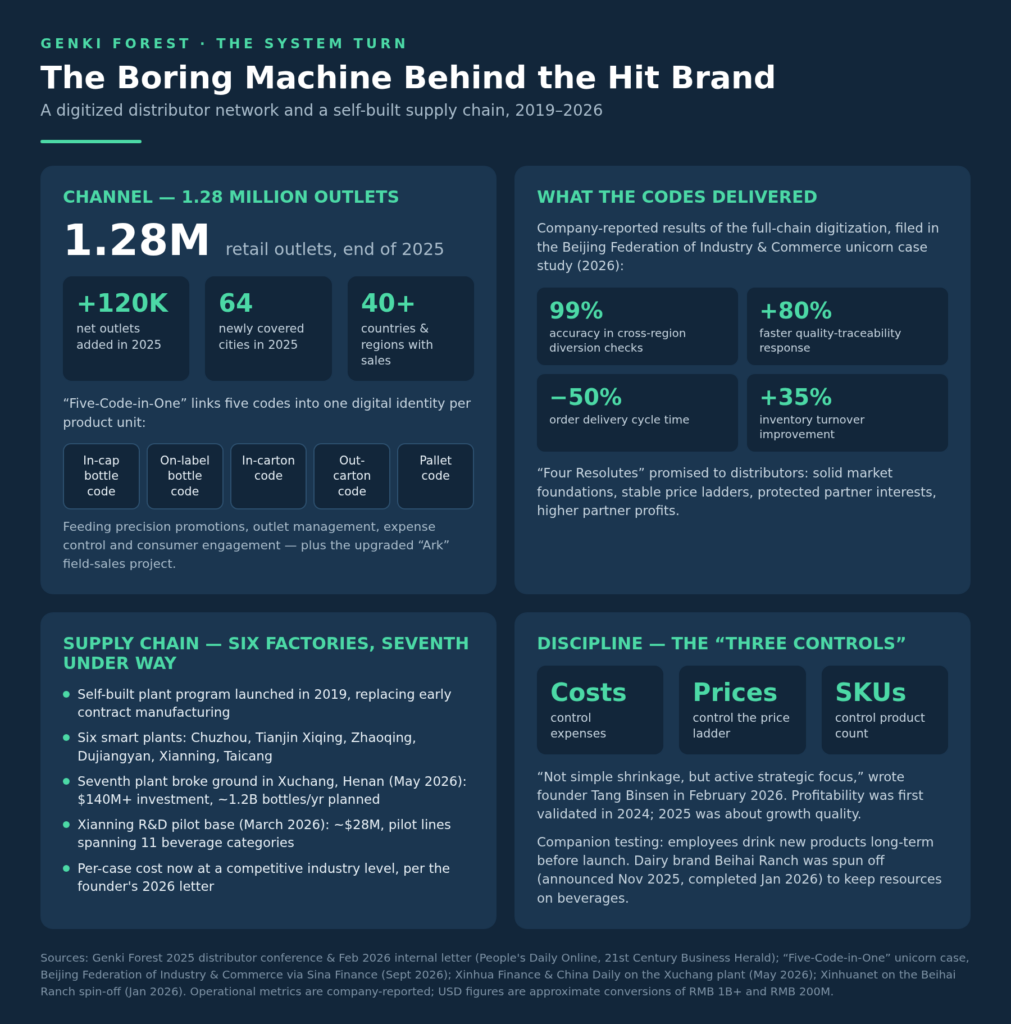
This is the unglamorous heart of the story. By the end of 2025, Genki Forest products were in 1.28 million retail outlets — a net addition of 120,000 in one year — with 64 newly covered cities. That’s the capillary network traditional giants spent decades building, assembled in a fraction of the time because Genki brought software to it.
The flagship system is called Five-Code-in-One. Every product unit gets a linked digital identity across five codes: in-cap, on-label, in-carton, out-carton, and pallet. Scan anywhere in the chain and the company knows where that bottle is, where it was supposed to be, and who moved it. In a case study recognized by the Beijing Federation of Industry and Commerce in 2026, the company reported 99% accuracy in catching cross-region diversion, 80% faster quality traceability, order delivery cycles cut by half, and inventory turnover up 35%. Those are company-reported figures — but they describe exactly the problems that kill beverage companies: diverted stock, broken price ladders, phantom inventory.
Around the tech sits an old-fashioned promise to distributors, the “Four Resolutes”: solid market foundations, stable price ladders, protected partner interests, higher partner profits. Translation: we won’t torch your margins with reckless online discounts. A Suzhou distributor who lost hundreds of thousands of yuan in 2022 stuck with the brand and was profitable by 2024 — the kind of story you only get when the channel believes you.
Engine three: build the factories yourself
Starting in 2019, Genki Forest began replacing contract manufacturing with its own plants. Six smart factories now operate — in Chuzhou, Tianjin Xiqing, Zhaoqing, Dujiangyan, Xianning, and Taicang — and a seventh broke ground in Xuchang, Henan, in May 2026, with over one billion yuan of investment and planned capacity of roughly 1.2 billion bottles a year. In March 2026 the company also unveiled a 200-million-yuan R&D pilot base in Xianning, with pilot lines spanning eleven beverage categories. Tang says per-case costs have reached a competitive industry level. Why does this matter? Because in beverages, margin lives in logistics and production, not in storytelling. You cannot content-market your way out of a bad cost per case.
Engine four: the Three Controls
In his February 2026 internal letter, titled “Focus, Concentrate, Answer Change with Constancy,” Tang distilled the operating philosophy into three controls: control expenses, control the price ladder, control SKU count. “This is not simple shrinkage,” he wrote, “but active strategic focus — resources concentrated on the main channel of navigation.” The letter also revealed something quietly important: 2024 was the year the company first validated that profitability was possible. New products now pass “companion testing” — employees drink them long-term before launch — and the dairy brand Beihai Ranch was spun off, announced at the November 2025 conference and completed in January 2026, so resources stay on beverages. For 2026, Tang’s plan was strikingly anti-plan: no new strategy, just deepen what works.
The Proof: Growth in a Shrinking Market
Context is everything here. NielsenIQ data showed China’s beverage sales fell 9% year over year across all channels in September 2025, with offline down 10.4%. Tingyi — the Master Kong empire — reported beverage revenue down 2.6% in the first half of 2025, with tea down 6.3%. Against that backdrop, Genki Forest’s disclosed 26% growth, its third straight double-digit year, looks less like marketing luck and more like share capture.
And look at what grew. Vitamin water: plus 128%. Iced tea: plus 56%. Two newer sparkling flavors — vitamin-C orange and Xiahei grape — plus 52%. Hao Zi Zai wellness water: plus 36%. Alienergy: plus 34%. Notice what’s absent: the company never disclosed total sparkling-line growth, only those two flavors. The original hit has matured. The matrix is doing the growing now.
The Price Pivot: From Premium to Mass
Here’s a detail that tells you the internet brand is gone. Genki Forest’s 900ml iced tea sells for five to six yuan in convenience stores, with recurring “second bottle for one yuan” promotions — seven yuan for two big bottles, undercutting the equivalent formats from Tingyi and Uni-President. One retailer summed it up to the International Finance News: Genki Forest “isn’t premium anymore.” That’s not an insult. It’s the strategy. Health positioning at mass-market prices, in big formats, in lower-tier cities — the exact opposite of the five-yuan slim can in a Shanghai FamilyMart that built the brand. Premium got them noticed; value gets them volume.
Why the Shelf Moved Their Way
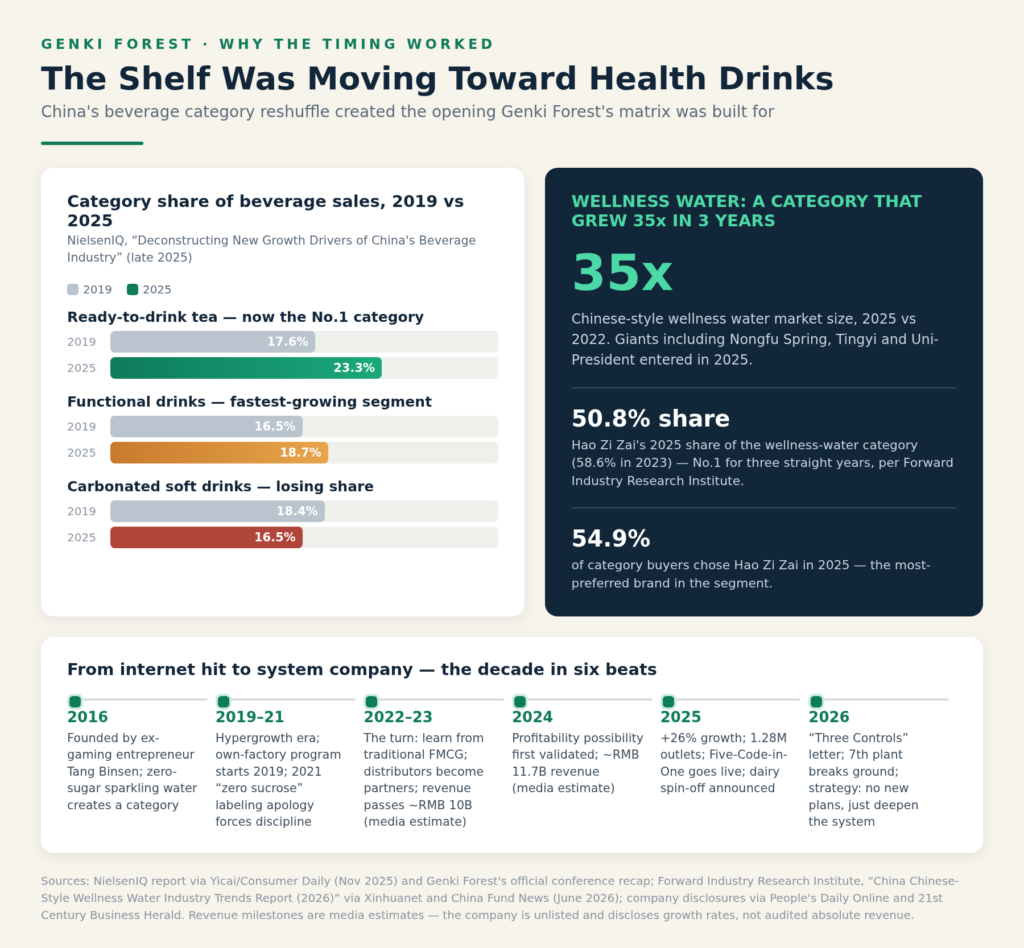
Genki Forest didn’t just execute better — it stood where the current was heading. NielsenIQ’s late-2025 industry report shows ready-to-drink tea overtaking carbonates as China’s largest beverage category, its share rising from 17.6% in 2019 to 23.3% in 2025, while functional drinks became the fastest-growing segment. Carbonates slid from 18.4% to 16.5%. Sugar-free and reduced-sugar teas grow double digits while sugared tea stalls.
Then there’s wellness water, a category that barely existed in 2022. According to the Forward Industry Research Institute’s 2026 report, the market grew 35-fold in three years, and giants including Nongfu Spring, Tingyi, and Uni-President all entered in 2025. Genki’s Hao Zi Zai holds a commanding lead: 50.8% share in 2025, down from 58.6% in 2023 as competitors arrived, but still number one for three straight years, and the choice of 54.9% of category buyers. When a trend you bet on five years ago becomes an industry land grab, being early looks like genius. It was actually patience.
What Everyone Gets Wrong
“It’s a sparkling water company.” No — sparkling was the entry. The fastest-growing line is vitamin water, and the disclosed growth engine is the matrix. “Internet brand means marketing genius.” The survival story is factories, distributor software, and SKU discipline. Marketing opened the door; operations paid the rent. “It’s a premium brand.” The value-priced 900ml iced tea says otherwise. “Its revenue is 14 billion yuan.” Careful — that’s a media estimate. The company is unlisted and discloses growth rates, not audited revenue. Media pegged 2023 at roughly 10 billion yuan and 2024 at about 11.7 billion; applying the disclosed 26% yields 14 billion-plus for 2025. Estimates, all of them. Treat them as such.
The Reusable Playbook
If you run a brand — any brand, any market — four lessons transfer.
- The hit is entry; the system is moat. A viral product acquires customers. Supply chain, channel, and portfolio keep them. Perfect Diary rode the same wave and never built the second story; compare outcomes.
- Internet brands must learn boring fundamentals. Tang’s phrase — learning from the FMCG veterans with humility — is the whole strategy. There is no growth hack for cost per case.
- A category portfolio de-risks the hit. Five growing lines beat one declining hero. When sparkling matured, the company didn’t panic; it leaned on tea, electrolytes, and wellness.
- Digitize the traditional channel instead of skipping it. Genki didn’t disrupt distributors away — it armed them. Five codes per bottle turned the oldest distribution model in China into a data asset.
Risks and Honest Caveats
Let’s not write a fan letter. The opacity is real: unaudited, self-reported growth rates from a private company deserve skeptical respect, not blind trust. The 128% vitamin water growth comes off a small base. Value pricing invites margin pressure, and the competitor it now faces head-on — Dongpeng Beverage, with guided 2025 revenue of 20.8 to 21.1 billion yuan — is bigger and stronger in exactly the lower-tier markets Genki is entering. Wellness water’s 50.8% share is already eroding as giants arrive. And a beverage market falling 9% is a headwind no matrix fully cancels. Tang himself wrote that the company’s risk resistance is “only a foundation, far from a reason for optimism.” Believe him.
Conclusion
Genki Forest disrupted Chinese beverages twice. First with a bottle: zero-sugar sparkling water, seeded on social feeds, stacked in convenience-store fridges. Then with a machine: six factories and counting, 1.28 million digitized outlets, a disciplined portfolio, and a founder who publicly chose boredom over buzz. The first disruption made it famous. The second made it durable. For every founder still hunting the next viral hit, the lesson sits in plain sight — hits expire, systems compound.
The Takeaway in One Paragraph
Genki Forest’s 26% growth in a shrinking market wasn’t marketing magic; it was what happens when an internet brand spends five years learning supply chain, distributor economics, and product discipline. The sparkling hit created the category and the customer; the health-drink matrix, the Five-Code-in-One channel machine, the self-built factories, and the Three Controls turned a moment into a business. If your brand depends on one hit, you don’t have a moat — you have a countdown.