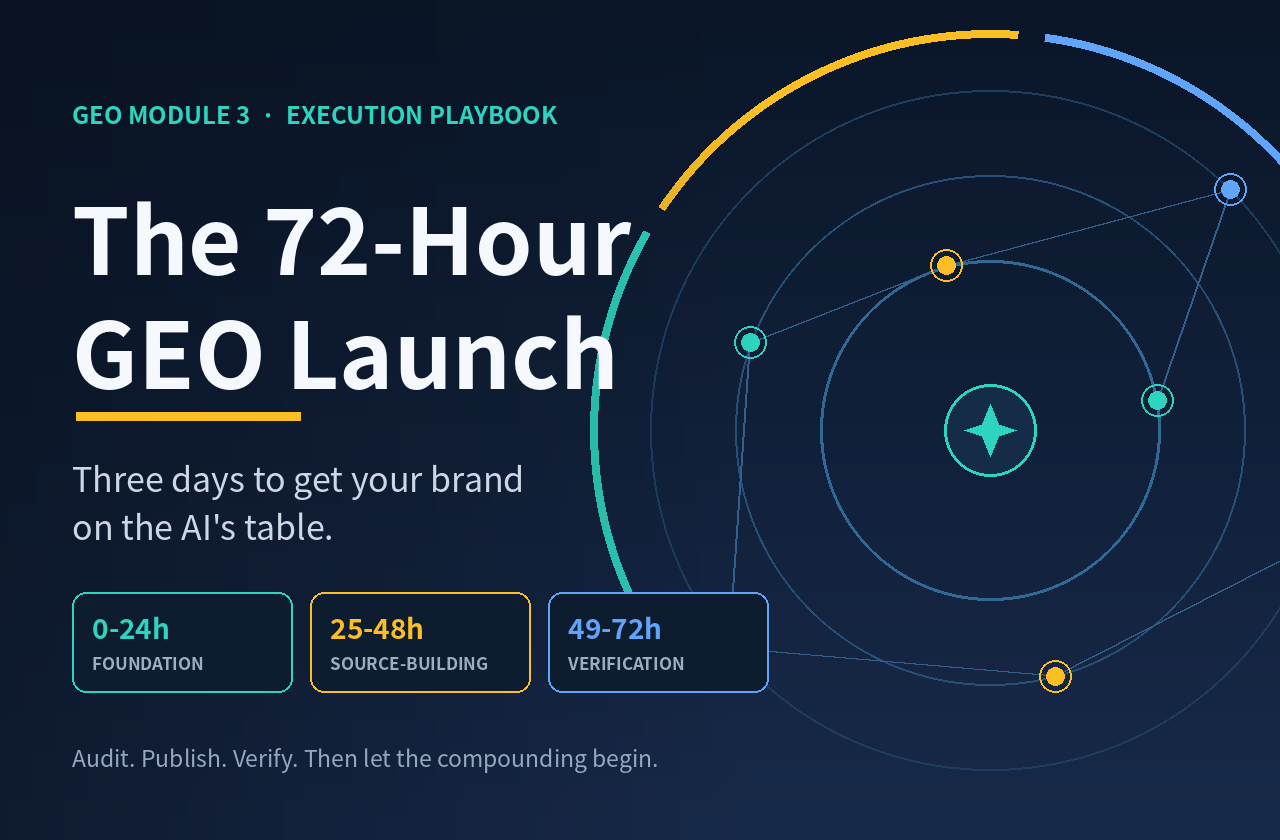
Most teams don’t have a GEO knowledge problem. They have a starting problem. A three-day, time-boxed launch fixes that: Phase 1 (hours 1–24) removes the technical blockers so AI systems can read you; Phase 2 (hours 25–48) builds external sources and publishes citable content so AI systems know you exist; Phase 3 (hours 49–72) verifies the work and installs the monitoring loop that makes progress measurable. Each phase ends with a verifiable acceptance gate — evidence, not intentions. The 72 hours launch the system; the following weeks and months compound it. This module is the execution spine of the GEO curriculum: every other module deepens one of these three days.
The Gap Isn’t Knowledge. It’s Ignition.
Here’s an uncomfortable number. In the State of GEO 2026 study from The Cocktail (WPP) and the Spanish Marketing Association, 83% of surveyed organizations said they know what GEO is, and 65% expect AI search to have a high or transformative impact within three years. Yet only 40% have a structured strategy with goals, owners and a roadmap. And among those already doing GEO work, just 3% could quantify a business impact.
Read that again. Almost everyone gets it. Fewer than half have a plan. Almost nobody can prove it’s working.
That’s not a competence gap — it’s an ignition gap. GEO sits on the to-do list like a gym membership in January. The fix isn’t another webinar. It’s a deadline. Three days, ten tasks, three acceptance gates. You can’t finish GEO in a weekend, but you can absolutely start it in one — and starting is where the compounding begins.
Why the urgency? Gartner has forecast that traditional search engine volume will drop 25% by 2026, and that many brands will see organic search traffic fall by 50% or more by 2028 as consumers embrace AI-powered search. Those are predictions, not measurements — but the direction is already visible in real data. Adobe Analytics, covering more than a trillion visits to US retail sites, found AI-referred traffic grew 393% year over year in Q1 2026. By July 2026, those AI-referred visitors converted 60% better than non-AI traffic and generated 53% more revenue per visit. A year earlier, the sign was flipped: AI visitors were the worst-converting cohort. The channel matured in twelve months.
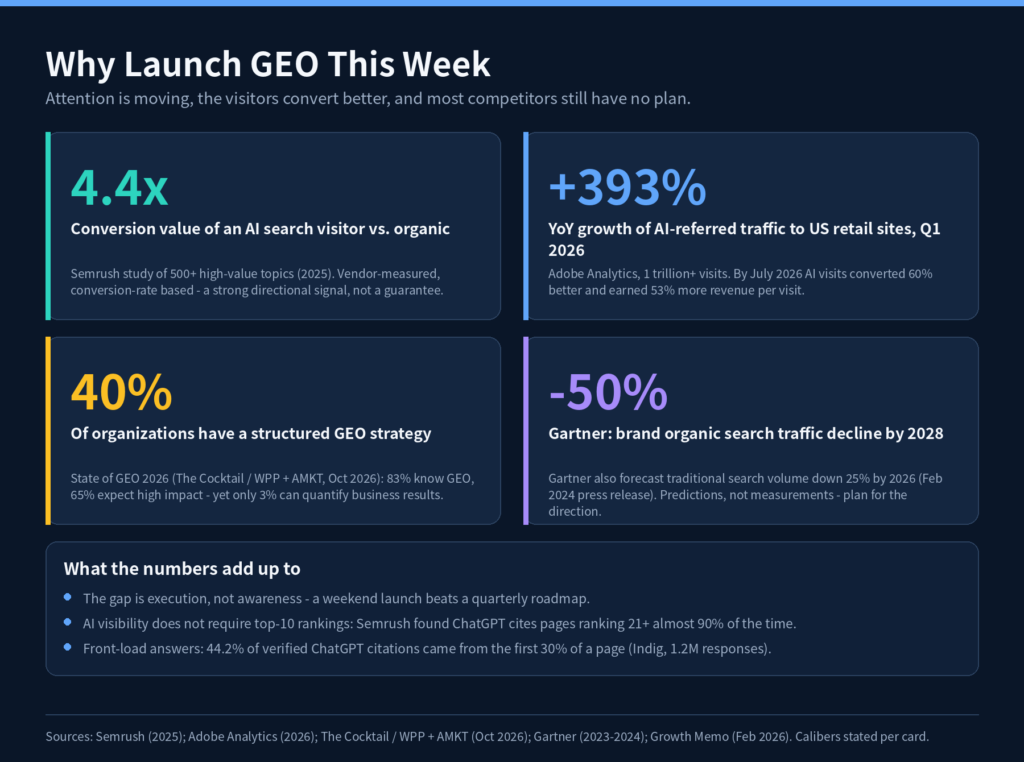
And the traffic is worth chasing. Semrush’s study of 500-plus high-value topics found the average AI search visitor is 4.4 times as valuable as the average organic visitor, based on conversion rate. That’s a vendor-measured figure across marketing-related queries, not a universal law — Ahrefs saw a 23x gap on its own site, which tells you the range is wide and the direction is consistent. AI assistants pre-qualify your visitors. By the time someone clicks through from ChatGPT, the comparison shopping already happened inside the chat.
One more finding should dissolve your excuses: you don’t need top rankings to get cited. In the same Semrush study, pages cited by ChatGPT search ranked in position 21 or worse for related queries almost 90% of the time. The AI’s table has seats your SEO never won.
The Logic of the Three Phases
Think of the launch like opening a restaurant. Phase 1 is the health inspection — unlock the doors, fix the wiring, make the kitchen legible. Phase 2 is getting listed and serving the first meals — your brand has to exist somewhere the guidebook writers actually read. Phase 3 is the review loop — check what guests say, fix what’s wrong, and set a rhythm so the place improves every week.
The order matters. Publishing content before fixing crawler access is like printing menus for a locked building. And skipping the monitoring baseline means you’ll never know which change worked.
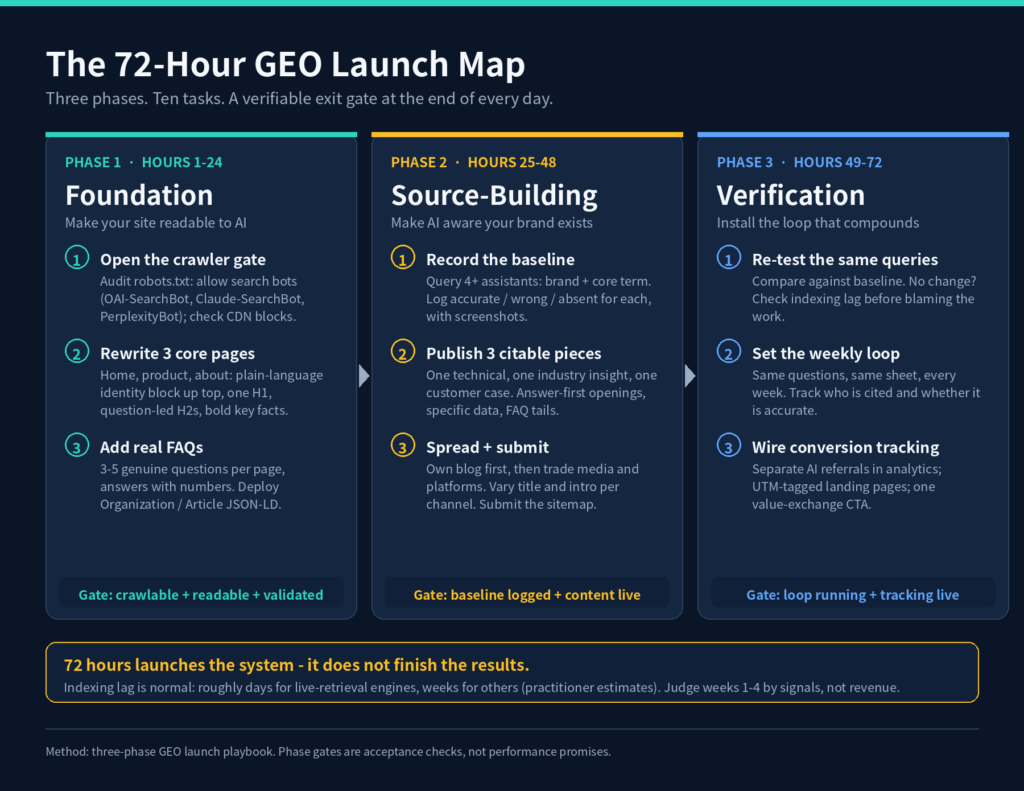
A note on the hour allocations: they’re curriculum design, not laboratory findings. Nobody has proven that hour 37 is the optimal moment to write an FAQ. The time-box exists to force sequencing and completion, and you should scale the depth to your team.
Phase 1 (Hours 1–24): Foundation — Remove the Blockers
The Crawler Gate: Audit robots.txt First
Open yourdomain.com/robots.txt. This plain-text file decides whether AI systems can read you at all, and a surprising number of sites are silently locked. Look for a blanket Disallow under the wildcard group, legacy anti-scraper rules, and named blocks against AI bots.
But here’s the nuance most 2024-era checklists get wrong: AI bots are not one category. Each major vendor now runs three kinds of agents — training crawlers, search crawlers, and user-triggered fetchers — and they’re controlled separately.
Per OpenAI’s own documentation, GPTBot collects content that may train its models, while OAI-SearchBot surfaces sites in ChatGPT search answers. Block GPTBot and you’ve made a training-policy choice; block OAI-SearchBot and you’ve removed yourself from ChatGPT search. Anthropic documents the same split: ClaudeBot for training, Claude-SearchBot for search indexing, Claude-User for fetching pages when a person asks. Perplexity says PerplexityBot powers its search results and is not used for training.
Google is the special case. Google-Extended is not a crawler at all — it’s a permission token controlling whether your content trains Gemini models and grounds answers in the Gemini app. Google states plainly that it does not affect inclusion in Google Search, and AI Overviews ride on Google Search. Blocking Google-Extended does not remove you from AI Overviews; blocking Googlebot does.
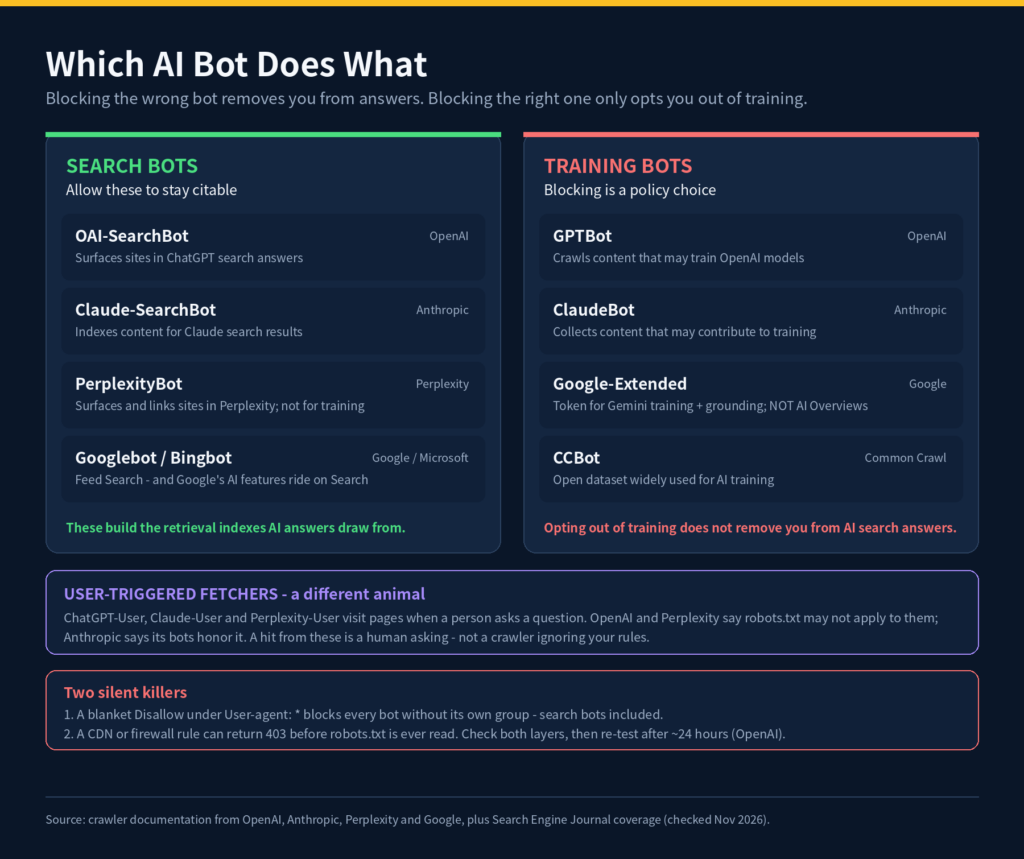
Two follow-ups. First, check your CDN or firewall — a bot rule returning 403 blocks crawlers before robots.txt is ever read. Second, be patient: OpenAI says changes can take about 24 hours to propagate to search. Finish with a speed check on mobile; if your page takes longer than three seconds to load, crawlers on timeouts may never finish reading it.
Rewrite Three Core Pages for Extraction
Don’t boil the ocean. Pick the homepage, your core product page, and the about page. On each one:
Add a plain-language identity block in the first screen — 50 to 100 words stating who you are, what you sell, and who you serve. “We deliver excellence” extracts to nothing. “Acme Sensors designs and manufactures pressure, temperature and flow sensors for automotive, petrochemical and industrial customers” extracts to three facts an AI can quote.
Fix the heading skeleton: one H1 per page, H2s for major sections, H3s beneath. Write headings as questions where you can. Then bold your key numbers — founding year, team size, certifications, patents — so both humans and parsers can find them.
Why so much emphasis on the top of the page? Kevin Indig’s analysis of 1.2 million ChatGPT responses and 18,012 verified citations found that 44.2% of citations came from the first 30% of a page, versus 31.1% from the middle and 24.7% from the final third. He calls it the ski ramp. AI reads like a news editor on deadline: if your answer isn’t near the top, a competitor’s already is.
Add Real FAQs and Honest Schema
At the bottom of each core page, add three to five questions your customers actually ask, answered with numbers and scenarios. Question-answer structure maps directly onto how retrieval systems assemble answers — and the GEO research backs the general approach: the Princeton/IIT Delhi team that coined the term showed that adding quotations, statistics and source citations raised content visibility in generative engine responses by up to 40% on their benchmark. That’s a benchmark result, not a promised citation rate — but the direction has held up across later studies.
Then deploy JSON-LD structured data: Organization on the homepage, Article on editorial pages, FAQPage where you have genuine FAQs. One honest caveat the hype articles skip: Google restricted FAQ rich results to government and health sites in August 2023, and removed the feature entirely in May 2026. Your FAQ markup will not earn accordion listings in Google, and no vendor has proven it directly buys AI citations. Treat schema as machine-readable hygiene — cheap, valid, and useful for extraction — not as a magic ranking switch. Validate everything with a schema validator before you call Day 1 done.
Phase 1 gate: crawlable, readable, validated. All three, with evidence.
Phase 2 (Hours 25–48): Source-Building — Make AI Know You Exist
Record Your Baseline Before You Change Anything
Thirty minutes, four or more assistants — use the ones your buyers actually use (ChatGPT, Perplexity, Gemini, and in China-market programs, Doubao, Qwen, DeepSeek or Yuanbao). Query your brand name plus your core business term, and a category query without your brand. For each engine, log one of three states: mentioned accurately, mentioned with errors, or absent. Screenshot everything.
This log is the most underrated artifact of the whole sprint. Without it, Day 3’s verification is guesswork, and every future improvement is unfalsifiable. With it, you own a before-photo.
Publish Three AI-Friendly Pieces
Not thirty. Three, one per proven angle: a technical piece (your product or patent, with real specifications), an industry-insight piece (trends and selection advice with dated data), and a customer-case piece (a named scenario, a timeline, measurable outcomes).
Write each one to the same skeleton: a title carrying the brand plus the core term; an 80-to-120-word opening that states what the piece is about and the key takeaway; H2 sections moving from problem to solution to evidence to conclusion; and at least three specific FAQs at the end. Every claim gets a number, a date, or a named source. Vague intensifiers — “significantly,” “industry-leading” — are uncitable filler. Concrete nouns are the currency here.
Distribute Deliberately, Then Submit the Sitemap
Publish on your own blog or newsroom first — you control it, and it goes live immediately. Then industry media, which carries editorial vetting, then platforms where your audience asks questions. One rule: never paste the identical article everywhere. Vary at least the title and opening paragraph per channel, or you’re volunteering for duplicate-content treatment.
Finally, submit your sitemap — Google Search Console and Bing Webmaster Tools for global programs, Baidu’s resource platform for China. Why bother with traditional engines in a GEO sprint? Because retrieval layers lean on search indexes. Semrush’s data shows the overlap runs deep: the same crawlability and content-quality signals that feed search also feed the retrieval pools AI answers draw from. The sitemap is the plumbing; don’t skip the plumbing.
Phase 2 gate: baseline logged, three pieces live, sitemap submitted.
Phase 3 (Hours 49–72): Verification — Install the Loop That Compounds
Re-Test the Same Queries
Run the identical queries from your baseline. Compare state by state. Absent to mentioned? The work is landing — expand publishing. Mentioned-with-errors to accurate? Your data precision is paying off — add more verifiable specifics. Nothing changed? Don’t panic, and don’t restart the sprint. Check the boring things first: was robots.txt accidentally reverted, did a platform reject your submission, were your queries too broad?
Then respect the lag. Live-retrieval engines can reflect changes in days; others take longer. Chinese-market practitioners estimate roughly three to seven days for Doubao, one to two weeks for Qwen, and one to three weeks for DeepSeek — practitioner estimates, not vendor commitments. Treat week one silence as normal physics, not failure.
Set the Weekly Monitoring Loop
Same questions, same spreadsheet, every week — pick a fixed slot, like Monday morning. Track three things per engine: whether you’re cited, whether the citation is accurate, and the sentiment around your brand. Being mentioned wrongly is its own crisis; accuracy is a KPI, not a nicety. Add a monthly content rhythm of two to four quality pieces — heavy on product and industry substance, light on corporate fluff. Quality times structure times source authority beats volume, every time.
Wire the Conversion Path
Here’s where most GEO programs quietly die: nobody separated the AI cohort, so the 4.4x-style value never shows up in anyone’s dashboard. Create a channel grouping for AI referrers in your analytics (ChatGPT, Perplexity, Gemini, Claude and friends), UTM-tag the landing pages you promote, and give each anchor page one value-exchange CTA — a spec sheet, a benchmark, a calculator — instead of a shouty “CONTACT US.” The AI-referred visitor arrived pre-qualified; hand them the next logical step, not a wall.
Phase 3 gate: verification logged, weekly loop scheduled, AI cohort tracked.
Sizing the Sprint to Your Stage
The phases are constant; the depth is yours to scale. A startup runs the minimum viable version: twenty core questions, schema on three pages, three anchor pieces — one founder, one weekend. A mid-size team runs the full framework as written, with content, SEO and dev sharing the ten tasks. An enterprise treats the 72 hours as a program launch: cross-department owners assigned, tooling selected, the first baseline recorded — and nobody pretends the program is finished on Friday. Same spine, different muscle.
Risks and Honest Caveats
Four things this playbook will not do. It won’t produce citations in 72 hours — retrieval effects lag days to weeks, and entity-level authority builds over quarters. It won’t work solo at enterprise scope — coordinate content, dev and SEO, or scale down honestly. It won’t turn schema into a citation guarantee — structured data aids extraction; nothing on the vendor record promises citations. And it won’t make the hour allocations science — they’re pedagogical scaffolding. Also budget for measurement honesty: the WPP/The Cocktail study found only 3% of organizations could quantify GEO’s business impact. Your Day 2 baseline and Day 3 tracking exist precisely so you don’t join that 97%.
Conclusion: Stop Planning. Launch.
The 72-hour launch converts GEO from intention to infrastructure. Day 1 makes you readable. Day 2 makes you findable. Day 3 makes you measurable. You end the sprint with a crawlable site, three upgraded pages, a baseline log, three citable pieces in the wild, and a weekly loop that turns every future improvement into evidence. That’s not the finish line — it’s the starting block, and it’s more than most of your competitors will build this quarter. The window rewards movers. Give it three days.