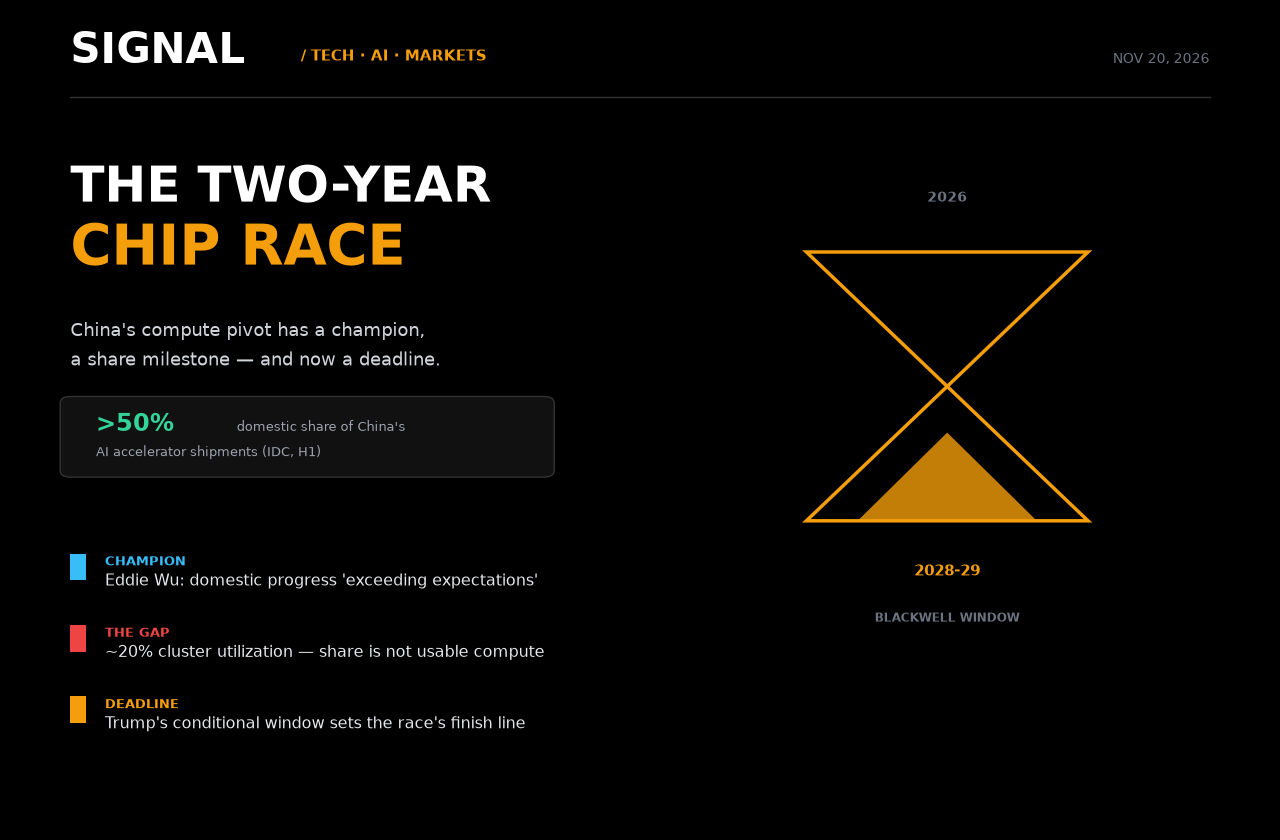
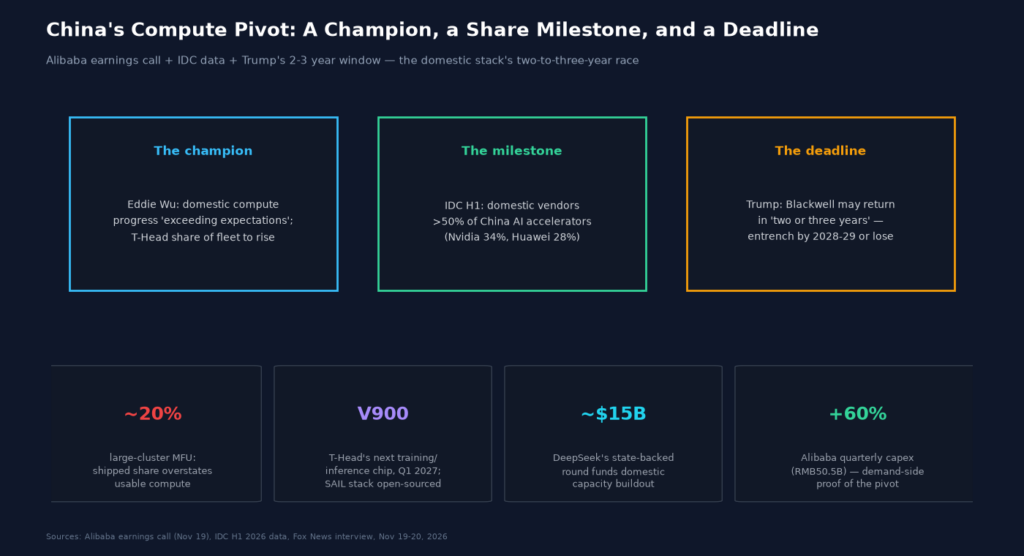
Three separate announcements this week, read together, define the most consequential industrial race of the next thirty months. On Thursday’s earnings call, Alibaba CEO Eddie Wu told analysts that China’s domestic compute progress is “exceeding expectations,” that chip unit T-Head’s share of Alibaba’s own fleet will rise as production ramps, and that the company’s next-generation Zhenwu V900 training-and-inference chip reaches commercial release in the first quarter of 2027. IDC data published the same week showed domestic vendors crossed 50% of China’s AI-accelerator shipments in the first half — Nvidia at 34%, Huawei at 28%, the rest split among a rising field. And in Shenzhen, President Trump sketched the condition on which Nvidia’s Blackwell processors might return to China: “two years or three years,” once newer chips supersede them. Champion, milestone, deadline. The domestic stack now has everything a race needs except proof that it can run — and the proof required is specific, measurable, and due before the window opens.
Share is not compute: the utilization problem
The milestone deserves its asterisk. Shipping half of China’s accelerators is a manufacturing achievement; using them is an engineering one, and the gap between the two is where the race will actually be decided. Brokerage analyses cited alongside the IDC data estimate that large domestic clusters achieve model FLOPs utilization around 20% — meaning four-fifths of theoretical capability is lost to interconnect bottlenecks, memory bandwidth, software immaturity and scheduling overhead, with communication consuming 40%-plus of training time on traditional architectures. A domestically built ten-thousand-card cluster can deliver less usable training throughput than a smaller Nvidia cluster running mature CUDA-era tooling. This is why the industry’s answer has shifted from chips to systems: Alibaba’s supernode architecture supporting two-trillion-parameter inference, Huawei’s CloudMatrix interconnect, and the open-sourcing of T-Head’s SAIL software stack are all attempts to attack the utilization gap rather than the transistor gap. The metric to watch through 2027 is not shipment share — it is MFU on production workloads, and whether the software ecosystem compounds fast enough to close it.
The demand side is now committed, not hypothetical
What changed this week is that the buyers stopped hedging. Wu’s endorsement matters because Alibaba is China’s largest cloud and can vote with procurement: its quarterly capex rose 60% to RMB50.5 billion, its AI cloud revenue grew 53% with external recurring revenue up 67%, and it explicitly plans a rising domestic share of its own fleet — the largest single demand pool in Chinese AI publicly committing to the domestic stack. DeepSeek’s reported ~$15 billion state-backed round funds capacity on domestic silicon for the lab whose open weights anchor the ecosystem. Tencent’s Hy4 flash topped global usage charts on release. The loop is closing: domestic chips serve domestic models that serve domestic applications whose revenue funds the next chip generation. Export controls, ironically, supplied the missing ingredient — guaranteed demand. When H200 shipments stopped and remote-access rules tightened, the substitution question changed from “why would we” to “what else is there,” and China’s answer is now financed, committed and calendared.
The deadline changes the strategy
Trump’s conditional window is the race’s clock, and it cuts two ways. If Blackwell-class chips return in 2028–29 at scale, every domestic vendor that has not reached price-performance parity loses its protected customers overnight — Chinese clouds will mix fleets the moment the legal ceiling lifts, exactly as they did in the H20 era. That gives the domestic stack roughly twenty-four to thirty months to make its advantage structural rather than regulatory: software lock-in, workload optimization, ecosystem depth, pricing that survives comparison. The V900’s Q1 2027 launch and the utilization roadmap are therefore not product milestones but existential ones. Conversely, if the window never opens — the condition is unverifiable, the timeline outlives Trump’s term, and Congress is tightening rather than loosening — the domestic stack inherits the market permanently, and the utilization gap becomes a national engineering project with unlimited time. Strategy under both branches looks similar in the near term (build, commit, optimize) but diverges sharply on pricing: protected permanence permits margin; a returning competitor enforces deflation. Every Chinese AI business plan written this quarter is implicitly betting on one branch.
What global businesses should do with this race
For companies operating across both ecosystems, the practical posture is dual-track by design, not by accident. Global brands serving China should assume domestic-model capability is the base case through 2028 — the demand commitments reviewed here make that trajectory close to policy — and build China stacks on Qwen, DeepSeek and domestic clouds with the same seriousness as their global stacks, rather than as compliance fallbacks. Technology vendors selling into China should price localization as a permanent line item: the customers signing multi-year deals are explicitly hedging the Trump window, and vendors who treat domestic integration as temporary will lose those contracts. And everyone — including pure-play Western businesses — should watch the utilization data, because it is the leading indicator of whether the world’s second AI stack becomes genuinely competitive or remains a protected garden. If MFU closes toward parity by 2027, the open-weight export subsidy this column has documented becomes a permanent deflationary force on global AI pricing. The race is China’s. The price consequences are everyone’s.






