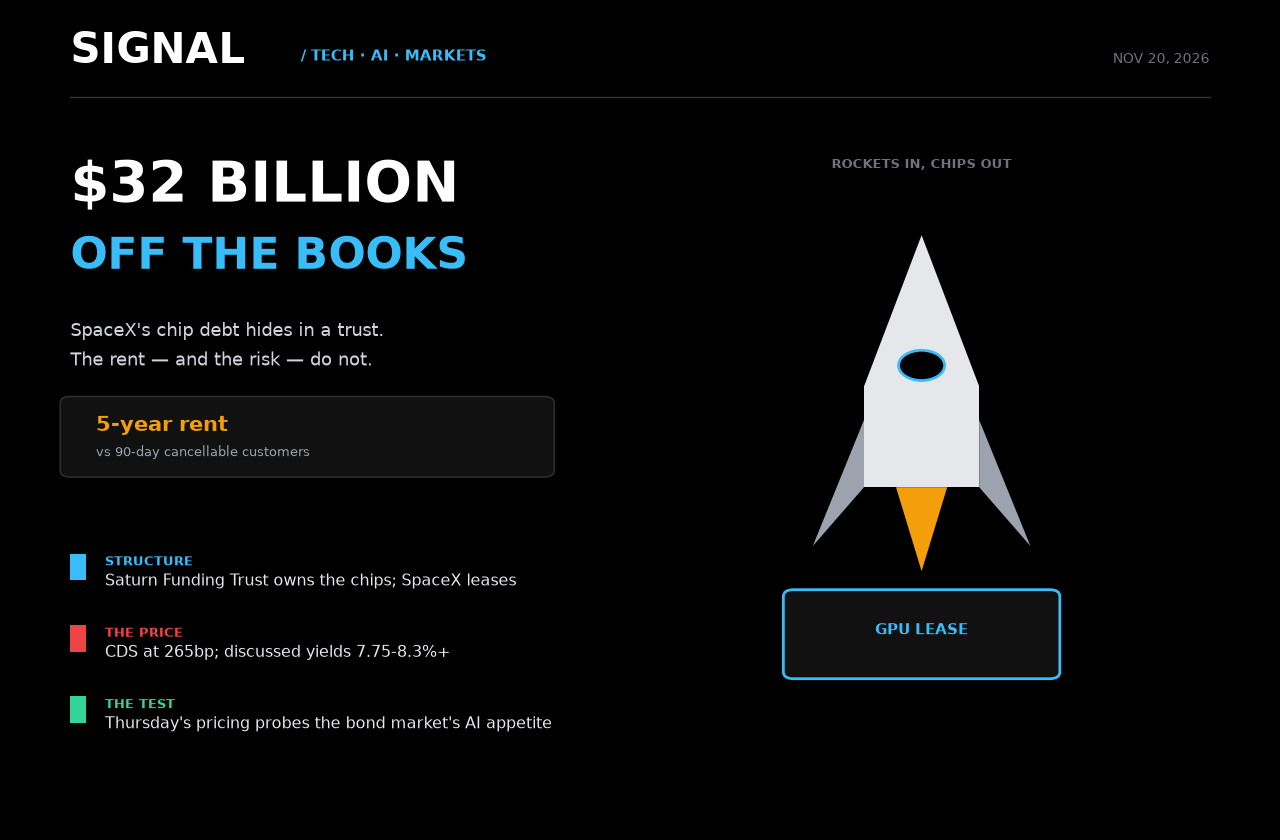
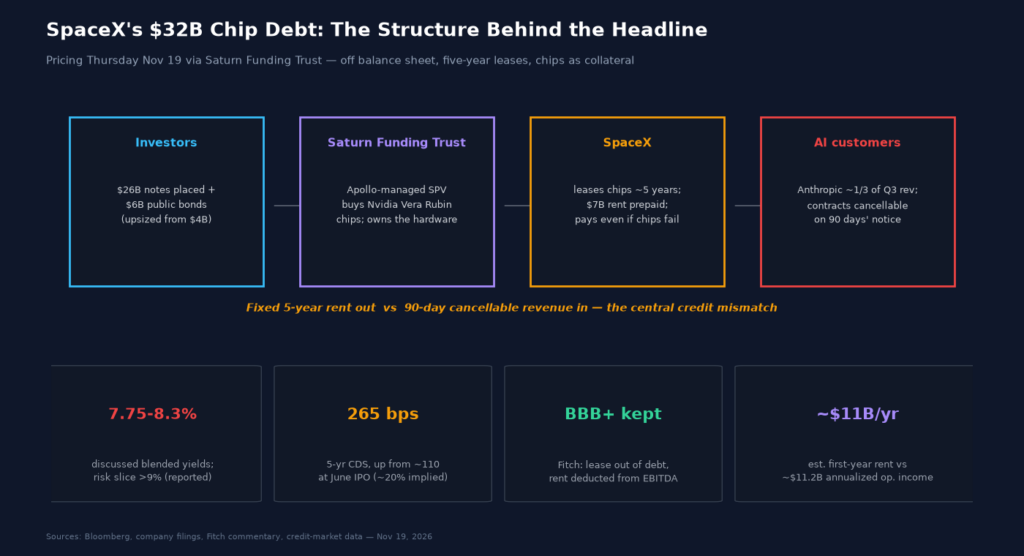
The company that launches rockets priced the largest chip financing in history on Thursday, and the structure tells you more about the state of the AI economy than any earnings report this week. SpaceX moved to complete a debt sale of at least $32 billion — roughly $26 billion of notes already privately placed with asset managers, plus a public bond tranche upsized from $4 billion to $6 billion on demand — to fund purchases of Nvidia’s Vera Rubin processors. Goldman Sachs and Apollo lead the deal; BlackRock, Goldman’s asset arm and KKR accounts are among the cornerstone investors. But SpaceX does not own the chips and the debt does not sit on SpaceX’s balance sheet. A special-purpose vehicle called Saturn Funding Trust, managed by an Apollo-backed entity, buys the hardware and leases it to SpaceX on roughly five-year terms running to 2032. SpaceX prepaid $7 billion of rent. It must keep paying even if the chips are damaged, and it cannot terminate early. The obligation is total; the accounting is invisible. That gap — between what the balance sheet shows and what the cash flow owes — is the defining financial fact of the AI infrastructure era, and this deal is its purest specimen yet.
The mismatch at the center
Follow the money in both directions and the fragility becomes legible. Money out: five years of fixed, non-cancellable, prepaid-in-part rent on hardware that Nvidia will supersede twice before the lease expires — the lenders keep the chips as collateral, but SpaceX keeps paying regardless, and no one guarantees the residual value of five-year-old accelerators. Money in: merchant compute revenue from customers who can leave almost at will. Anthropic alone accounts for roughly a third of SpaceX’s third-quarter revenue, and its contract — disclosed in Anthropic’s own IPO prospectus at up to $120.5 billion through 2029 — becomes cancellable by either side on 90 days’ notice after initial commitments lapse in early 2027. A five-year fixed cost against ninety-day elastic revenue is not a subtle mismatch; it is the central credit fact, and it is disclosed. Musk himself conceded the logic on X: if compute becomes plentiful and cheap, “SpaceX revenue will drop.” The lease will not.
The scale comparison sharpens it. At the discussed blended yields of 7.75–8.3% (with a risk slice above 9%), first-full-year rent on the fully delivered ~$40 billion lease structure would run roughly $11 billion by independent calculations on the filed formula — approximately equal to SpaceX’s entire annualized operating income of $11.2 billion, and more than Starlink’s $9.5 billion annualized segment profit. The AI segment the chips serve earned $431 million of operating income last quarter while burning $16.4 billion of capex. This is not a solvency prediction; Starlink’s cash engine is real and growing. It is a statement of what must become true — AI compute revenue compounding for years — for the arithmetic to close.
The rating shell game, and the market’s verdict
SpaceX carries investment-grade labels — Baa1/BBB+/BBB — and the off-books structure exists precisely to keep them. Fitch confirmed its BBB+ is unchanged, but read the mechanism: the lease balance is excluded from debt while lease amortization and interest are deducted from EBITDA. The rating survives because the agency adjusts the denominator, not because the obligation vanished. There is precedent for the accounting failing: an earlier Valor Equity sale-leaseback was ruled a “failed sale-leaseback,” forcing roughly $13 billion onto SpaceX’s books, on which it paid $864 million of interest in nine months. The new vehicle is built with a genuine third-party owner — whether it holds depends on residual-value terms and control provisions investors will only see in the offering documents.
The market, meanwhile, has already rendered its opinion in prices. SpaceX’s five-year credit-default swaps climbed from ~110 basis points at the June IPO to ~265 by mid-November — an implied five-year default probability near 20%. Its June bonds, sold at a 5.855% weighted coupon, were marked around 92 cents on the dollar by September. The company’s own debt has risen from ~$23 billion at year-end 2025 to nearly $39 billion. Investment-grade label, speculative-grade behavior: the gap between the rating and the market is where the truth of AI credit currently lives. And the backdrop is tightening — JPMorgan’s Cembalest counts over $4 trillion of AI-related commitments sitting off balance sheets across the industry, roughly six times what is on them, and the Fed’s own minutes now discuss the stability implications.
What this means beyond the bond desk
For everyone else — including the marketing organizations buying AI services downstream — three readings matter. First, the price of AI compute now includes a visible credit premium: 8%-plus financing costs flow into lease rates, which flow into cloud prices, which flow into your inference bills. The era of assuming perpetually cheapening AI infrastructure should end at this deal’s yield sheet; efficiency gains will fight financing costs, and the net direction is no longer obvious. Second, vendor risk assessment must read structures, not labels: your AI provider’s provider may carry an investment-grade rating and a 20% implied default probability simultaneously. Service-continuity clauses, workload portability and multi-vendor fallbacks are the operational translation of this credit analysis. Third, watch Thursday’s final pricing and the aftermarket: a tight clear with strong books says the bond market still funds the buildout; a wide concession or weak trading says the constraint has arrived — and every capex plan in the industry, including the ones embedded in your vendors’ roadmaps, inherits that answer. The rockets get the headlines. The rent schedule is the story.






