Here’s a puzzle nobody in brand marketing seems to ask: second-hand prices have existed forever. Flea markets, classifieds, pawn shops — humanity has been pricing used goods for centuries. So why did “resale value as brand equity” only become a serious idea in the 2020s?
The answer isn’t that brands suddenly got humble. It’s that the price itself was lying.
The suspicion tax
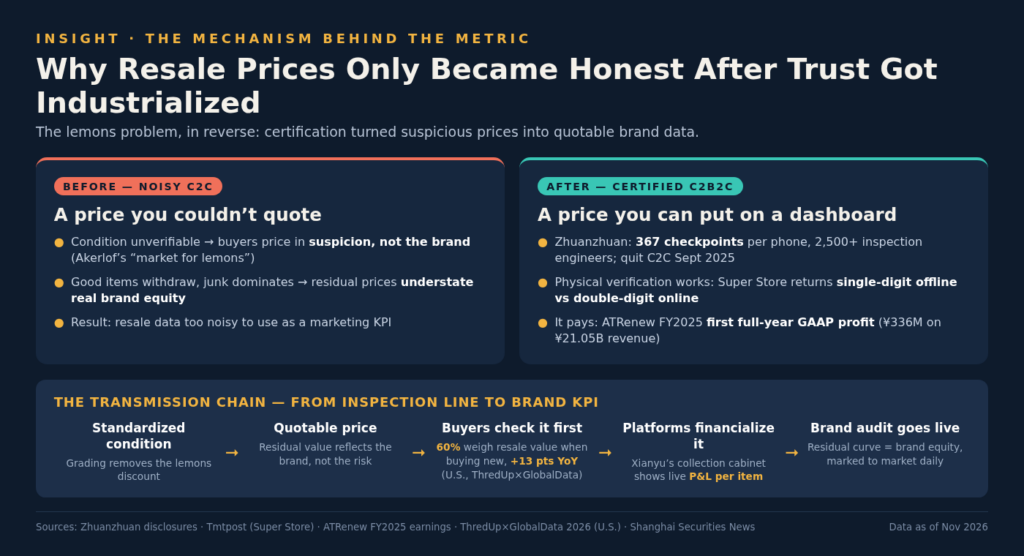
In 1970, economist George Akerlof described the “market for lemons”: when buyers can’t verify quality, they assume the worst and discount everything. Good sellers withdraw; junk dominates; prices collapse toward the floor. A used-phone listing on an unmediated C2C platform wasn’t pricing the brand — it was pricing the buyer’s fear of being scammed. Call it the suspicion tax.
That’s why old resale data was worthless as a brand KPI. A low residual price could mean weak brand equity — or just a market drowning in unverifiable condition claims. The signal and the noise were inseparable.
What changed: trust became a factory
China industrialized the missing ingredient. Zhuanzhuan shut down its founding C2C marketplace in September 2025 and rebuilt itself around 367 inspection checkpoints per phone and 2,500+ inspection engineers. Its 3,000-square-meter Beijing Super Store reports single-digit return rates offline versus double-digit online — physical verification literally converts. And the economics now close: ATRenew posted its first full-year GAAP profit in FY2025, RMB 336 million on RMB 21.05 billion of revenue, processing 41.7 million used devices.
Standardized condition grading strips out the suspicion tax. What’s left in the price is the thing you actually wanted to measure: the brand.
The transmission: from inspection line to purchase decision
Once residual prices became trustworthy, three things happened in sequence. Buyers started checking them before buying new — 60% of U.S. consumers now weigh resale value in new-apparel decisions, up 13 points in one year (ThredUp×GlobalData). Platforms financialized the data: Xianyu’s 2026 collectibles homepage shows live profit-and-loss on every item in your collection. And the residual curve became what it always secretly was: a daily mark-to-market audit of brand equity that no ad budget can inflate.
The takeaway
The second-hand price didn’t become honest because consumers changed. It became honest because someone built the factories that verify condition at scale — and proved they pay. Trust infrastructure isn’t a cost center sitting next to marketing. It’s the printing press for the truest brand metric ever devised. Brands that treat certification as plumbing will keep reading noisy surveys. Brands that treat it as instrumentation will watch their equity trade in real time.



