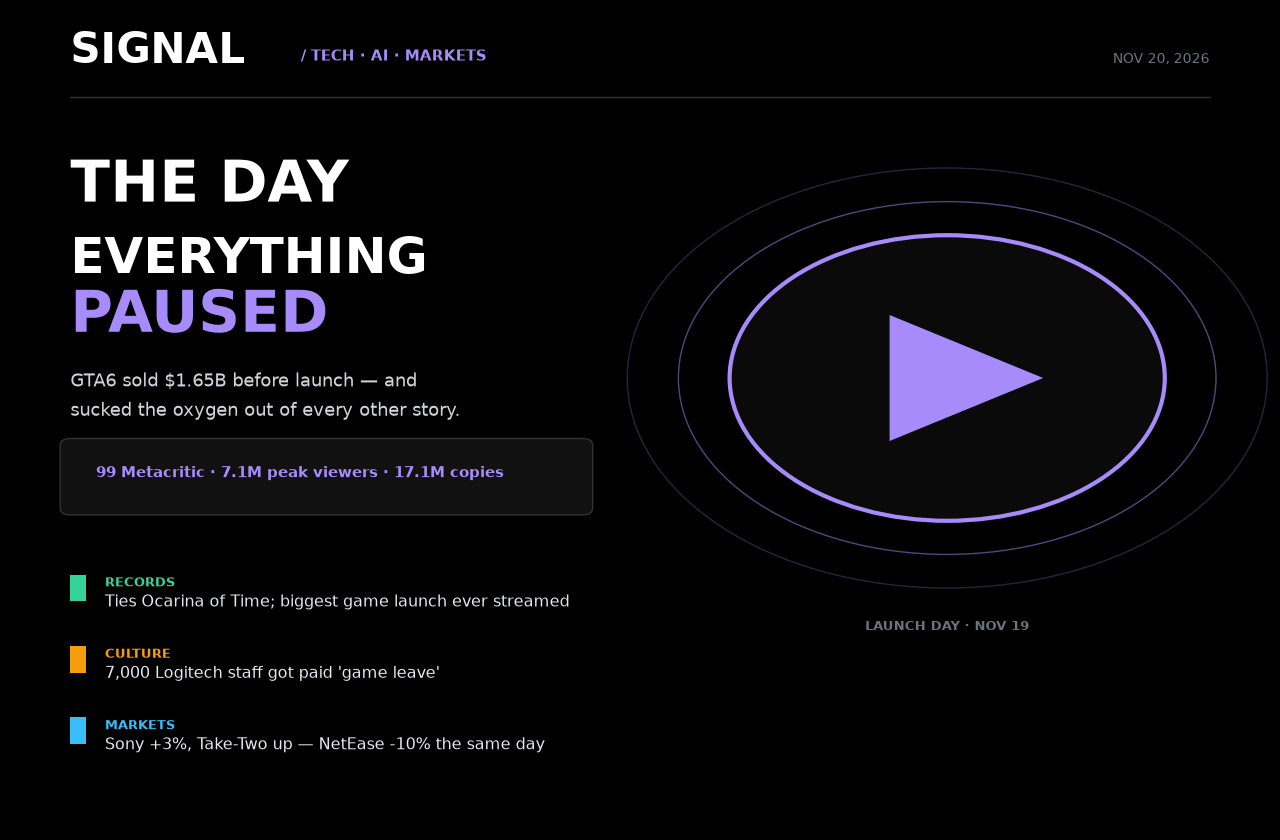
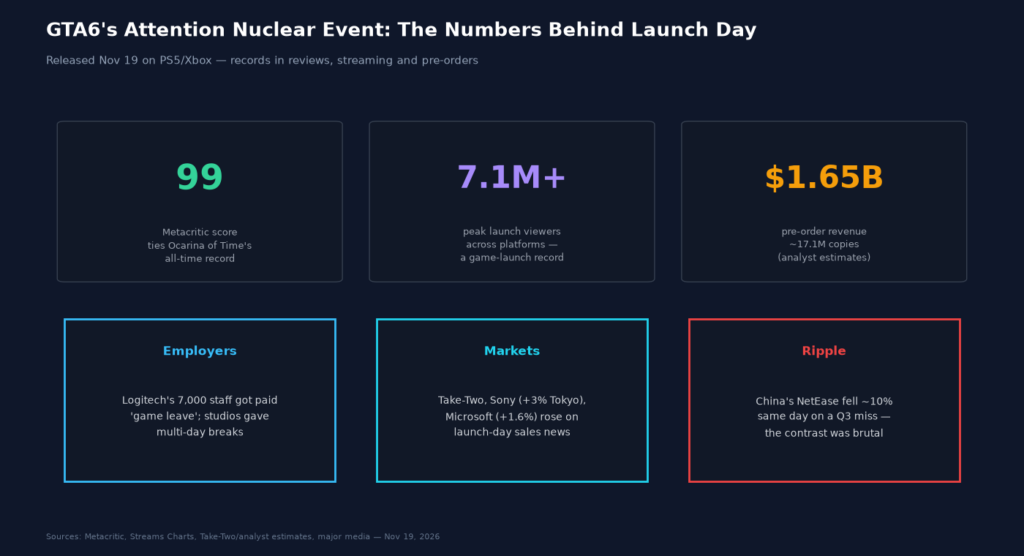
Thirteen years after its predecessor, Grand Theft Auto VI arrived on November 19 and demonstrated something no media plan can buy: total, simultaneous, voluntary attention. The numbers, as compiled within hours of launch, are categorical. A Metacritic score of 99 — tying The Legend of Zelda: Ocarina of Time for the highest-rated game ever. A peak of more than 7.1 million concurrent launch viewers across streaming platforms, per Streams Charts, obliterating every previous game-launch record. An estimated 17.1 million pre-ordered copies generating roughly $1.65 billion before launch day even began, according to analyst estimates — figures that, if confirmed in Take-Two’s disclosures, make it the biggest entertainment launch in history by revenue, ahead of any film, album or game. Sony shares closed nearly 3% higher in Tokyo; Microsoft rose 1.6%; Take-Two climbed on the sales news. And in the human layer: Logitech gave its 7,000 employees paid “game leave,” studios scheduled multi-day breaks, and tens of thousands of workers reportedly called in sick. For one day, the attention economy had a single owner — and every marketer who bought media that day paid full price for a fraction of the audience.
The physics: what total attention does to everyone else
The marketing lesson is not “games are big.” It is that attention events of this magnitude create measurable dead zones in every other channel. When 7 million people watch a launch simultaneously — and tens of millions more play, scroll clips, or discuss it — feed engagement for non-related content collapses, ad viewability degrades, and conversion intent for anything except the event itself evaporates. The prediction made in this column before launch — that November 19’s social conversation would belong to GTA6 and that tech/finance advertising would get poor value that day — was not clever; it was arithmetic. What is instructive is the asymmetry it creates. Brands adjacent to the event (peripherals makers like Logitech, console platforms, energy drinks, food delivery) can ride the wave with permissionless contextual relevance; Logitech’s paid game leave is the cheapest earned-media stunt of the quarter, converting an HR decision into global coverage. Brands unrelated to it should have dark-dayed their spend or shifted budgets to adjacent days. Most did neither, because media plans are built weekly and attention moves hourly. The gap between planning cadence and attention volatility is a permanent, exploitable inefficiency — for whoever builds the calendar discipline to exploit it.
The contrast case: NetEase’s brutal timing
The same day’s cruelest juxtaposition belonged to NetEase. The Chinese gaming giant reported a third-quarter miss — revenue of RMB27.85 billion against expectations near RMB30.4 billion, game revenue similarly short — and its US shares fell as much as 10%. Part of that is company-specific: aging titles, a pipeline whose next anchor, the open-world Ananta, ships in January 2027 with 27 million pre-registrations. But part is atmospheric: on the day the biggest game in history launches, every other game company’s numbers get read against an impossible benchmark, and the genre’s attention pool visibly drains toward one title. The lesson for any category with a mega-event — gaming, sports, film, even AI model releases — is that competitors’ earnings, launches and campaigns scheduled against the event inherit a discount they did nothing to earn. Calendar positioning is strategy. NetEase’s next window, Ananta’s January launch, sits deliberately far from GTA6’s initial saturation — that spacing is now a case study.
The economics underneath the spectacle
Strip the culture and the financial structure is worth studying. Take-Two’s reported expectations of roughly $3 billion in the first four months make GTA6 less a product than an annuity launch: the pre-order base de-risks the P&L before reviews existed, and the online ecosystem to come converts a one-time purchase into recurring monetization — the same subscription-and-services logic that reshaped software, applied to a $70 entertainment product at unprecedented scale. The console partners’ stock moves reveal the distribution tax: Sony and Microsoft earn on every copy regardless of who makes it, which is why platform holders can celebrate a third-party launch like their own. And the estimated figures deserve their caveat — pre-order counts and revenues are analyst estimates until Take-Two confirms; the responsible reading is “record-shattering by any estimate,” not a specific audited number.
For marketers, three durable takeaways survive the hype cycle. Build an attention calendar: the year’s mega-events are knowable in advance, and both dark-daying and adjacency-riding should be pre-planned, not improvised. Price cultural permission: Logitech’s game leave worked because the brand had standing in gaming; forced adjacency from unrelated brands reads as parasitic and underperforms. And study the annuity structure: the most successful modern launches sell an entry point to a recurring relationship — which is, not coincidentally, exactly what every AI subscription and every loyalty ecosystem is attempting. GTA6 is the masterclass, delivered to 17 million paying students at once. The exam is your next launch calendar.






