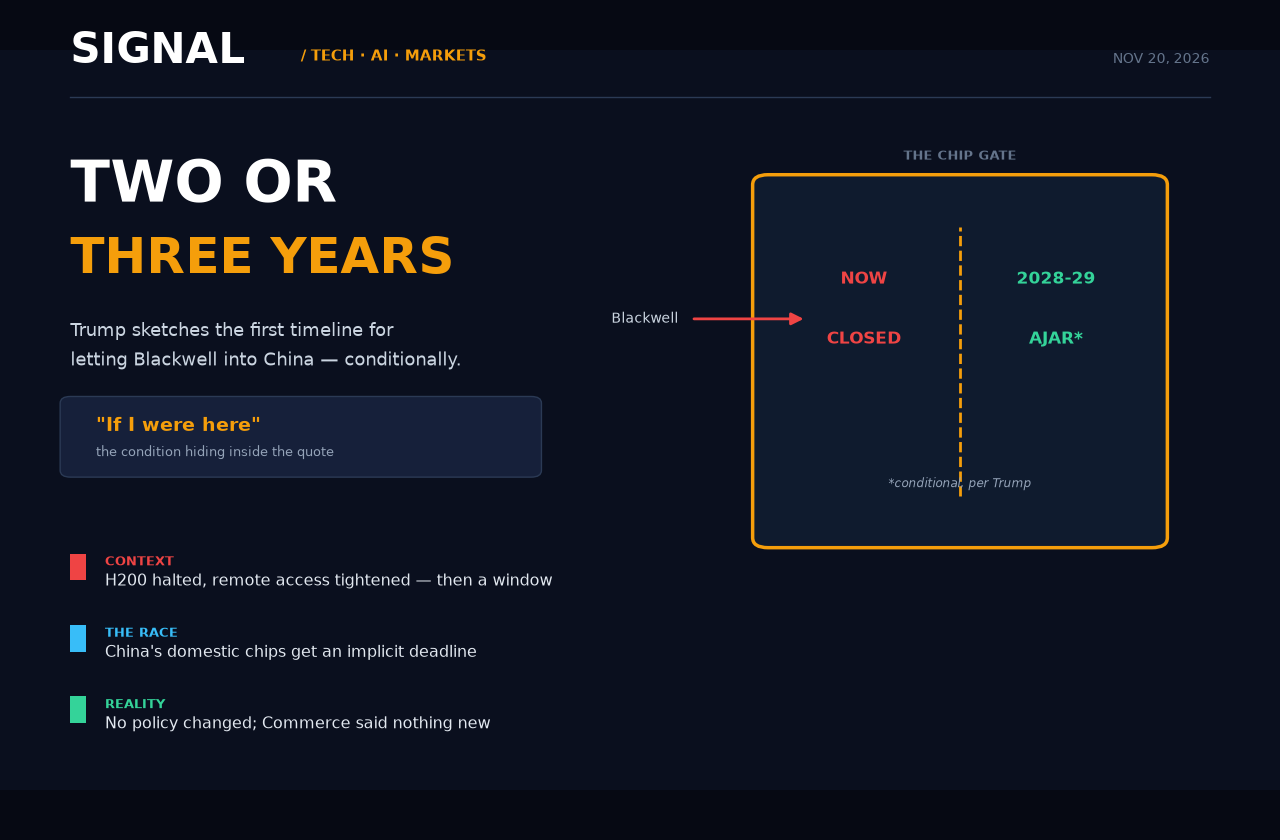
For three years, American policy toward China’s access to advanced AI chips has moved in one direction: tighter. This week, in Shenzhen of all places, the President sketched the first reversal timeline anyone in the administration has put on the record. In a Fox News interview recorded during the APEC summit, Donald Trump said the US could allow Nvidia to sell its Blackwell processors to China “in two years or three years” — once newer chips have superseded them. “In two years or three years, I would, if I were here, I would say, go ahead. You can now sell Blackwells because they’ll have something else,” he said, adding that Nvidia is “already working on something else that’s going to be superseding the Blackwell chip.” No policy changed. The Commerce Department announced nothing. But for the first time, the wall has a door drawn on it, with a date beside the handle.
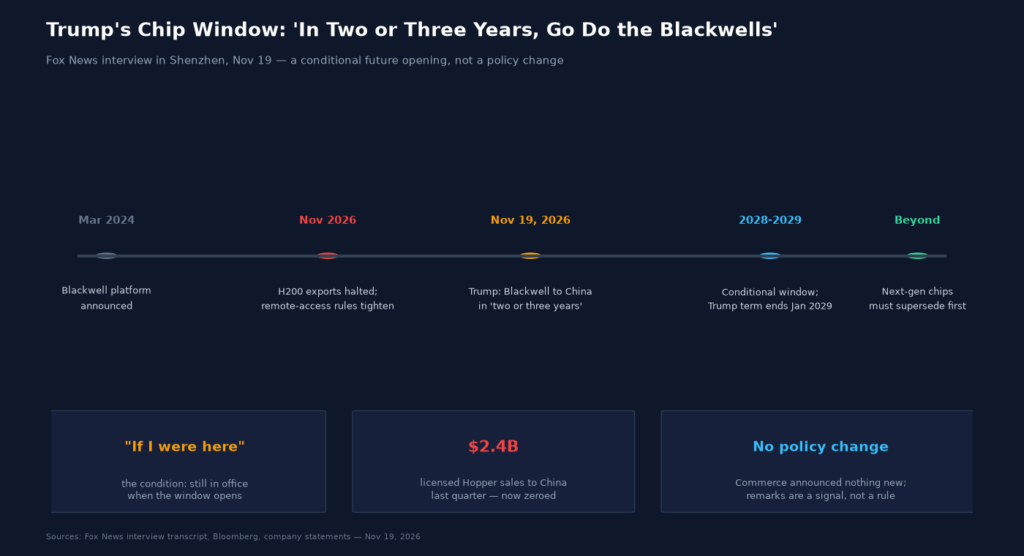
Read the condition, not just the number
Three qualifiers hide inside the quote, and each matters. First, “if I were here”: Trump’s term ends in January 2029, so a two-to-three-year window lands at the very end of his presidency or in his successor’s. This is a sketch of intent, not a commitment anyone can enforce. Second, the obsolescence condition: Blackwell becomes exportable only when something better exists at the frontier — the same logic that governed the H20, the licensed, cut-down Hopper chip that had been the sole legal channel. That channel is now closed too: Nvidia’s interim CEO confirmed this month that H200 shipments have stopped entirely, with roughly $2.4 billion of licensed Hopper sales in the latest quarter and zero in the forward outlook. Third, the framing: “We allow them to buy. In fact, encourage. We want to make money” — paired with “we don’t want the highly sophisticated chips.” The doctrine is not embargo; it is a moving ceiling calibrated to keep China a generation behind while keeping American vendors selling.
What makes the remark consequential despite its conditionality is the setting. It came during the summit that produced the Shenzhen Outlook, alongside a bilateral agreement to draft a “constructive strategic stability” action plan — the first formal channel in which chip access could actually be negotiated. And it landed in the same week Washington tightened remote-compute access rules, closing the rent-the-datacenter workaround, and Beijing threatened countermeasures. The administration is simultaneously raising the wall and describing its future gate. Both moves serve the same negotiating position: scarcity now, leverage later.
The clock this starts in China
For China’s domestic AI stack, the remark functions as an implicit deadline. If frontier-adjacent American chips return in 2028–29, the window for domestic alternatives to entrench is exactly the next two to three years — and Chinese policy is visibly racing that clock. Alibaba’s CEO told analysts this week that domestic compute progress is “exceeding expectations” and that T-Head’s share of Alibaba’s fleet will rise; IDC data showed domestic vendors above half of China’s AI-accelerator shipments for the first time; DeepSeek’s state-backed mega-round funds capacity precisely for this period. The utilization gap is the honest caveat — cluster efficiency around 20% on large deployments means shipped share overstates usable compute — but the direction is unambiguous. Trump’s window gives that race a finish line: be good enough by the time Blackwell arrives, or lose the customer base again.
There is a paradox worth naming. The obsolescence condition means the faster Nvidia innovates, the sooner its own current products become exportable — American technological leadership becomes the trigger for arming the competitor’s data centers with last-generation gear. Nvidia’s roadmap, in other words, is now also China’s import calendar. Whether that is strategic genius or a slow-motion leak depends on how much capability a two-generation-old chip still confers in 2028 — a question the export-control community has argued about since the A100 era, without consensus.
What businesses should do with a conditional presidential remark
For companies with China exposure, the practical guidance is disciplined skepticism in both directions. Do not re-plan supply chains around a quote: nothing is approved, the condition is unverifiable today, and the timeline outlives the speaker’s term. But do not ignore it either — it is the clearest signal yet of where the equilibrium sits, and it aligns with the commercial reality that American vendors want the revenue. Three planning moves follow. Global brands operating AI workloads in China should treat domestic-model capability as the base case through 2028 and design switching costs down now, rather than betting on restored access. Technology vendors selling into China should price the two-to-three-year window into their localization commitments — the customers signing multi-year deals are explicitly hedging against exactly this scenario. And everyone should watch the action-plan negotiations: if chip access appears in the written framework, the sketch becomes a process; until then, it is weather, not climate.
The wall stands. The date on the door is new. In a conflict where every previous signal pointed toward permanent separation, a conditional “go ahead” — even two presidencies of qualifiers deep — is the most important sentence of the week.






