Imagine a market with tens of millions of customers, unusually high loyalty, and almost no competition for their attention — and imagine that most brands are afraid to say its name out loud. That is the strange position of LGBTQ+ consumers in China. The money is real. The demand is measurable. But the public space where marketing normally happens keeps shrinking, and the companies that understand this paradox are quietly building some of the most durable customer relationships in Chinese consumer business.
This piece pulls together what can actually be verified — an SEC prospectus, a United Nations survey of nearly 30,000 people, an Ipsos consumer study, peer-reviewed health research, and the regulatory record through late 2025 — and turns it into a practical playbook. The core argument is simple: in a visibility-constrained market, the winning move is to serve without signaling. Meet the needs discreetly, earn trust through the community, and never make your customer’s identity the price of your product.
One warning before we start. Most of the good numbers here are dated — 2016 to 2022 — because the institutions that produced them have since gone private, closed, or stopped publishing. We flag every vintage. The patterns are durable; the exact figures are benchmarks, not live dashboards.
The Shape of a Quiet Market
How big is this market, honestly? Nobody can give you a census-grade answer, and anyone who quotes a confident trillion-dollar figure is selling something. The most defensible estimate comes from a 2018 UNDP and ILO report on LGBTI employment, which put China’s “pink market” at around 70 million people. Academic meta-analyses triangulate a range of roughly 42 to 70 million. Treat that as an order of magnitude: tens of millions, concentrated in cities, skewing younger.
The best behavioral window into that population came from an unlikely document: a Nasdaq IPO prospectus. When BlueCity Holdings — the company behind Blued, China’s dominant gay social app — filed its F-1 with the SEC in June 2020, it disclosed platform metrics audited into the public record. As of March 31, 2020, Blued had over 49 million registered users across more than 210 countries and regions, with about 6 million average monthly active users, roughly half of them outside mainland China. By the time the company went private in August 2022, it cited more than 60 million registered users.
What matters more than the scale is the stickiness. According to the Frost & Sullivan report cited in the prospectus, the average active Blued user in 2019 spent over 60 minutes a day on the app, opened it more than 16 times daily, and came back the next month at a 71% rate. Blued’s average monthly and daily active user bases were six times and nearly seven times larger than the number two player in China. If you have ever run a consumer app, you know those are not normal numbers. They are the signature of a community with nowhere else to go — and no reason to leave a place that finally gets it right.
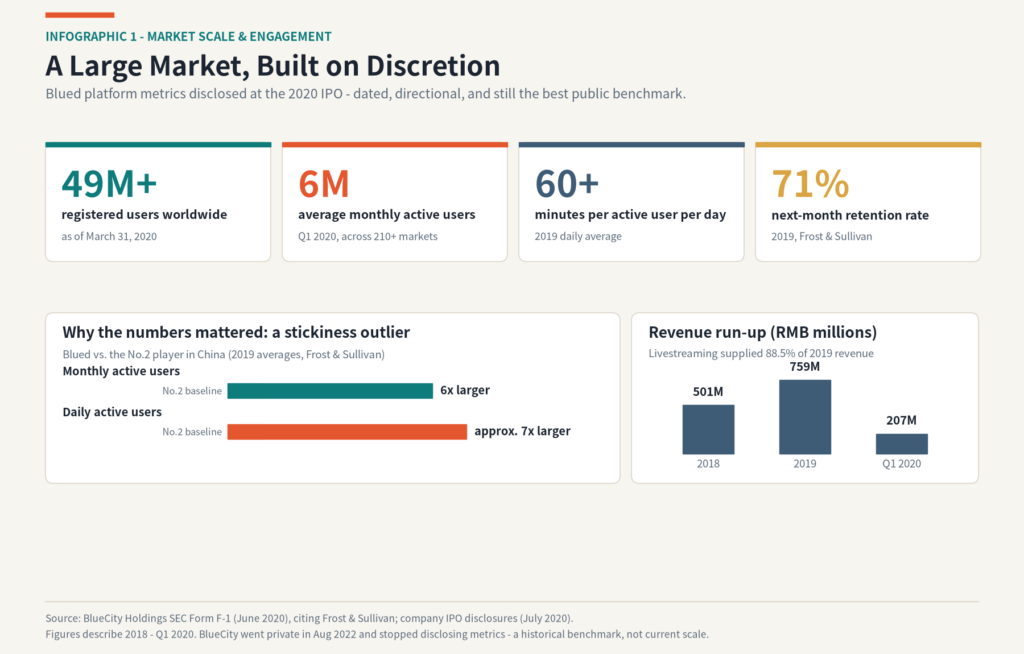
The business built on that engagement was less romantic than the community it served. Livestreaming supplied 88.5% of BlueCity’s 2019 revenue of RMB 759 million, with paying livestream users generating an average of RMB 2,059 each that year. Revenue grew from RMB 501 million in 2018 to RMB 759 million in 2019, and hit RMB 207 million in the first quarter of 2020 alone. The company raised about US$84.8 million in its July 2020 Nasdaq debut — the world’s first publicly listed LGBTQ-community business — and then, within two years, watched its share price collapse from a first-day high of US$35.89 to US$1.54. It completed a going-private merger on August 12, 2022, at US$1.60 per ADS. The founder, Ma Baoli, resigned ten days later and wrote publicly about how hard it is to run an LGBTQ business in China.
Hold those two facts together, because the tension between them is the whole article: extraordinary community loyalty, fragile commercial visibility. The market is deep. The stage it stands on is not.
Why “Quiet” Is Structural, Not a Preference
Western marketers sometimes read the low public profile of Chinese LGBTQ+ consumers as cultural shyness. The data says otherwise. In 2016, UNDP, Peking University’s sociology department, and the Beijing LGBT Center released the largest survey of its kind ever conducted in China: nearly 30,000 respondents across every province. Only about 5% of sexual and gender minority respondents were fully open about their identity at school, at work, or in religious communities. No more than 15% were fully out to their families. More than half reported experiencing discrimination or unfair treatment, and the workplace ranked as the least comfortable place of all to be open.
That last finding deserves a pause. The office — where Western inclusion programs concentrate their energy — is precisely where Chinese LGBTQ+ people are least visible. At a UNDP–Economist executive dialogue cited in the ILO report, a Goldman Sachs representative described the cascade inside his own firm: only about 4% of employees disclosed a minority identity even anonymously in an internal survey, and less than 1% were willing to be out within the company. Multinational diversity policies, the report noted, frequently exist on paper in China but go unimplemented because employees will not participate.
Meanwhile, the same UNDP survey found the general public far more accepting than the silence suggests: roughly 70% of non-minority respondents rejected the idea that homosexuality is a disease, and nearly 85% supported legalizing same-sex marriage. The report itself cautions that its public sample tilted toward LGBT-friendly respondents, so treat those figures as an upper bound on friendliness, not a national average. Still, the direction is unmistakable. This is not a society of uniform hostility. It is a society where acceptance is real but visibility is costly — and individuals rationally manage that gap by staying quiet in public and being themselves in trusted private spaces.
The legal backdrop explains the cost. Homosexuality was decriminalized in 1997 and removed from the official classification of mental disorders in 2001. Same-sex marriage, however, remains unrecognized; the Civil Code that took effect in 2021 defines marriage in heterosexual terms. Couples have improvised a workaround: Article 33 of the Civil Code lets any adult appoint any other willing adult as a voluntary guardian, and same-sex partners across China have notarized these agreements to secure hospital visitation and medical decision rights. It is a real tool — one Sichuan law team has drafted over a hundred such agreements since 2020 — but it is not marriage, and it carries no automatic inheritance rights. The quiet, in other words, is engineered by the environment, not chosen by the consumer.
The Visibility Squeeze, 2017–2025
If the legal floor has been stable, the public ceiling has been lowering. In June 2017, the China Netcasting Services Association — an industry body, not a legislature — issued content-review rules for online video that listed homosexuality among “abnormal” sexual depictions to be cut before broadcast. The rules are an association standard rather than law, but platforms treat them as a compliance signal, and even the state-linked Global Times published an English editorial calling the classification absurd. The practical effect: mainstream entertainment stopped depicting same-sex relationships, removing the cultural mirror that normal marketing campaigns lean on.
The squeeze then moved from content to infrastructure. Shanghai Pride, the country’s longest-running pride event, suspended operations in 2020. In 2021, WeChat deleted dozens of LGBT student association accounts without detailed explanation. In May 2023, the Beijing LGBT Center — the very organization that helped run the UNDP survey — announced it was ceasing operations due to “forces beyond our control.” Grindr disappeared from China’s App Store in 2022 during a regulatory clean-up campaign.
Then came the sharpest move yet. On the weekend of November 8–9, 2025, Apple removed Blued and Finka — the two largest domestic gay dating apps, both owned by BlueCity’s parent — from its China storefront. Apple confirmed to Wired, the BBC, and AFP that it acted on an order from the Cyberspace Administration of China, stating it follows the laws of the countries where it operates. The apps also vanished from several Android stores. Existing installs kept working; a stripped-down Blued Lite, stripped of the open content feed and video features that draw moderation risk, remained downloadable; and the international version, rebranded HeeSay under new owner Newborn Town, was untouched. As of early 2026, the full apps had not returned to Chinese stores.
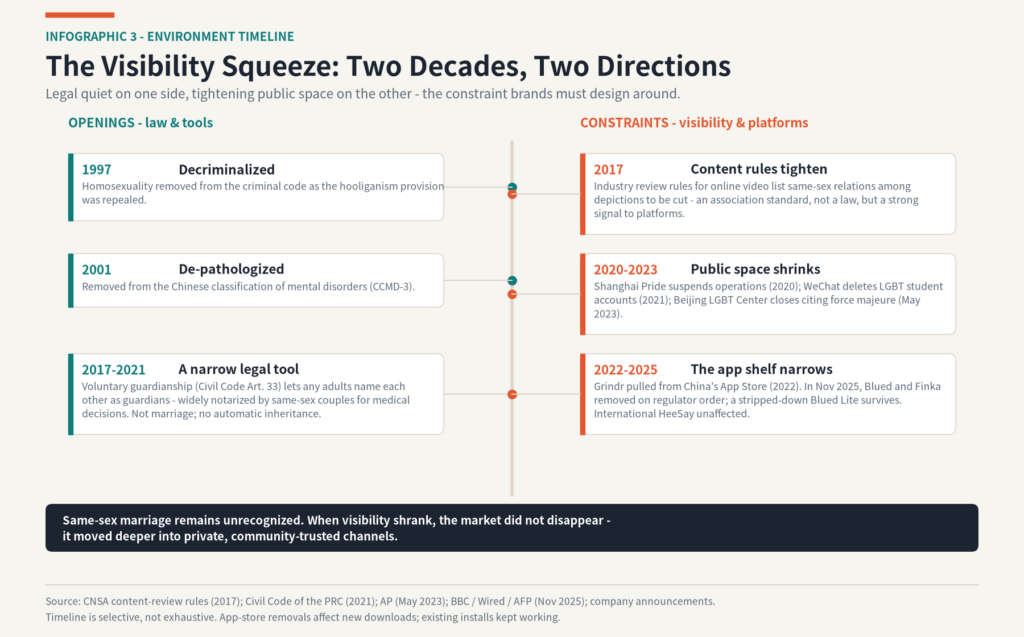
Here is the counterintuitive part, and the commercial heart of this story. Every contraction of public space pushes the community deeper into the channels that remain: private groups, trusted apps, word-of-mouth networks. Newborn Town’s filings show the overseas business thriving — group revenue reached RMB 5.09 billion in 2024, up 53.9% — while the domestic app operates in survival mode. The demand did not evaporate when the shelf space shrank. It concentrated. For a marketer, concentrated demand inside trusted channels is not a consolation prize. It is the most valuable kind of audience there is, provided you can enter without breaking the trust that holds it together.
How This Market Actually Buys
In December 2022, BlueCity and Ipsos published the most recent credible consumer study of this population: 2,202 online respondents in tier-one to tier-three cities, surveyed in the last quarter of 2021, plus six in-depth interviews. It is the last good snapshot we have — more on that limitation shortly — and it overturns the lazy stereotype of the free-spending “pink dollar.”
These consumers are pragmatists. The top purchase-decision factors were product price (50%), content and quality (39%), and word of mouth (37%). The brand positioning that resonated most was function and practicality (49%), followed by an ordinary, comfortable life (41%), uniqueness and individuality (38%), and quality and elegance (27%). Read that list again: the community that Western marketing imagination dresses in rainbow glitter actually responds best to competence, comfort, and a touch of individuality. They evaluate purchases rationally — and then, having done the math, willingly pay for niche products that express who they are. Rational process, expressive outcome.
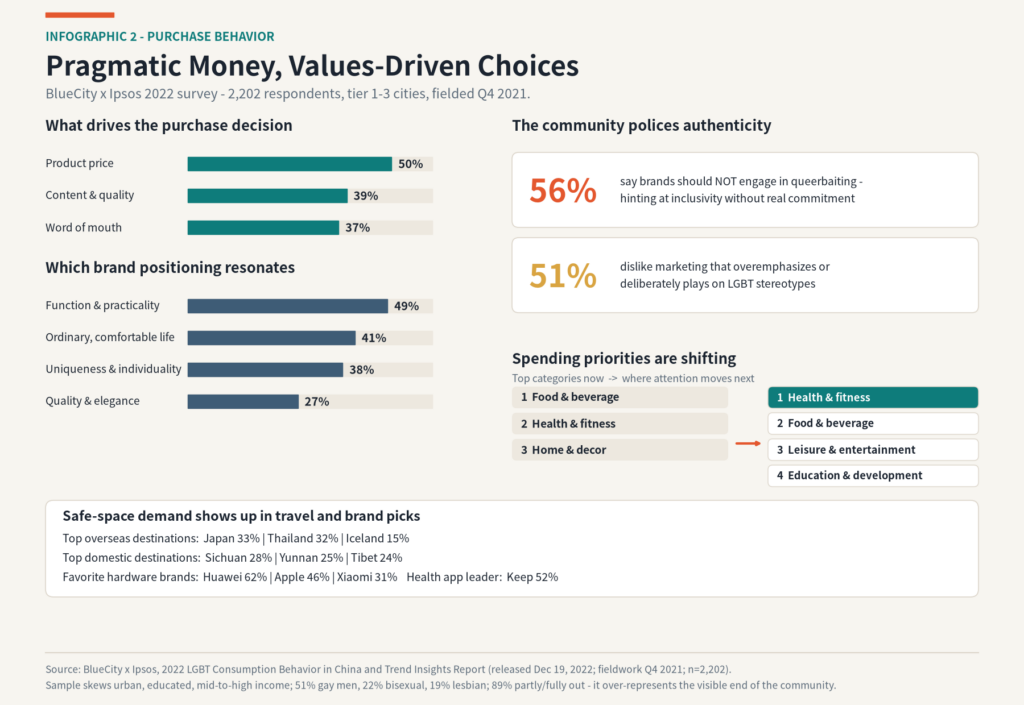
And they are watching how brands behave. Fifty-six percent of respondents said companies should not engage in queerbaiting — hinting at inclusivity to win affection without genuine commitment. Fifty-one percent disliked marketing that overemphasizes or deliberately plays on LGBT stereotypes. This is a community with finely tuned detectors for exploitation, for the obvious reason that exploitation has been its historical experience. The survey’s message to marketers could not be plainer: we can tell the difference between being served and being harvested.
Where does the money go? Current spending concentrates in food and beverage (64%), health and fitness (62%), and home and living (55%) — the categories of a settled, self-investing life. Asked about future priorities, respondents put health and fitness first, ahead of food, leisure and entertainment, and education. Travel preferences read like a map of safe spaces: Japan (33%) and Thailand (32%) lead overseas choices, with Iceland (15%) third; domestically, Sichuan (28%), Yunnan (25%), and Tibet (24%) top the list. In brand picks, Huawei (62%) outranked Apple (46%) and Xiaomi (31%) in hardware, and the fitness app Keep led health services at 52%, helped by crossover collaborations. None of these are “identity products.” They are ordinary categories where this community’s trust, once earned, compounds.
The generational texture matters too. The youngest cohort (18–26) splits its spending across dining, grooming and fashion, and leisure — rational evaluators who still pay for self-expression. The 27–36 cohort shifts toward health, vitality, and the home. Older cohorts increasingly prioritize living comfort and risk management; where the general post-65 population focuses on well-being, its LGBTQ counterpart focuses on managing precarity — a quiet reminder that aging without legal family recognition is a financial planning problem, not just a social one.
The Playbook: Serve Without Signaling
Put the evidence together and a four-part operating model falls out. None of it requires a pride campaign. All of it requires discipline.
First, treat privacy as product value, not a compliance checkbox. When disclosure carries social and professional risk, discretion is a feature customers will choose you for. The health data below proves this at clinical scale: men who would not walk into a clinic ordered HIV self-tests through an app and had kits mailed to them. Discreet packaging, private purchase flows, minimal data collection, no identity-revealing push notifications — in this market, these are not hygiene factors. They are the value proposition.
Second, enter through community-trusted channels, not corporate outreach. Word of mouth already ranks as a top-three purchase driver (37%), and the platform economics show why: a community concentrated in a few trusted spaces validates brands internally, peer to peer. The brands that win here are endorsed by community-native voices — the KOC logic that powers so much of Chinese consumer marketing, intensified by the fact that an outsider’s recommendation carries no social proof at all. You cannot buy your way into this trust graph with mass media. You can only be admitted to it, one credible interaction at a time.
Third, offer inclusive service without performative solidarity. Serve the customer; do not announce the customer. A hotel that quietly trains staff to welcome any couple without asking questions is serving. A campaign that plasters a customer’s identity across a billboard in a visibility-constrained society is exposing them to risk — and the survey numbers (56% anti-queerbaiting, 51% anti-stereotype) show the community itself grades that behavior as harm dressed up as support. The ethical line and the commercial line happen to be the same line: quiet service is both respectful and effective.
Fourth, build for category-native needs. Grooming and fashion for self-expression. Health and fitness, where demand is strongest and rising. Travel and leisure oriented around safety and welcome. Home and living for the settled life the data keeps pointing to. And — the most underserved category of all — competent, confidential health services, which the next section shows is where the real gap lives. Market to the need, not to the identity. The need is durable demand; the identity, in this environment, is exposure.
The Real Gap Is Health, Not Rainbow Merchandise
If you want to see what “underserved” means in numbers, look at the peer-reviewed record. A 2023 study in JAMA Network Open surveyed 89,342 students across all 63 universities in Jilin Province. Among them, 66.5% of LGB students and 71.0% of transgender and gender-nonconforming students showed elevated depressive symptoms on standard screening instruments, versus 47.3% of cisgender heterosexual peers. Elevated anxiety ran 51.8% and 56.9% versus 33.9%. Screened suicide risk was 36.2% among LGB and 43.0% among TGNC students, against 11.7% among their cisgender heterosexual peers — and TGNC students faced 5.4 times the adjusted odds. These are screening results from one province, not national clinical diagnoses, but the direction and magnitude are consistent with a decade of smaller studies. Behind those numbers is a vast, largely unmet demand for mental health care that does not require a patient to out themselves to access it.
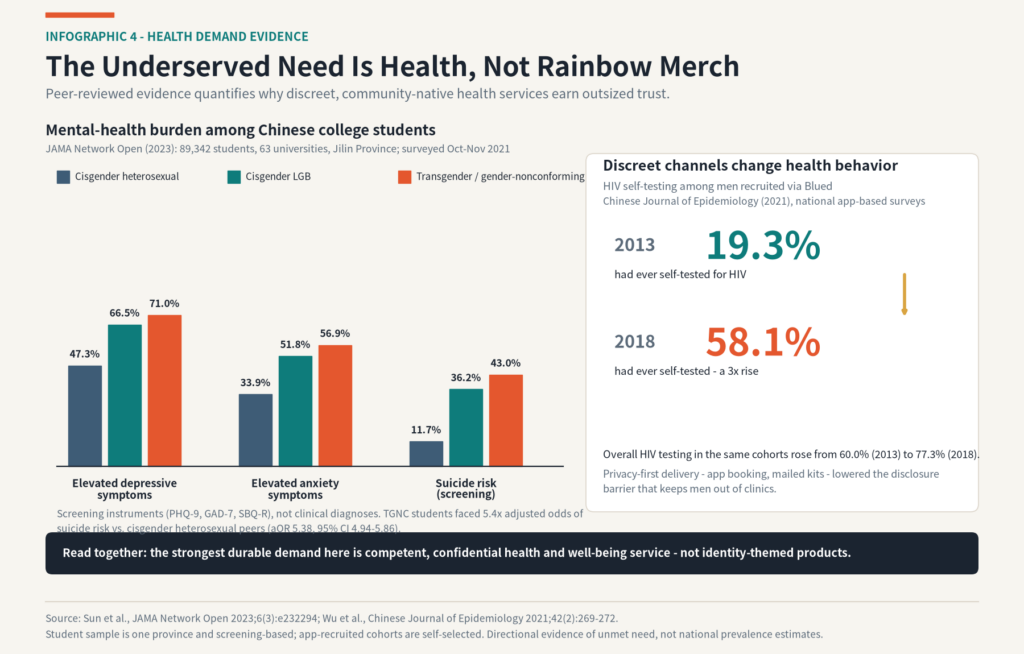
The physical-health story is just as telling — and more hopeful, because it shows what happens when service is designed around discretion. Researchers recruiting through Blued tracked HIV testing behavior among men who have sex with men across national app-based surveys: the share who had ever self-tested for HIV rose from 19.3% in 2013 to 58.1% in 2018 — a threefold jump — while overall testing rose from 60.0% to 77.3%. Self-testing went from a third of all tests to three quarters. The mechanism was privacy: book in the app, receive the kit by mail, never face a receptionist’s raised eyebrow. Published protocols from 2025 describe the next iteration — full prevention packages, including PrEP counseling and mailed medication, embedded directly in the app — precisely because disclosure fears keep men out of facility-based care. BlueCity itself pivoted toward health services for this reason, and its HIV-prevention nonprofit work earned official recognition even as its social app faced removal. Public health utility, it turns out, is the most durable license to operate this community’s businesses have ever held.
For brands outside health, the lesson generalizes cleanly. The community’s deepest unmet needs are services that are competent and confidential. Whatever category you are in, ask what the discreet version of excellence looks like — then build it.
What Everyone Gets Wrong
Four errors recur in how outsiders think about this market, and each has a correction written in the data.
The performative-solidarity error. Importing loud, Western-style rainbow marketing into a visibility-constrained context does not export the support; it exports the risk. A campaign that identifies its audience publicly can cost that audience social and professional standing. The community’s own survey verdict — majorities against queerbaiting and stereotype marketing — confirms it experiences this as harm. Quiet service is not cowardice. It is the respectful model.
The niche-small assumption. Tens of millions of people, 71% next-month retention on the dominant platform, and purchase behavior indistinguishable from the urban mainstream in its rationality — this is a substantial market wearing a niche costume. And because mainstream brands avoid it, the competitive density is low. Underserved plus loyal equals concentrated value, which is what every marketer claims to want and most never find.
The identity-marketing trap. Rainbow-packaged products market to the identity; grooming, health, safe travel, and home goods market to the needs. The Ipsos data shows needs winning every resonance test. The identity is the risky surface; the needs are the durable demand. Sell the excellent ordinary thing, delivered with uncommon discretion.
The data-staleness trap. Here we must be candid about our own evidence. The best platform numbers are from 2020; the consumer survey fielded in late 2021; the landmark social survey is from 2016. BlueCity went private and stopped disclosing. The Beijing LGBT Center closed. No credible new consumption survey from the usual research houses has appeared in 2023–2026 — versions of the 2022 report circulating online under newer dates are re-posts, not new research. Anyone quoting a “2026 market size” for Chinese LGBTQ+ consumption is extrapolating, and you should ask from what. Use the patterns — loyalty, privacy-as-value, community-as-channel, pragmatism — as durable insight. Do not use the old numbers as current facts.
Risks, Biases, and the Ethical Floor
An honest playbook names its own limits. Start with sample bias: the Ipsos survey reached people through a gay men’s platform, and its respondents were 51% gay men, 89% at least partly out, urban, educated, and mid-to-high income. That is the visible end of the community. Lesbians (19% of the sample), bisexual people (22%), transgender people (barely represented), rural residents, and the deeply closeted majority implied by the UNDP’s 5% figure are all underweighted. The JAMA study, meanwhile, is students in one province; the HIV cohorts are self-selected app users. Every dataset in this piece is directional. None is a national census, and the argument’s confidence rests on their convergence, not on any single number.
Then there is platform risk, which is real and rising. The November 2025 removals show that even the most compliant, health-contributing community business can lose its distribution overnight. Any strategy built on a single community platform is building on rented land. Brands should diversify their touchpoints — private communities, offline service quality, CRM that respects privacy — so that one regulatory action cannot sever the relationship.
Finally, the ethical floor, which is also the strategic floor. Serving this community’s needs is legitimate commerce, full stop. Exploiting its trust, harvesting its data, or outing its members — even inadvertently, even with a rainbow logo and good intentions — is harm. The serve-without-signaling model is not a trick for extracting value from a vulnerable group. It is the recognition that in a market where visibility is costly, the only sustainable business is one that lowers the cost of being a customer. Do that, and the loyalty documented in every dataset here is yours to earn. Fail at it, and no campaign budget will buy back what one careless exposure destroys.
Conclusion
China’s LGBTQ+ consumers are not a hidden market because they are small or shy. They are quiet because the environment prices visibility, and they are underserved because most brands mistake that quiet for absence. The verifiable record — an IPO prospectus showing extraordinary retention, a UN survey showing rational concealment, an Ipsos study showing pragmatic, authenticity-sensitive spending, and clinical research showing vast unmet health needs — all points to one strategy. Serve without signaling: privacy as product value, community-trusted channels, inclusive service without performance, and category-native needs, especially health. The numbers are dated; the logic is not. In this market, the brands that lower the cost of being a customer inherit a loyalty that louder competitors will never even see.