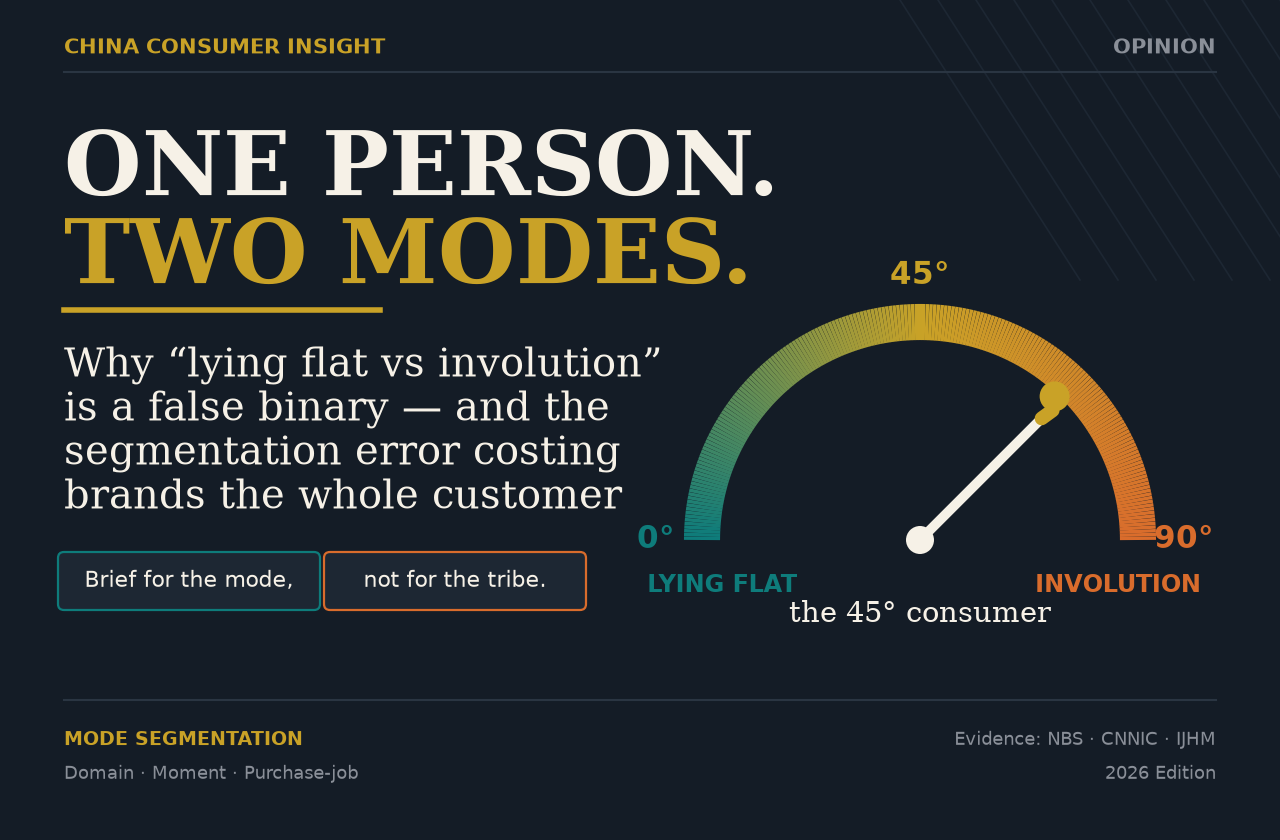
Picture your best customer. Monday morning, she’s comparing three certification courses on her phone between meetings, because the promotion window closes in March and everyone on her team knows it. Saturday afternoon, the same woman is forty minutes into a plush-toy unboxing video, checking whether the new Labubu drop is worth queueing for — not because it does anything, but because it feels like something.
Your CRM has her tagged twice. Once as an “ambitious striver.” Once as a “lying-flat Gen Z.” Two personas, two briefs, two campaigns — aimed at one person who sees both and trusts neither.
Here’s the position this piece defends: lying flat and involution are not two consumer cohorts. They are two modes of the same person, and segmenting them as tribes is a category error that costs brands the whole customer. The fix isn’t a better persona. It’s a different unit of segmentation: the mode, the moment, and the job the purchase is hired to do.
Two Words, One Pressure System
Let’s define terms, because the confusion starts upstream.
Involution (neijuan) describes competition that intensifies without producing progress — more effort, same or shrinking returns. The word has a surprisingly academic pedigree: anthropologist Alexander Goldenweiser coined the concept, Clifford Geertz applied it to Javanese rice farming in his 1963 book Agricultural Involution, and historian Philip Huang brought it into Chinese studies as “growth without development.” It escaped academia around 2020 and became the defining workplace slang of a generation.
Lying flat (tang ping) is the individual’s answer to that system: withdrawing from a race whose prizes keep shrinking. It went viral in 2021 and made that year’s official top-ten internet buzzword list.
Notice the grammar of the pair. Involution names a structure. Lying flat names a response to it. Cause and symptom — not Coke and Pepsi, not two tribes with membership cards. When your segmentation deck treats them as parallel audiences, it has quietly turned a diagnosis into a demographic.
The Binary Is a Category Error — Here’s the Evidence
This isn’t just a semantic quibble. Peer-reviewed work has traced the mechanism inside individual people.
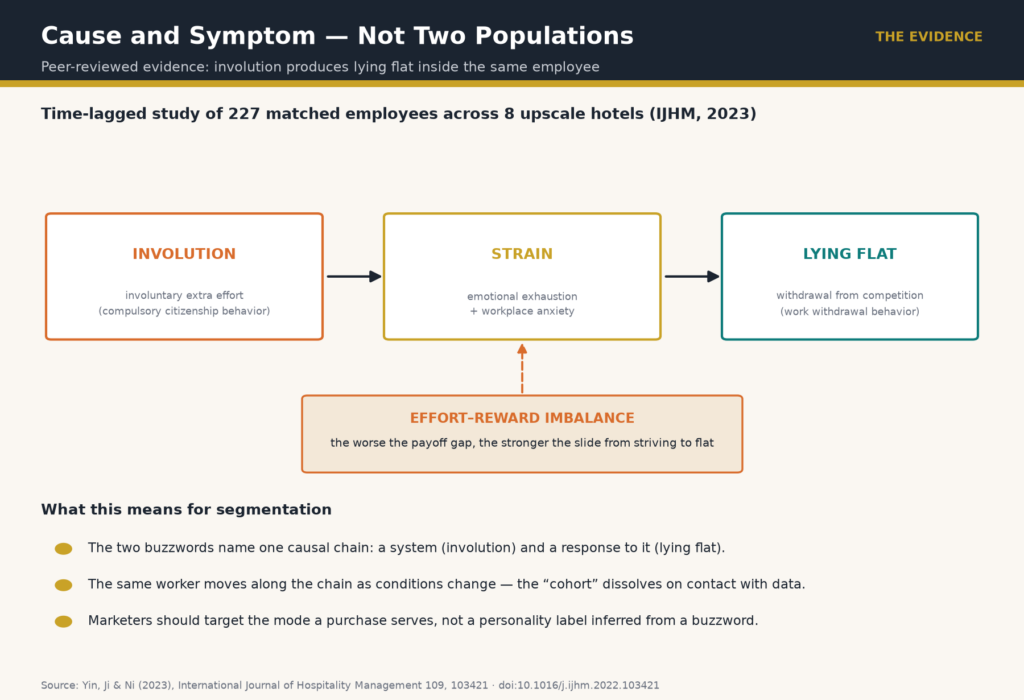
A 2023 study in the International Journal of Hospitality Management followed 227 matched employee responses across eight upscale hotels, using time-lagged data. It found that involution — measured as involuntary extra-role effort — predicts lying flat, measured as work withdrawal, through two mediators: emotional exhaustion and workplace anxiety. And the worse the effort-reward imbalance, the stronger the slide. The striver becomes the flattener. Same person, deteriorating conditions.
Read that again with a marketer’s eye. The two “cohorts” in your deck are connected by an arrow, not a wall. People move along it — sometimes within a single week.
Meet the 45-Degree Consumer
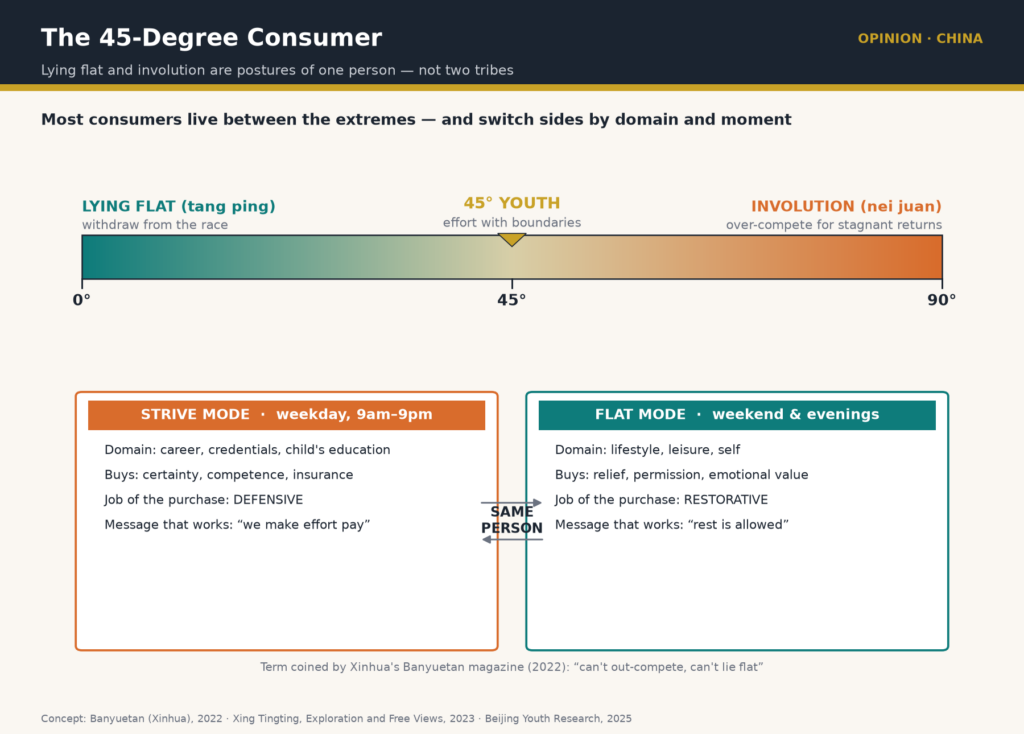
Chinese public discourse found the honest label years before most marketing decks did. In 2022, Banyuetan — the Xinhua-affiliated current-affairs magazine — described young people who “can’t out-compete, can’t lie flat either,” mapping life onto angles: 0 degrees is lying flat, 90 degrees is involution, and the mass of people sit at 45. The “45-degree youth” label stuck, and academic journals from Exploration and Free Views (2023) to Beijing Youth Research (2025) have since documented the posture: refusing mediocrity while feeling exhausted, setting clear goals while delaying execution, wanting upward mobility while refusing its full price.
The 45-degree consumer isn’t a compromise between two tribes. She’s the majority the binary erases. Effort with boundaries. Ambition with refusal rights. She’ll pay for a credential that genuinely de-risks her career, and she’ll also pay for a plush toy that makes Sunday feel survivable — and she experiences zero contradiction, because the purchases serve different jobs.
One Population, Both Modes: What the 2025 Data Shows
If mode-switching were a fringe behavior, the national statistics wouldn’t rhyme. They do.
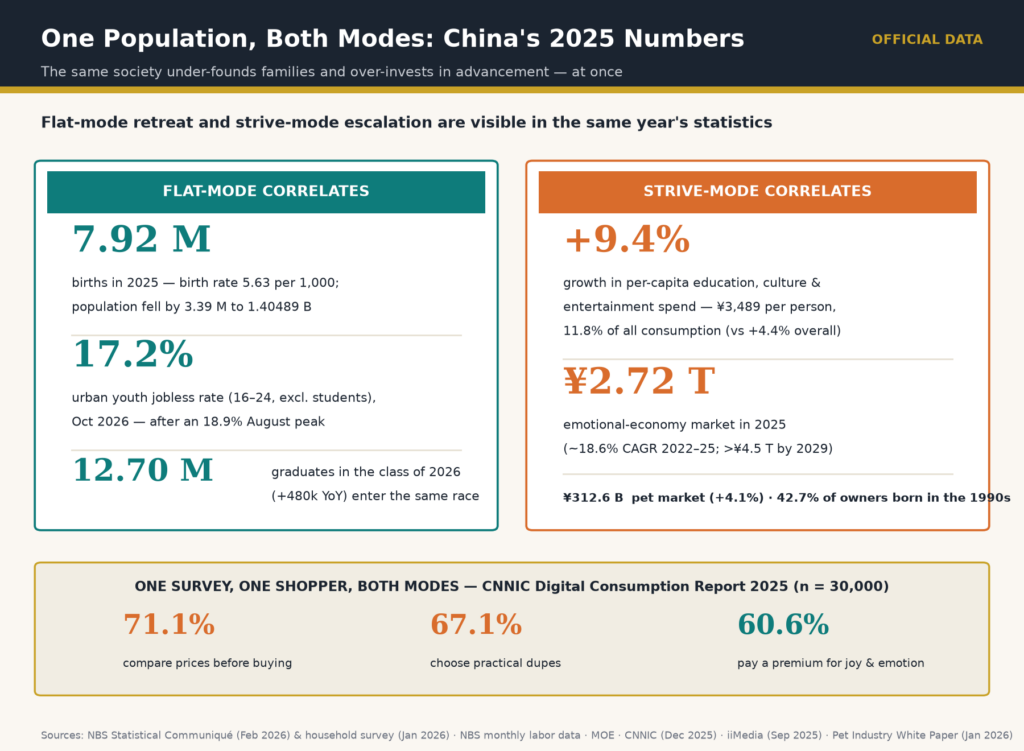
China’s National Bureau of Statistics reported 7.92 million births in 2025, a birth rate of 5.63 per thousand, and a population that shrank by 3.39 million. That’s the flat-mode correlate at civilizational scale: a society quietly opting out of the milestone race. In the same year, per-capita spending on education, culture and entertainment grew 9.4% to 3,489 yuan — more than double the 4.4% growth of overall consumption. That’s the strive-mode correlate: the same society doubling down on advancement spending. Meanwhile, the Ministry of Education expects 12.7 million graduates in the class of 2026, up 480,000, entering a labor market where the youth jobless rate (16–24, excluding students) peaked at 18.9% in August before easing to 17.2% in October.
Under-found families, over-invest in credentials, dread the job market. One population, doing all three at once.
The Same Shopper Compares Prices and Pays for Feelings
The cleanest proof comes from a single survey asking the same respondents about both behaviors.
CNNIC’s Digital Consumption Report 2025, based on 30,000 residents across 31 provinces, found that 71.1% of online shoppers compare prices before buying and 67.1% deliberately choose practical, lower-priced alternatives. In the same report, 60.6% said they’d pay a premium for hobbies and emotional value. Not different people. The same 958-million-strong digital consumer base, being rational and emotional in the same checkout flow.
The emotional side isn’t a rounding error, either. iiMedia Research sized China’s emotional economy at 2.72 trillion yuan in 2025 — roughly 18.6% compound annual growth since 2022 — and projects it beyond 4.5 trillion by 2029. A September 2025 tracking study by the Shanghai Youth and Children Research Center with Soul App found young consumers averaging 949 yuan a month in emotional spending, with nearly 40% buying frequently. And the pet economy — companionship you can invoice — reached 312.6 billion yuan in 2025, with 42.7% of owners born in the 1990s: the very cohort your deck files under “strivers.”
Your customer isn’t conflicted. Your segmentation is.
Why Cohort Labels Break the Brief
Follow the failure downstream and it gets expensive in four distinct ways.
The contradiction problem. The ambition campaign (“grind now, shine later”) insults her flat mode; the relief campaign (“you deserve to do nothing”) patronizes her strive mode. Run both at the same tagged cohort and she reads the brand as tone-deaf in stereo.
The moralization trap. “Lying flat = lazy” and “involution = victim” both moralize a structural condition. She’s neither. She’s rationally repricing effort against returns — exactly what the effort-reward research describes.
The generation-essentialism trap. “Gen Z flats, millennials strive” collapses on contact with the pet-owner data and the credential-spending data. Modes span generations; the 35-year-old studying for a professional exam on Sunday night is also the one buying concert tickets for Thursday.
The data-erasure problem. Cohort labels average away the switching. The “mean” consumer looks moderate, and the variance — which is the actual behavior — disappears from the dashboard. You end up optimizing for a person who doesn’t exist.
The Alternative: Segment by Mode, Moment, and Purchase-Job
Here’s the framework this opinion argues for. Three axes, none of which requires a personality label.
By domain. Work, credentials, a child’s education: strive territory — sell certainty, competence, a safer future. Lifestyle, leisure, the self: flat territory — sell relief, permission, emotional value.
By moment. Weekday office hours and exam seasons are strive contexts. Evenings, weekends and holidays are flat contexts. Same person, different brief, different clock.
By purchase-job. This is the strategic addition. Defensive purchases (education, health, insurance) protect a future; restorative purchases (comfort, hobbies, pets, solo dining) repair a present. The job decides the mode — not the person. A restorative purchase made by a “striver” is still a restorative purchase, and it deserves restorative creative.
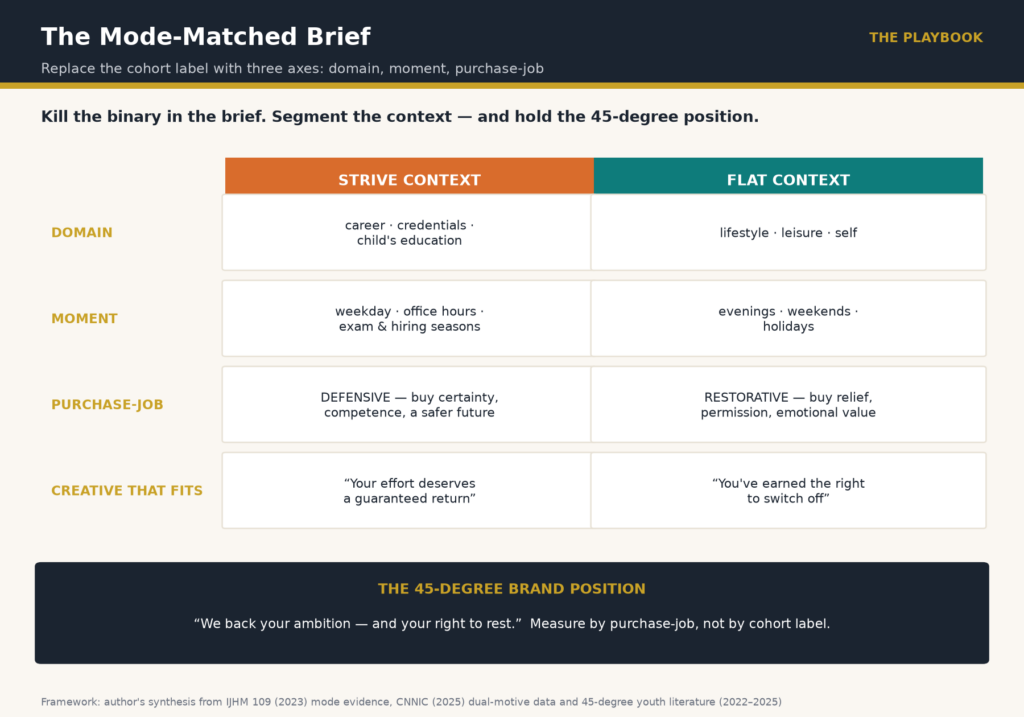
The 45-Degree Brand Position
The brand that wins the whole person doesn’t pick a side. It holds both: we back your ambition — and your right to rest.
That’s not a tagline trick; it’s an operating rule. Strive-context creative promises that effort gets a guaranteed return. Flat-context creative grants permission without a productivity justification — rest that doesn’t have to earn its keep. The two messages stop contradicting each other the moment they stop targeting the same context. And measurement follows the same logic: track defensive versus restorative purchase behavior, not membership in a buzzword cohort. The job is the stable segment. The label never was.
Counterarguments, and Where They Break
“But some people really are predominantly flat or predominantly strivers.” True — predominant-mode individuals exist. They’re the tails. The 45-degree switcher is the mass, and cohort segmentation over-weights the tails because they’re louder online. Use predominant mode as a secondary axis if you must; never as the primary one.
“This is just context targeting with new vocabulary.” Partly fair. Dayparting is old. What’s new is the specific claim: this particular binary is a false cohort, and the purchase-job axis — defensive versus restorative — gives context targeting a strategic spine it usually lacks.
“The binary is useful shorthand.” As discourse, sure — it names a real cultural tension, and this piece uses the words throughout. As segmentation, it’s harmful. Keep the discourse. Kill the segment.
One honest limitation: mode-switching evidence is strongest for urban, digitally active consumers; rural and older populations are thinner in the survey base. And official statistics show correlates, not causation — the argument leans on the peer-reviewed mechanism, with the macro data as corroboration.
Conclusion: Keep the Discourse, Kill the Segment
Lying flat and involution are two modes of one 45-degree person — striving at work, flattening on the weekend, buying certainty for the child and relief for the self. The 2025 numbers, the survey data and the peer-reviewed mechanism all point the same way: the binary describes a pressure system, not a population split. So kill the cohort label in the brief. Match creative to the mode. Hold the ambition-and-rest position. Measure by purchase-job. Your customer was never lying flat or involuting. She’s doing both — and the brand that holds both wins the whole person.