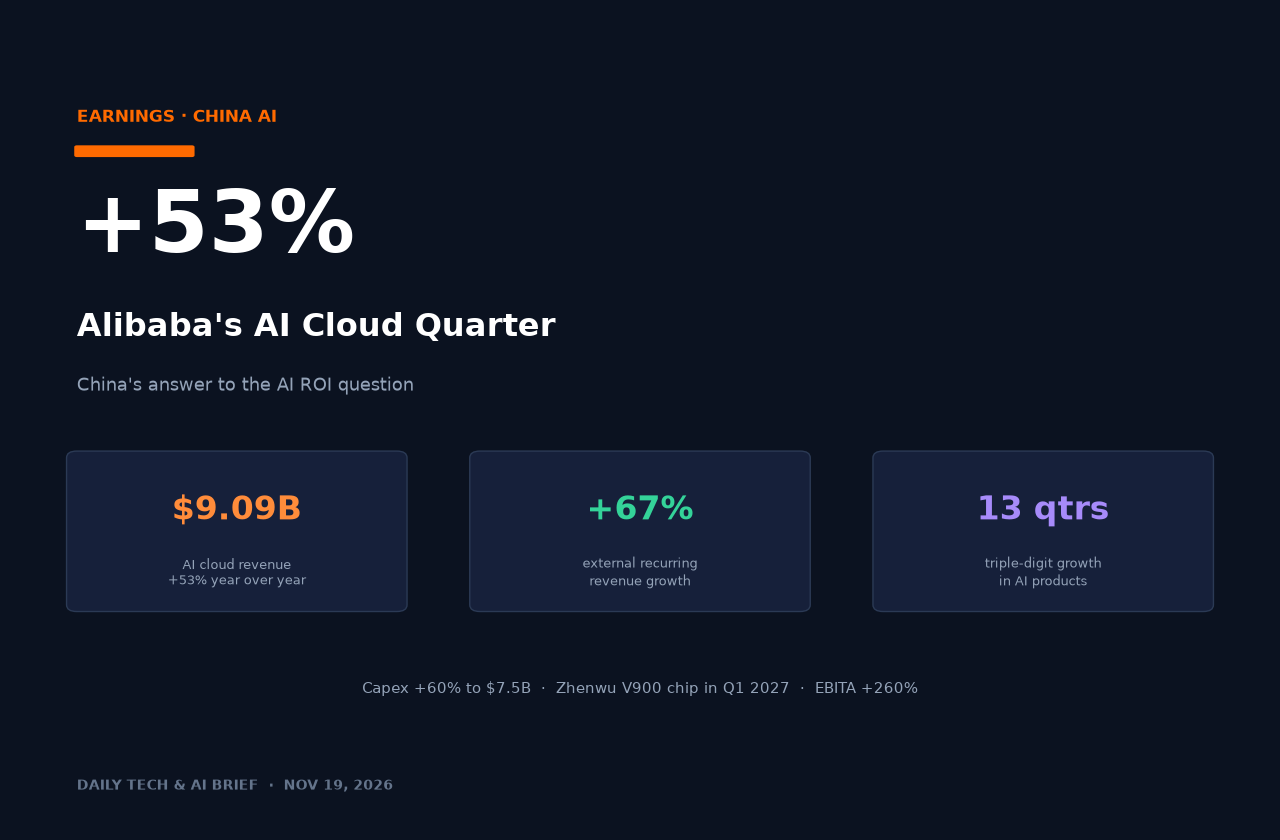
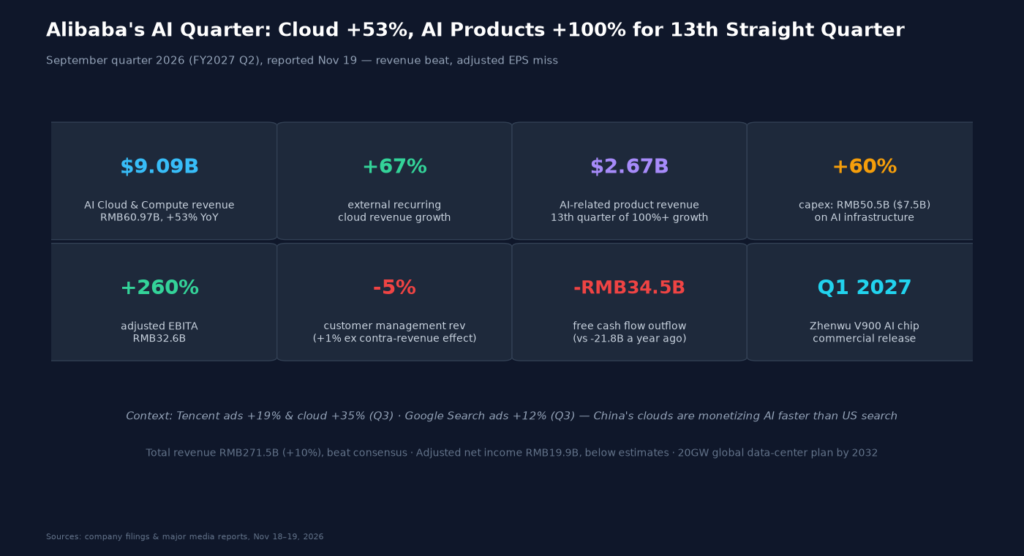
While American markets spent the week debating whether AI spending can ever pay for itself, Alibaba answered the question with a spreadsheet. The Chinese group’s September-quarter results, published Thursday, showed AI Cloud and Compute Services revenue of RMB60.97 billion ($9.09 billion), up 53% year over year, with growth from external customers accelerating to 64% and recurring external revenue — the cleanest measure, stripping out equipment sales — accelerating to 67%. AI-related product revenue reached RMB17.92 billion ($2.67 billion), the thirteenth consecutive quarter of triple-digit growth. Total group revenue rose 10% to RMB271.5 billion, beating consensus, and adjusted EBITA jumped 260% to RMB32.6 billion. The most quoted number in Western coverage of AI this quarter was Google’s search-ad growth decelerating to 12%. Alibaba’s cloud is growing more than five times faster, and getting more profitable while doing it.
Read the whole spreadsheet, not just the highlights
Honest analysis requires the other column too. Adjusted net income of RMB19.9 billion came in well below analyst expectations, despite growing sharply year over year. Customer management revenue — the advertising-adjacent line most relevant to marketers — fell 5%, or grew 1% excluding the contra-revenue effect of a new business-development program. Free cash flow was an outflow of RMB34.5 billion, deeper than the RMB21.8 billion outflow a year earlier, because capital expenditure rose 60% to RMB50.5 billion ($7.5 billion) as the company races to build compute capacity. The stock is down roughly 40% this year. This is not a company that has solved the AI equation; it is a company demonstrating that the revenue side of the equation can compound at extraordinary rates while the cost side remains brutal.
What makes the quarter strategically legible is where the growth comes from. Management described demand extending well beyond AI labs’ training and inference: internet, automotive, embodied AI, financial services, and biotechnology customers are all expanding cloud usage. Alibaba Cloud was named a Leader in Gartner’s 2026 Magic Quadrant for Strategic Cloud Platform Services — the first and only Asia-Pacific provider in the highest quadrant. Underneath sit proprietary assets most Western clouds don’t have: chip unit T-Head, which confidentially filed for a Hong Kong listing this month, unveiled the Zhenwu V900 training-and-inference chip for commercial release in Q1 2027, open-sourced its SAIL software stack, and already operates China’s first supernode architecture supporting inference for models above two trillion parameters. On top sits Qwen4-Max, a 2.4-trillion-parameter mixture-of-experts model with native vision, and an agent platform, QwenWork, embedding into enterprise workflows. Chips, supernodes, models, agents, cloud — one company owns the entire stack, and the 67% recurring growth is what that integration sells.
The China–US monetization contrast is now a three-point dataset
Set this quarter beside its American and domestic peers and a genuine pattern emerges. Google’s search advertising — the most mature monetization engine in internet history — slowed to 12% growth as its own AI answers cannibalize ad inventory, a drag its commercial chief admitted on the record. Tencent’s marketing-services revenue grew 19% with cloud up 35%, and its president likened AI capex to building factories that pay off from 2028. Alibaba’s external recurring cloud growth: 67%. The pattern is not “China good, US bad” — it is that AI monetization is currently flowing through infrastructure and enterprise consumption faster than through consumer attention markets. Selling shovels and selling work beats selling eyeballs, at least in this phase of the cycle. Ratings agency Fitch put the frame plainly this week: AI competition has shifted from model capability to commercialization, and demand growth guarantees no one’s return on investment. Alibaba’s quarter is the strongest evidence yet for the first half of that sentence, and its cash-flow statement is evidence for the second.
What global marketers should take from this
For brands operating in or selling into China, three implications are concrete. First, the agent-native commerce stack is real: Alibaba’s consumer Qwen app now spans shopping, local services and travel across 20-plus categories, and its Qwen Go! personal agent executes multi-step tasks across platforms. When a Chinese consumer’s agent does the browsing, product data quality, structured content, and machine-readable offers become the new shelf space — the GEO discipline Western marketers are learning for ChatGPT applies with more commercial force inside Alibaba’s ecosystem. Second, the advertising line’s softness (-5% headline) alongside instant-commerce profitability gains says budget is migrating from classic display toward transaction-closer formats; plan China media mixes accordingly. Third, for global martech vendors, Alibaba’s full-stack self-sufficiency — down to open-sourcing its chip software — signals a market where foreign AI middleware faces a vertically integrated native competitor with a 20-gigawatt data-center buildout planned by 2032.
The AI ROI debate will not be settled by one quarter from one company. But when the skeptics’ strongest argument is that nobody can show AI revenue compounding at scale with improving margins, a $9 billion cloud quarter growing 53% — with the profitable, recurring part growing 67% — is the hardest counter-evidence anyone has produced. It deserves to be read in full, cash outflows included.






