Can a brand charge luxury prices on the strength of cultural identity alone — without nationalist sentiment to lean on? Florasis, the Hangzhou-born makeup house founded in 2017, is the cleanest test case we have. Its carved lipsticks and relief palettes turned Eastern aesthetics into a differentiation premium, and that premium traveled: on Amazon Japan in 2021, its Love Lock lipstick listed at 6,129 yen — above Chanel’s 5,270 yen — and still cracked the platform’s hourly top-three lipstick ranking on day one. By January 2025 the brand had opened the first Chinese beauty flagship in Tokyo’s Ginza Six; by late 2025 it became the first Chinese beauty brand inside Ulta Beauty’s US channel. But the domestic story is a caution: the September 2023 “79-yuan eyebrow pencil” crisis exposed how fragile an asserted premium can be, and online GMV slid from a reported peak of roughly RMB 5.4 billion (2021) to about RMB 2.39 billion (2024, industry estimates). The rebuild — a RMB 1 billion five-year R&D pledge, a self-built smart factory, a skincare extension — is the second curve. Cultural identity opened the premium door. Verifiable science and trust have to keep it open.
Background: The Cultural-Premium Thesis (2017–2021)
A Positioning Designed to Be Un-copyable
Florasis launched on March 8, 2017, beside Hangzhou’s West Lake, under the Yige Group (EastGarden). Its founder, Wu Chenglong — known by his industry alias Hua Mantian — previously ran Tmall flagship operations for Pechoin and, from 2014, for Danz. He understood the machinery of Chinese e-commerce before he built a brand around it. The positioning was “Eastern makeup, nourished by flowers”: floral and herbal extracts fused with Chinese craft aesthetics. Hero products — the Love Lock carved lipstick, the Phoenix relief palette, the jade-inspired setting powder — were designed as cultural symbols, not disposable SKUs. Miao silverwork, ceramics, Su embroidery and leather carving were folded into packaging through collaborations with intangible-heritage artisans.
The price architecture was deliberate. While most domestic makeup sat under RMB 100 and international labels started above RMB 200, roughly 40% of Florasis products landed in the RMB 100–200 gap — a vacuum nobody owned, as China Business Journal reported. And the brand eventually gave the aesthetic a physical home: in December 2022 it opened the Hidden Villa, a 1,000-square-meter, two-story flagship beside West Lake — the largest store of its kind for a Chinese beauty brand, part garden, part gallery, part counter.
The Rise — and the Borrowed Audience
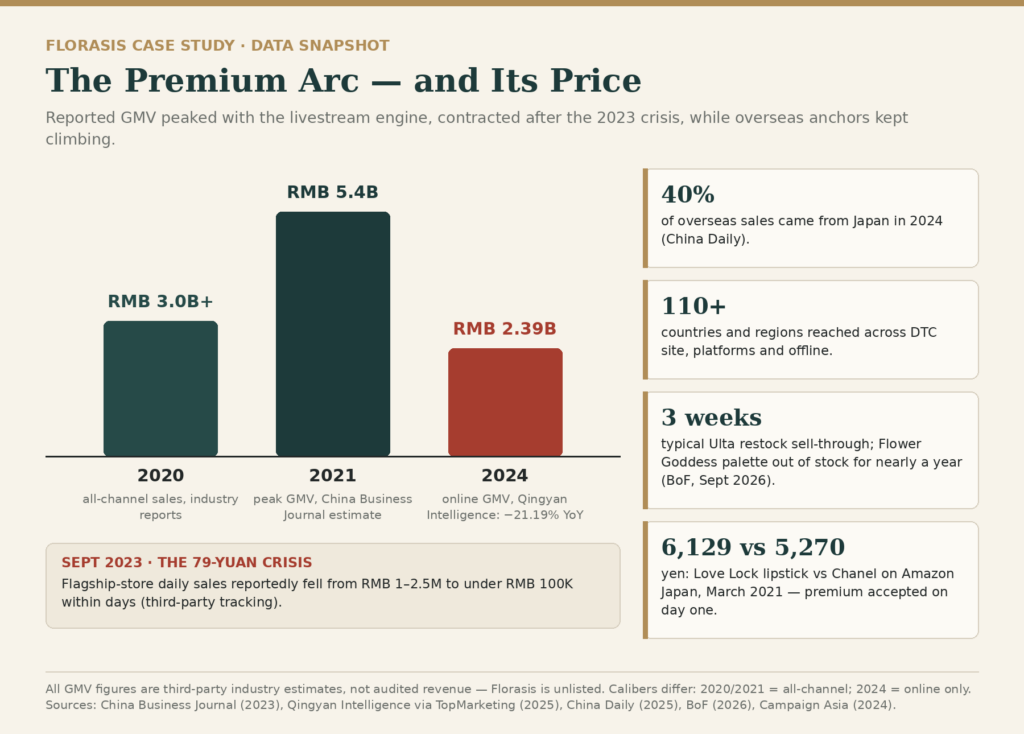
The growth engine was content commerce plus one man: Li Jiaqi, China’s “Lipstick King,” who became the brand’s chief recommendation officer in September 2019. Industry reporting puts 2020 sales above RMB 3 billion and 2021 GMV around RMB 5.4 billion — estimates, not audited figures; Florasis is private, has disclosed no external funding, and its founder reportedly holds about 99% of the parent entity. The dependence was structural. In 2020, more than 80% of sales ran through Tmall, and roughly 40% of Tmall sales came from Li’s livestream room, per ECdataway data cited by Jiemian News. Around Double 11 in 2019, his room contributed nearly 80% of the brand’s traffic and over 64% of transactions. The thesis worked — cultural differentiation as pricing power, the anti-dupe route — but the audience was borrowed, not owned.
The Globalization Ladder: Four Stages, Four Years
Stage 1 — Test in the Aesthetically Closest Market (2021)
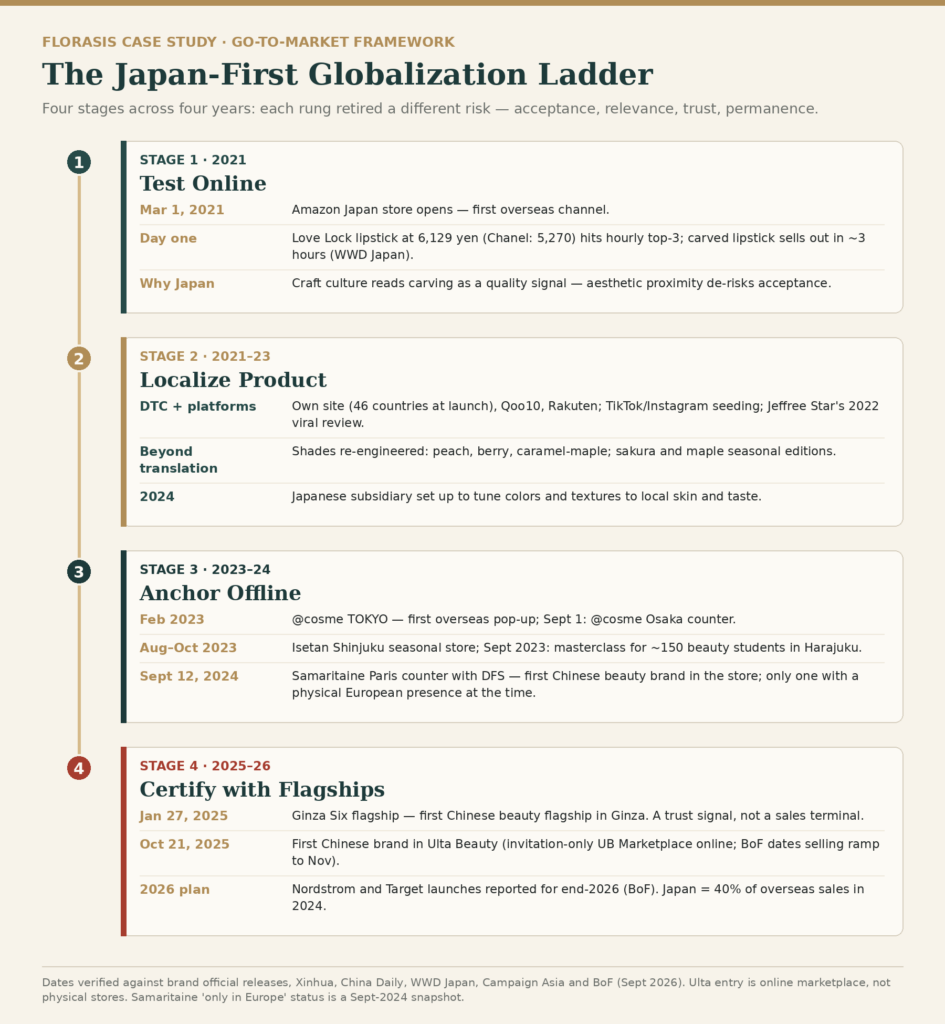
On March 1, 2021, Florasis opened its Amazon Japan store — its first overseas e-commerce channel. The Love Lock lipstick, priced at 6,129 yen against Chanel’s 5,270 yen on the same platform, entered the hourly best-seller top three on launch day, and multiple listings sold out within hours; WWD Japan’s retrospective records the signature carved lipstick selling out in three hours. Why Japan first? Because Japan’s craft culture reads intricate carving as a quality signal, not as exotic decoration. Aesthetic proximity lowered acceptance risk: the brand skipped the usual Southeast Asia “warm-up” and went straight into one of the world’s pickiest premium markets — and won on craft, not on price.
Stage 2 — DTC, Seeding and Real Localization (2021–2023)
The brand built its own site (shipping to 46 countries and regions at launch, per Ebrun and local government disclosures; total reach across all channels now exceeds 110 countries and regions), plus Qoo10 and Rakuten presence in Japan, and TikTok/Instagram seeding abroad. Overseas social followers passed 3.5 million by September 2024 and 4 million by April 2025, per the brand’s own disclosures. Jeffree Star’s 2022 review — titled around “the world’s most beautiful makeup” — went viral and did more for Western awareness than any ad buy. Crucially, localization went beyond translation: shades were re-engineered for Japanese preferences (peach, berry, caramel-maple tones rather than domestic reds), with sakura and maple seasonal editions. In 2024 the brand set up a Japanese subsidiary specifically to tune colors and textures to local skin and taste. This is demand engineering, not copy-paste.
Stage 3 — Offline Anchors and Professional Education (2023–2024)
Offline began as high-status pop-ups, not heavy assets: @cosme TOKYO in February 2023 (the first overseas pop-up), a seasonal counter at Isetan Shinjuku from late August to October 2023, and a permanent @cosme Osaka counter from September 1, 2023. Then the professional layer: in September 2023, Florasis taught a public “Chinese noble-lady makeup” class to roughly 150 beauty students at Harajuku Belle Epoque College of Beauty — seeding the future practitioners who will one day recommend products to clients. In September 2024 the brand opened a counter at Samaritaine, Paris’s oldest department store, in partnership with DFS Group — the first Chinese beauty brand in the century-old store, and at the time the only Chinese color-cosmetics brand with a physical presence in Europe.
Stage 4 — Flagship Trust-Anchors (2025–2026)
On January 27, 2025, Florasis opened its first overseas flagship at Ginza Six, Tokyo — the first Chinese beauty flagship in Ginza, beside the mall’s luxury cohort. The store is a trust signal, not a sales terminal: a “we’re here to stay” certification. On October 21, 2025, it became the first Chinese beauty brand to enter Ulta Beauty — via Ulta’s invitation-only online UB Marketplace (BoF dates the selling ramp to November 2025). The demand surprised everyone: global markets president Gabby Chen told BoF that restocks sold out within three weeks, and the Flower Goddess palette stayed out of stock for nearly a year. Japan accounted for 40% of overseas sales in 2024, per China Daily. BoF reports Nordstrom and Target launches planned for end-2026.
The Crisis: When the Premium Flipped to Arrogance
The 79-Yuan Night
On the evening of September 10, 2023, Li Jiaqi was defending Florasis’s eyebrow pencil — RMB 79.9 in his room, bundled with two refills — against a viewer who said it was getting expensive. His reply: the price hasn’t changed in years, domestic brands have it hard… and then, “sometimes look for your own reasons — has your salary risen all these years? Have you been working hard?” The clip detonated. He lost roughly a million Weibo followers in a day, apologized on Weibo around 1 a.m. on September 11, and cried through a second apology in his livestream that night. Netizens converted the pencil’s price into a per-gram figure and declared it costlier than gold — the calculations varied wildly by bundle (roughly RMB 333 to 985 per gram across different media reckonings), but the meme didn’t need precision. It needed a villain.
Why It Was a Pricing Crisis, Not a PR Crisis
The deeper wound was value perception. Florasis had spent years asserting a cultural premium while its marketing trained consumers to see it as a prestige dupe. When the brand’s own spokesperson mocked ordinary buyers’ purchasing power, the premium read as arrogance. The flagship store’s daily sales reportedly collapsed from the RMB 1–2.5 million range to under RMB 100,000 within days (third-party e-commerce tracking). On September 19 the brand published an open letter that dodged pricing entirely and leaned on its “domestic brand” identity — critics called it hiding behind patriotism. The lesson: an asserted premium is fragile; an earned premium needs verifiable substance.
The Rebuild: Buying Back the Premium with Science
The RMB 1 Billion R&D Pledge
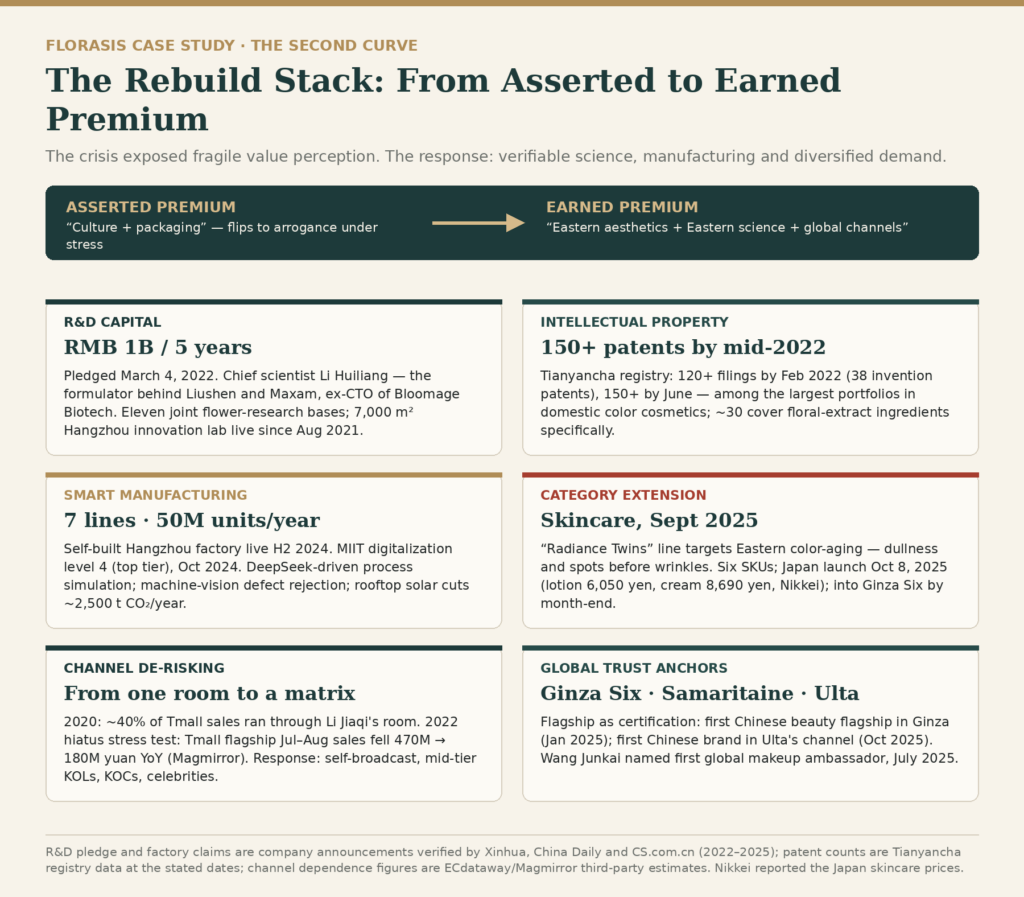
The rebuild predates the crisis — which matters. On March 4, 2022, Florasis announced it would invest over RMB 1 billion in R&D across five years, led by newly appointed chief scientist Li Huiliang, the veteran formulator behind Shanghai Jahwa’s Liushen and Maxam and formerly CTO of Bloomage Biotech. The program spans eleven joint flower-research bases, a 7,000-square-meter innovation lab in Hangzhou (operational since August 2021), and a patent portfolio that Tianyancha data put at 120+ filings by February 2022 (including 38 invention patents), growing to 150+ by mid-2022 — among the largest in domestic color cosmetics, with roughly 30 patents specifically on floral-extract ingredients.
The Smart Factory and the Skincare Second Curve
In the second half of 2024 the group’s self-built smart factory in Hangzhou’s Qiantang district went live: seven digital production lines, roughly 50 million units of annual capacity across skincare, base and powder makeup, certified at level four — the top tier — of MIIT’s SME digitalization scale in October 2024, with DeepSeek integration for process simulation and rooftop solar cutting about 2,500 tonnes of CO₂ a year. In September 2025 Florasis launched its first full skincare line, the “Radiance Twins” collection, targeting what it calls “Eastern color-aging” — dullness and spots that arrive before wrinkles do — with six SKUs and actress Jing Tian as skincare ambassador. It reached Japan on October 8, 2025 (lotion at 6,050 yen, cream at 8,690 yen, per Nikkei), landing in the Ginza Six flagship by month-end. In July 2025, Wang Junkai became the brand’s first global makeup ambassador.
Channel De-risking
The brand had begun diversifying before the crisis — daily self-broadcasting since March 2020, mid-tier KOL and KOC matrices, celebrity endorsements — and accelerated after. The 2022 stress test was instructive: when Li Jiaqi’s channel went dark for roughly three months, Magmirror data showed the Tmall flagship’s July–August sales falling from RMB 470 million to RMB 180 million year-on-year, a drop of more than 60%. One channel should never own that much of your destiny.
Offline de-risking moved in parallel. After the duty-free standalone store in Sanya (opened around the turn of 2024 — the first of its kind for a Chinese beauty brand), Florasis opened its first Shanghai store in June 2025 at Grand Gateway 66 in Xujiahui — its first shopping-mall location nationwide. There are early green shoots in the domestic data, too: during the 2025 618 festival, the brand reported double-digit growth in beauty repurchase rate on JD.com and transaction growth above 60% year-on-year. Small numbers against a halved base, perhaps — but repurchase, not reach, is the metric that matters for an earned premium.
What Everyone Misunderstands
It’s not guochao sentiment abroad. Japanese buyers aren’t purchasing Chinese nationalism; they’re purchasing craft-as-quality and a distinct aesthetic lane — the sculpted “noble-lady” look versus Japanese sheer and Korean dewy. Cultural premium travels as universal aesthetic value, not domestic patriotic sentiment. It wasn’t overnight. The ladder took four years from Amazon test to Ginza flagship — a siege, not a blitz. The crisis didn’t collapse the brand; it rebalanced it. Domestic online sales shrank while the global ladder advanced. And the data trap: Florasis is unlisted, so every GMV figure is an estimate. The verifiable facts are channel milestones, pledges and certifications — treat financials accordingly.
The Reusable Methodology
Five transferable lessons: (1) Cultural premium is differentiation pricing power — sell what can’t be bought elsewhere, never “cheaper than locals.” (2) Enter the aesthetically closest premium market first; proximity de-risks acceptance. (3) Localize product, not language — re-engineer shades, formats and education. (4) Back cultural premium with verifiable R&D; asserted value flips to arrogance under stress. (5) De-risk channel concentration before the market does it for you.
Risks and Honest Caveats
The competitive tier has shifted: Maogeping’s audited 2025 results show RMB 5.05 billion revenue (+30%), with color cosmetics at RMB 2.996 billion and online overtaking offline for the first time — a listed rival compounding while Florasis contracts. The ranking signal is brutal: Florasis fell out of Douyin’s top-10 color-cosmetics brands during the 2025 618 festival, a slot it had held a year earlier. Origin perception remains a headwind for Chinese premium brands abroad; the craft-as-quality framing is the de-risking narrative, but it must be re-earned continuously. And the premium-perception fragility hasn’t vanished: trust rebuilds slowly, and one arrogant sentence can still undo years of positioning.
Conclusion: Aesthetics Must Be Earned
Florasis proved cultural identity can be pricing power — a carved lipstick outpricing Chanel on Amazon Japan, a four-year ladder to Samaritaine, Ginza Six and Ulta. It also proved, expensively, that asserted premium is fragile. The second curve — R&D capital, smart manufacturing, patents, skincare, diversified channels — is the attempt to convert aesthetics into something verifiable. If you’re building a cultural-premium brand, the playbook is clear: open the door with differentiation, keep it open with science, and never let one channel own 40% of your sales.