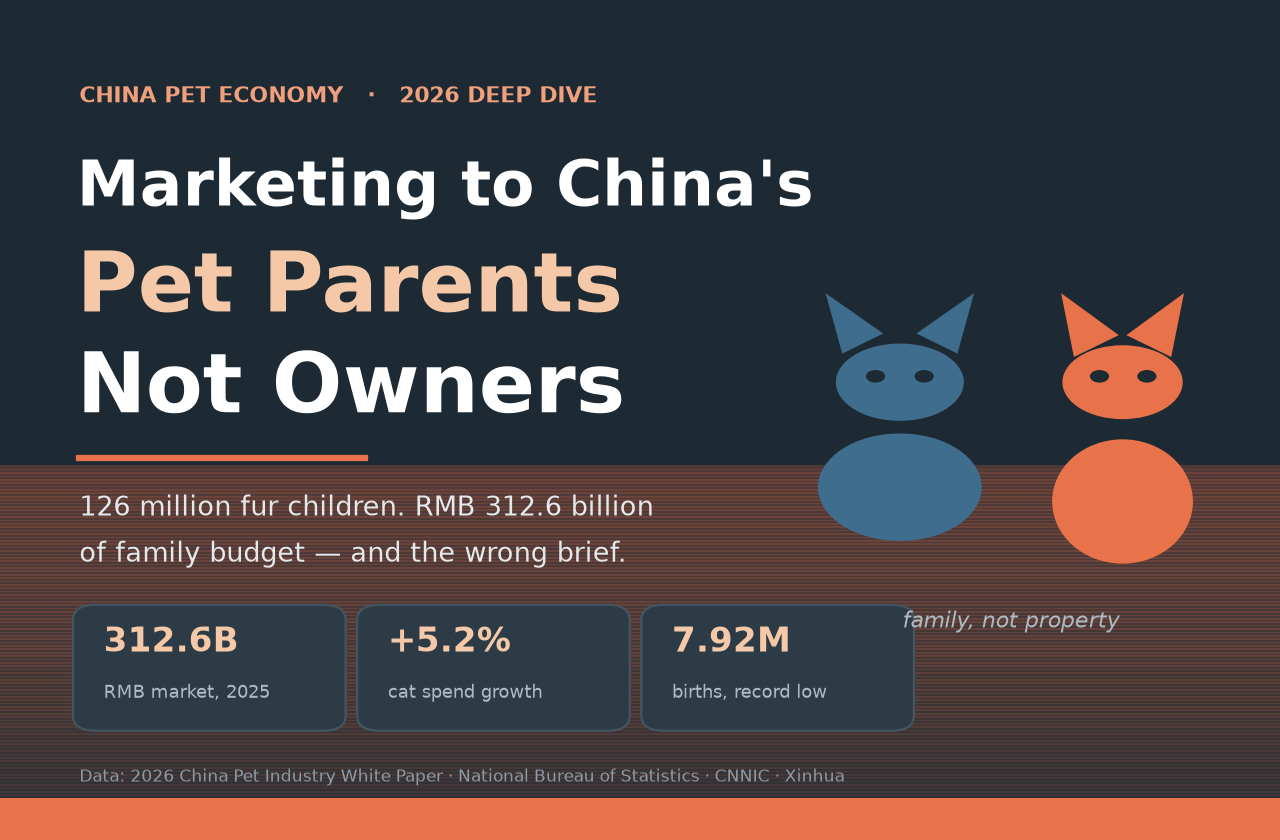
China has 126 million urban cats and dogs. It also had 7.92 million births last year — the lowest since 1949. Put those two numbers side by side and the pet market stops looking like a pet market. It looks like a parenting economy that happens to involve fur.
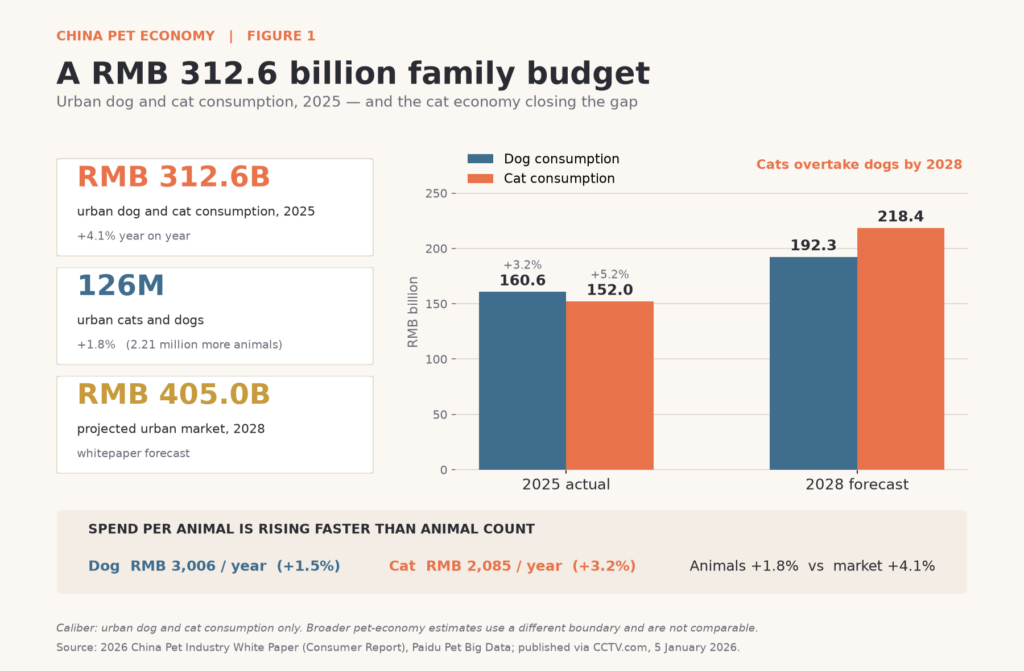
Urban dog and cat consumption reached RMB 312.6 billion in 2025, up 4.1 percent. Animal numbers grew only 1.8 percent. The gap between those two growth rates is the whole story: this market is no longer driven by more households acquiring animals. It is driven by existing households spending more per animal, on things that look suspiciously like childcare.
The strategic point is uncomfortable for a lot of brand teams. The word owner is the wrong brief. Chinese buyers call themselves fur parents, and they shop with parental psychology: safety anxiety, evidence demand, guilt-driven premiumization, identity affirmation. Address them as owners managing an animal and you miss the emotional job entirely. Market to the parent, not the pet.
1. Background: From Animal to Family Member
Start with the language, because language is where identity shows up first. In their own online communities, Chinese pet owners rarely describe themselves with the Mandarin word for owner. They use a self-deprecating title that translates roughly as poop-scooping officer — a job description that puts the human in a service role. The animal is the fur child. The human is the parent.
That is not a cute linguistic quirk. It is a role reversal, and it reorganizes the entire purchase logic.
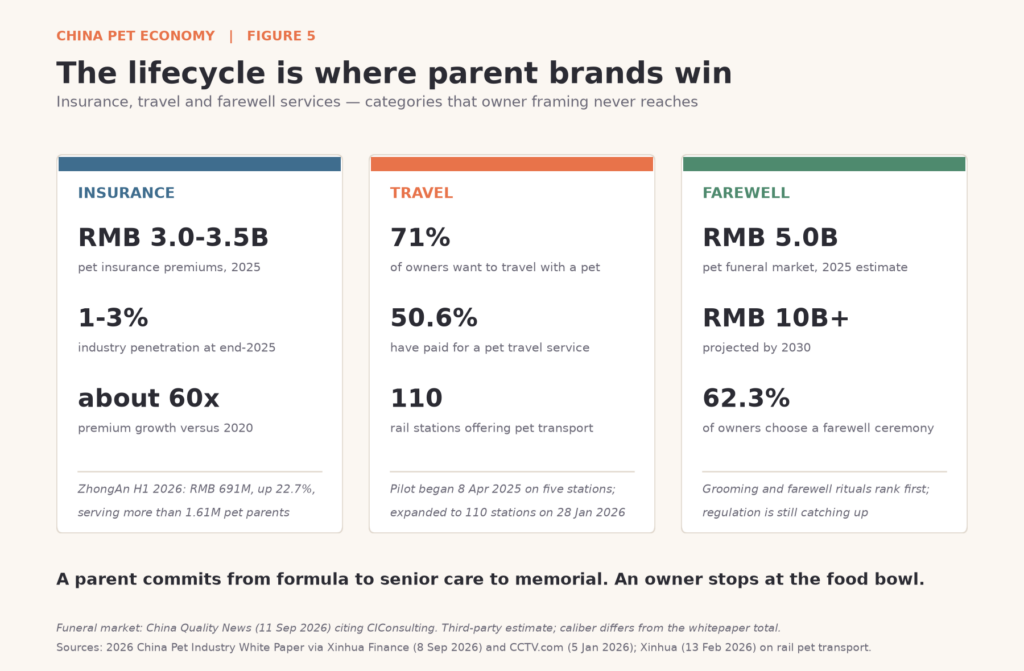
The rituals confirm it. During the 2026 Spring Festival, Xinhua reporters found pet bakeries in Wuxi preparing custom reunion dinners — the New Year’s Eve meal that families share — for cats and dogs. Boarding facilities in Changchun and Nanning sold out weeks ahead. Photo studios in Wuhan ran New Year portrait sessions for pets. Railway authorities expanded their pet transport pilot to 110 high-speed rail stations from 28 January 2026, up from a five-station trial on the Beijing–Shanghai line that began on 8 April 2025. Airlines added dedicated pet seats adjacent to the owner’s seat.
You do not book a reunion dinner for property. You book it for family.
The Demographic Engine
Here is the context that makes the reframe more than sentiment. The National Bureau of Statistics reported 7.92 million births in 2025, a birth rate of 5.63 per thousand, against 11.31 million deaths. The population fell by 3.39 million — a fourth consecutive annual decline.
Meanwhile the urban cat and dog population rose by 2.21 million animals.
For cohorts delaying marriage or opting out of it entirely, the dependent slot in the household budget does not stay empty. It gets filled. The parenting budget is redirected, not invented — which is precisely why spending per animal can outrun animal count by more than two to one.
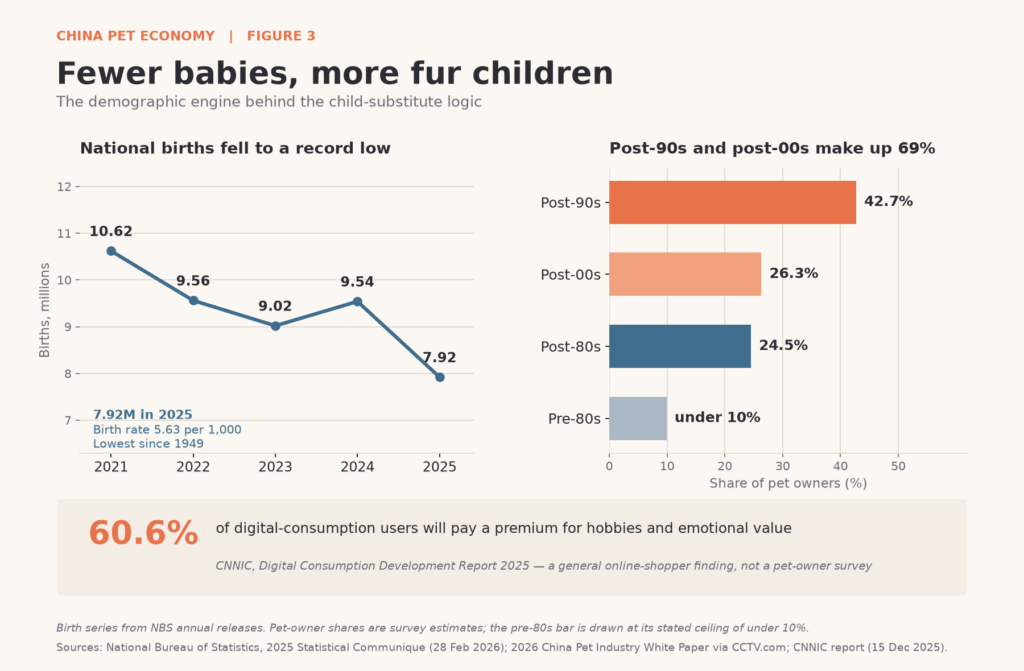
The whitepaper’s owner demographics fit this reading closely. Owners born in the 1990s make up 42.7 percent of the base, those born in the 2000s 26.3 percent, and those born in the 1980s 24.5 percent. Owners born before 1980 have fallen below 10 percent. Roughly seven in ten pet parents belong to the two youngest cohorts — the same cohorts whose childbearing has been postponed.
One caution on evidence discipline. CNNIC’s Digital Consumption Development Report 2025 found that 60.6 percent of users will pay a premium for hobbies and emotional value. That is a genuine, official figure, and it is frequently cited in pet-industry commentary. But it comes from a general digital-consumption survey, not a pet-owner study. Use it as context for the emotional-value economy. Do not present it as a pet-parent statistic.
2. The Parenting-Budget Framework
The most useful way to read this market is to map each spending category onto the parenting decision it actually represents. The whitepaper gives us the shares. The mapping is the analytical layer.
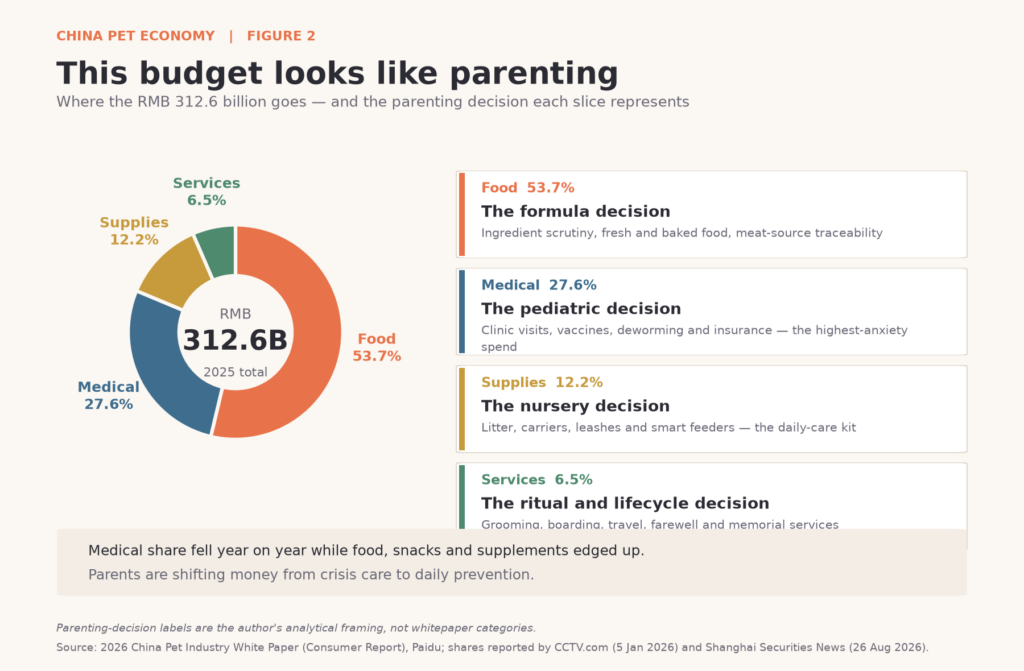
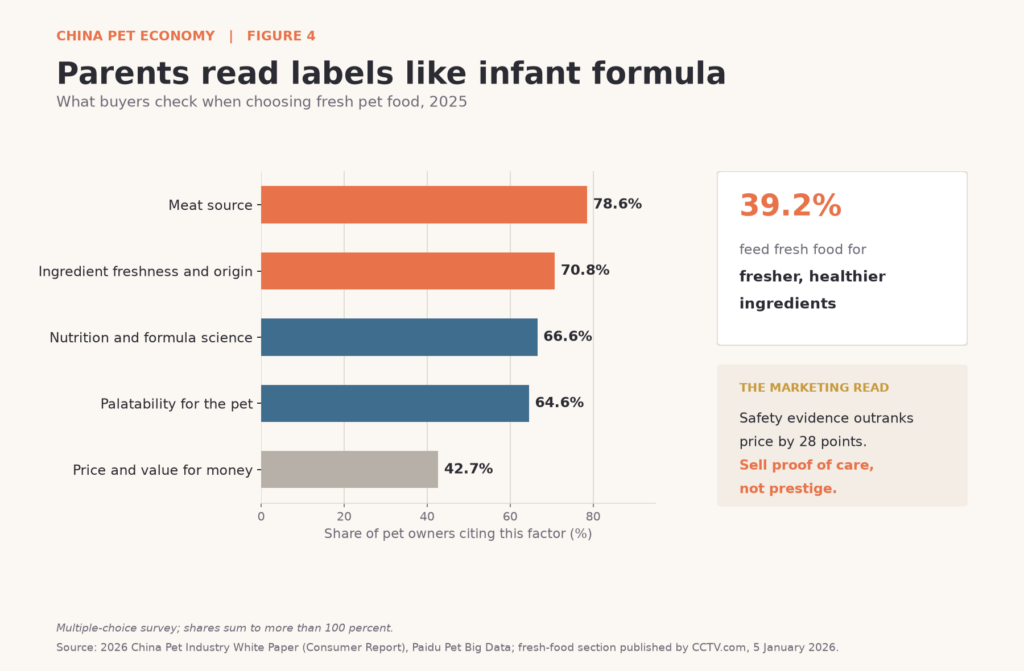
Food, 53.7 percent — the formula decision. This is infant formula logic applied to kibble. Ingredient scrutiny, meat-source traceability, processing method, functional additives. The whitepaper found that 78.6 percent of owners buying fresh food pay closest attention to meat source, 70.8 percent to ingredient freshness and origin, 66.6 percent to nutritional formulation. Price and value for money came in at 42.7 percent — nearly 28 points below freshness.
Read that gap again. In a category most Western marketers would treat as price-sensitive commodity feed, safety evidence outranks price by a wide margin.
Medical, 27.6 percent — the pediatric decision. Roughly RMB 86 billion. This is the highest-anxiety category and the one where credentials matter most. Cat infectious-disease vaccination reached 54.7 percent, up 2.5 percentage points year on year. Notably, the medical share declined while food, snacks and supplements edged up — parents appear to be shifting money from crisis treatment toward daily prevention.
Supplies, 12.2 percent — the nursery decision. Litter, carriers, leashes, feeders. Cat litter remains near-universal at 94.2 percent of cat owners. Mixed litter overtook tofu litter as the leading preference at 45.8 percent, and the preference splits by city tier — tofu litter leads in tier-one cities, bentonite in tier-three and below. That is a consumption-upgrade ladder visible inside a single SKU category.
Services, 6.5 percent — the ritual and lifecycle decision. Grooming, boarding, travel, memorial. Smallest slice, fastest structural change.
The Insurance Signal
Insurance is the clearest tell that the relationship has changed. The whitepaper estimates pet insurance premiums at roughly RMB 3.0–3.5 billion in 2025, against about RMB 50 million in 2020 — a roughly sixtyfold increase in five years.
Penetration remains tiny. The whitepaper puts industry penetration at 1–3 percent as of end-2025. ZhongAn’s pet insurance head told Yicai it has since climbed to nearly 4 percent. Both figures are defensible; they differ in timing and in who is measuring. Use the whitepaper number as the baseline and the insurer number as the upper bound, and say which is which.
The growth is real regardless. ZhongAn reported RMB 691 million in pet premiums for the first half of 2026, up 22.7 percent, serving more than 1.61 million pet parents. Ping An P&C reported RMB 247 million, up 113.2 percent. Nearly 60 property insurers have entered the category.
Why does a parent insure an animal? Because the animal is a dependent whose medical bills land on the household. ZhongAn’s 2025 claims report put average per-visit medical spend at RMB 1,489 for cats and RMB 1,664 for dogs — among insured, claiming pets, not the national average across all animals. That distinction matters, and most coverage of this statistic drops it.
3. Four Things Marketers Get Wrong
The Owner-Language Error
Copy that addresses the reader as an owner reads as property management to a buyer who identifies as a parent. It is not offensive so much as irrelevant — it describes a relationship the reader does not have. The fix is not translating the word more warmly. It is rewriting the brief around the parenting job.
The Product-Category Error
Selling pet supplies assumes the buyer is comparing specifications. Most are asking a different question: is this safe for my child? The whitepaper’s fresh-food data makes the hierarchy explicit — freshness and origin at 70.8 percent, formulation science at 66.6 percent, price at 42.7 percent. A spec-sheet-led campaign is answering a question nobody asked first.
The Dog-Default Assumption
Dog consumption is still larger at RMB 160.6 billion. But cat consumption reached RMB 152.0 billion, growing 5.2 percent against the dog category’s 3.2 percent. The gap is down to RMB 8.6 billion. The whitepaper forecasts cats overtaking dogs by 2028 — RMB 218.4 billion versus RMB 192.3 billion.
The growth archetype is the cat parent: solo, apartment-dwelling, time-poor. And the stereotype of the indoor-only cat is already outdated — 52.9 percent of cat owners report taking their cat outside, and 25.3 percent have bought a harness or leash. Dog-centric category planning under-serves the fastest-moving front.
The Guilt-Premium Misread
Premiumization here is not luxury consumption. It is anxiety relief. The whitepaper found 39.2 percent of owners feed fresh food primarily to get fresher, healthier ingredients. The premium buys parental reassurance — I am not neglecting my fur child — not social status. Frame safety and care, and the premium converts. Frame prestige, and you are selling to a motivation that mostly is not there.
4. The Cat-Parent Lane
If the cat parent is the growth archetype, what does serving that archetype actually require?
The constraint set is specific: limited floor space, limited hours at home, no garden, a landlord who may not approve, and a work schedule that does not accommodate a six o’clock walk. Every product decision that assumes a house and a flexible afternoon fails this buyer.
The categories that fit are the ones the data already shows moving. Automatic feeders and water fountains address the absence problem. Low-dust, low-tracking litter addresses the apartment problem — and the tier-one preference for tofu litter is precisely an apartment-driven preference. Small-pack formats address single-animal households where a ten-kilogram bag goes stale. Telehealth and at-home services address the transport-friction problem for an animal that finds carriers stressful.
There is a subtler point about the cat parent’s emotional posture. Because the cat is less demonstrative than the dog, the parent’s anxiety runs higher and the evidence demand runs harder. You cannot see the cat enjoying your product the way you can see a dog eat. That uncertainty is what makes traceability, clinical backing and third-party certification disproportionately valuable in the cat lane.
The Domestic-Brand Shift
Trust rebuilding is visible in the numbers, though the caliber needs care. The whitepaper found that 35 percent of dog owners buy only domestic brands, up 2.1 percentage points, while cat owners buying only Chinese brands approached 40 percent, up 3.5 points. Separately, brokerage research citing Euromonitor puts domestic brands’ overall pet-food share at 61 percent in 2024 — a figure worth attributing to Euromonitor via the brokerages rather than asserting as settled fact, since it circulates in secondary form and is sometimes confused with a different 61 percent figure referring to cat food’s share of the category.
The directional conclusion holds either way: the imported halo is fading, and it is fading fastest among cat parents. For a domestic brand, that is an opening built on evidence, not patriotism. For an international brand, it means the premium of foreign origin no longer carries the argument on its own.
5. Serving the Full Lifecycle
The deepest competitive advantage available in this market is the one owner framing structurally cannot reach: staying with the family from formula through senior care to memorial.
Consider the end of that arc. China Quality News, citing CIConsulting, put the pet funeral market at roughly RMB 5 billion in 2025, projected to exceed RMB 10 billion by 2030. Treat that as a third-party estimate with a caliber that differs from the whitepaper total — commercial data providers give narrower figures, and the gap largely reflects whether coffins and memorial goods are included. The whitepaper’s own preference data is firmer: 62.3 percent of owners choose a farewell ceremony and 58.5 percent choose grooming and presentation of the body.
Those are not disposal preferences. They are funeral preferences.
The regulatory side is genuinely unsettled — reporting through 2026 describes operators lacking harmless-disposal credentials, no dedicated supervising authority, and no unified professional certification for pet funeral practitioners. That is a real risk for any brand entering the space, and it should be stated plainly rather than glossed as an emerging opportunity.
Travel sits at the other end of the lifecycle arc and shows the same pattern. The whitepaper found 71 percent of owners want to travel with their pet and 50.6 percent have already paid for a pet travel service. During the 2026 Spring Festival travel rush, Xinhua confirmed the rail pet-transport pilot had expanded to 110 stations and 170 trains. One Hangzhou airport ground-services supervisor told CCTV that daily pet transport and in-cabin volume had risen seven- to eightfold against normal periods.
A brand that shows up at the memorial has earned something a brand that only shows up at the food bowl never will. That is the retention mechanism, and it has almost nothing to do with points or discounts.
6. What Brands Should Actually Do
Rewrite the address, not just the tone. Replace owner-language with parent-language across copy, packaging and service scripts. Brief creative teams on the parenting job — safety, development, ritual, lifecycle — rather than the product category.
Lead with proof of care. Publish ingredient origin, processing method, testing results and clinical backing where you have them. The whitepaper’s decision hierarchy tells you these outrank price. Treat certification and traceability as conversion infrastructure, not compliance overhead.
Build a dedicated cat-parent line. Not a cat SKU extension of a dog range — a product architecture designed around apartment living, absence hours and low-maintenance care, with telehealth and at-home service attached.
Instrument the lifecycle. Senior nutrition, hospice guidance, memorial partnerships. Enter funeral services with eyes open about the regulatory gaps, or partner rather than operate.
Mark festival moments as family moments. The Spring Festival data is unambiguous: reunion dinners, boarding with cameras, New Year portraits. During the 2026 New Year shopping festival, the deals platform Smzdm recorded pet apparel GMV up 115.60 percent, grooming up 40.35 percent and toys up 18.51 percent year on year. Note the source carefully — that is one deals platform’s festival data, not an industry-wide e-commerce reading.
7. Risks and Honest Caveats
Never blend market calibers. RMB 312.6 billion is urban dog and cat consumption. Broader pet-economy figures that run into the trillions include breeding, adjacent services and other animals. Mixing them produces a number that means nothing. Claims that China is the world’s second-largest pet market circulate widely but rest on commercial sites with shifting definitions; the defensible statement is that China is among the fastest-growing large pet markets.
Humanization has a backlash. Public-space conflict is live. Coverage in November 2026 examined the dispute over pets in restaurants, and the criticism of excessive anthropomorphism has real social traction. Affirm care without prescribing family ideology — a brand that lectures people about whether pets are children will lose the people who disagree.
Safety trust is fragile. Pet food safety incidents re-price entire categories, not just the offending brand. Evidence infrastructure is the moat precisely because it is the thing that survives a category-wide shock.
Regulation is formalizing. The existence of the national companion-animal standardization technical committee, alongside veterinary and food rules, signals rising compliance requirements. That favors professional operators and squeezes the informal tail — which is an opportunity for established brands and a threat to anyone relying on loose sourcing.
Survey data is survey data. Owner age shares, preference percentages and motivation rankings come from a consumer survey with a stated caliber. They are directionally strong and should be cited as survey findings, not as census facts.
Conclusion
China’s pet market is a parenting economy wearing a pet costume. One hundred and twenty-six million fur children. RMB 312.6 billion of redirected family budget. Buyers who purchase with the psychology of parents — safety anxiety, evidence demand, guilt premium, identity affirmation — in a country where the birth count has fallen to a record low while the animal count keeps climbing.
Brands that address owners managing animals miss the job. Brands that parent alongside fur parents — speaking the relationship, proving the care, serving the cat-parent archetype and staying through the full lifecycle — inherit a loyalty that discounts cannot buy.
The pet was never the customer. The parent is.