Every few years, a brand discovers women, paints its product pastel, and announces a “for her” line. And every few years, the market teaches it the same expensive lesson. The strange part is not that pink-washing fails. It is that brands keep paying for it after the receipts came in.
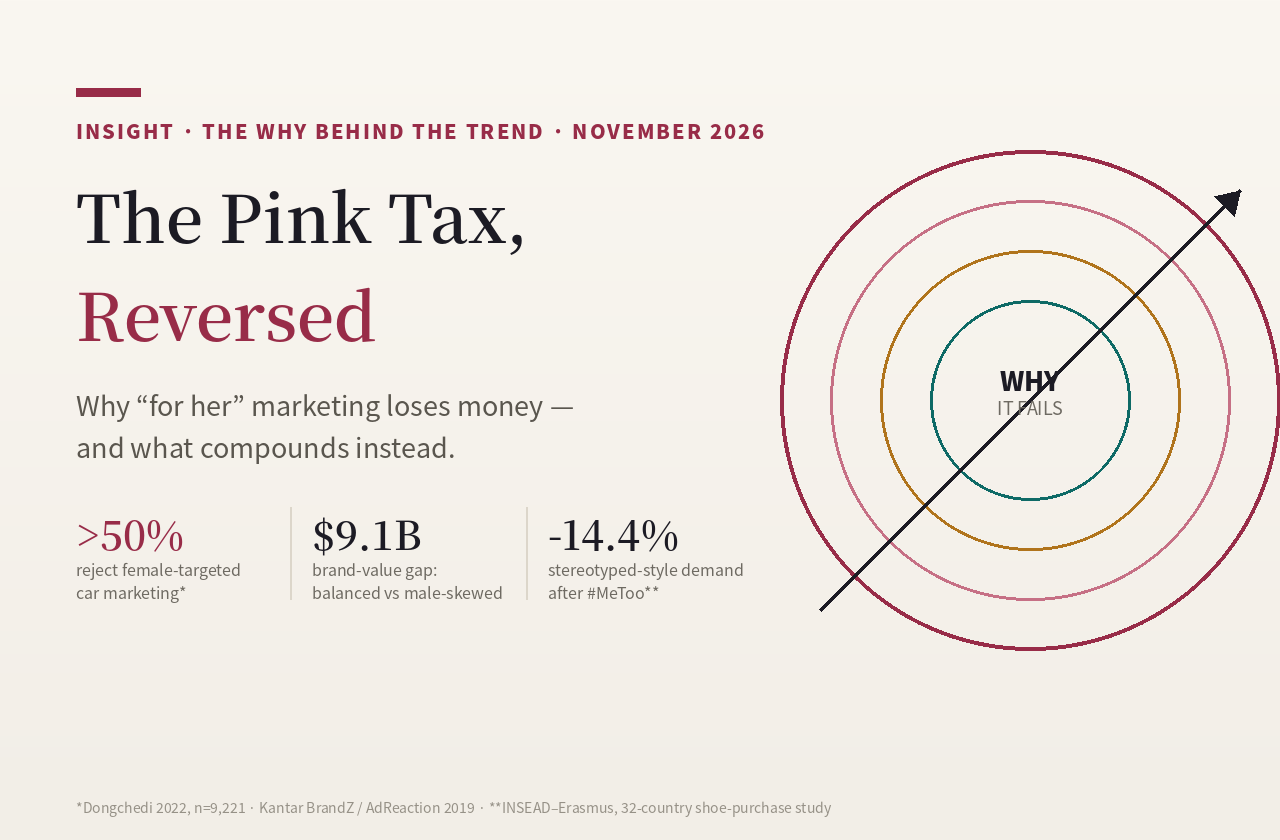
Start with the clearest receipt. In March 2022, the Chinese auto platform Dongchedi surveyed 9,221 users about women and cars. More than half rejected automakers’ female-targeted marketing outright. Over 41% of women preferred white cars; just 4.59% would buy pink. What women said they wanted was brand and safety — the same boring, rational criteria everyone wants. The pink option was not a gift. It was a signal that the manufacturer had not done the homework.
That signal is the mechanism. Gender-coding without functional redesign tells the buyer: we changed the wrapper, not the product. For a consumer trained to verify — and Chinese consumers are among the world’s most verification-happy, as Roland Berger and Meituan’s 2025 aesthetics white paper documents — the wrapper reads as condescension. You have not honored her. You have priced her credulity.
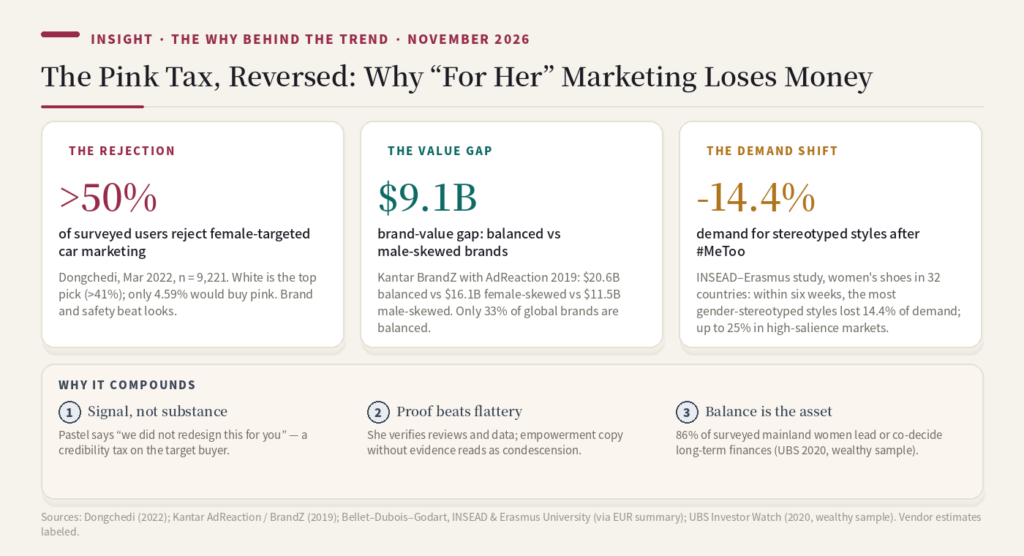
The economics run deeper than one failed campaign. Kantar’s BrandZ analysis, published with its 2019 AdReaction study, found that gender-balanced brands average $20.6 billion in brand value, against $16.1 billion for female-skewed brands and $11.5 billion for male-skewed ones. Male-skewed brands trail balanced ones by roughly $9 billion. Yet only a third of global brands achieve balance, and 98% of baby-care, laundry and household-cleaner ads still target women alone — in categories where decisions are often joint. The industry is overpaying for the wrong address.
Nor is this only a China story. Researchers from INSEAD and Erasmus University tracked women’s shoe purchases across 32 countries around the rise of #MeToo. Within six weeks, demand for the most gender-stereotyped styles fell 14.4%, and up to 25% in markets where the movement was most salient. Women did not switch to neutral styles. They stopped buying the stereotype. Identity-coded products carry a demand risk that functional products do not.
Meanwhile the actual prize keeps growing. UBS’s 2020 Investor Watch found 86% of surveyed mainland Chinese women lead or co-decide long-term family finances — the highest of eleven markets, in a wealthy sample worth labeling honestly. She is not an aisle. She is the household’s capital allocator.
So the reversal is this: the pink tax was never just what women paid extra. It is what brands pay for talking down to the person holding the budget. Functional respect compounds. Pastel does not.