Same product. Same margin target. Two completely different price behaviors. In Shanghai, a subsidy section is somewhere you go on purpose, the way you’d open a search engine. In Chicago, a permanent 40%-off banner is somewhere a brand goes to die. Marketers keep filing this under national character — Chinese shoppers are cheap, Western shoppers are loyal — and that filing is wrong in a way that costs real money. The difference isn’t temperament. It’s infrastructure. Two markets built two different reference-price machines, and once you see the machines, the pricing playbook rewrites itself.
Executive Summary
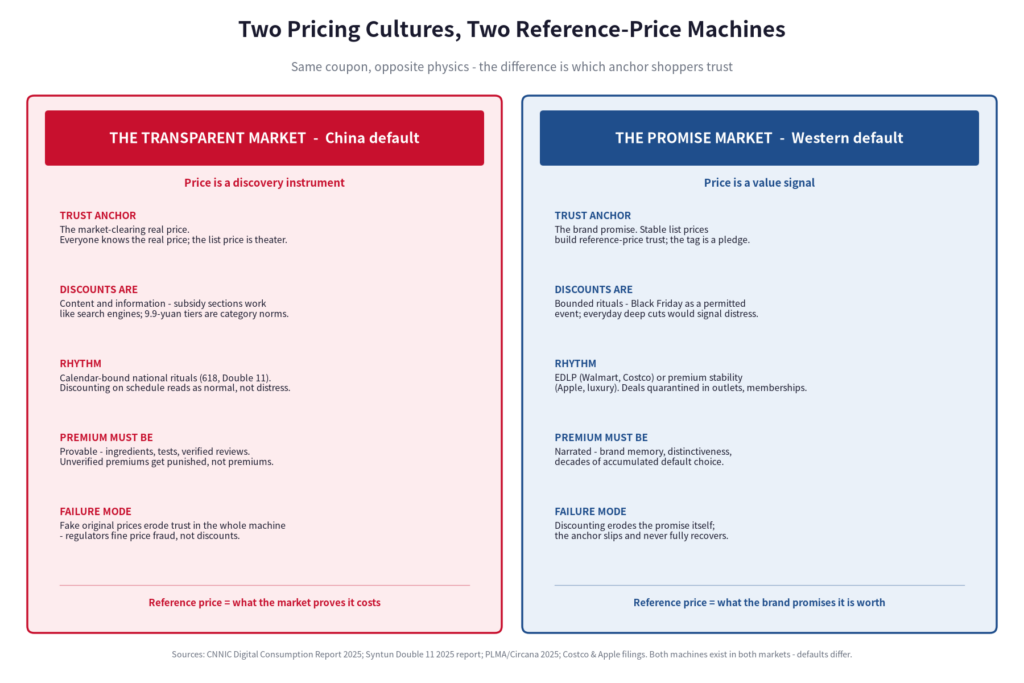
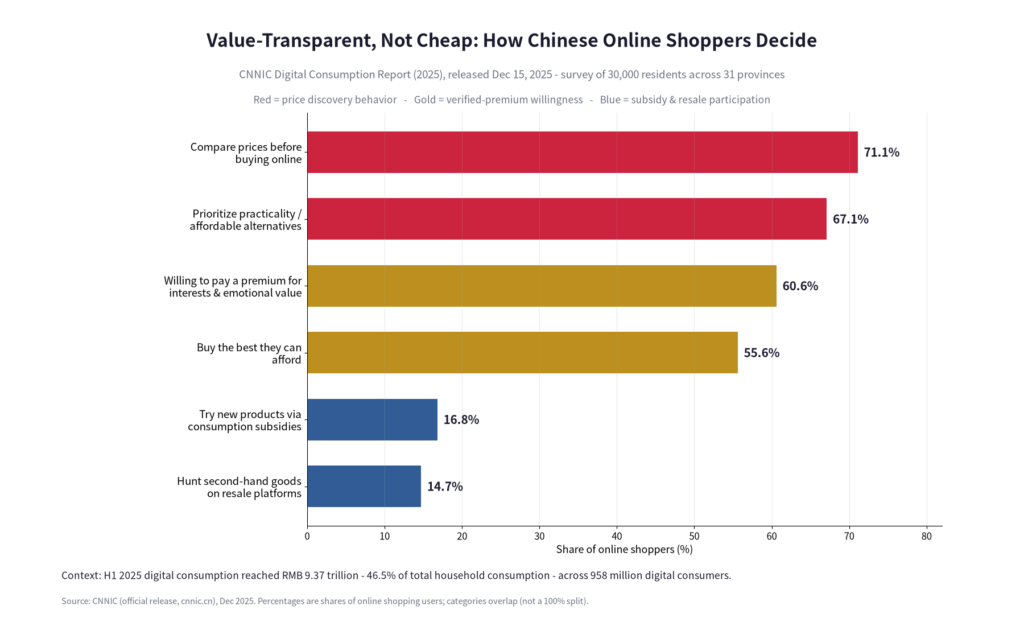
Western pricing doctrine treats the price tag as a promise: stable prices build trust, discounts are bounded events, premium brands hold the line. Chinese pricing culture treats price as a discovery instrument: subsidy sections behave like search engines, festival calendars synchronize national browsing, and the listed price is widely understood to be theater. CNNIC’s 2025 digital consumption report shows 67.1% of Chinese online shoppers prioritize practicality and affordable alternatives — while 60.6% will pay a premium for interests and emotional value. That is not cheapness; that is verification-seeking. The strategist’s job is to diagnose which machine your customer lives in, frame discounts accordingly, justify premiums in the local currency (proof in China, narrative in the West), and govern AI pricing before it dissolves both anchors at once.
1. The Phenomenon: One Coupon, Two Physics
Watch what a discount does in each market. On Pinduoduo, the Ten Billion Subsidy section launched during the 2019 618 festival and became permanent infrastructure; within months its entrance passed 100 million daily active users, carrying 2,800-plus brands and 23,000-plus subsidized products. People browsed it like a destination. JD copied the format in March 2023, gave it a first-screen entrance, and called it the beginning of a low-price mindset strategy. Price, in this machine, is content.
In the American machine, the discount is a ritual with walls around it. Deloitte’s 2025 Black Friday–Cyber Monday survey found 82% of consumers planned to shop the event — yet 60% had already parked items in online carts, waiting for the deals to arrive. They weren’t browsing discounts; they were scheduling them. And 38% said they would only buy items marked down at least 50%. The event is permitted precisely because it is bounded. Outside the window, everyday deep discounting reads as distress — which is why outlet channels exist: to quarantine the markdown away from the flagship’s reference price.
Same coupon. Opposite physics.
2. The Consumer Data: Value-Transparent, Not Cheap
Here is where the stereotype dies. CNNIC’s Digital Consumption Report (2025), based on a 30,000-resident survey across 31 provinces, found that 67.1% of online shoppers prioritize practicality and choose affordable alternatives — but 60.6% will pay a premium for hobbies and emotional value, and 55.6% say they buy the best they can afford. Meanwhile 71.1% compare prices before purchasing. Read those numbers together and you get a precise portrait: a shopper who refuses to overpay for an unverified claim, and happily pays up when the value is real. They distrust unverified premiums, not premiums.
The scale behind this behavior is enormous. In the first half of 2025, Chinese digital consumption reached RMB 9.37 trillion — 46.5% of total household consumption — across 958 million digital consumers. And 16.8% of online shoppers used consumption subsidies specifically to try new products. Read that again: the subsidy is functioning as a trial budget, a discovery mechanism — not evidence that shoppers can only afford the cheapest option.
3. The Festival Machine: When Discounting Is the Calendar
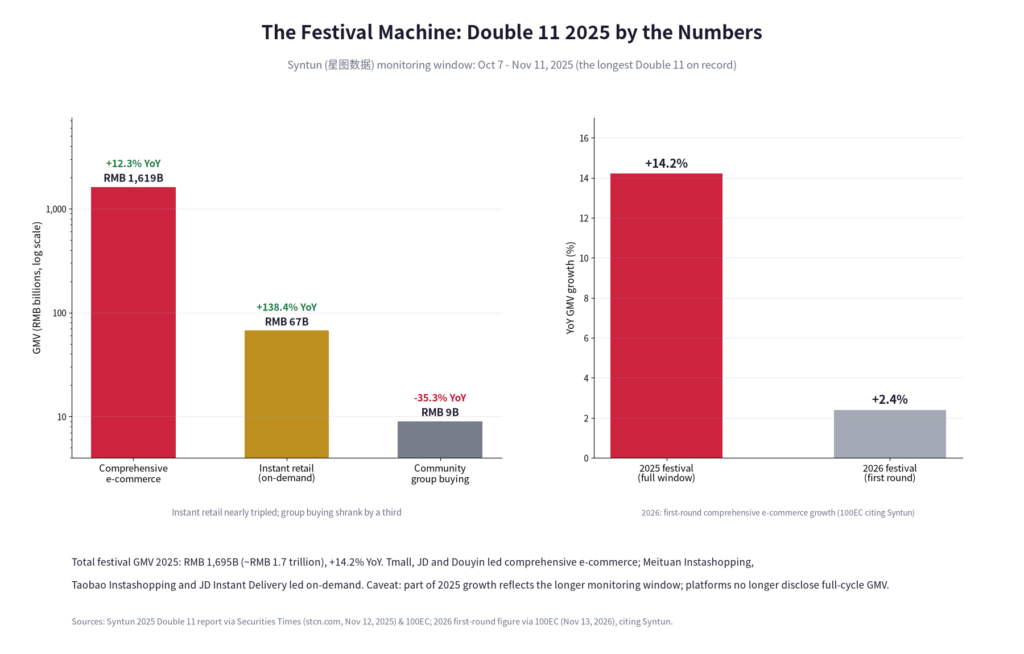
China’s discounts are synchronized national rituals. Syntun’s monitoring of the 2025 Double 11 — a record-length window from October 7 to November 11 — counted RMB 1.695 trillion in total festival GMV, up 14.2% year over year. Comprehensive e-commerce contributed RMB 1.619 trillion; instant retail nearly tripled to RMB 67 billion. Two honest caveats belong next to those numbers: part of the growth reflects the longer monitoring window, and the platforms themselves no longer disclose full-cycle GMV. The machine is maturing — early reports on the 2026 festival’s first round put comprehensive e-commerce GMV growth at just 2.4%, a sharp deceleration from 2025’s pace.
The strategic point survives the caveats. When the whole country discounts on the same schedule, a discount stops being a signal about your brand and becomes a signal about the date. Calendar-bound markdowns read as normal. That is the opposite of the Western logic, where the discount’s meaning comes from its rarity.
4. The Deep Mechanism: Four Drivers Behind the Machines
Why did each machine take its shape? Four drivers, each structural rather than cultural.
Price transparency infrastructure. Chinese platforms made price history, cross-seller comparison and subsidy stacking trivially visible. Once the real price becomes common knowledge, the listed price loses its signaling power — it can’t promise anything, because everyone can check. Western retail stayed fragmented and opaque longer, so brand promises filled the information gap. The anchor followed the information structure.
Calendar density. China’s discount calendar is dense and national (618, Double 11, Double 12, livestream price-reveals as entertainment). The West’s is sparse and bounded. Density changes meaning: in a dense calendar, discounting is weather; in a sparse one, it’s news — and news about your brand is rarely good.
Brand-default strength. Western markets carry decades of accumulated brand defaults; memory has pre-decided most purchases before price enters the room. China’s brand defaults are younger and weaker in many categories, so price does more of the choosing. Discounts discover brands there precisely because memory hasn’t already chosen.
Margin structure. China’s manufacturing-adjacent supply chains tolerate thin margins at volume; Western brand premiums fund the promise machine. Each pricing culture sits downstream of its cost structure. You cannot import one culture’s price behavior without its economics.
5. The Margin Architecture: Who Carries the Trust
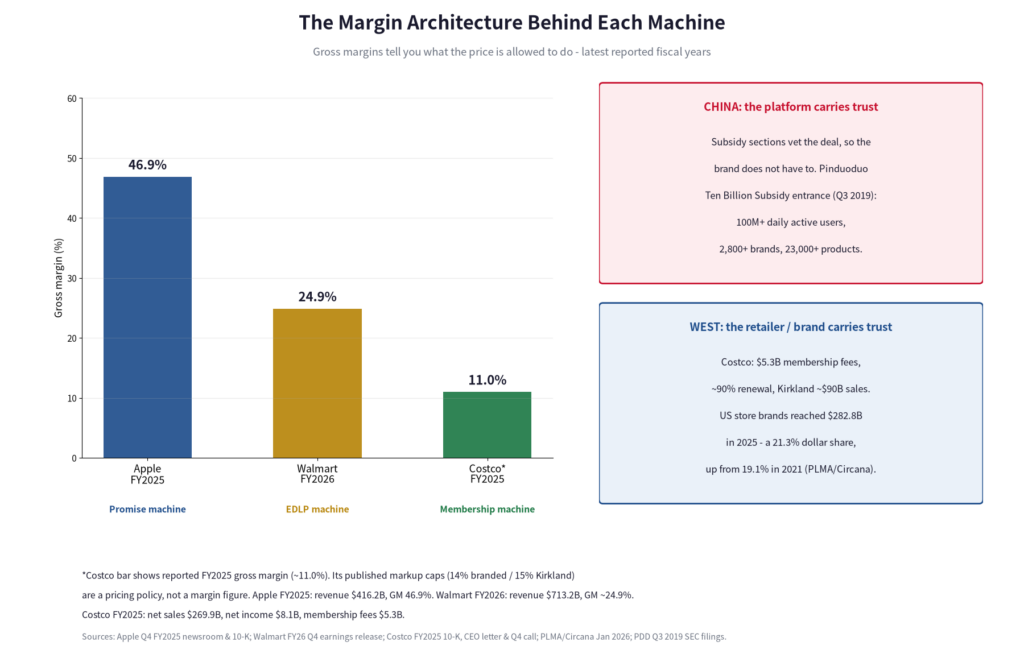
Follow the gross margins and the machines become visible in the accounts. Apple’s fiscal 2025 gross margin was 46.9% — a premium narrated by brand, with Services at 75.4% gross margin carrying the story. Walmart’s fiscal 2026 gross margin ran about 24.9% on $713.2 billion of revenue: the margin funds everyday low prices, with advertising and a richer e-commerce mix adding profit on top. Costco runs the opposite architecture — published markup caps of 14% on branded goods and 15% on Kirkland Signature, with profit living in membership fees: $5.3 billion in fiscal 2025, roughly 90% renewal worldwide, and Kirkland alone selling about $90 billion a year.
Notice what differs: not the price level, but who vouches for it. In the Chinese machine, the platform’s subsidy section vouches — it vets the deal, so the brand doesn’t have to. In the Western machine, the retailer or the brand itself vouches, which is why Costco can cap markups and still win: members trust the cap. America’s private-label boom is the same trust transfer at scale — store brands hit a record $282.8 billion in 2025, growing 3.3% against national brands’ 1.2%, reaching 21.3% dollar share. The retailer’s promise is becoming the anchor.
6. What Everyone Misunderstands
Chinese consumers are price-sensitive. No — they are value-transparent. The same shoppers who chase 9.9-yuan deals pay premiums for verified quality. The variable is verification, not price.
Discounting always erodes brands. True in promise machines. In transparent machines, calendar-bound, trial-framed discounts discover customers without permanently re-anchoring the reference price. The frame and the timing decide — not the discount itself.
EDLP is Western-only. Pinduoduo’s everyday-low-price is EDLP with social fission attached; JD explicitly said its goal was everyday low prices, not a promotion. The machines borrow from each other constantly. The difference is which layer carries the trust — subsidy platform or retailer brand.
AI pricing is culture-neutral. Personalized discounts read as recognition or as insult depending on the machine — and the political reaction differs even when the technology is identical. More on that below, because it’s where both machines are being rewired at once.
7. AI Is Dissolving Both Anchors — and Regulators Noticed
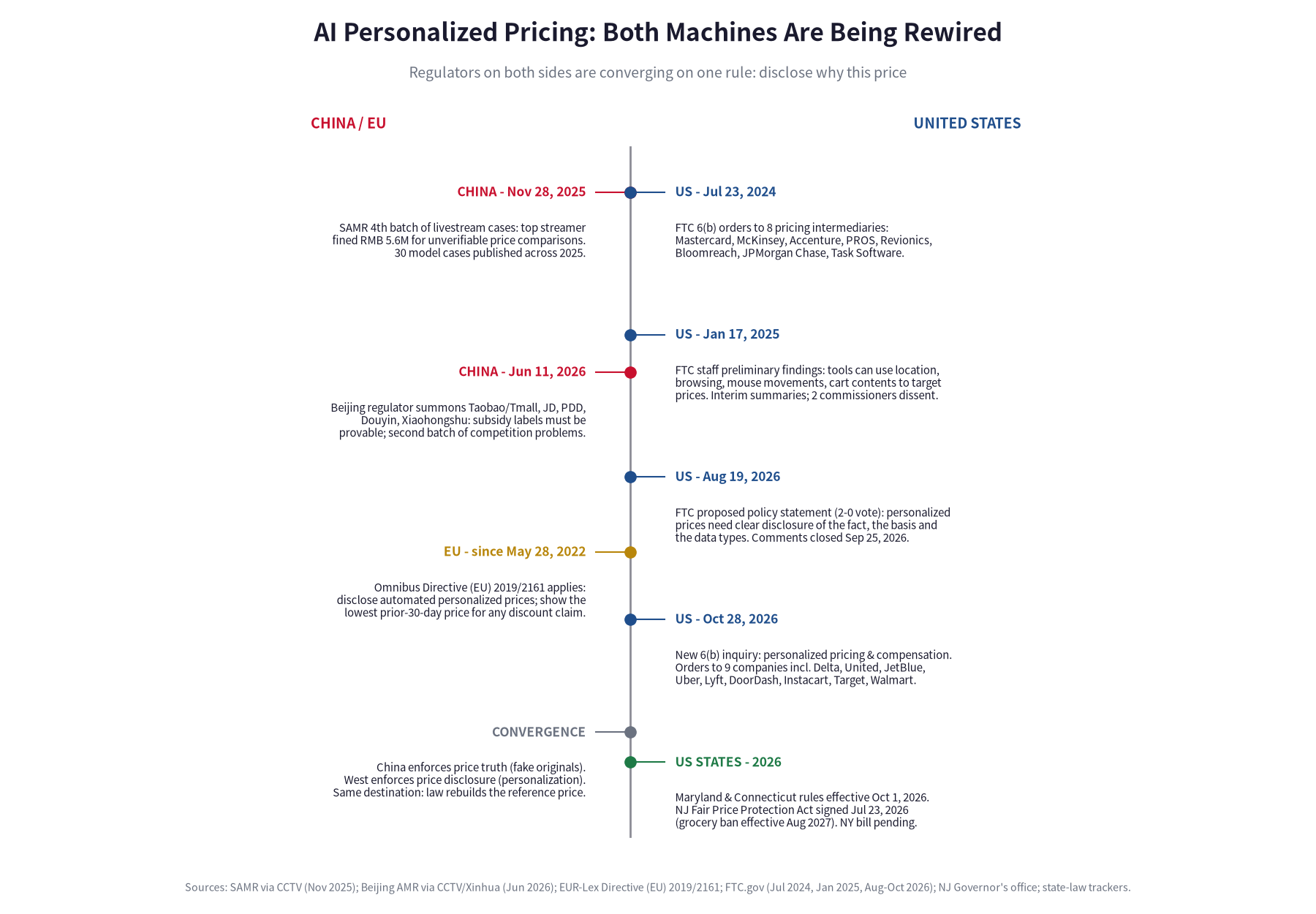
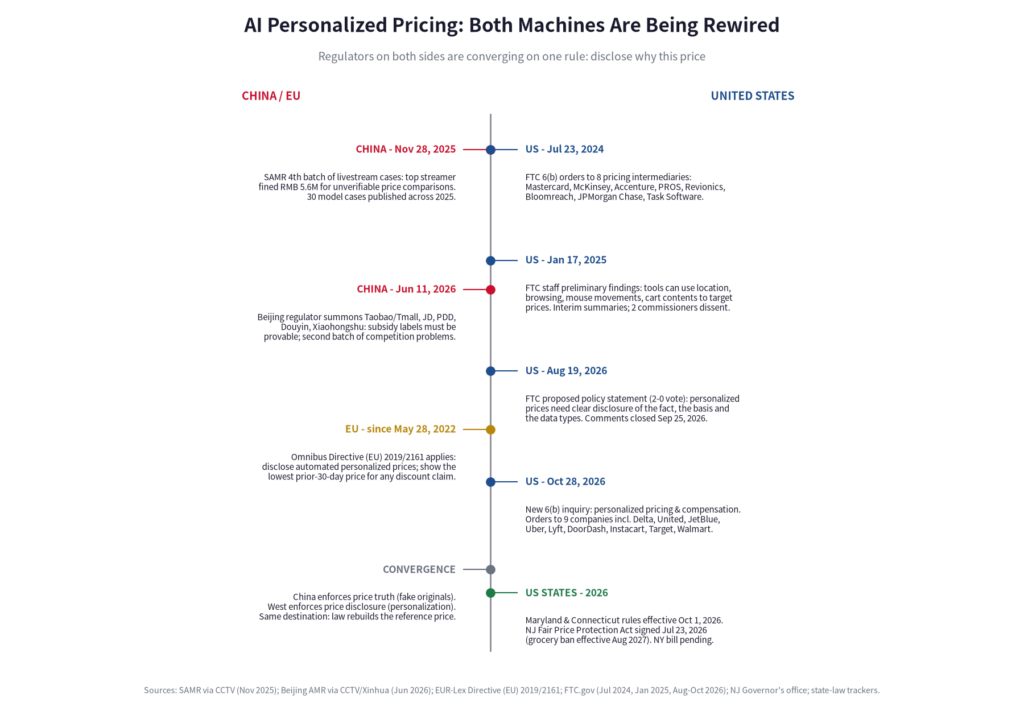
Personalized pricing attacks the public reference price itself. If every shopper sees a different number, the anchor that both machines depend on — shared knowledge of what things cost — evaporates. The FTC’s January 2025 preliminary findings from its surveillance-pricing study described tools that can use location, browsing history, even mouse movements and abandoned-cart contents to target individual prices. Those were interim staff summaries, not a final report — but the direction survived a change of administration. In August 2026 the FTC proposed an enforcement policy statement, approved 2–0, saying that where consumers reasonably expect a common price, businesses must clearly disclose that a price is personalized, the basis for it, and the data types used. In late October 2026 it launched a fresh 6(b) inquiry covering nine companies including Delta, Uber, DoorDash, Target and Walmart. States moved faster: Maryland and Connecticut rules took effect October 1, 2026; New Jersey’s Fair Price Protection Act was signed in July 2026 with its grocery ban phasing in through 2027.
China attacked the same problem from the other end — not personalization, but fabrication. In November 2025 the market regulator’s fourth batch of livestream e-commerce cases fined a top streamer RMB 5.6 million for comparing prices against unverifiable originals; thirty model cases were published across the year. In June 2026, Beijing’s regulator summoned five major platforms and told them their Ten Billion Subsidy labels had to be provable. And the EU has been quietly ahead of both since May 2022: the Omnibus Directive requires disclosure of automated personalized prices and forces any discount claim to reference the lowest price of the prior 30 days.
Three jurisdictions, three angles, one destination: the law is rebuilding the public reference price that AI was dissolving.
8. The Counterargument — and Its Limit
The honest objection: the West is discounting more too. Inflation-era value-seeking, private-label records, Temu and Shein pressure — the promise machine is leaking. True. But look at where the leak comes from: cross-border apps importing the transparency machine itself. The cultures are converging under shared information infrastructure, yet brand-default strength still differentiates behavior — American shoppers still pay Apple’s premium while Chinese shoppers demand proof for theirs. And Chinese premium brands prove value-first works there too — by verifiable value, ingredient wars and quality narratives, not pure promise. Both machines exist in both markets. The default trust anchor differs, and defaults decide mass behavior. The final objection — AI makes pricing culture irrelevant — fails the same way: cultures decide the emotional and political reaction to dissolution. Recognition framing survives; surveillance framing triggers backlash. The machine changes; the meaning-making doesn’t vanish.
9. The Playbook: Diagnose Before You Price
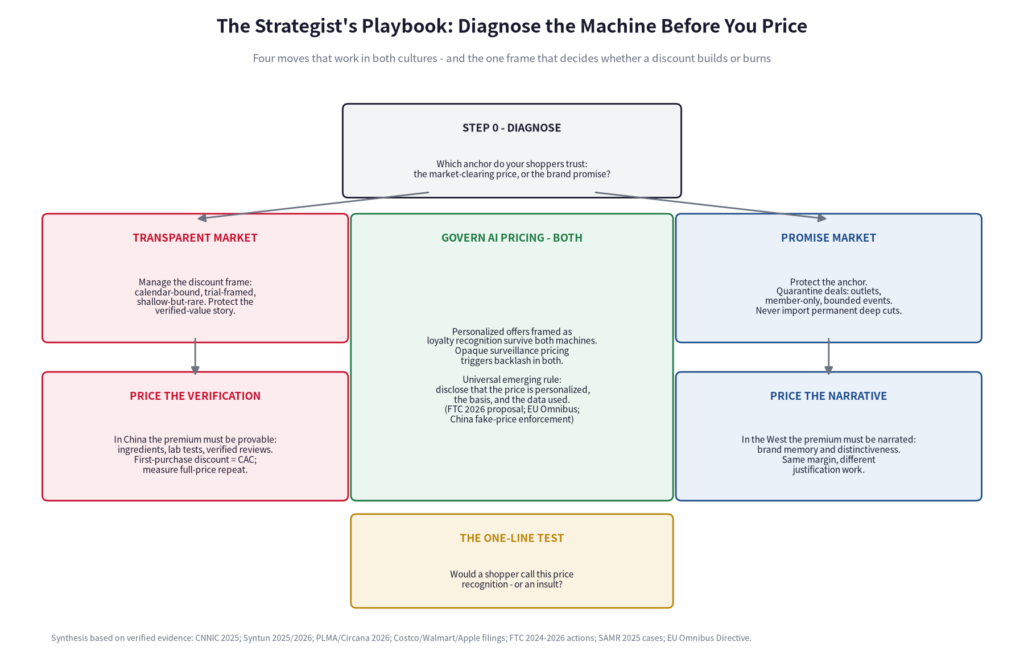
Four moves, in order.
Diagnose the machine first. Ask which anchor your shopper trusts: the market-clearing price or the brand promise. Category matters more than geography — commodities run transparent everywhere; luxury runs promise-bound everywhere.
Frame the discount for the machine. In transparent markets: calendar-bound, trial-framed, shallow-but-rare; protect the verified-value story. In promise markets: protect the anchor, quarantine deals into outlets and member-only channels, never import permanent deep discounting.
Justify the premium in local currency. In China the premium must be provable — ingredients, tests, verified reviews. In the West it must be narrated — brand memory, distinctiveness. Same margin, different justification work. Treat first-purchase discounts in transparent markets as customer acquisition cost, and measure them by full-price repeat, not by the subsidized first order.
Govern AI pricing before it governs you. Personalized offers framed as loyalty recognition survive both machines. Opaque surveillance pricing triggers backlash in both — and now carries disclosure obligations in the EU, proposed federal enforcement in the US, and price-truth enforcement in China. The one-line test for any personalized price: would the shopper call this recognition, or an insult?
Conclusion
Two pricing cultures, two information structures. Where prices are transparent and brand defaults young, discounts discover and inform — price is content. Where opacity and brand promises persist, discounts erode and signal distress — price is a promise. Neither culture is about national cheapness; both are about which anchor shoppers trust. Diagnose the machine, frame the discount, justify the premium in the local currency, and govern AI pricing before it dissolves both anchors. The coupon and the price tag were never the same object. They just looked alike.