Privacy translates cleanly and means differently. The West built boundary rights against corporate collection; China built safety rules against misuse and leakage. Marketers who import the wrong architecture misread both compliance and conversion — and AI is now rewriting the contract on both sides.
Ask a room in Berlin what “privacy” means and you’ll hear about consent banners, tracking pixels, and the right to be forgotten. Ask the same question in Shenzhen and you’ll hear about leaked phone numbers, scam calls that know your name, and whether the platform can be trusted to keep your data from criminals. Same word. Two different fears. And behind each fear sits a legal architecture built to fight it.
This is not a story about one regime being strict and the other lax. Both are strict. They are strict about different things, in different ways, for reasons rooted in what each society has actually suffered. If you run campaigns in both markets — or advise brands that do — the distinction is not academic. It determines what your consent flow should say, what your trust messaging should promise, and which compliance calendar your team should live by.
Two enforcement grammars
Start with the money, because the money tells you what each system punishes.
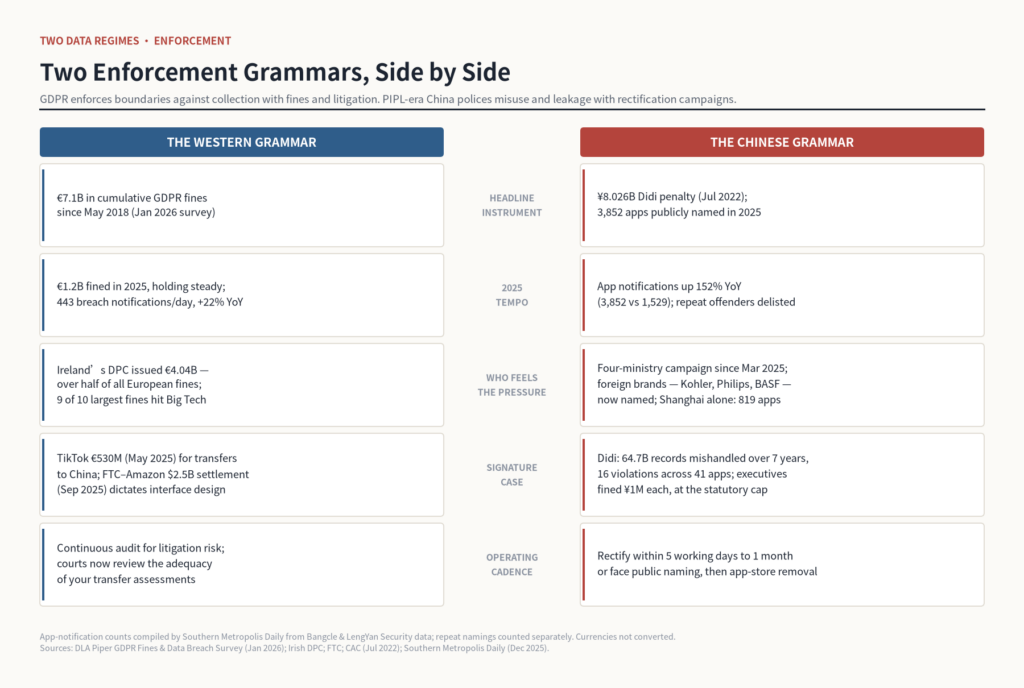
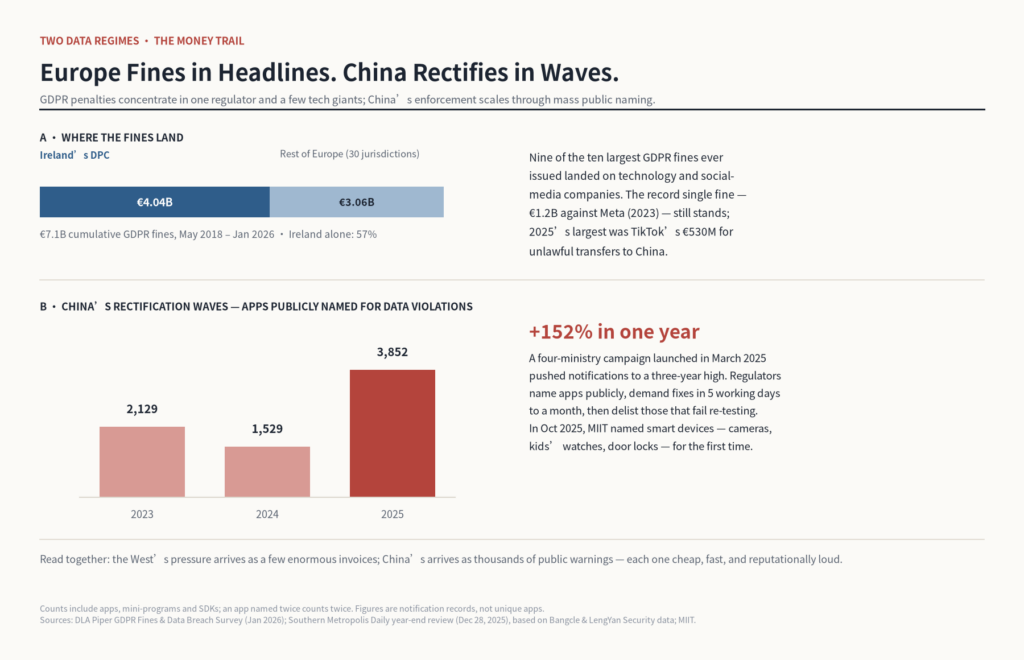
Europe’s GDPR has now generated roughly €7.1 billion in cumulative fines since it took effect in May 2018, according to DLA Piper’s eighth annual fines and breach survey, published in January 2026. About €1.2 billion of that landed in 2025 alone — essentially flat against 2024, which the firm reads as sustained enforcement rather than a slowdown. Nine of the ten largest GDPR fines ever issued have hit technology and social-media companies. The single record still belongs to Meta: €1.2 billion, imposed by Ireland’s Data Protection Commission in 2023.
The concentration is striking. Ireland’s DPC — regulator to most of Big Tech’s European headquarters — has issued €4.04 billion of that €7.1 billion total. One regulator, roughly 57% of all European fines. GDPR enforcement is adversarial, procedural, and litigated for years. It is also, increasingly, about design: when the FTC settled with Amazon over Prime subscription “dark patterns” in September 2025 for $2.5 billion — a $1 billion civil penalty plus $1.5 billion in consumer refunds covering roughly 35 million people — the order didn’t just extract money. It dictated interface elements: a conspicuous option to decline, simpler cancellation, the ability to cancel through the same channel used to sign up. As one law firm analysis put it, the design is the conduct. American enforcement, long dismissed as toothless next to Brussels, has arrived at the same conclusion by a different road: how you build the flow is itself the legal question.
China’s grammar reads differently. The landmark penalty is Didi’s: ¥8.026 billion (about $1.2 billion), announced by the Cyberspace Administration of China on July 21, 2022, after a year-long cybersecurity review. The company’s chairman and president were each fined ¥1 million — the statutory maximum for individuals under the Personal Information Protection Law. The regulator’s findings were granular: 16 violations across eight categories, 64.7 billion personal-information records mishandled over seven years across 41 apps, including 107 million passenger facial-recognition records, clipboard contents, photo-album screenshots, and precise location data. The framing mattered as much as the fine. The CAC tied the punishment to national data security and critical information infrastructure — not only to individual rights. The company had also, in the regulator’s words, evaded supervision.
But the Didi fine is the exception, not the rhythm. The everyday grammar of Chinese enforcement is administrative rectification: regulators test apps, publish lists of offenders, demand fixes within deadlines as short as five working days, re-test, and delist those that fail. In March 2025, four ministries — the CAC, MIIT, the Ministry of Public Security, and the market regulator — launched a joint personal-information protection campaign. By year’s end, regulators at national and local level had publicly named 3,852 apps and SDKs for user-rights violations, according to a Southern Metropolis Daily year-end tally compiled from security-firm data — up 152% from 1,529 in 2024. Repeat namings count separately; the figure measures enforcement events, not unique apps. Foreign-invested brands appeared on the lists alongside domestic ones: Kohler, Philips, BASF. Shanghai’s communications administration alone named 819. In October 2025, MIIT extended the practice to smart hardware for the first time, naming 20 devices — home cameras, children’s watches, door locks — for violations like silently uploading personal data to the cloud.
Set the two systems side by side and the pattern is clear. The West’s pressure arrives as a few enormous invoices, fought over in court for years. China’s arrives as thousands of public warnings — each one cheap, fast, and reputationally loud. Neither is gentle. They are gentle and harsh about different things.
Why the regimes diverged
The divergence is not arbitrary. Four forces explain most of it.
The injuries each society remembers. European data-protection culture carries the memory of state surveillance — the Stasi files, the Gestapo registries, and, more recently, the Snowden revelations, which directly triggered the Schrems litigation that tore up two transatlantic transfer frameworks. The adversary in the European legal imagination is the entity that collects too much and keeps it too long. China’s formative injury is different: a decade-long epidemic of telecom fraud fed by an industrialized black market in personal data. When a leaked database lets a scammer recite your name, your courier orders, and your flight number, the adversary is not the collector — it is whoever gets the data next. Law encodes the injury a society remembers.
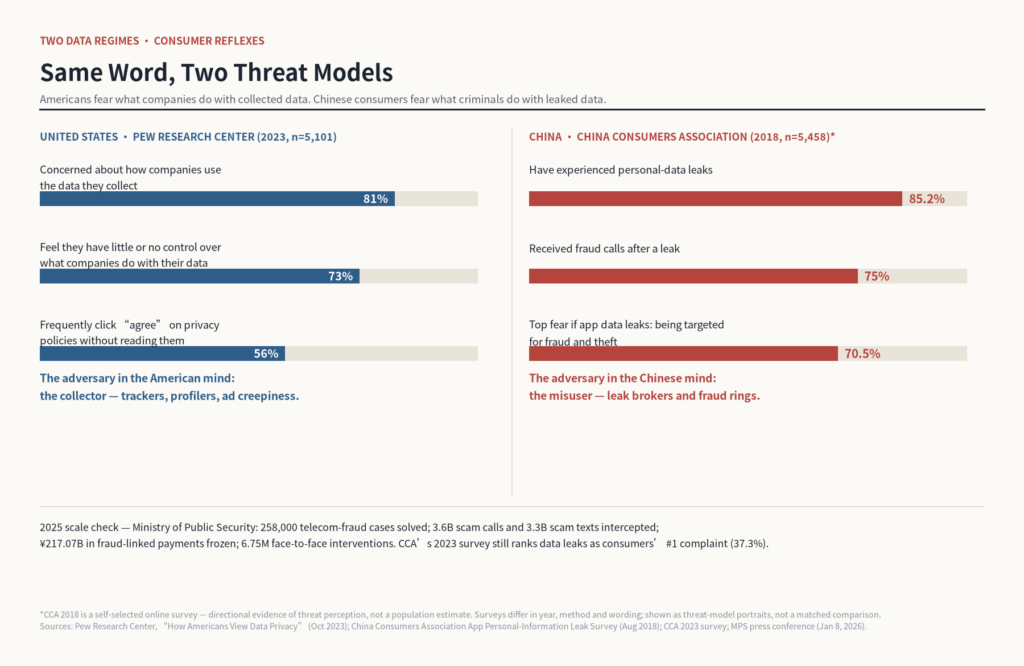
The identity architecture. China’s real-name system binds phone numbers, and therefore most app accounts, to verified identity. Anonymity was never a practical baseline; collection by platforms is structural, and the regulatory question becomes what holders do with what they hold. The Western web grew up pseudonymous, which made collection contestable — hence consent as the load-bearing wall of the entire regime. It also produced consent theater: 56% of American adults say they frequently click “agree” on privacy policies without reading them, Pew Research Center found in its October 2023 survey of 5,101 adults. The consent banner is legally central and behaviorally hollow, and regulators know it — which is part of why enforcement has moved toward design and defaults rather than signatures.
The state’s role. Western privacy law positions the state as referee between citizen and corporation: the regulator sues, the company appeals, the court decides what the boundary is. Chinese law positions the state as guardian of data order. Cross-border flows are treated as sovereignty questions, gated by security assessments for large or sensitive exports. That architecture has teeth — but it is also more adjustable than its reputation suggests. In March 2024, the CAC’s new cross-border data provisions exempted routine transfers entirely: non-sensitive personal data on fewer than 100,000 people per year needs no assessment, no standard contract, no certification; transfers needed for HR administration or to perform a contract with the individual are exempt at any volume below the assessment thresholds. Security assessment remains mandatory for exports covering more than a million people a year, or sensitive data on more than 10,000. The gate is real, but it was deliberately widened for ordinary business — a reminder that the Chinese system optimizes for controlled flow, not for no flow.
The enforcement economics. Fines-and-litigation is slow, adversarial, and continuous: a Western brand audits against standing legal risk, because a claim can arrive any day and take years to resolve. Campaigns-and-rectification is fast, administrative, and episodic: a brand operating in China audits against campaign windows and platform-rule shifts, because the costliest moment is being named in a batch notice during an active sweep. Same underlying obligation — protect personal data — but two different operating calendars. One global policy, two rhythms.
And the TikTok case shows the two grammars now reach across each other’s borders. In May 2025, Ireland’s DPC fined TikTok €530 million for transferring European users’ data to China without demonstrating essentially equivalent protection, and for privacy notices that failed to name China as a destination — the first major GDPR transfer fine aimed at flows to a country other than the United States. The company was ordered to bring processing into compliance within six months or face suspension of the transfers. TikTok appealed. In June 2026, the Irish High Court upheld the core findings — ruling that regulators may examine whether a company’s transfer assessment actually demonstrates what it claims — while sending the suspension order back to the DPC for reconsideration on procedural grounds, and referring questions about how the fine should be calculated to the EU’s top court. Strip away the procedure and the message to any global marketer is simple: signing the standard contract is not compliance. You must be able to prove the protection is real, in the destination country, with evidence a regulator can audit.
Consumers mirror their laws
Here is where the threat-model framing earns its keep, because the survey evidence on the two publics is remarkably consistent with the legal architectures above.
Americans fear the collector. In Pew’s 2023 survey, 81% of U.S. adults said they were concerned about how companies use the data collected about them — more than the 71% concerned about government use. 73% felt they had little or no control over what companies do with their data. Among those who had heard of AI, 81% expected companies to use collected information in ways people would not be comfortable with. The anxiety is about profiling, tracking, and corporate purposes the user never agreed to. It is surveillance anxiety.
Chinese consumers fear the misuser. The China Consumers Association’s landmark 2018 app-privacy survey — an online, self-selected sample of 5,458 respondents, directional rather than representative — found 85.2% had experienced personal-data leaks. After a leak, 86.5% received sales-call or SMS harassment and 75% received outright fraud calls. Asked what they feared most if app data leaked, 70.5% named being targeted for fraud and theft — well ahead of resale to third parties (52.4%) or ad harassment (37.7%). These are not people indifferent to privacy. They are people whose privacy fear has a specific, bitter shape: the leak-to-fraud pipeline. Notably, 61.2% of those who never read privacy policies said the reason was blunt — “no authorization, no service.” Consent fatigue exists on both sides; it just sits on top of different fears.
The scale of the Chinese state’s response tells you the injury is ongoing. At its January 2026 press conference, the Ministry of Public Security reported that police solved 258,000 telecom-fraud cases in 2025, intercepted 3.6 billion scam calls and 3.3 billion scam texts, froze ¥217.07 billion in fraud-linked payments before they could move, and conducted 6.75 million face-to-face interventions with people mid-scam. Over 7,600 Chinese suspects were repatriated from scam compounds in Myanmar’s Myawaddy region under a trilateral mechanism with Myanmar and Thailand. Five years after the CCA survey, its 2023 follow-up still ranked personal-information leakage as consumers’ number-one complaint — cited by 37.3%, ahead of every other consumer problem.
So the stereotype collapses in both directions. The Western user is not a rational consent-manager; the Chinese user is not indifferent. Both care intensely. They care about different adversaries — and each legal system, with its fines or its rectification lists, is fighting the adversary its public actually fears.
What everyone gets wrong
Four assumptions deserve retirement.
“China has no real privacy law.” The PIPL, effective November 2021, is among the world’s strictest texts on paper: separate consent for sensitive data, purpose limitation, individual rights of access and deletion, and localization-adjacent gates on export. Its maximum penalty for serious violations — ¥50 million or 5% of the prior year’s turnover — sits closer to GDPR’s 4% than most Western commentary admits, and the Didi fine demonstrated the ceiling is real. What differs is the enforcement grammar and the weighting between individual rights and data order, not the existence of protection. Marketers who assume anything goes in China get named in a batch notice, and in 2025 nearly four thousand apps learned what that feels like.
“GDPR is the gold standard.” Procedural compliance is not experienced privacy. The consent-banner regime produces fatigue (56% clicking through), dark patterns that regulators are only now unwinding case by case, and enforcement so concentrated that a single Irish regulator accounts for most of the fine total. The Amazon settlement is an admission, in effect, that disclosure-and-consent doctrine missed the design layer for a decade. And the regime itself is now under revision pressure: the EU’s Digital Omnibus process, debated through 2026, proposes AI-related adjustments and incident-notification thresholds that critics warn could amount to death by a thousand cuts. The gold standard is being re-minted while we watch.
“Chinese users don’t care about privacy.” They care about a different failure mode, ferociously. A public that has been trained by years of fraud calls to treat a leaked phone number as a financial threat will accept real-name registration — the collector is not the enemy — while demanding that platforms and police crush the leak-and-fraud chain. That is why trust messaging converts differently in the two markets, a point we’ll return to.
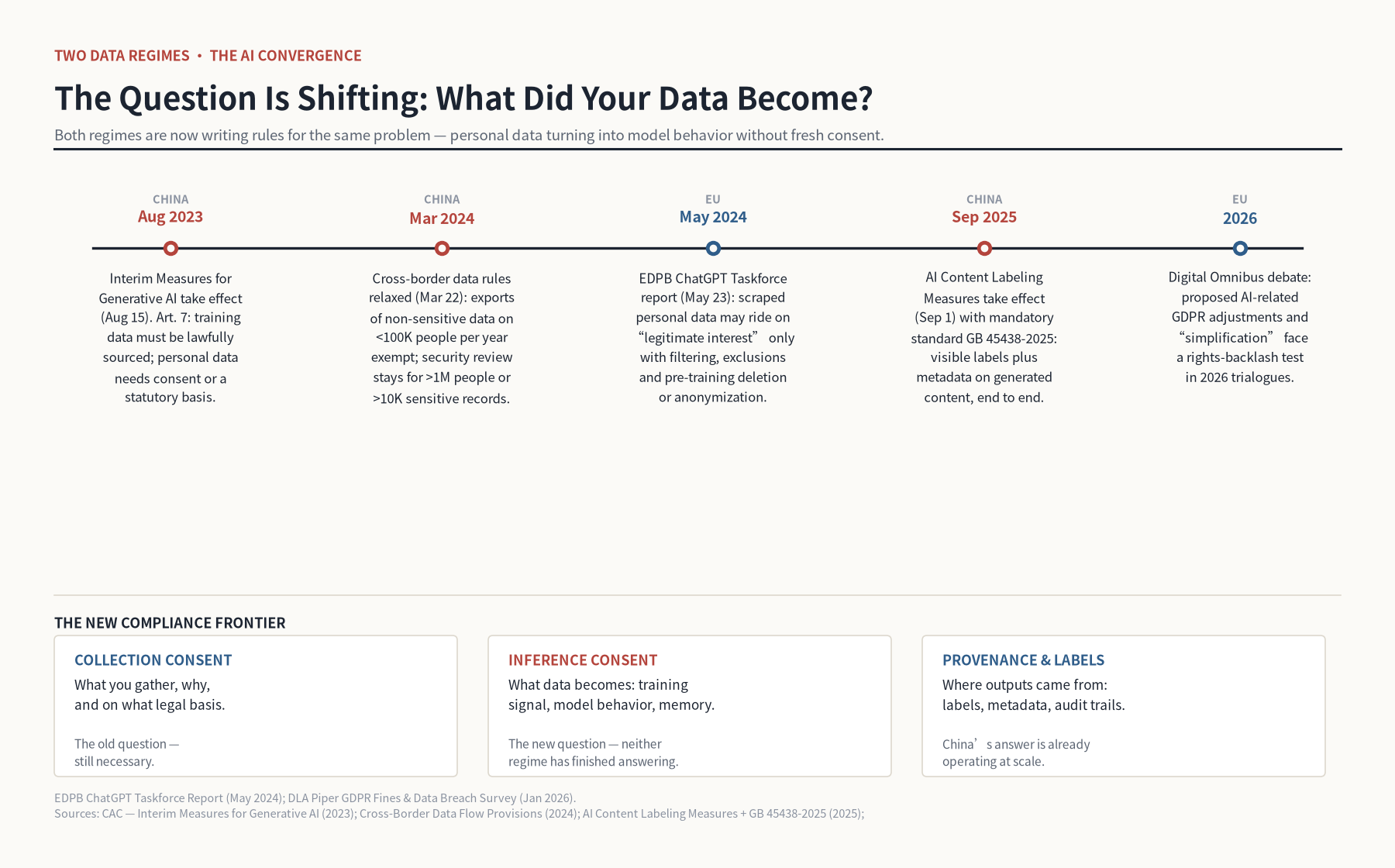
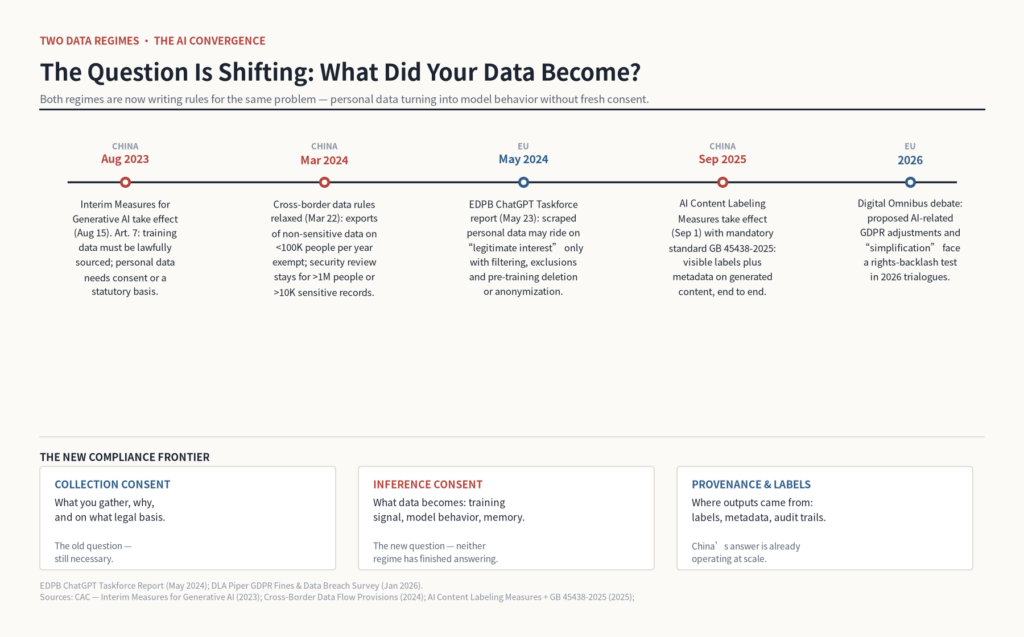
“The regimes stay separate.” They are converging on the hardest new question: what happens when data you never consented to becomes model behavior. China’s Interim Measures for Generative AI, effective August 2023, require lawfully sourced training data and consent or another statutory basis wherever personal information is involved. The EDPB’s ChatGPT Taskforce report of May 2024 walked the same problem from the European side: web-scraped personal data might ride on “legitimate interest,” but only with precise collection filters, exclusion of sensitive sources, and deletion or anonymization before training — and publicly accessible does not mean freely usable. Since September 2025, China’s AI content-labeling rules, backed by a mandatory national standard (GB 45438-2025), have required visible labels and embedded metadata on generated content across the whole generate-distribute chain, with enforcement actions against non-compliant apps already underway. Two grammars, one new chapter: both systems are learning to regulate not what you collect, but what your data becomes.
What this means for brands
Five operating implications follow directly from the analysis.
Design consent for the local threat model. In Western markets, the converting message is restraint: collect less, make opt-outs real, prove the deletion works — because the user’s fear is you. In China, the converting message is custody: your data is safe here, encrypted, access-controlled, never sold — because the user’s fear is what happens after you. “We collect minimal data” lands as reassurance in Berlin and as a shrug in Chengdu; “your data can never leak into a scammer’s hands” is the promise that matches the local wound. Same product, two trust architectures.
Run two compliance cadences. The Western calendar is continuous: standing litigation risk, design audits, transfer-assessment evidence kept current because a regulator — as the TikTok appeal confirmed — can examine whether your assessment actually proves what it claims. The Chinese calendar is episodic: know when joint campaigns are running, monitor your SDKs as closely as your app (they are named too), and keep a rectification playbook ready that can produce a fixes-and-evidence package inside five working days. One global policy, two operating rhythms, staffed accordingly.
Treat data-flow design as market-entry architecture. China’s cross-border gates — now relaxed for routine volumes, still firm for large or sensitive exports — mean the decision of where data lives and who can access it remotely belongs in the market-entry plan, not in a legal appendix written after launch. The TikTok judgment’s core lesson generalizes: remote access counts as transfer, and the burden of demonstrating protection sits with you.
Watch the design layer everywhere. The FTC’s Amazon order shows American enforcement now prescribing buttons and flows. The EU’s dark-pattern scrutiny and China’s naming of default-consent privacy policies point the same direction. The era when a compliant privacy policy could coexist with a manipulative interface is closing in all three jurisdictions. Audit the journey, screenshot the screens, version-control the flows — the interface is now evidence.
Prepare for inference consent. The next frontier is not the checkbox at collection; it is the pipeline after collection. If customer data feeds a model — a recommendation engine fine-tuned on support chats, an agent that remembers users, a segmentation model trained on purchase histories — the legal question in both regimes is becoming what the data was allowed to become. Audit your AI vendors’ training-data provenance now, label generated content where the rules require it, and write data-use clauses that survive the shift from collection consent to inference consent. The brands that treat this as architecture rather than paperwork will not be the ones rewriting their stacks under enforcement pressure in 2027.
The counterarguments, honestly weighed
Three objections deserve serious answers.
“The PIPL is basically GDPR with Chinese characteristics — convergence is already here.” Textually, much is borrowed, and the AI-era rules on both sides increasingly rhyme. But convergence on paper is not convergence in practice: the enforcement grammar, the identity architecture, and the consumer threat model still produce different lived privacy and different compliance operations. A regime where one regulator litigates billion-euro fines for years and a regime where four ministries name four thousand apps in a year are not the same operating environment, whatever their statutes share.
“Western users trade privacy for convenience anyway — the paradox makes this moot.” The privacy paradox is real; the click-through rates prove it. But enforcement does not depend on users caring. Regulators now act on design and procedure — the Amazon order, the default-consent namings — precisely because revealed preference cannot be trusted to protect anyone. The paradox changes marketing; it does not relax compliance.
“China’s regime is purely state security, not individual privacy.” Overstated. The PIPL’s individual rights are real and increasingly litigated; Chinese courts issued typical-case guidance in 2025 on separate consent for sensitive data and the difference between account deletion and consent withdrawal. The regime is dual-purpose — order and rights — with the weighting shifted toward order. Different weighting, not absence. The honest read is the one this piece has argued throughout: two threat models, both genuine.
The takeaway
Two data regimes, two threat models. The West built boundary rights against corporate collection and enforces them through €7.1 billion in fines, design-level settlements, and courts that now audit your transfer assessments. China built safety-and-order rules against misuse and leakage, enforced through rectification waves, sovereignty gates, and a police apparatus that froze ¥217 billion in fraud payments last year. Consumers mirror their laws — fearing trackers on one side, fraudsters on the other. For marketers, privacy is not one global checkbox but two operating systems: consent architecture, trust messaging, and compliance cadence must match the local threat model. And AI is writing a shared new chapter, where the question stops being what did you collect and becomes what did your data become.