Flipkart beat Amazon India the way local champions beat global giants everywhere: it solved the barrier the giant underestimated. Amazon arrived in June 2013 with the world’s best e-commerce machine. Flipkart — founded in 2007 by two ex-Amazon engineers selling books out of a Bengaluru apartment — had already done the one thing that machine couldn’t do quickly: make India trust buying from strangers online. Cash on delivery, easy replacements, and a shopping festival welded to Diwali built a trust-and-habit moat before Prime logic could land. Then, in 2018, Walmart paid $16 billion for 77% of the company, converting a local champion into a globally capitalized one.
The honest 2026 scoreboard is more interesting than a simple win. ICICI Securities puts Flipkart’s group GMV share at 50–60% against Amazon’s 25–30%. Amazon’s marketplace entity just posted its first operating profit in thirteen years; Flipkart’s marketplace revenue fell 19% because it deliberately stopped charging commissions to keep sellers. And quick commerce — a battlefield neither giant invented — is eroding the duopoly’s combined lead. Mass-market king, premium profit engine, perimeter under siege: that’s the real verdict.
Two Entries, Two Theories of India
The bookstore boys who learned Amazon’s craft — then broke its rules
Sachin and Binny Bansal (no relation) quit Amazon in 2007 and started delivering books themselves, sometimes on a motorbike when couriers refused their tiny volumes. Their founding insight wasn’t selection or speed. It was psychological: Indian consumers wouldn’t prepay a website they’d never heard of. Credit-card penetration was negligible, and typing card details into a stranger’s form felt like handing your wallet to a pickpocket.
The world’s biggest machine arrives with a blank check
Amazon tested India with the Junglee comparison site in February 2013, then flipped the switch on Amazon.in that June. In July 2014, Jeff Bezos committed $2 billion — announced one day after Flipkart raised $1 billion, because neither side wanted the other to enjoy the headline. India’s FDI rules forced Amazon into a pure marketplace: it could run the stage but couldn’t be the performer. Everything Amazon knew — Prime, fulfillment science, obsessive selection — had to be rebuilt inside a market where cash still ruled and addresses read like riddles.
Move One: Cash on Delivery Was the Strategy
In 2010, Flipkart let customers pay the delivery agent in cash. Sounds trivial. It wasn’t. COD meant building cash collection, reconciliation, fraud control, and return logistics across a country where a failed delivery meant a second and third attempt. Unit economists hated it: COD orders cost more to deliver and got returned more often. Adoption engineers loved it. Within months of launch, COD was roughly 30% of Flipkart’s revenue, per The Hindu’s 2010 reporting; by 2012, co-founder Sachin Bansal told Frontline about 65% of deliveries were cash. Paired with a 30-day replacement promise and the “No Kidding, No Worries” campaign, COD didn’t just win customers — it manufactured India’s first-time online buyer pool. Both giants now fish in that pool. Flipkart built it.
Here’s the uncomfortable lesson for anyone with a spreadsheet: COD was worse economics and better strategy. The barrier blocking adoption outranks the cost that annoys your CFO.
Move Two: Owning the Calendar
On October 6, 2014, Flipkart ran the first Big Billion Day. It claimed $100 million in sales in ten hours, crashed its own servers, sold out its flash deals in minutes, and published an apology. It also invented India’s online festive season. Amazon launched its Great Indian Festival in response, and October became the month Indian e-commerce lives for.
The genius wasn’t discounting — everyone discounts. It was timing. Indian households already concentrate spending around Diwali the way Western households concentrate it around Christmas. Flipkart didn’t create demand; it built a toll booth on a river that already flowed. Bain’s 2026 report, co-produced with Flipkart (interest noted), finds festive windows still deliver about one in four new shoppers, with traffic tripling during Big Billion Days. By the 2025 edition, Flipkart’s own disclosures showed units up 24% year-on-year, 7.3 million shipments in a single day, and over 400,000 seasonal jobs created. Manufactured rituals work best when they ride real ones.
Move Three: Depth Where the Habit Lives
Flipkart concentrated on categories that anchor an app habit: smartphones, appliances, fashion. Per ICICI Securities, electronics, smartphones, and appliances now contribute 63–64% of Flipkart’s GMV — high-ticket purchases that bring a shopper back for accessories, upgrades, and eventually everything else. Myntra, acquired in 2014, locked up fashion. In the 2025 festive first wave, TechInsights tracked roughly a million iPhone 16 units sold in eleven days, with 83% of iPhones moving online — the kind of premium volume both platforms now fight over.
A caution on a number you’ll see elsewhere: the claim that Flipkart holds “60% of online smartphone sales” traces to 2016 IDC figures Flipkart itself cited (Counterpoint’s parallel estimate was 45%). No 2025–26 authority supports repeating it today. The defensible statement is category concentration, not a decade-old share claim.
Move Four: Delivering to Bharat, Not Just India
While Amazon optimized metros, Flipkart’s logistics arm eKart pushed into the country Google Maps struggled to parse. Its network now reaches 21,000+ pincodes, and roughly 90% of orders move through its own logistics, per ICICI. The payoff shows up every festive season: over 60% of Big Billion Days 2025 orders came from Tier-2 and Tier-3 regions, with towns like Jhajjar and Bahraich posting exponential growth. Company disclosures note small furniture and household supplies grew 90% in non-metro markets.
This isn’t a niche. Deloitte told CNBC that smaller cities now account for more than 60% of India’s online shoppers. Flipkart’s early bet — vernacular interfaces, local assortment, delivery agents who know which lane the blue house is in — became the market’s center of gravity.
Move Five: The $16 Billion Homecoming
In May 2018, Walmart announced it would buy 77% of Flipkart for $16 billion — then the largest e-commerce acquisition ever, beating out an interested Amazon. Buybacks in 2023 lifted Walmart’s stake to roughly 85%. The logic was symmetrical: Walmart bought India exposure through the local trust leader; Flipkart bought a balance sheet that could outlast any subsidy war, plus the world’s most experienced retail supply-chain brain.
The endgame is still being written. Flipkart completed its “reverse flip” in March 2026, moving its holding company from Singapore back to India — a structural prerequisite for a domestic listing, cleared by the NCLT and, because Tencent holds 5–6%, by the government under Press Note 3. But the IPO itself was deferred. Moneycontrol reported in May 2026 that Walmart told Flipkart to reach EBITDA breakeven before the end of FY27 before any listing or external raise. As of late 2026, no draft prospectus has been filed, roughly a thousand former employees have petitioned Walmart for stock-option liquidity, and a July 2026 buyback valued the company near $38 billion — below the $50 billion IPO dream. Local instincts plus global capital is a powerful combo. It is not a fast one.
Reading the Scoreboard: Three Lenses, Three Stories
Ask “who’s winning?” and India hands you three different answers.
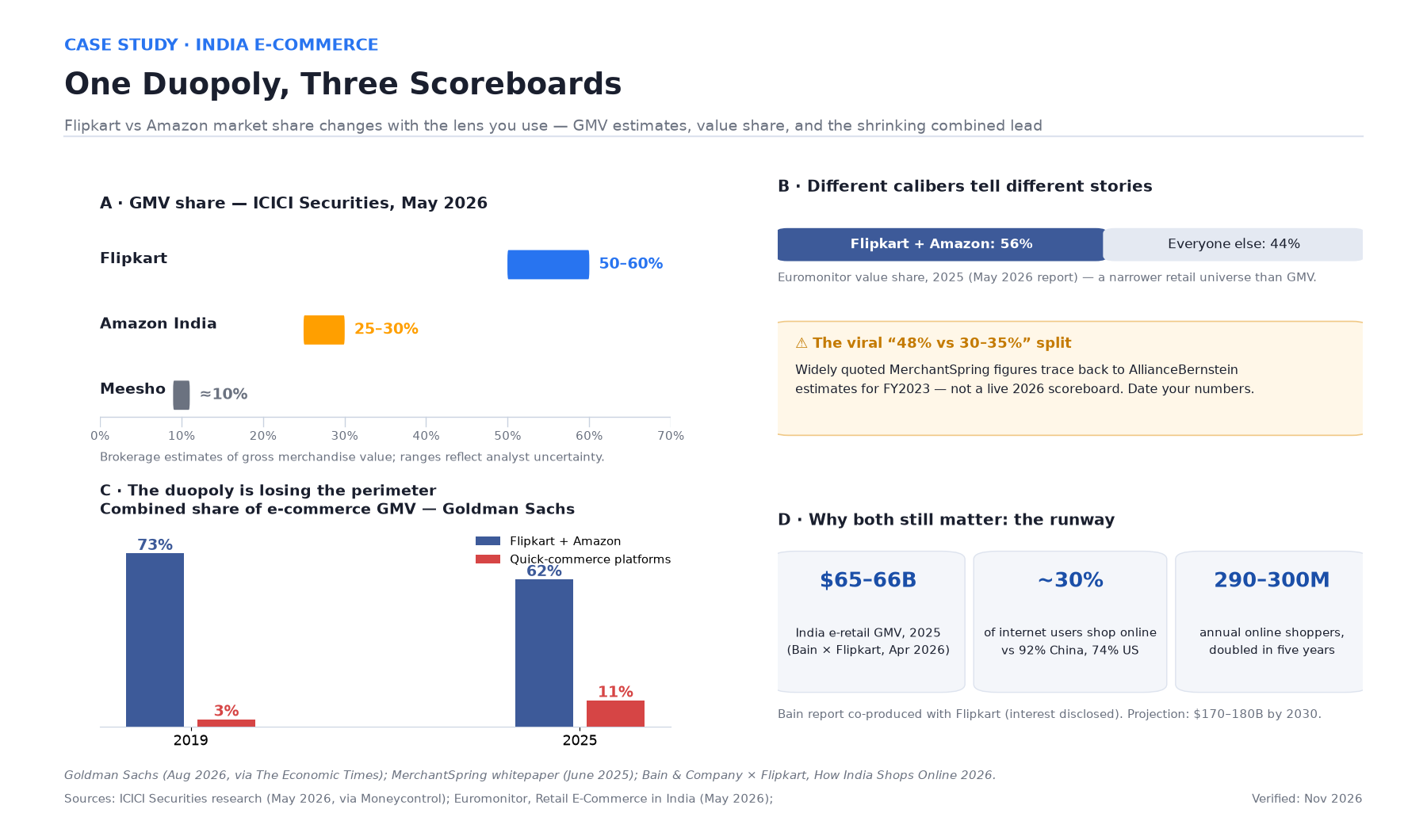
By GMV estimates, ICICI Securities (May 2026) puts the Flipkart group at 50–60%, Amazon at 25–30%, and Meesho around 10%. The viral “48% vs 30–35%” split you’ll see quoted in 2026 coverage comes from a MerchantSpring whitepaper whose AllianceBernstein-sourced figures date to FY2023 — a vintage trap worth naming. By value share, Euromonitor’s May 2026 report puts Flipkart and Amazon together at just 56% of its narrower retail universe in 2025. And by trajectory, Goldman Sachs calculates the pair’s combined GMV share slid from 73% in 2019 to 62% in 2025 as quick commerce grew from 3% to 11%.
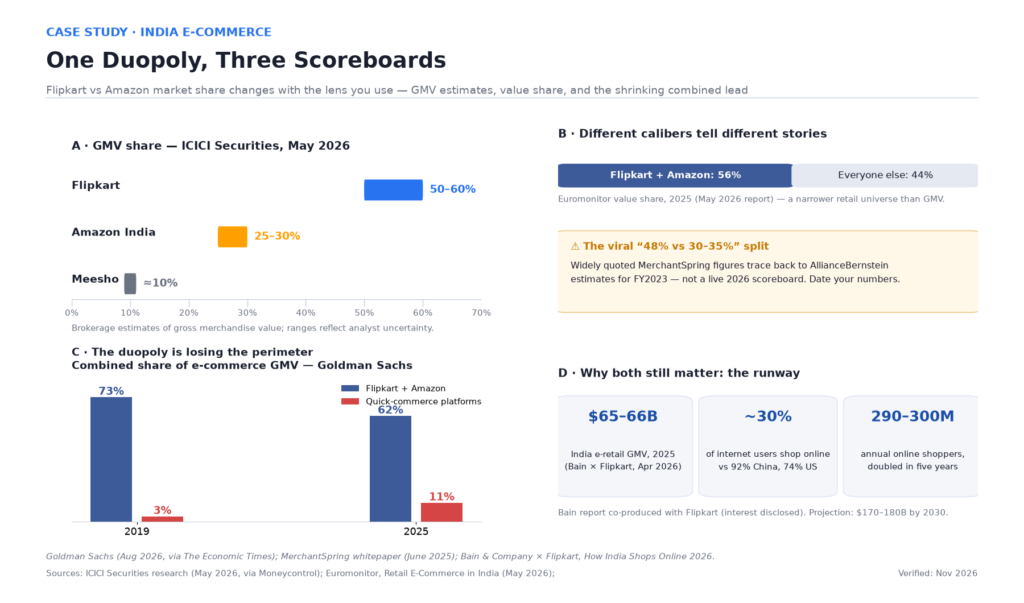
Why does this matter beyond pedantry? Because the strategic question determines the metric. Entering India? Use GMV share. Sizing the addressable retail pool? Use value share. Judging whether the duopoly’s moat is holding? Watch the trend line, not the snapshot. And remember the denominator is exploding: Bain × Flipkart pegs 2025 e-retail GMV at $65–66 billion, growing 19–21%, with perhaps $170–180 billion by 2030. Both giants can lose share and still grow rich, because only about 30% of India’s internet users shop online at all — against 92% in China and 74% in the US.
Where Amazon Actually Wins: The Honest Ledger
The premium engine
Amazon India is not a defeated company; it’s a differently positioned one. Prime loyalty, imported selection, and reliability trust dominate high-value urban baskets. ICICI’s read: Amazon over-indexes in metros, beauty, personal care, and FMCG. If Flipkart owns the festival, Amazon owns the reorder.
The profitability race Amazon just won a lap of
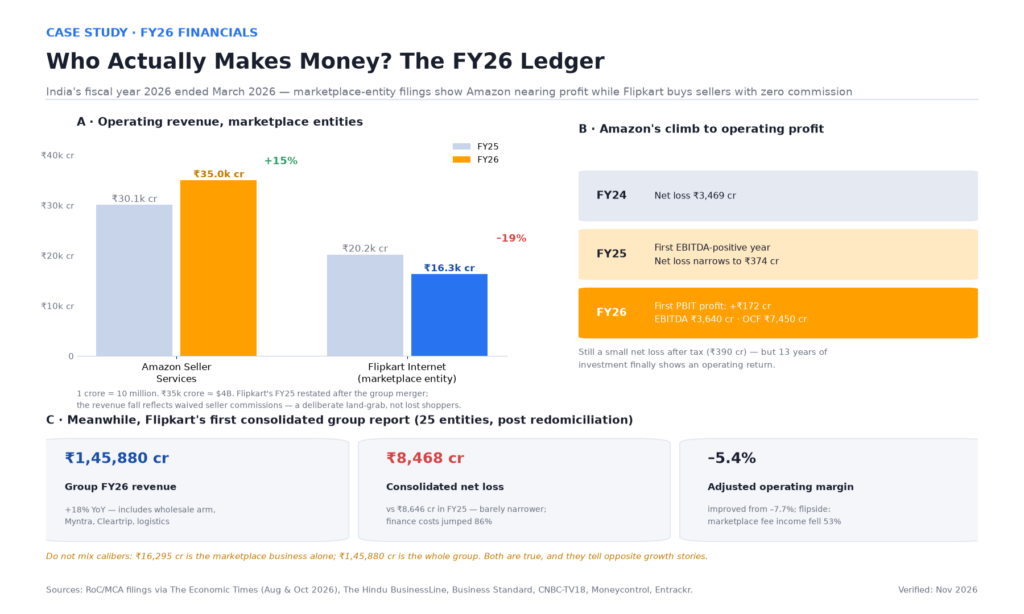
Here’s the twist most “Flipkart won” tellings skip. In FY26 (ended March 2026), Amazon Seller Services grew operating revenue 15% to ₹34,967 crore and posted its first-ever profit before interest and tax: ₹172 crore, after thirteen years. EBITDA hit ₹3,640 crore; operating cash flow ₹7,450 crore. Flipkart’s marketplace entity went the other way — revenue down 19% to ₹16,295 crore, with losses more than tripling to ₹5,498 crore — largely because it waived seller commissions on sub-₹1,000 items in November 2025 and extended zero commission to all fashion price points in July 2026. That’s not decline; it’s a deliberate land-grab paid for in fee income, betting that advertising (already ₹8,213 crore, its biggest revenue line) and seller loyalty pay it back.
Watch the caliber, though. Flipkart’s first consolidated group report — 25 entities folded under Flipkart Internet after the redomiciliation — shows revenue up 18% to ₹1.46 lakh crore with net losses barely narrowing to ₹8,468 crore and adjusted operating margin improving from –7.7% to –5.4%. Marketplace down, group up: both true, opposite stories. Amazon monetizes better today; Flipkart buys tomorrow’s sellers. Meesho, meanwhile, listed in December 2025 at a 46% pop, proving public markets will fund the value flank too.
The Minutes War: A New Leaderboard Nobody Owns Yet
Ten-minute delivery is re-teaching urban India how to shop, and neither giant invented it — Blinkit, Zepto, and Swiggy did. By June 2026, Blinkit ran 2,243 dark stores and roughly 3 million daily orders. Flipkart Minutes, launched in August 2024, hit 1,000 micro-fulfilment centres across 130 cities — about 90 of them non-metro — in under two years, targeting 1,500 stores in 180+ cities by year-end, with order volumes up five-fold and Tier-2/3 scale up a startling 42-fold. Amazon Now, from about 500 dark stores in 15+ cities, upgraded its target from 100 cities to 300+ in June 2026; CEO Andy Jassy says orders grow 25% month-on-month and Prime members triple their shopping frequency once they start using it.
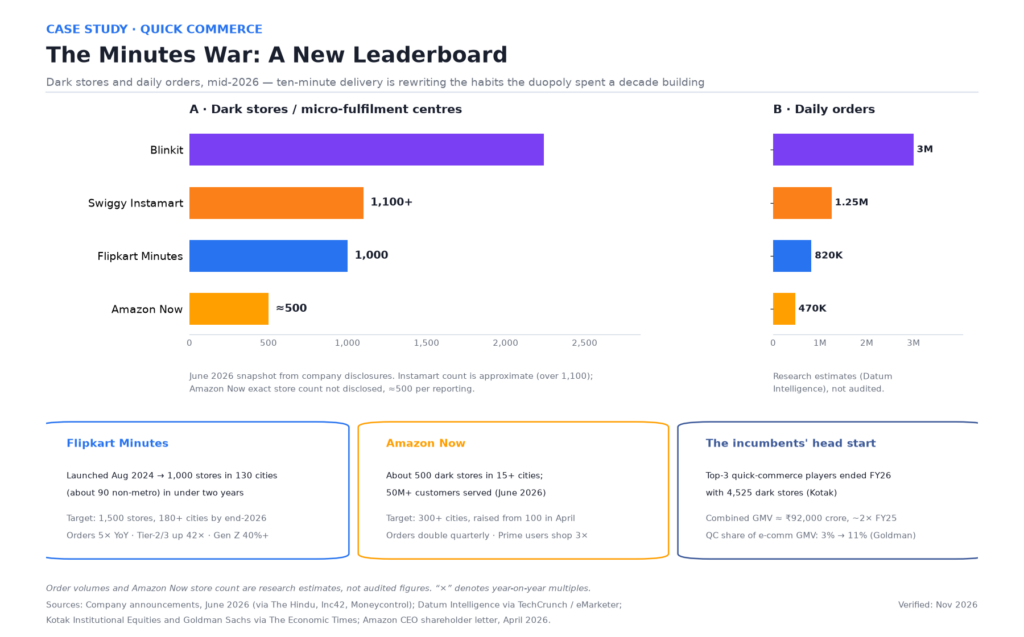
The strategic danger for Flipkart is subtle. COD-era trust was built on “your money is safe until the box arrives.” Minutes-era trust is built on “it arrives before the chai cools.” The first moat doesn’t automatically transfer to the second battle — which is why both giants are spending like startups again. Amazon’s December 2025 pledge of $35 billion more through 2030 (on top of ~$40 billion already invested) and Flipkart’s debt doubling to ₹13,708 crore say the arms race never ended; it changed weapons.
Risks and Honest Caveats
Three caveats keep this case honest. First, estimate dispersion: every share number above is an analyst estimate with a specific universe and vintage — none is audited fact, and Bain’s market-size report is co-branded with Flipkart itself. Second, dependence: Flipkart’s endurance is Walmart’s decision, and the parent’s new profitability-first posture (plus leadership turnover in Bentonville) constrains subsidy firepower exactly when the minutes war demands it; group cash burn and a pending GST change on in-house logistics add pressure. Third, regulatory symmetry with asymmetric bite: FDI rules confine both to marketplaces, and the CCI’s investigation — whose 2024 director-general reports, per Reuters, found preferential sellers and deep discounting anti-competitive — still awaits a final order, with a fresh seller-body complaint filed in July 2026. The leader, with 33 alleged preferred sellers versus Amazon’s six, carries more exposure; allegations are not findings, but the uncertainty itself is the risk.
The Reusable Methodology
Strip away the rupees and four transferable rules remain.
One: solve the trust barrier before the efficiency barrier. COD, easy returns, and vernacular access were adoption engineering; they created the market everyone now optimizes. Two: own a calendar moment your culture already celebrates — manufactured rituals compound only when they ride real ones. Three: sequence local innovation and global capital deliberately. Pure local players run out of money; pure global players run out of relevance; Flipkart innovated locally, sold equity to a strategic parent, and kept operating locally — then brought the domicile home when the endgame required it. Four: read share by caliber and date every number. GMV share, value share, and revenue growth told three different stories here, and the loudest number in circulation was three years stale.
Conclusion: The Verdict That Survives Scrutiny
Flipkart won the mass market by treating trust as infrastructure: cash on delivery created the buyers, Big Billion Days created the habit, and Bharat logistics created the reach. Walmart’s $16 billion made that position durable. Amazon won the profitable niche — premium baskets, Prime loyalty, and now India’s only operating-profitable marketplace at scale. And quick commerce is reopening both contests, with the duopoly’s combined share already down eleven points in six years. If you take one line into your next market-entry debate, take this: in trust-scarce markets, adoption engineering beats efficiency engineering — and the strongest seat in emerging-market retail belongs to local instincts funded by global capital. Just don’t expect the scoreboard to hold still while you admire it.