Google Just Made Search a Subscription to Its Own Roadmap
On 3 November, Google said out loud what it had been implying for a year. In the one market it has effectively owned since the Chromebook, “AI in Search” is not a feature you can decline. It is the price of the product.
Chris Phillips, Google’s vice-president and general manager for education, needed nine words to end a two-year debate about whether schools could have the web without the model: “Search and AI are deeply integrated.”
Then he made it concrete. A school that bans AI outright, he told The New York Times, means students “will not have access to search, and they’ll see a message from their school that indicates it’s not available.”
That is not a deprecation notice. It is a condition of sale. And once you read it that way, the rest of the announcement stops looking like a product update and starts looking like the most consequential piece of platform governance in education since the district-wide Chromebook rollout.
What Google actually announced on 3 November
The mechanics are simple enough to fit on a slide, which is part of the problem.
Four products, one switch
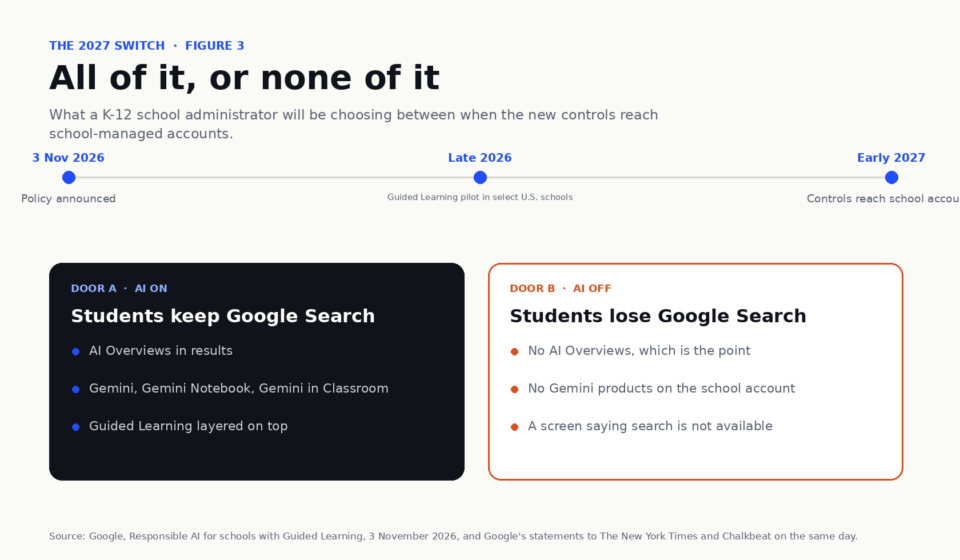
Google said access to Gemini, Gemini Notebook, Gemini in Classroom and Google Search will be “entirely off for K-12 student accounts until school administrators explicitly turn them on.” The default flips from on to off, and the administrator becomes the only person who can flip it back.
Alongside that, Google shipped Guided Learning — a mode that coaches a student through a problem with prompts and step-by-step breakdowns rather than handing over the finished answer. It is available in Google Classroom worldwide as of the announcement, and it began a pilot inside Google Search for selected U.S. schools this month.
Full rollout of the new controls is expected in early 2027. When it arrives, schools reportedly get two configurations: one with AI Overviews and the standard AI layer in Search, and one with Guided Learning in its place. Neither is AI-free.
The ultimatum is not in the announcement
This is where the story gets interesting for anyone who reads primary documents for a living.
Google’s own blog post says the company wants to give school leaders “the control and confidence to use AI products in classrooms as they see fit.” It describes administrators as having “full control to enable or disable AI products.” Nowhere in the post does it say that disabling those products also disables Search.
That detail arrived in interviews — first with The New York Times, then with Chalkbeat — and was confirmed by Google rather than corrected.
So the single most consequential sentence in the whole policy exists only as a quotation. A district that reads the blog and stops there will plan for a world where it can keep Search and drop Gemini. A district that reads the trade press will plan for something else entirely. Two different preparations, one announcement, and the gap between them is where legal exposure and parent anger both live.
“Deeply integrated” is a business decision, not a law of nature
Google is not claiming an engineering impossibility. It is describing an architecture it chose.
DuckDuckGo, which competes on roughly six-tenths of one percent of global search, put the counter-argument bluntly: “There is no technical reason why Google can’t turn AI off.” Its reasoning is sound. AI Overviews behaves like any other search module — maps, flights, weather, a sports score — something the engine decides to render or not render. DuckDuckGo runs a version of its own engine with generated answers disabled and AI-generated images filtered, and no settings required.
Google could have built a schools-only index without generated answers. Instead it built two flavours of AI and made the flavour mandatory. That is a roadmap decision, and it is a revenue decision: an answer that resolves a question in place monetizes differently from ten blue links. When a company’s most profitable surface and its least negotiable surface are the same surface, “integrated” stops being a technical description and becomes a commercial one.
Note also the quiet reversal buried in the same week. Google had previously switched on some AI features by default for schools that had already permitted Gemini. The new policy turns that off and hands the choice back. In a single announcement, Google moved from assuming consent to requiring it — while making the thing being consented to unavoidable.
The leverage, in numbers
Google’s position in search is not a matter of opinion, which is why the ultimatum has teeth.
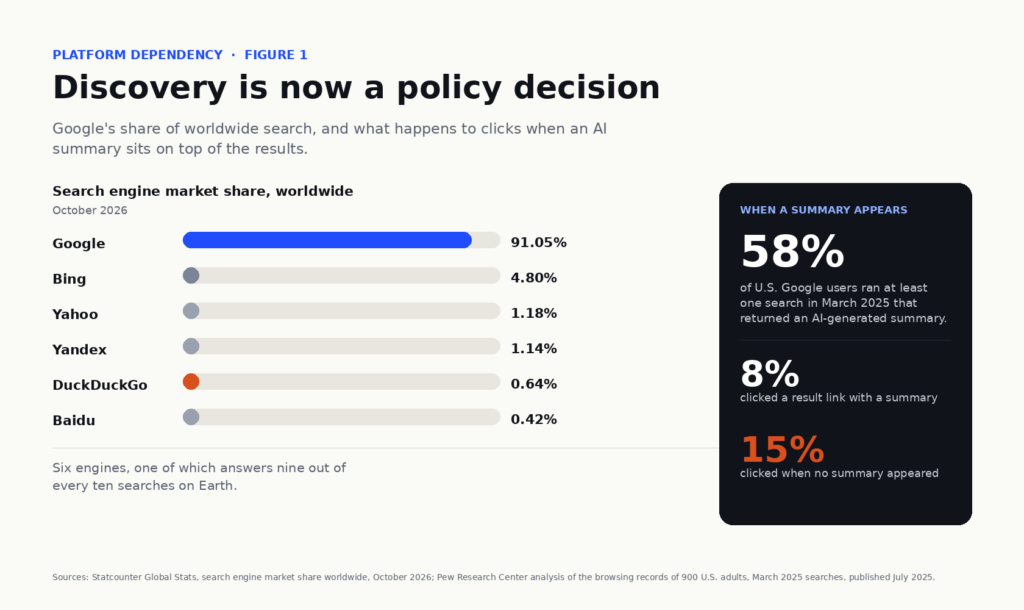
Statcounter puts Google at 91.05% of worldwide search engine traffic in October 2026. Bing sits at 4.80%, Yahoo at 1.18%, Yandex at 1.14%, DuckDuckGo at 0.64% and Baidu at 0.42%. When a school tells students to “look it up,” it is describing a Google product by reflex.
What students find when they get there has also changed. Pew Research Center tracked the browsing records of 900 U.S. adults across 68,879 Google searches in March 2025, 12,593 of which returned an AI-generated summary. Fifty-eight percent of those users met at least one summary that month. When a summary appeared, users clicked a traditional result in 8% of visits; when it did not, they clicked in 15%. They clicked a source cited inside the summary in 1% of visits, and they ended the browsing session altogether on 26% of summary pages versus 16% of pages without one.
Put those two datasets next to each other and the shape of the ultimatum becomes obvious. The value of Google Search inside a classroom was never really the index. It was the reflex. Take the reflex away and you have not downgraded a tool; you have caused a blackout during homework hours, with a message on screen telling students their school did it.
A classroom is a stack, and stacks are not sold in pieces
The reason this works as leverage is that Google does not sell schools a search engine. It sells them an operating environment: Workspace for Education, Classroom, Meet, single sign-on, teacher training, parent communications, and the Chromebooks those services run on.
Ars Technica’s read is the correct one. Google’s education products became enormous because the hardware became ubiquitous, and the software followed the hardware into procurement. The device fleet, the identity layer and the classroom workflow are one purchase order in all but name.
Once AI ships inside the same admin console as the rest of it, the AI decision is a procurement decision. And procurement collapses a rich pedagogical argument — how much scaffolding, at what age, with what guardrails — into a toggle that also happens to control whether students can reach the web at all.
That is the design. Not malice, necessarily. Just the natural gravity of bundling.
The contradiction schools are actually living inside
Here is the part that gets lost in the outrage cycle: teachers are not anti-AI. They are anti-default.
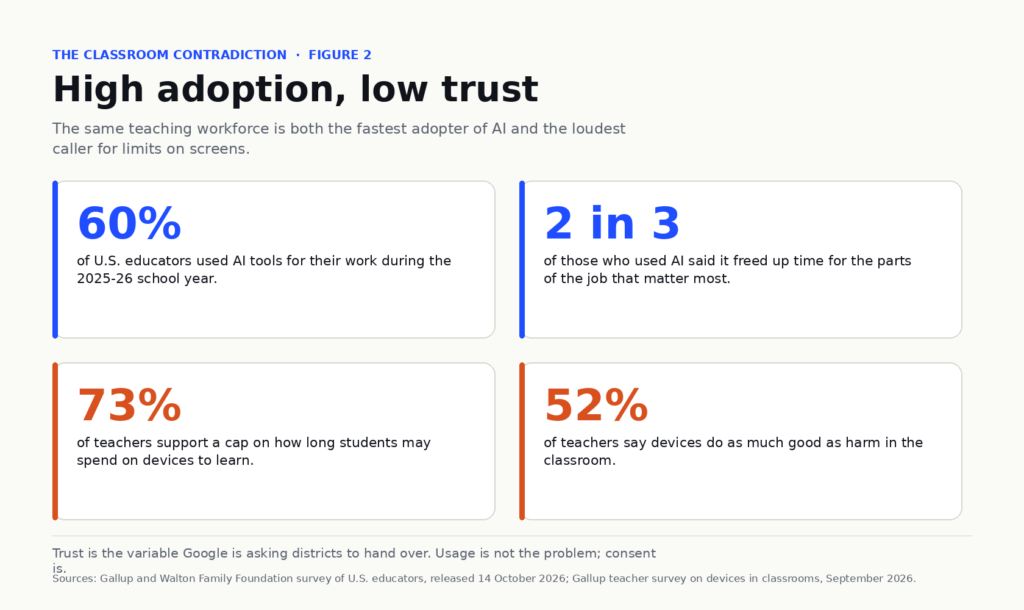
A Gallup and Walton Family Foundation survey released on 14 October 2026 found that nearly three in five U.S. educators used AI tools for their work during the 2025-26 school year. Of those who did, nearly two-thirds said it freed up time for the parts of the job that matter most — time with students. Roughly half said it freed up “somewhat more” time, which is a modest claim, not a revolution, and more believable for it.
The same workforce, asked a different question a month earlier, went the other way. In Gallup’s September 2026 survey, 73% of teachers said they support a cap on how long students may spend on devices to learn. Sixty-one percent said students should spend less time on devices. Fifty-two percent said devices do as much good as harm. Fifty-nine percent still said digital tools help students learn more effectively.
Those numbers are not contradictory. They answer two different questions. Will adults use this technology to get through their week? Yes, enthusiastically. Should children be defaulted into it before anyone has agreed on the terms? No, not yet.
Google’s announcement answers the first question and asks districts to ratify the second. That is a hard trade to sell when the people doing the ratifying are the same people who told you last month they want fewer screens.
Guided Learning is good design carrying an impossible burden of proof
Strip away the politics and Guided Learning is a genuinely interesting product. It is built around what Google calls “productive struggle” — the idea that a student who is nudged through a physics problem learns more than one who is handed the answer. In Classroom it anchors to assigned material and reports back to the teacher on where the class struggled. In Search it will, in Google’s example, meet a pasted physics problem with prompts rather than a solution.
Two problems, though.
The first is accuracy. Google states plainly that its generative products can make mistakes. A tutoring mode that makes mistakes at scale is a different category of risk from a search result that makes mistakes, because the student cannot easily tell which is which.
The second is containment. Testing reported by The New York Times found the consumer version of Guided Learning producing a detailed essay when handed an Advanced Placement history prompt. Google says the school version carries additional restrictions. That may well be true. But schools are being asked to trust a guardrail whose behaviour they cannot inspect, running on infrastructure they cannot modify, delivered on a date they do not control. The burden of proof here is not “does it usually work.” It is “can we verify it, and who is accountable when it doesn’t.”
The policy vacuum Google is stepping into
There is no national standard for AI in American classrooms, so the vacuum has been filled district by district, and then by vendors.
New York City, the largest school system in the country, announced on 2 September 2026 a one-year prohibition on student use of generative AI from 2-K through eighth grade, paired with AI literacy work for high schoolers. Los Angeles added restrictions the same month. State legislatures have been pushing districts to write AI policies of their own rather than waiting for federal guidance.
The result is a patchwork in which the most consequential settings are not written by legislators at all. They are written in a defaults panel by a company that ships the panel. Governance by changelog is efficient, consistent and completely unauditable — and it is exactly what a school district discovers it has been relying on the day the changelog arrives.
The antitrust weather will not save anyone on a school calendar
It is tempting to file this under “monopoly behaviour, regulators incoming.” The timeline does not cooperate.
In September 2025, Judge Amit Mehta declined to order a Chrome divestiture, required some sharing of search data with competitors, and left Google’s default-placement payments in place. Alphabet’s shares rose on the ruling. Google’s appeal is now before the D.C. Circuit, with a decision unlikely to land inside a district’s budget cycle.
The political reaction to the schools policy has been sharper than the judicial one. New York’s mayor, Zohran Mamdani, accused Google of using “monopoly power to force AI into our public schools.” Lina Khan, the former chair of the Federal Trade Commission, said the company was using its search monopoly to “coerce schools into adopting AI.” Both are describing the same mechanism: control of a default used as consideration in a negotiation the other side cannot refuse.
Courts move in years. Procurement moves in quarters. If you want to know how this resolves, watch purchasing decisions, not dockets.
The marketing lesson: you are a tenant, and the landlord just re-zoned the building
For anyone who sells to schools, this is not an education story with a marketing footnote. It is the clearest recent demonstration of a structural risk that every brand carries and few price in.
When a platform changes the terms of distribution, three things break at once.
Measurement breaks first. Your click-through rate is not a property of your creative. It is a property of the interface above your creative. Pew’s 8% versus 15% is not a small delta; it is roughly half your traffic, decided by someone else’s layout.
Then the unit of value changes. In a world where a cited source is clicked in 1% of visits, the goal stops being “rank and be clicked” and becomes “be the sentence that survives summarization.” That is a different discipline, with different artefacts: precise claims, dated figures, definitions that can be lifted cleanly.
Then audience definition shifts. Students are not your customers, but they are the cohort that will form the default research habits of the next buying generation. When the default tool inside a school account is re-specified, you are not losing a channel. You are losing the chance to be in the room when a habit forms.
And for education marketers specifically, the squeeze is symmetrical. Your buyer’s research environment is being re-scoped by the same company that decides whether your site is reachable from inside the school day. One toggle, two consequences.
A 90-day plan for education marketers
Theory is cheap. Here is what is actually actionable before the controls ship.
| Move | What to do | Why now |
|---|---|---|
| Instrument the invisible | Separate branded search, .edu referral traffic and district pipeline attribution from general organic. Track them weekly. |
You cannot detect a default change after the fact if your reporting lumps everything into “organic.” |
| Rewrite for extraction | One claim per heading. Numbers with dates attached. Definitions in the first sentence of each section. | Cited sources get clicked 1% of the time. Being quoted is the new impression. |
| De-risk the funnel | Build conference, association, procurement-portal and partner channels that do not depend on a search result. | The 2027 cohort of student researchers may not have the same engine you optimized for. |
| Prepare the sales narrative | Brief teams on the two-door reality so they can talk to districts about constraint, not just features. | Districts will be making a forced choice. Vendors who understand the constraint become advisors instead of line items. |
What to watch between now and early 2027
Four signals matter more than the commentary.
The specifics Google promised. The blog commits to sharing details “in the coming months.” If a search-without-AI tier appears for schools, the whole ultimatum deflates. If it does not, the two-door structure is real.
Whether Guided Learning in Search ships with the classroom version’s restrictions. Google says the school build is tighter. Verification will come from districts, not from the press release.
DuckDuckGo’s school traction. At 0.64% of global search it looks irrelevant. Defaults are precisely how a number like that becomes a number that matters, and DuckDuckGo has already positioned on the one thing Google will not sell: an AI-free switch.
Competitor posture. Anthropic’s Claude for Teachers, launched in July 2026, is restricted to adults, with no student accounts at all. That is a different bet — teacher tooling rather than student surfaces — and it will be used as a contrast in every procurement conversation for the next two years.
The uncomfortable summary
The fight is not really about whether AI belongs in classrooms. Most of the people in those classrooms have already answered that with their own behaviour.
The fight is about who owns the default, and whether a default can be used as leverage over an institution that has no realistic alternative. Google has now demonstrated, in public and on the record, how much it believes that lever is worth: the search engine that made the company a verb, offered as a bundle with a condition attached.
Schools will mostly take the deal. That is what happens when the alternative is a blank screen during homework hours. But they will take it knowing what it is, and the next time a vendor presents a “control” panel, the first question in the room will be about what is wired to what. That question is worth more than any single procurement decision this year.
FAQ
Did Google really say schools cannot use Search without AI?
Yes. Google’s vice-president for education, Chris Phillips, told The New York Times that Search and AI are deeply integrated, and that students at schools blocking AI will not have access to search. Google’s blog post is softer: it says administrators have full control over AI products and does not itself mention losing Search. The binding detail came in interviews, confirmed by the company.
When does this take effect?
The controls are expected to reach school-managed accounts in early 2027. Guided Learning has been live in Google Classroom worldwide since the 3 November announcement, and a Search pilot is running in selected U.S. schools.
Can a school keep Google Search but switch off AI Overviews?
Not under the announced policy. Schools reportedly get two configurations in early 2027 — one with the standard AI layer including AI Overviews, one with Guided Learning instead. Both contain AI. An AI-free version of Google Search for schools has not been offered.
Is this legally exposed?
Unclear, and unresolved. Google’s search monopoly finding is under appeal at the D.C. Circuit, and the September 2025 remedies stopped short of structural break-up. Critics including New York’s mayor and former FTC chair Lina Khan have framed the schools policy as coercion, but no regulator has acted on that framing.
What should marketers take from it?
Two things. First, treat every click-based metric as a rented asset with a revision date. Second, shift effort toward being quotable rather than clickable, because generated answers cite sources far more often than users click them.