Digital Humans Go Global: What China’s AI Hosts Actually Export
At two in the morning, in a warehouse on the edge of a Chinese manufacturing belt, a sales room is still open. The lights are on, the product wall is lit, and someone is explaining the difference between two grades of cotton, then answering a question about shrinkage, then moving to the next item on the list. The building is empty.
That room is the thing going overseas. Not the face.
The pitch at trade shows is usually narrower than that. Look at our avatar, the vendors say, it blinks, it gestures, it reads your script in nine languages, and it costs a tenth of a human host. All of that is roughly true, and almost all of it misses the point. What has been built in China over the past three years is not a better presenter. It is a production system for covering selling hours that no roster was ever going to cover: a night shift with no wages, no turnover, no sick leave, and no dignity to protect.
Export that system and you run into three walls, in ascending order of stubbornness. The economics only work on hours nobody was buying. The trust only holds for a narrow band of products. And the largest overseas stage for live selling has, since May 2026, banned the exact workflow that makes the arithmetic work.
The short version
- China is exporting an operating model, not a technology. The unit of export is a shift, plus a script, plus a compliance file.
- The ten-to-one cost claim is a claim about marginal hours. It does not survive if you compare a four-hour human show with a twenty-four-hour synthetic room and call it the same product.
- Three tiers of synthetic host exist, with different rulebook exposure. The photo-real tier is the worst risk-adjusted buy, because research keeps finding that behavioural realism only pays when form realism is low.
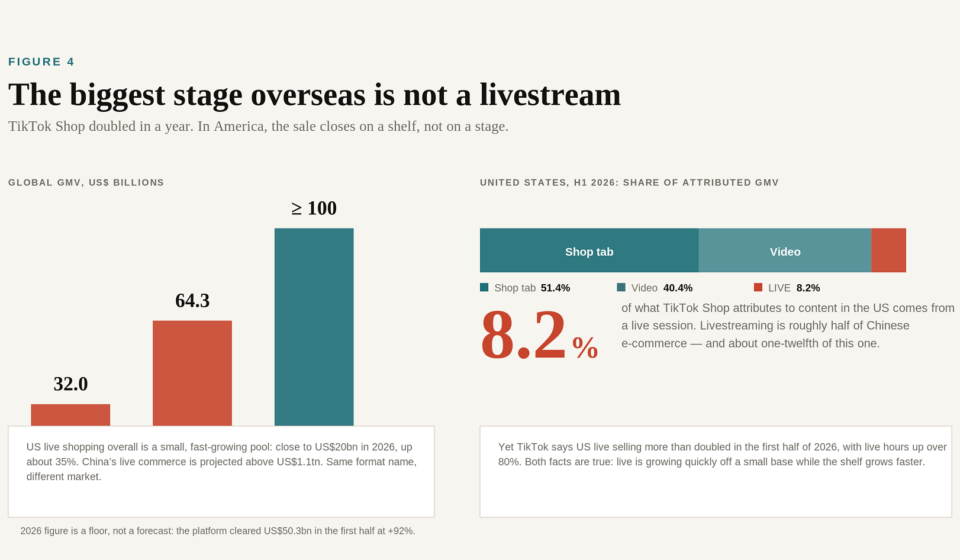
- TikTok Shop is the right venue by volume (about US$64 billion of global GMV in 2025, on pace past US$100 billion in 2026) and the wrong venue by format: in the United States, live sessions account for roughly 8% of what the platform attributes to content.
- Since May 2026, TikTok Shop’s US rulebook prohibits AI-generated voices and pre-recorded narration in shopping livestreams, requires real-time human speech, and caps synthetic figures at half the frame. The cheapest version of this technology is now the non-compliant version.
- The durable export is therefore the boring half: catalogue video, localisation, agentic product Q&A, and the paperwork that proves consent. The avatar is the flourish.
1. First, there are three kinds of digital human, and they are not substitutes
The word covers three products that share a face and nothing else.
Tier one is an agent wearing a body. A photo-real or filmed avatar, driven in real time by a speech model and a language model, able to answer an unscripted question, notice a comment, and improvise a demo. This is the only tier that can stand in for a host in the conversational sense, and it is the only tier with a serious compliance surface, because everything it says is a claim made on your behalf.
Tier two is a presenter reading a script. A filmed or synthesised person, triggered by keywords, looping through a product list. It looks alive. It answers like a menu. Most of what is sold as a digital human in China sits here, and most of what Chinese merchants actually use sits here too.
Tier three is a character that admits it is a character. Three-dimensional, illustrated, stylised, with a wardrobe and a voice and no pretence of being a person. Nobody has ever mistaken it for a human, which is precisely why it does not trigger the reflex that ruins the photo-real tier.
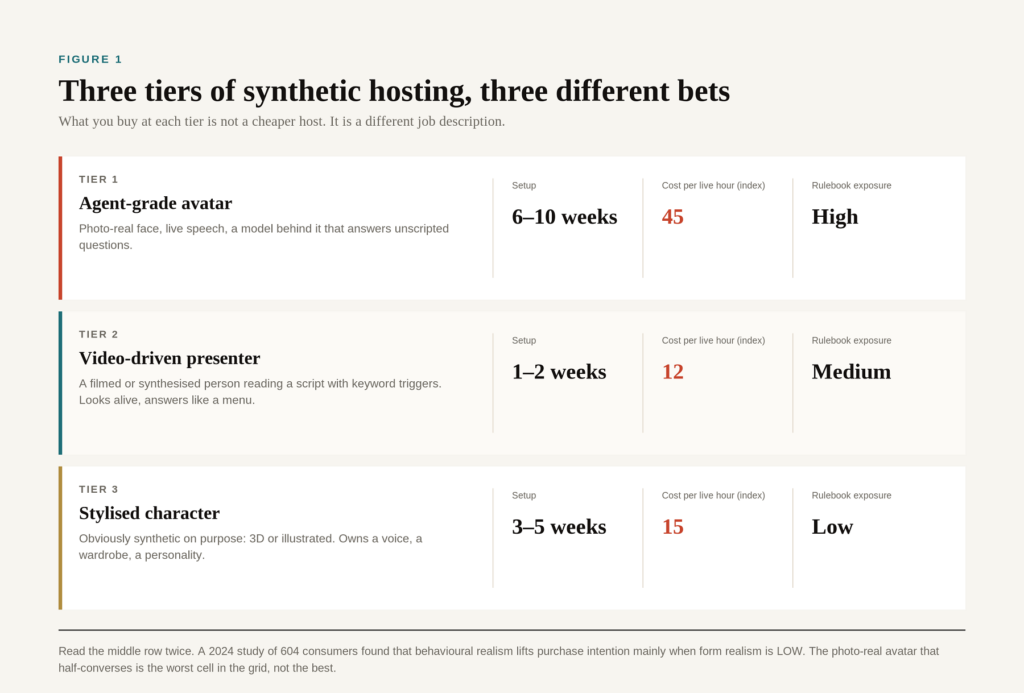
Here is the counter-intuitive part, and it is the most useful finding in the literature. A 2024 study with 604 participants and three controlled experiments tested how the realism of an AI streamer’s body and behaviour interact. The result: behavioural realism raises purchase intention mainly when form realism is low. When the avatar already looks like a photographed human, better acting does not rescue it. The mechanism is parasocial interaction, and the effect only holds for consumers who treat the relationship as communal rather than transactional.
Read that as a purchase instruction. If you cannot be a perfect human, do not look like one. The middle of the market — a photoreal body with a menu for a mind — is sitting in the valley, not on the peak.
2. The cost arithmetic: one-tenth is real, but it is a shift, not a salary
The number that circulates is that a digital human costs about a tenth of a live host. Treat it as an operating ratio that vendors and trade press converge on, not an audited figure, and then take it apart.
A live room’s cost is not a wage. It is a roster: host, operator, moderator, and the supervisor who covers the gaps. Add the set, the lights, the gear, the platform commission, and the creative that has to be rewritten weekly or the room dies. Multiply by the hours you want to be open. Then notice the thing that actually decides the ratio — how many of those hours a human would have worked.
Build the index honestly and the shape becomes obvious. Covering a room around the clock with people sets the reference at 100. Adding a synthetic night to a human day lands near 42. Running the room on people for eight hours and closing it lands near 33. So the night shift costs about nine points and buys sixteen hours. The marginal hour is where the whole claim lives.
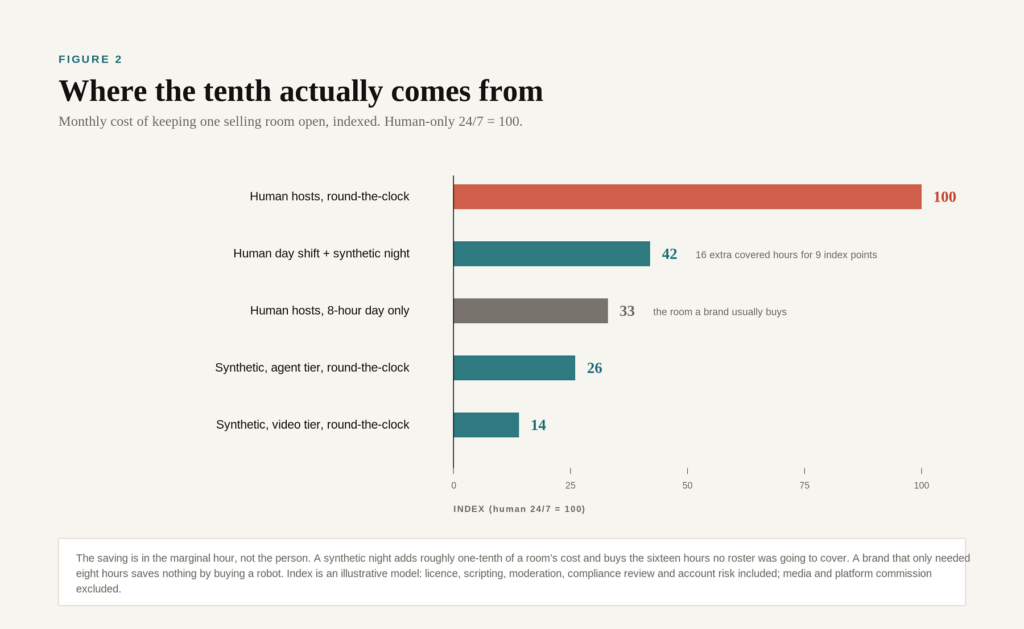
Which produces an uncomfortable corollary. If you only ever wanted eight hours, a robot saves you nothing. You were never buying a host. You were buying a shift pattern, and a shift pattern for the daytime is cheap.
Two costs also vanish from vendor quotes and then reappear on your P&L. The first is scripting: an avatar cannot fill silence with charm, so somebody has to write the silence out, week after week, in the local language. The second is compliance review, and it is not optional once a synthetic presenter is making product claims at three in the morning with nobody in the room.
3. Where it holds: catalogues, night hours, repeat buyers
The technology works where the product’s value is in its parameters rather than in its feel.
Standardised goods are kind to a synthetic host. Cables, cases, consumables, refills, supplements with a clear label, small appliances with three selling points, anything where the customer’s question is “which model” rather than “will this suit me”. The information is finite, the answers are stable, and the sale does not depend on the buyer believing that the person on screen has a body like theirs.
Night is where the arithmetic turns positive. Demand does not sleep, but wages do not either — a host costs the same at 3 a.m. as at 8 p.m., and the audience at 3 a.m. is worth less per impression. That gap is the entire business case. A synthetic room at 3 a.m. is not competing with a human room, because the human room was never open.
Repeat purchase is the quiet third condition. When the buyer already knows the product, the presenter’s job is retrieval and reassurance, not persuasion. That is a search problem with a face on it, and search problems are what language models are for.
There is also a fourth surface that gets ignored because it is unfashionable: the long tail. A brand with eight hundred SKUs cannot put a host behind each one. It can put a two-minute video behind each one, in four languages, generated from the same product feed. No live session, no audience, no risk of an avatar improvising a refund policy. Just a catalogue that talks. That is where most of the near-term value sits, and it is also the part that no platform currently bans.
Worth remembering that live commerce is a normalised behaviour in some markets and a novelty in others. In China it is roughly half of ecommerce. In the United States, live shopping overall is a pool of about US$20 billion in 2026, against a Chinese market projected at more than US$1.1 trillion. The format travels; the habit does not travel at the same speed.
4. Where it breaks: fit, complaints, and the thing people actually came for
Three failure modes, and only one of them is technological.
Fit. Apparel, footwear, eyewear, anything worn against the skin. A human host’s body is the try-on. An avatar’s body is a claim. When the claim is wrong, the cost does not appear in the room — it appears as a return, and returns are where the saved wage goes to die. Europe’s distance-selling withdrawal rights and the free-return expectations American shoppers now treat as a right turn a marginal sale into a negative one fast. The arithmetic that looked like nine-to-one becomes one-to-one and then worse.
Complaints. An avatar cannot decide. It cannot judge that this is the third time this customer has written, or that the right answer is a refund before the review lands. Routing complaints through a synthetic presenter is not a cost saving; it is a reputational loan with a short maturity.
The reason people were watching. Live commerce sells co-presence. The systematic review literature is fairly blunt about the mechanisms: trait-based trust, perceived social presence, and message framing. Strip the human out and you have removed one of the three inputs and weakened another. The survey data is consistent with that. When consumers detect AI-generated content in brand marketing, they are several times more likely to trust the brand less than more — one widely cited read of the data puts it at 31% reporting lower trust, against just 7% reporting higher.
Then there is fatigue, which compounds all three. One 2026 analysis estimated that a majority of videos on TikTok now carry signals consistent with AI generation, and platforms have started labelling at industrial scale. Scarcity was never the avatar’s problem. Abundance is.
The honest caveat: this literature is thinner than it looks. A 2026 systematic review of 41 peer-reviewed studies on virtual streamers found the field geographically concentrated, heavily reliant on self-reported intention rather than observed purchase, and short on longitudinal work. Which means nobody can tell you the conversion penalty with confidence. Plan for a discount factor, not a benchmark.
5. The overseas problem is not the accent. It is the rulebook
Everyone worries about the voice. Will a synthetic English accent sound foreign, will it mispronounce the brand, will it land the joke. Reasonable worries, and largely beside the point.
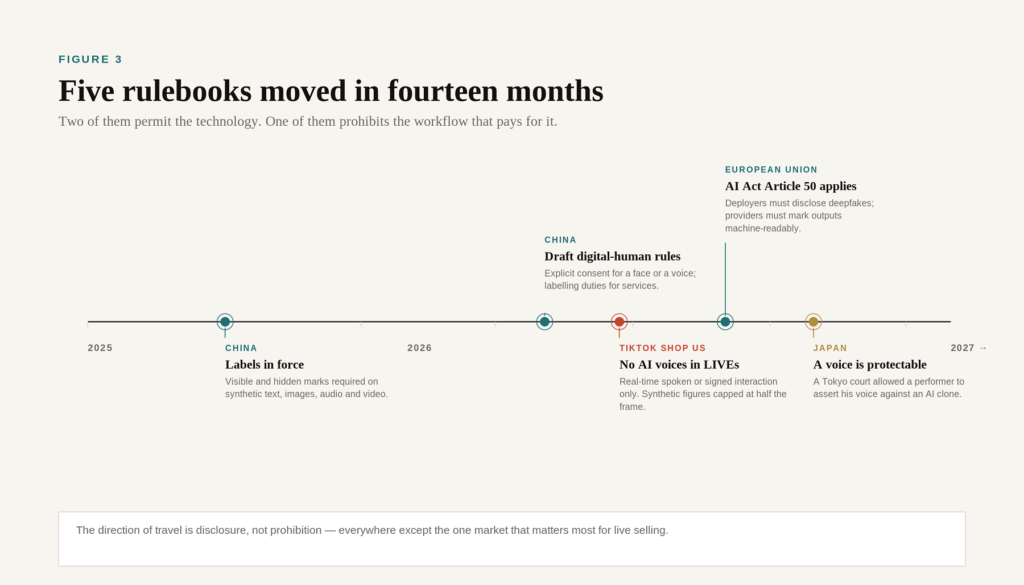
On 23 May 2026, TikTok Shop published its requirements for high-quality videos and LIVEs in its US seller academy. The prohibited list is specific: no AI-generated voices, no pre-recorded audio used as narration, no radio-style scripted audio. Broadcasters must engage viewers in real time, by speech or sign language. Still frames and non-live animated figures cannot exceed half the screen area. Enforcement is not advisory: violations feed an account health score that governs access to campaigns, commissions, and eventually the account itself.
Sit with that for a moment. The workflow that produces the ten-to-one ratio — a synthetic presenter, talking continuously, to nobody in particular, through the night — is the workflow the rule describes. The saving and the violation are the same object.
The rule is also narrower than the headlines about it. It bans non-real-time interaction, which leaves genuine grey zones that nobody has litigated yet: a live human host wearing a synthetic skin, a human speaking through real-time voice conversion, an avatar used as a visual aid beside a real presenter, and every pre-production use of AI from scripting to translation. In practice the compliant version of this technology in the US is not a synthetic host at all. It is a human, with a machine doing the boring parts.
Compare the two rulebooks inside one company. Douyin, TikTok’s Chinese sibling, has not banned synthetic streamers. It requires them to be labelled, registered, and supervised, within a national framework that has required visible and invisible marking of synthetic content since September 2025. Beijing’s posture is disclosure. Washington’s platform posture, at least on this surface, is prohibition. That divergence is not hypocrisy. It is a maturity gap: a market where viewers have spent a decade learning what a live room is can absorb a synthetic host with a label; a market still deciding whether the format is worth the friction cannot.
So the accent question resolves into something more practical. Since the cheap accent fix — text-to-speech — is off the table on the largest Western live surface, what is left is either hiring people who already speak the market’s language, or moving the synthetic work to surfaces where voice-over is permitted: product video, ads, post-purchase explainers, and markets whose rulebooks still allow it. The operating model exports. The host exports conditionally.
6. TikTok Shop is big enough to matter, and shaped wrong for the play
Start with the size, because the size is real. TikTok Shop’s global GMV roughly doubled to about US$64 billion in 2025. The first half of 2026 alone cleared US$50 billion, up 92% year on year, and the full year is tracking past US$100 billion. The United States was the largest single market in that half at US$11.8 billion, up 103%, with roughly 1.35 million stores and 20 million creators attached to the platform.
Now the shape, which is where the Chinese playbook breaks.
In the US, the marketplace tab accounted for just over half of what TikTok Shop attributes to content in the first half of 2026. Video accounted for about 40%. Live accounted for 8.2%. Read that again in the context of a company whose Chinese sibling built live commerce into roughly half of a trillion-dollar ecommerce market. The overseas platform is not a live business with a shop attached. It is a shop with a live feature.
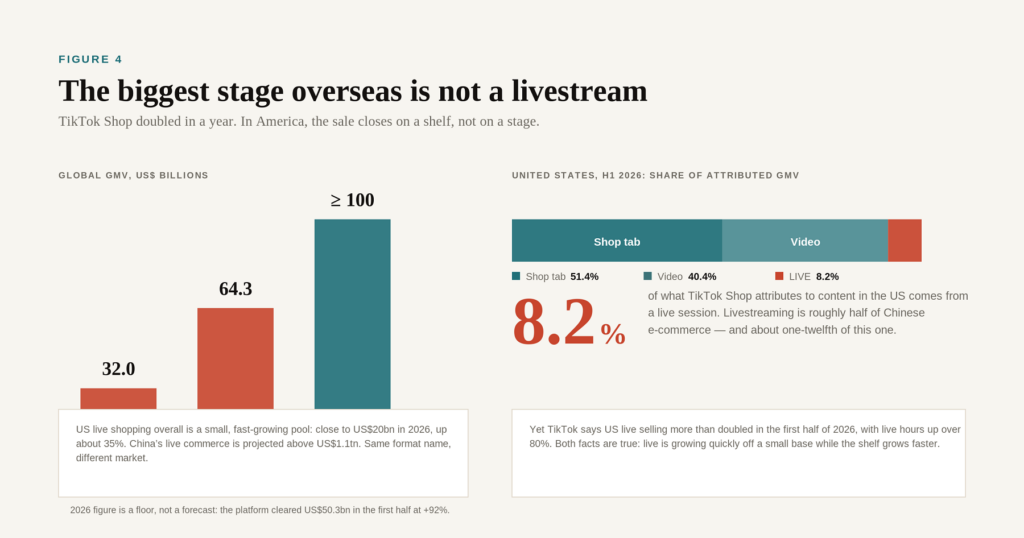
Both things are true at once, and the tension is instructive. TikTok says US live selling more than doubled in the first half, with live hours up over 80%. Live is growing quickly off a small base while the shelf grows faster. That is what a market looks like before the habit sets.
For anyone exporting a Chinese operating model, this is the single most consequential fact in the file. The night shift still makes sense. But its job is not to host a show in front of an audience that is not there. Its job is to keep a listing alive — a product page that answers, a short video per SKU, a room that exists for the few who wander in at 2 a.m. and for the algorithm that rewards continuous presence. That is a different product from the one Chinese merchants buy, and it is priced differently too.
7. Compliance has three files: disclosure, consent, territory
The regulatory question is usually framed as “do I have to say it is a robot.” That is the easiest of the three.
Disclosure. China’s labelling measures took effect on 1 September 2025 and require both a visible mark and a hidden, machine-readable one on synthetic text, images, audio and video. Europe’s AI Act Article 50 becomes applicable on 2 August 2026: deployers of deepfake image, audio or video must disclose that the content is generated, and providers must mark outputs in a machine-readable format. Platforms have built their own layer on top, with content credentials attached at the point of generation and labelling running into the billions of items. Disclosure is becoming plumbing. Budget for it and stop thinking about it.
Consent. Harder, and moving faster than most brand teams realise. China’s cyberspace regulator published draft measures on digital virtual human information services in April 2026, with consultation running into early May: explicit consent for the use of a person’s likeness, voice or other personal data, labelling duties, and a prohibition on using digital humans to defeat identity checks. In late September 2026, a Tokyo court allowed a performer to assert rights over his voice in a dispute with TikTok about an AI clone — the first time a Japanese court has treated a voice as protectable in this way. Voice is becoming a right, not a licence term.
For a brand, this converts into an unglamorous document: for every avatar, a file stating whose face and voice were used, for how long, in which territories, for which categories, with which exit clause. When the model is a real employee or a real creator, the file is also an employment and a talent-contract problem. When the model is fictional, the file is shorter and the risk is lower. That asymmetry alone should move some brands toward tier three.
Territory. One avatar, many jurisdictions, and consent that does not travel automatically. A model released for Chinese ecommerce may not have signed for German advertising. A voice licensed for one platform may not be licensed for another. Add data-residency rules, and the compliance file becomes a per-market artefact rather than a global one.
Here is the part worth noticing: this paperwork is becoming a product. Chinese suppliers that have already built consent capture, labelling and audit trails for a domestic regime that has been enforcing them for over a year are, in effect, exporting compliance maturity. Western studios are better at faces. The gap is in the file.
8. The supplier map: two archetypes, one missing layer
IDC’s first assessment of this category, published in April 2025, tested seven Chinese products across technical capability, product performance, commercial maturity, compliance and platform stability, and service. Two archetypes emerged.
Platform-type vendors sit inside a marketplace and inherit its traffic, its product data and its order history. Their advantage is distribution: the avatar is pre-integrated with the room, the listing, and the settlement. Their weakness is the same as their strength — the platform can build the feature itself, and eventually will.
Tool-enablement vendors sell rendering and cross-platform operation. They travel better between marketplaces, and they compete on visual quality, which is a race with a visible finish line and no moat at the end of it.
The assessment’s more useful findings were the negatives. Emotional interaction across the market was rated as homogeneous — most products cannot yet do the thing that distinguishes a good host, which is reading the room. Content compliance risk was flagged as structural, because autonomous rooms at scale generate advertising claims nobody reviewed. And many platforms were described as cautious about scaling synthetic anchors at all. That was 2025. The May 2026 rulebook suggests the caution was justified.
Then there is the layer that almost nobody sells, and that the export case actually needs: localisation plus governance. Not translation — localisation of script, price framing, sizing conventions, humour, and the specific claims that are legal in one country and actionable in another. A Chinese stack assumes a platform that permits the room. A Western buyer needs a stack that survives a platform that does not.
In a bake-off, ignore the demo reel. Ask five questions. What happens when the avatar is asked something outside the script — walk me through the fallback. Who writes the script, in which language, and how often. What is the labelling method, and is it machine-readable. Where is the consent file, and what happens on termination. And what does the account-health penalty look like when this goes wrong at 3 a.m.
9. A pilot design that survives contact with a platform
Most pilots fail because they test the technology instead of the business. Nobody learns anything from a robot reading a script to eleven viewers.
Run it against a business question: can we cover hours we currently do not cover, at a cost per incremental sale that beats not covering them.
Weeks zero to one: the audit. List every surface where synthetic content is permitted and every surface where it is not, for each market you sell into. Confirm labelling method. Confirm consent for any real person’s face or voice. This week is boring and it is the whole project.
Weeks two to three: build narrow. Twenty SKUs, not two hundred. Choose catalogue goods with stable answers and low return rates. Write the script by hand for the first ten, because the failure mode is not the avatar, it is the copy. Produce one short video per SKU plus one night-room loop.
Weeks four to nine: three cells, matched. Same SKUs, same budget, same weeks. Cell A: human-hosted, current practice. Cell B: synthetic only, on permitted surfaces. Cell C: hybrid — human day, synthetic night. Hold out hours, not just spend, or you will measure the algorithm’s mood instead of your decision.
Guardrails, agreed in writing before launch. No synthetic first contact on high-consideration goods. No synthetic handling of complaints or refunds. Every product claim pre-approved, and no dynamic generation of claims in a live room. A kill switch that a duty manager can hit without a meeting. A named owner for the account-health score.
The design detail that most teams skip: measure the nights you would otherwise have been dark, not the nights you replaced a human. Weekends at 2 a.m. are a different market from Tuesday at 8 p.m., and averaging them together produces a number that is true and useless.
10. The only KPIs that tell the truth
Cost per selling hour is the headline and the least interesting. It rewards you for being open when nobody is shopping.
Better set, in order of usefulness:
Revenue per covered hour, banded by time of day. If the 2 a.m. band does not clear its own cost within two quarters, the model is wrong for your category, and no amount of avatar quality fixes it.
Incremental revenue against a dark-room control. Not against your human-hosted sessions. Against the counterfactual where the room was closed. This is the only comparison that answers whether the night shift created value or moved it.
Return rate delta by cell. The silent killer. A two-point rise in returns can erase a ten-to-one labour saving on low-ticket apparel.
Hours covered per operator. The real productivity gain is not the host’s wage, it is that one producer can supervise several rooms. Track it, because it is where the scaling actually happens.
Account health trend. Whatever the platform calls it — a score, a rating, a tier — treat it as a leading indicator with the same seriousness as revenue. A banned room has an infinite cost per selling hour.
Share of revenue from non-live surfaces. If catalogue video and product-page Q&A do not grow, you have bought a stage in a market that is buying shelves.
One anti-metric worth naming: GMV per stream. A twenty-four-hour room generates more streams and dilutes the average. The number will fall as the strategy succeeds, and somebody in finance will notice at exactly the wrong moment.
11. The hybrid model is the end state, not the compromise
The interesting question was never human or machine. It is which part of the job each one is bad at.
Humans are bad at repetition, at 3 a.m., at the four hundredth identical question. Machines are bad at judgement, at objection handling, at the moment a customer says something that is not in the script. Put them in the same room and the division is obvious: the machine covers, the human converts.
Concretely, three patterns are emerging and they are not equally difficult.
Cover-and-escalate. A synthetic presenter runs the quiet hours and hands off when a viewer signals intent — a cart of a certain value, a question about compatibility, a complaint keyword. The handoff is the product. Design it before you design the avatar.
Human-led, machine-assisted. A human host runs the show; the machine handles the wall behind them — spec cards, comparison answers, live translation, the twenty questions the host does not have time for. Fully permitted on the platforms that ban synthetic voices, because the voice is human.
Machine-produced, human-approved. No live session at all. Catalogue video, ad variants, product-page answers, post-purchase explainers, all generated and all reviewed before publication. The least glamorous pattern and, on current evidence, the highest return per unit of risk.
The organisational consequence is underrated. A synthetic room does not need fewer people; it needs different ones. The job that grows is room director: someone who owns the script library, the escalation rules, the claim approvals and the account health. That is a marketing operations role, not a production role, and most teams do not have it yet.
12. 2027: three forecasts and what would prove them wrong
One. Rulebooks converge on disclosure, but not before 2028 in the US. The direction is set: China labels, Europe labels, platforms label at scale. Prohibition is the exception, and it is the exception because the format is young in the market that imposed it. My expectation is that the US rule softens into a disclosure-plus-quality regime once live shopping has enough volume that banning the cheap production method costs more than it protects. What would prove me wrong: a second consecutive year of tightening, or a platform extending the voice ban to shoppable video.
Two. Competition moves from faces to files. Avatar quality is converging, and the differentiation that survives is the unglamorous stack: catalogue integration, localisation, consent documentation, and the ability to switch surfaces when a rule changes. Vendors that sell only rendering will be priced like rendering. What would prove me wrong: a step-change in real-time emotional interaction that buyers can actually measure in conversion.
Three. Chinese suppliers go around the brand, not through it. The obvious route — sell the avatar to a Western brand — runs into the platform wall and the trust ceiling. The route that works is selling the stack to the operators who already run local rooms: agencies, marketplace service providers, and the growing cohort of creator-led shops. That is a B2B business with Chinese unit economics and local faces. What would prove me wrong: a Chinese consumer brand building a synthetic-host franchise that Western audiences recognise by name.
Underneath all three sits a number worth watching more than any other. If live’s share of TikTok Shop’s attributed GMV in the US climbs past 20%, the format has arrived, the rulebook has a reason to soften, and the Chinese operating model becomes directly transferable. Until then, the export is a night shift, a catalogue, and a file of consents.
Which is a less exciting story than a robot that sells. It is also the one that survives a platform audit.
The close
The digital human is not the product. It is the visible edge of a system for owning hours, and the system is what has been built, tested, priced, and regulated first in China.
Export it carefully. Keep the shift, keep the catalogue, keep the paperwork. Lose the fantasy that the face is the point — because the platforms have already decided that the face, when it speaks without a human behind it, is the risk.
Frequently asked questions
Can I legally run an AI host on TikTok Shop in the US? Not as a speaking presenter. Since May 2026, TikTok Shop’s US requirements prohibit AI-generated voices and pre-recorded narration in shopping livestreams and require real-time human speech or sign language. Synthetic figures are permitted within limits — they cannot occupy more than half the frame — and AI remains allowed in pre-production and in shoppable video. The compliant configuration is a human host with machine assistance, not a machine host.
Is a digital human really one-tenth the cost of a live host? For the hosting line, on hours a human would not have worked, the ratio is in that neighbourhood. It is not a general claim about labour costs. Per staffed hour the gap is far smaller, and once you add scripting, moderation, compliance review, return-rate risk and account-health exposure, the all-in ratio moves. The saving exists, but it belongs to the night, not to the salary.
Which products should never be sold by an avatar? Anything where the body on screen is part of the evidence: apparel, footwear, eyewear, anything worn. Anything where the decision is emotional and the objection is personal. Anything regulated, where an improvised claim is a liability. And anything where a complaint is likely, because complaint handling is a judgement task and judgement is the one thing the technology does not have.
Do synthetic hosts convert worse than humans? Probably, and nobody can say by how much. The peer-reviewed literature on virtual streamers is dominated by survey-based intention studies, concentrated geographically, and short on observed purchases over time. The direction of the effect is negative for trust-sensitive categories; the magnitude is unmeasured. Plan a discount factor into the model and let your own holdout tell you the number.
What should a brand do first? Audit the surfaces, not the vendors. Work out which of your selling surfaces permit synthetic content in each market, what labelling each requires, and whose consent you need. Then pick twenty catalogue SKUs and one permitted surface, run nine weeks against a dark-room control, and measure incremental revenue per covered hour rather than cost per stream. The technology decision is easy once the compliance map exists. Without it, the technology decision is a coin flip.