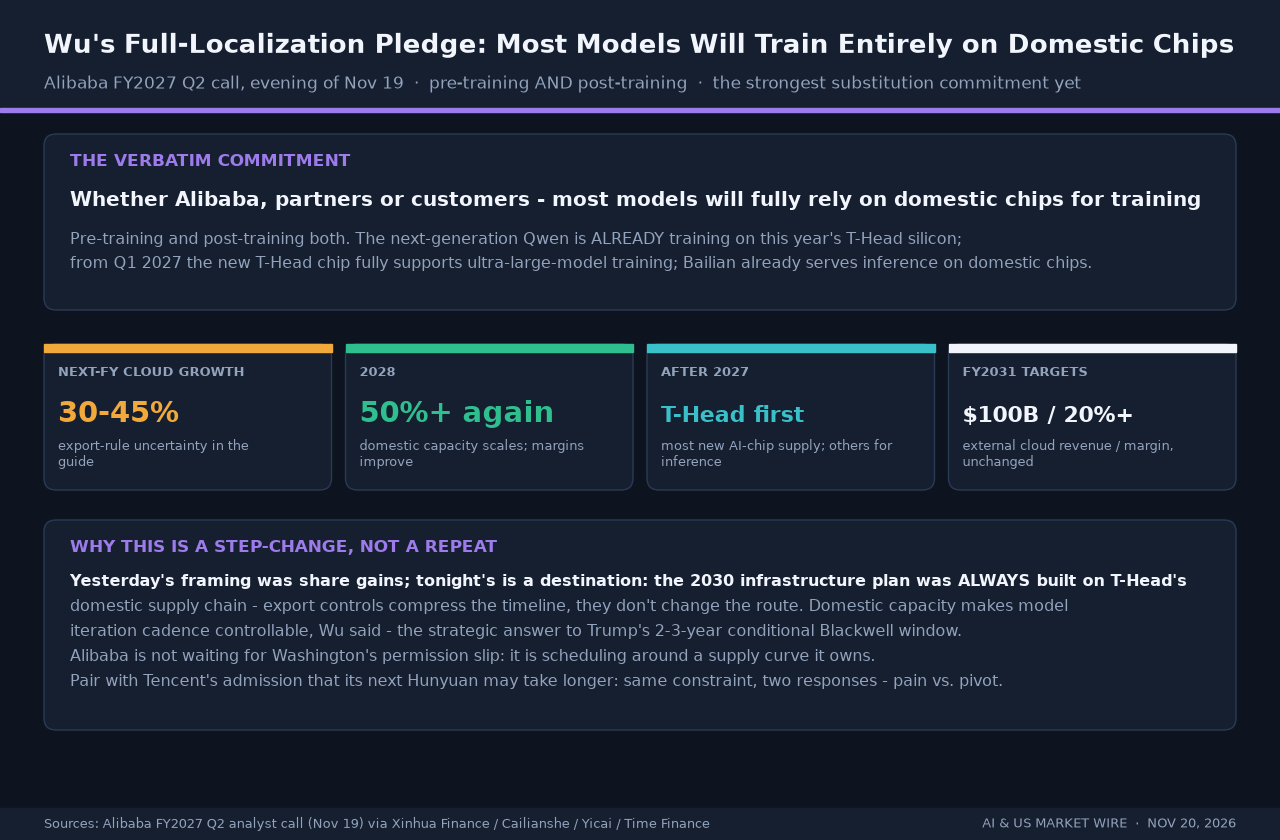
On the FY2027 Q2 analyst call the evening of November 19, Alibaba CEO Wu Yongming escalated yesterday’s “share gains” framing into a destination statement, verbatim: “whether Alibaba, partners or customers, most models will fully rely on domestic chips for training — pre-training and post-training both.” The operational proofs are already running: the next-generation Qwen is training on this year’s T-Head silicon now, from Q1 2027 the new T-Head chip fully supports ultra-large-model training, and Bailian already serves inference on domestic chips; after 2027 most new AI-chip supply is T-Head-first, with other domestic brands mixed into inference. The guidance frames the transition cost honestly — next fiscal year’s cloud growth at 30–45% under export-rule uncertainty, re-accelerating above 50% in 2028 as domestic capacity scales and margins improve, with FY2031 targets ($100B external cloud revenue, 20%+ margins) unchanged because the 2030 infrastructure plan was always built on T-Head’s supply chain.
The strategic read: China’s largest cloud is not waiting for Trump’s conditional 2–3-year Blackwell window — it is scheduling around a supply curve it owns, making model-iteration cadence controllable; paired with Tencent’s same-week admission that its next Hunyuan may take longer, the two giants illustrate the same constraint’s two responses: pain, and pivot.