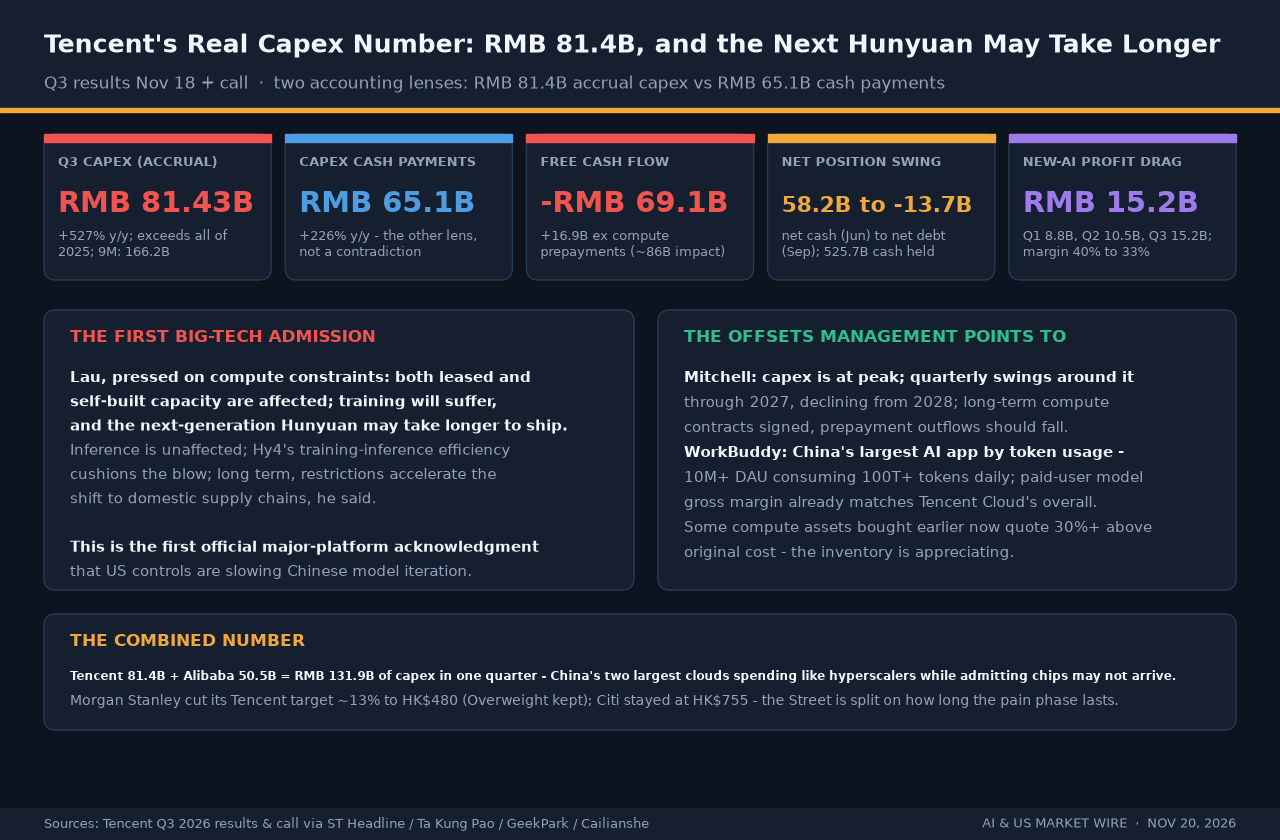
Tencent’s Q3 capex was RMB 81.43 billion on the accrual basis (+527% y/y, exceeding all of 2025; nine-month total RMB 166.2 billion), while the RMB 65.1 billion figure circulating earlier is the cash-payments lens (+226%) — two columns of the same disclosure, not competing numbers; free cash flow was negative RMB 69.1 billion (positive 16.9 billion excluding ~RMB 86 billion of compute prepayments), swinging the balance sheet from RMB 58.2 billion net cash in June to RMB 13.7 billion net debt in September despite RMB 525.7 billion of cash holdings, and new-AI products dragged RMB 15.2 billion from adjusted operating profit this quarter (Q1 8.8B → Q2 10.5B → Q3 15.2B, margin 40% → 33%).
The substantive first: pressed on compute constraints, President Martin Lau admitted both leased and self-built capacity are affected, training will suffer, and the next-generation Hunyuan may take longer to ship — the first official major-platform acknowledgment that US controls are slowing Chinese model iteration, with inference unaffected and long-term domestic substitution accelerating.
The offsets: CSO James Mitchell says capex is at peak through 2027 and declines from 2028 as long-term contracts replace prepayments; WorkBuddy is China’s largest AI app by token usage (10M+ DAU, 100T+ tokens daily) with paid-user model margins already matching Tencent Cloud’s; and some earlier-bought compute now quotes 30%+ above cost.
Tencent plus Alibaba spent RMB 131.9 billion of capex in one quarter — hyperscaler-scale spending with an admitted supply ceiling; Morgan Stanley cut its target ~13% to HK$480 while Citi held HK$755.