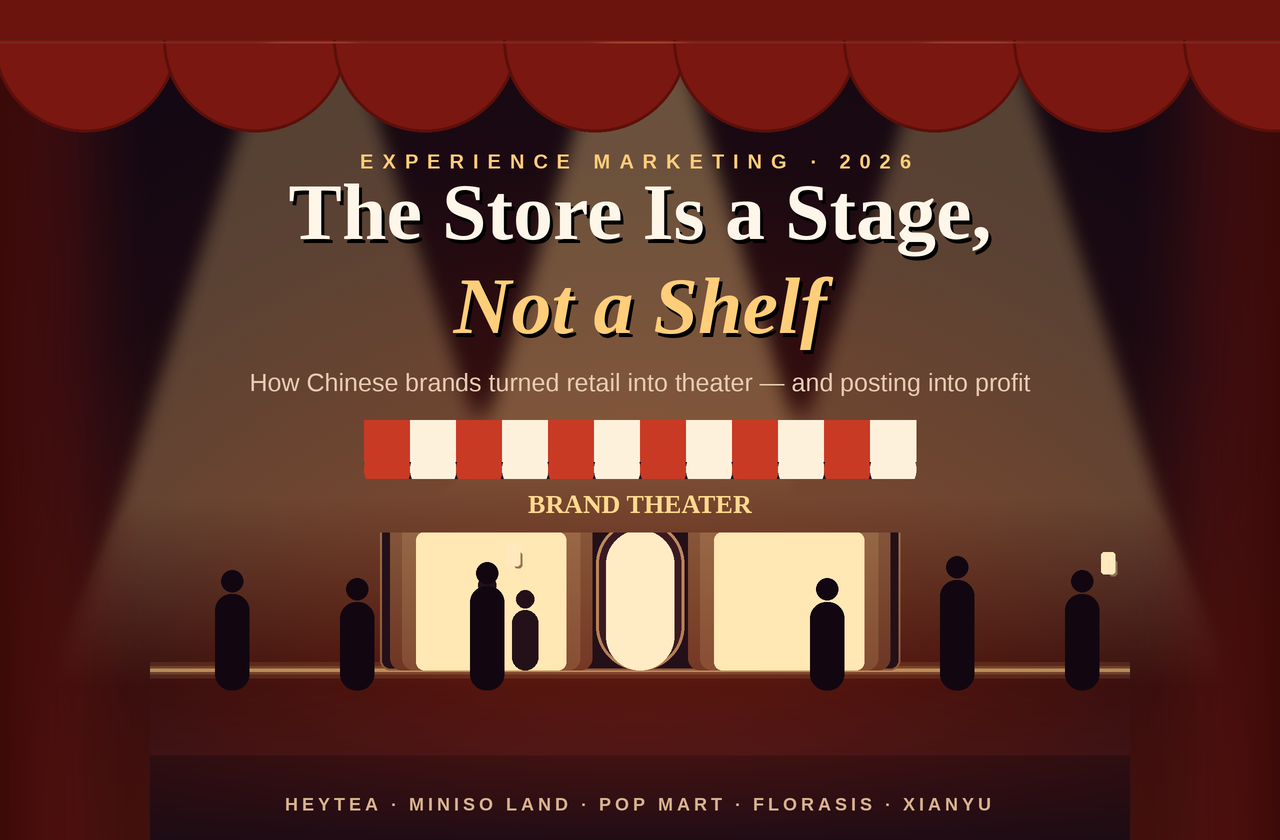
Offline retail was supposed to die. E-commerce would eat it, the story went — why would anyone drive to a store when everything ships overnight? Two decades into that prediction, something stranger happened. The physical store did not die. It changed jobs. The shelf moved online; the stage stayed offline. Walk through Shanghai’s Nanjing East Road, Bangkok’s ICONSIAM or Tokyo’s Ginza today and you will find flagship stores that behave less like shops and more like theaters — and the ticket price is your attention, your photos, and your feed.
That is brand theater: stores designed to be worth posting about, where the experience is the product and the transaction is almost a souvenir. Chinese brands are directing this play better than almost anyone, and the research finally explains why the box office works.
A Prediction That Aged Badly
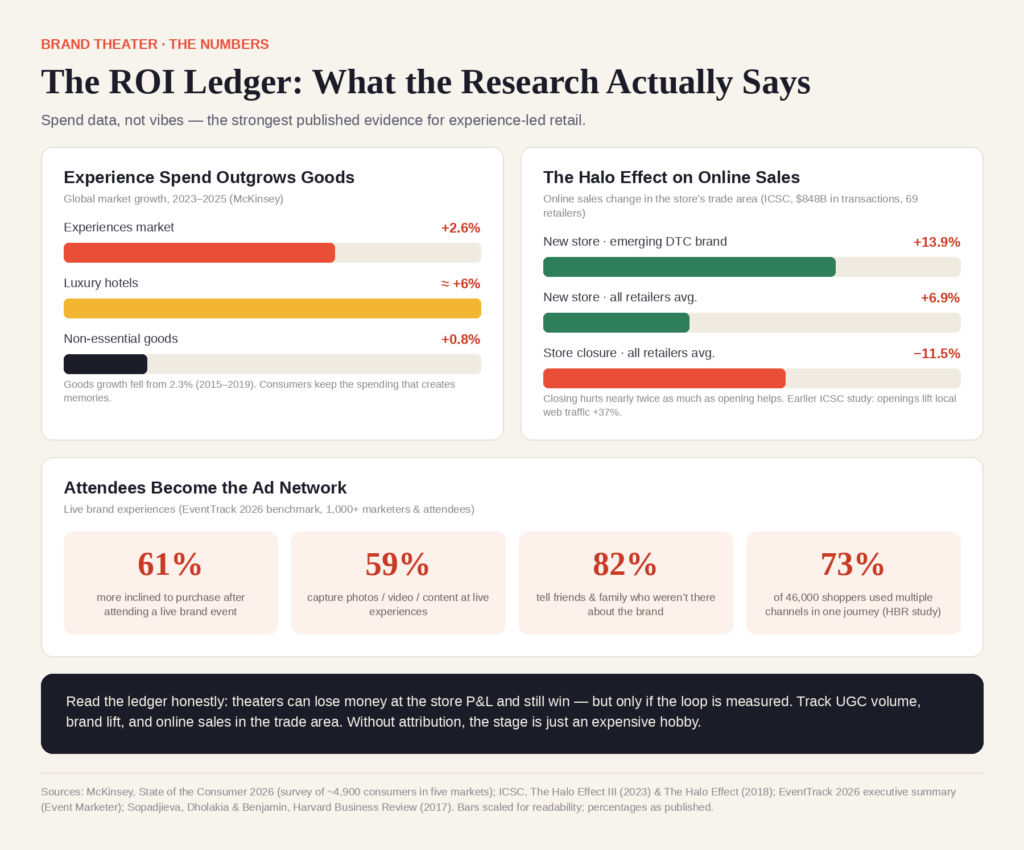
McKinsey’s State of the Consumer 2026 report puts numbers on the reversal. Between 2023 and 2025, the global experiences market grew 2.6% — roughly its pre-pandemic pace — while non-essential goods crawled along at 0.8%, down from 2.3% before 2020. Luxury hotels grew nearly 6%, almost double the rate of hotels overall. When budgets tighten, consumers do not cut everything evenly. They protect the spending that becomes a memory.
This is not a new idea, just a newly urgent one. Back in 1998, B. Joseph Pine II and James Gilmore told Harvard Business Review readers that companies would soon stage experiences the way theaters stage plays — services as the stage, goods as the props. What they could not foresee was the camera in every pocket. Today the audience does not just watch the show. It broadcasts it.
The Flagship-Theater Wave: Five Stores, One Script
Look at what leading Chinese brands actually built between 2024 and 2026, and a pattern snaps into focus.
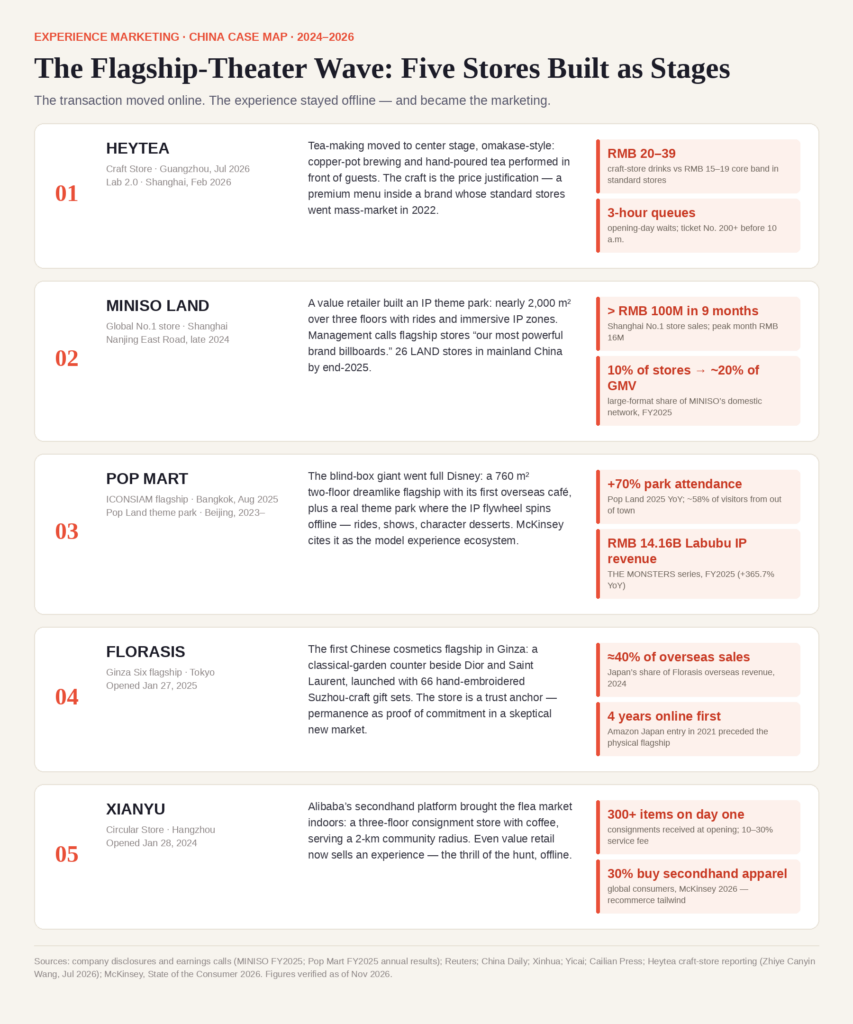
Heytea spent 2022 escaping its premium image — it publicly said goodbye to the RMB 30 era, and its standard menu settled into a RMB 15–19 core band. Then, in July 2026, it opened its first craft store in Guangzhou and walked prices back up to RMB 20–39. Tea masters brew in copper pots and hand-pour single-origin teas at a counter, omakase-style, in front of the guest. Opening-day visitors queued for three hours; by the time doors opened at 10 a.m., ticket numbers had already passed 200. Earlier that year, its Lab 2.0 in Shanghai drew four-hour waits and resellers charging RMB 50–100 just to place an order for someone else. Nobody queues like that for a shelf.
MINISO, the ten-yuan variety chain, built a theme park instead. Its MINISO LAND global flagship on Nanjing East Road spans nearly 2,000 square meters over three floors, complete with rides and immersive IP zones. It crossed RMB 100 million in sales within nine months, peaking at RMB 16 million in a single month. By the end of 2025 the company ran 26 LAND stores in mainland China — and founder Ye Guofu announced plans to close and rebuild 80% of the existing network into large formats of at least 400 square meters. That is not renovation. That is a rewrite.
Pop Mart went furthest. In August 2025 it opened a 760-square-meter landmark flagship at ICONSIAM in Bangkok — two dreamlike floors, a four-meter Molly in Thai dress, and the brand’s first café outside China. In Beijing it runs an actual theme park, Pop Land, where 2025 attendance grew more than 70% year over year and roughly 58% of visitors came from out of town. Tourists travel to visit a toy brand. McKinsey’s 2026 consumer report singles out Pop Mart as the model of a product company building an experience ecosystem — the park feeds the IP, the IP feeds the park, and a Labubu film with Sony Pictures is next.
Florasis chose a different stage: credibility. In January 2025 the Hangzhou cosmetics brand opened its first overseas flagship in Ginza Six, Tokyo — the first Chinese beauty flagship in Ginza, a garden-styled counter sitting beside Dior and Saint Laurent. It launched with 66 hand-embroidered gift sets showcasing Suzhou needlework. Japan already accounted for about 40% of Florasis’s overseas sales; the flagship was not there to move units. It was there to say: we are real, and we are staying.
Even Alibaba’s secondhand platform Xianyu joined the cast. Its Circular Store, opened in Hangzhou in January 2024, turned consignment into a three-floor community destination with coffee on the menu, drawing more than 300 consigned items on day one. Experience is not a luxury-only game. The thrift aisle has a stage now too.
The Store’s Job Changed: From Selling to Being Worth Posting
Here is the reframe that makes all five cases coherent. In the old model, the store’s job was to sell; marketing’s job was to drag people in. In the theater model, the store’s job is to be worth posting about. The scene generates the photos; the photos generate the reach; the reach generates demand somewhere else — usually online. The visitor becomes the media channel.
MINISO’s own earnings call says it plainly. Management described tens of thousands of consumers sharing LAND store visits on Xiaohongshu, Douyin and WeChat Moments, and called physical stores the company’s most powerful brand billboards and its most enduring source of consumer traffic. When a CFO calls stores billboards, the P&L argument is already over: this line item is media spend.
Four Engines Under the Stage
Why does theater work? Strip away the spectacle and four mechanisms do the heavy lifting.
Engine One: Social Currency
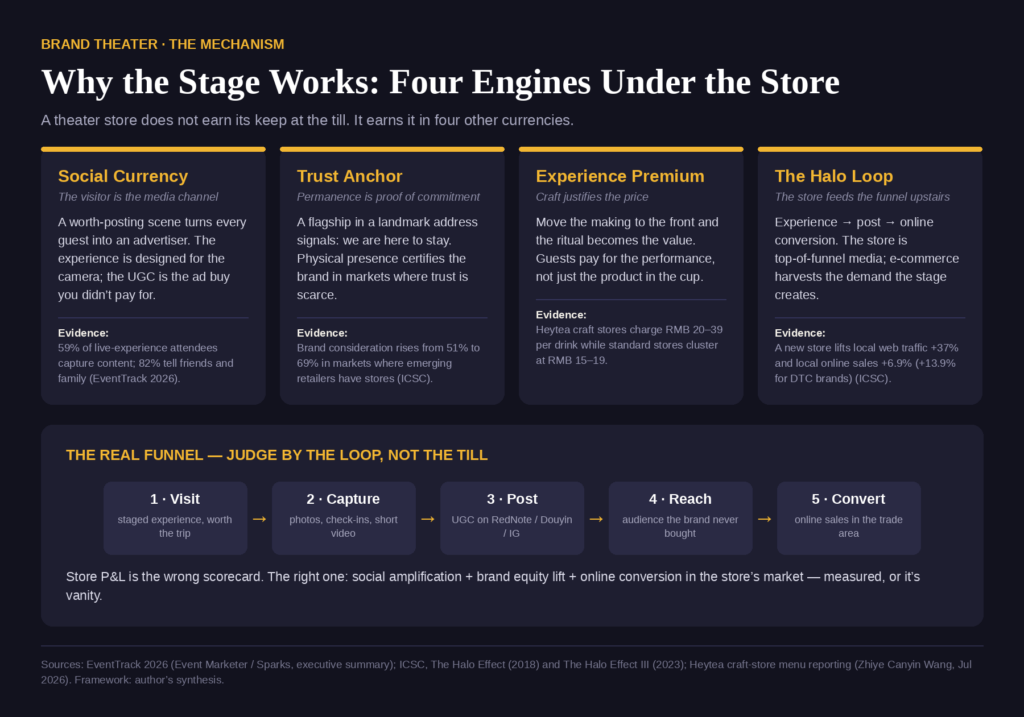
A worth-posting scene converts guests into advertisers. The experience is designed for the camera — the queue, the copper pot, the four-meter Molly — because the photo is the distribution. EventTrack 2026, the experiential industry’s benchmark study, found that 59% of attendees capture content at live brand experiences and 82% tell friends and family who were not there. Your reach is no longer what you bought. It is what your guests decided to broadcast.
Engine Two: The Trust Anchor
A flagship in a landmark address is a signal that cannot be faked cheaply. Rent in Ginza Six is a hostage: no fly-by-night operation posts collateral like that. This matters most for brands entering skeptical markets, which is exactly why Florasis spent four years selling online in Japan before planting a physical flag. The International Council of Shopping Centers found that consumers in markets where emerging retailers have stores consider those brands 69% of the time, versus 51% elsewhere. Presence is certification.
Engine Three: The Experience Premium
Move the making to the front and the ritual becomes the value. Heytea’s craft store charges up to RMB 39 for a drink while its standard stores sell at RMB 15–19 — and the difference is not sugar. It is the visible labor, the copper pot, the story you can retell. Pine and Gilmore called this staging; economists would call it de-commoditization. Either way, the performance justifies the price in a way a better recipe never could.
Engine Four: The Offline-Online Loop
The store feeds a funnel that closes online. ICSC’s Halo Effect research series measured it with real money: its 2023 installment analyzed roughly $848 billion in card transactions across 69 retailers and 2,103 stores, and found that opening a store lifts online sales in the surrounding trade area by 6.9% on average — 13.9% for emerging direct-to-consumer brands. Closing a store cuts local online sales by 11.5%. The earlier 2018 study found openings lift local website traffic by 37%. The stage is top-of-funnel media, and e-commerce is the box office that collects.
The ROI Ledger: Judge by the Loop, Not the Till
This is where most commentary gets lazy. Critics point at a theater store’s thin margins and declare the model a vanity project. Defenders wave at brand values and refuse to measure anything. Both are wrong, and the data adjudicates.
A Harvard Business Review study of 46,000 shoppers found 73% used multiple channels in a single purchase journey — only 7% shopped purely online. The customer was never channel-loyal; the reporting structure was. EventTrack 2026 reports 61% of consumers are more inclined to purchase after attending a live brand event. And MINISO’s large-format stores, about 10% of its domestic store count by the end of 2025, contributed nearly 20% of domestic GMV — theaters that also sell, when the IP is right and the location is prime.
The honest position: judge a theater store the way you judge a campaign. Track UGC volume and sentiment, brand consideration lift in the market, and online sales in the trade area around the store. ICSC’s closure data is the sharpest argument here — shutting the stage costs nearly twice what opening it earns, which means the store’s value was never fully visible in its own register anyway. But the loop must be measured. An unmeasured theater is not brand-building; it is an expensive hobby with good lighting.
Pop-Ups: Scarcity as a Ritual
If the flagship is a resident theater company, the pop-up is a limited run — and the closing date is part of the script. Temporary means worth posting now. The same scarcity psychology that makes a brand day or a limited drop convert makes a two-week installation urgent: miss it and you miss the content moment too.
Florasis ran this playbook in sequence: a pop-up inside @cosme Tokyo in early 2023, a seasonal store in Isetan Shinjuku that August, then the permanent Ginza flagship in 2025. Each temporary act tested the audience before the brand committed to a permanent stage. IBISWorld counts a $15.6 billion pop-up shop industry in the United States alone in 2026 — modest as retail, enormous as a testing infrastructure. The pop-up is not a gimmick. The gimmick is the mechanism.
What Everyone Gets Wrong
Three errors keep circulating. First, offline is dead — no; the transaction moved online and the experience stayed, so what died was the shelf’s monopoly on the store’s purpose. Second, the store must sell — the theater store’s return lives in amplification, trust and downstream conversion, and demanding a clean store-level P&L is like demanding a billboard close deals. Third, experience means luxury — MINISO sells affordable IP joy and Xianyu stages secondhand treasure hunts; worth-posting works at every price tier because the currency is social, not monetary.
The Counterargument, and Where It Breaks
The strongest objection is real: novelty decays. Heytea’s own history proves it — its lavish handmade-craft concept store in Shenzhen, opened in 2021 with teas up to RMB 138, quietly closed about a year later, and several early Lab stores shut in 2022. A stage that stops surprising stops earning posts. Design press covering Pop Mart’s Bangkok flagship raised the same worry: when the wow factor fades, does the magic hold?
The limit of the objection is that not every engine runs on novelty. Trust-anchor value persists as long as the doors stay open; the halo effect on local online sales showed up in transaction data even after researchers excluded the opening honeymoon weeks from the measurement window. The synthesis is operational: theaters need a refresh budget, like any media property. Pop Land’s answer was a year-long renovation and a new Labubu Forest zone in 2026; MINISO’s is a rolling program that remodeled 290 stores in 2025 with reported sales uplifts of 40–50%. Novelty is a consumable. Budget for it.
A Playbook for Brands Outside China
You do not need a theme park to run this play. Five moves transfer:
- Design for the camera. Pick the one moment guests will photograph — the pour, the wall, the ritual — and build the space around it. If nothing is worth posting, nothing will be.
- Budget the store as media. Move flagship costs into the marketing ledger mentally, and hold them to campaign metrics: reach, brand lift, downstream conversion.
- Use the flagship as a trust anchor. Entering a skeptical market? Physical permanence in a credible address does what no ad budget can.
- Run pop-ups as rehearsals. Test the city, the assortment and the audience with temporary acts before signing a permanent lease.
- Instrument the loop. QR bridges, trade-area sales analysis, UGC tracking. The halo is measurable — ICSC proved it with card data. Measure yours or fly blind.
Conclusion
Offline did not die; it auditioned for a new role and got it. Heytea’s craft counter, MINISO’s IP parks, Pop Mart’s literal theme park, Florasis’s Ginza garden and Xianyu’s community flea market all run the same script: the store is a stage, the experience is the product, the visitor is the channel, and the sale often closes online. The research backs the drama — experience spend outgrows goods, presence lifts trust, stages lift surrounding e-commerce, and attendees broadcast for free. The reusable lesson is four words long: direct the theater deliberately. Design for the camera, judge by the loop, refresh the novelty, and measure everything. The shelf never earned a standing ovation. The stage can.