Walk into a media-buying meeting in New York and you will hear about bid strategies, supply paths, and verification vendors. Walk into one in Shanghai and you will hear about rate cards, MCN relationships, and which platform sales team can unlock a festival slot. Same industry, same goal — buying attention — but two different languages for how a deal actually happens.
For years, the lazy summary has been that the West buys programmatically while China buys relationally. That framing is wrong in an interesting way. China runs some of the most sophisticated real-time auction machinery on earth. What differs is not the presence of auctions. It is what sits on top of them, and what, exactly, the money is buying.
This piece compares the two models the way a buyer should: by the object of purchase, the pricing mechanism, the opacity each system tolerates, and where both are heading as AI moves in.
Two Buying Motions, One Industry
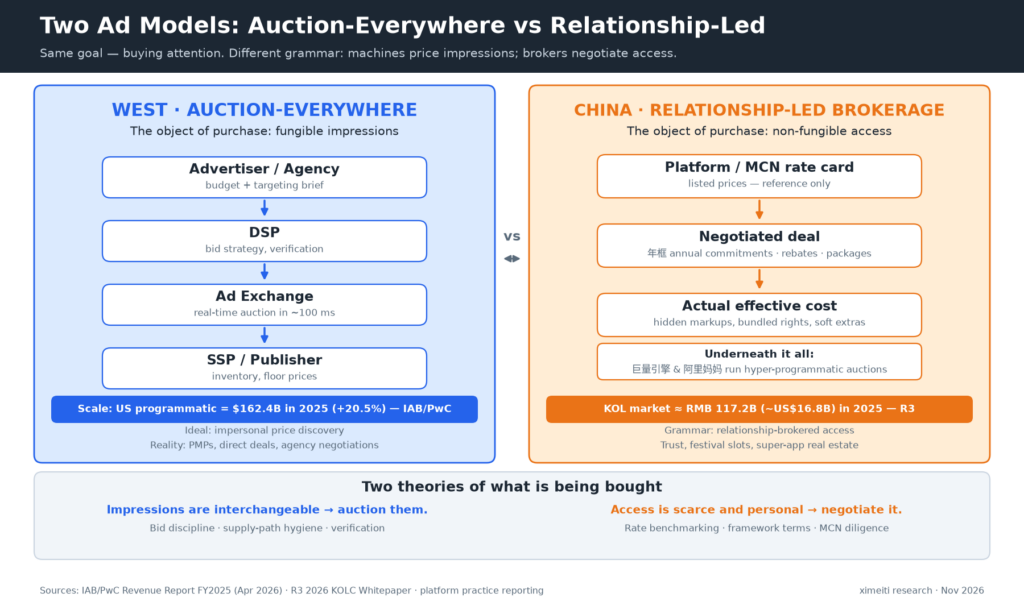
The Western motion is familiar. An advertiser sets a brief, a demand-side platform bids into exchanges, supply-side platforms offer inventory, and an auction clears in roughly a hundred milliseconds. The grammar is impersonal price discovery. Even the walled gardens run internal auctions; Meta and Google simply keep the exchange inside their own walls.
The Chinese motion has an extra floor in the building. Underneath, platform consoles like Ocean Engine and Alimamarun massive real-time auctions for performance inventory. Above them sits a brokerage layer: KOL and MCN price negotiation, annual framework commitments known as Year frame, agency rebates, and resource-package bargaining for splash screens, brand zones, and festival positions. The auction is real. It is just not the whole market.
The Western Grammar: Auctions as the Default
Programmatic became the West’s default because the open web produced something auctions love: fungible impressions. A banner on one mid-tier site is roughly interchangeable with a banner on another, so impersonal bidding is an efficient way to clear the market.
The scale confirms it. In the IAB/PwC Internet Advertising Revenue Report for full-year 2025, released in April 2026, US internet ad revenue reached $294.6 billion, up 13.9%. Programmatic accounted for $162.4 billion of that, growing 20.5% — faster than the market itself. eMarketer’s January 2025 forecast expects programmatic to reach 90% of worldwide digital display spending by 2026, capturing nearly all new display dollars.
But notice the fine print. The Western ideal was never pure auction. Private marketplaces, programmatic guaranteed deals, and upfront negotiations are all relational instruments — they just orbit the auction rather than replace it. The grammar is bidding; the exceptions are deals.
The Chinese Grammar: Brokerage Wrapped Around Auctions
China’s performance layer is hyper-programmatic. Ask anyone running Qianchuan campaigns on Douyin: bids, targeting, oCPM optimization, all machine-driven. The relationship layer sits above it, where the inventory stops being interchangeable.
A minute inside a top livestream, a Xiaohongshu search position for a category keyword, a splash screen on a festival morning — these are not fungible impressions. They are access to specific trust and specific scarcity, and access gets negotiated. The evidence goes back years: in a 2016 Digiday report, the COO of programmatic video firm ReachMax described Chinese media buying as very much relationship-driven, and eMarketer data in the same report showed non-auction programmatic direct deals at roughly 60% of China’s programmatic display spend that year. The pattern did not disappear as auctions matured. It institutionalized.
The Price Scissors: What Opacity Actually Costs
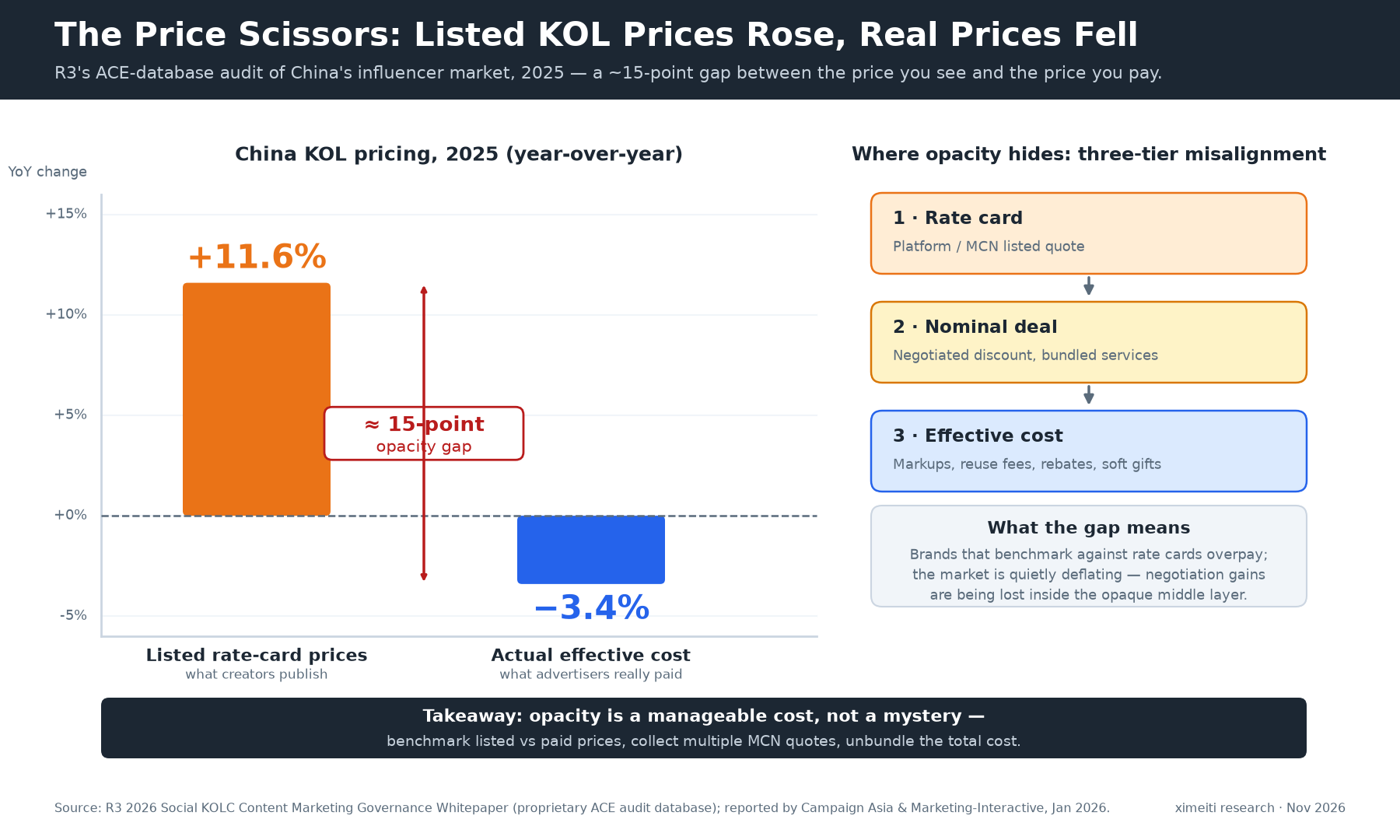
The cleanest evidence of the brokerage layer’s pricing behavior comes from R3, an independent marketing consultancy, in its 2026 Social KOLC Governance Whitepaper, built on its proprietary ACE audit database. In 2025, listed KOL rate-card prices rose 11.6% while actual effective costs paid by advertisers fell 3.4% — a gap of roughly 15 percentage points between the price you see and the price you pay.
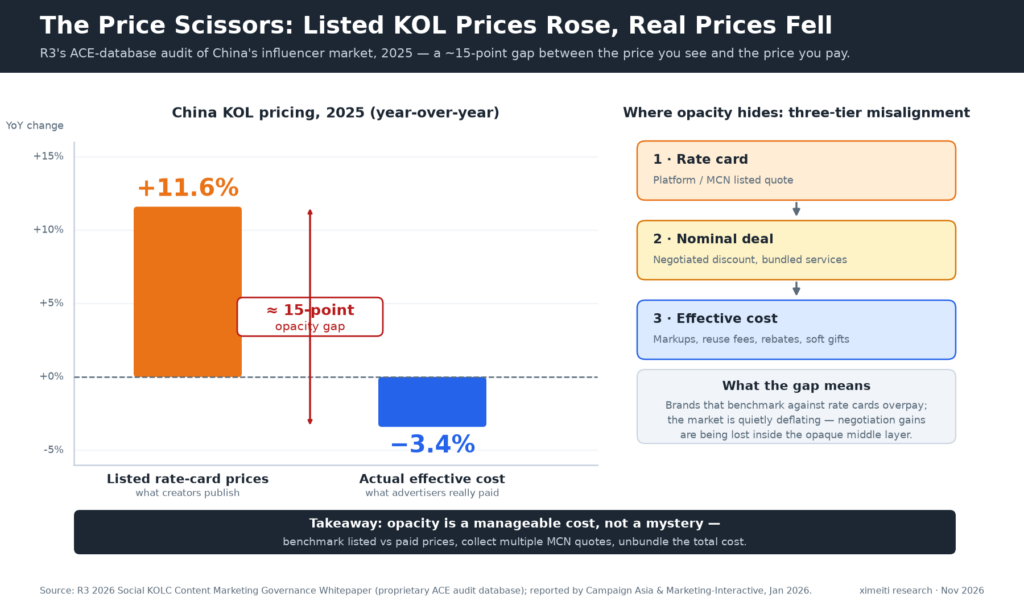
Read that again, because it inverts the usual anxiety. Brands worried about creator inflation were, on average, paying less — if they knew how to negotiate. R3 describes a three-tier misalignment: the platform or MCN rate card, the nominal negotiated price, and the actual effective total cost, which quietly re-adds production fees, reuse charges, bundled services, and unpriced soft extras. The whitepaper projects continued mild deflation in effective costs into 2026. Caveat worth stating: this is one consultancy’s client-audit sample, not a market census, and R3 sells governance services — though as an independent consultancy it does not sell the media itself, which matters for objectivity.
The market being priced this way is substantial. Campaign Asia, reporting on the same whitepaper, put China’s influencer economy at about RMB 117.2 billion (US$16.8 billion) for 2025, growing roughly 8%. Chinese-language releases of the same whitepaper cite a narrower RMB 108.5 billion figure — the scopes differ, so treat any single number as an estimate, not a census.
Why the Models Diverged: Four Structural Causes
Why did two markets with the same technology end up with different buying grammars? Four causes do most of the work.
Fungible Impressions vs Non-Fungible Access
Auctions need interchangeable goods. The open web’s millions of sites produced exactly that. China’s super-app inventory concentrates value in specific, scarce placements — and scarcity attaches to named slots, named creators, named moments. You cannot run a meaningful auction for the one livestream minute that matters. You negotiate for it.
Trust Is Not an Impression
Western display historically priced eyeballs. Chinese creator commerce prices believable access — the audience’s willingness to act on a specific person’s recommendation. Trust is non-fungible by definition, so its purchase stays relational even when the delivery pipes are automated.
Platforms as Both Exchange and Broker
Chinese platforms built large direct-sales and service-provider networks because premium super-app inventory is sold, not just bid. The platform is simultaneously the exchange and the broker. Western platforms automated sales at scale because open-web inventory was too fragmented to broker by hand.
Two Verification Cultures
Auction-everywhere demands impersonal verification: third-party measurement, viewability standards, log-level audits. Relationship-led buying tolerates private settlement because the relationship itself is a verification device — repeat dealings, reputation, the fear of losing next year’s framework. Neither culture is naive; they just trust different referees.
The Brokerage Layer, Up Close: Rebates and Year Frame
To understand the relationship layer, follow the rebate. Until recently, Chinese platforms paid agencies rebates typically in the 10%–20% range of spend, according to industry reporting by Ebrun; agency sources said contract-style inventory such as splash screens and brand zones could carry rebates above 20% in 2026, while auction inventory carried little or none. Agencies passed part of the rebate to big clients and kept the rest — which let platforms charge different effective prices to different customers while keeping one public rate card. The broker was the pricing instrument.
That arrangement also financed the ecosystem: agencies floated credit to advertisers, and the rebate spread was partly their interest income. It had a dark side too — rebates routed privately to individuals inside advertisers blurred into kickbacks, a problem Chinese industry press has documented for years.
Then, on October 30, 2026, Ocean Engine announced that from January 1, 2027 it would cancel agency rebate policies entirely, replacing them with lower published rate cards and optimized framework discounts passed directly to clients, with agency incentives rebuilt around assessment and ranking. Read that carefully: the platform is not deleting the relationship layer. It is compressing the rebate arbitrage and moving value into framework terms — Year frame survivors; the opaque spread shrinks. The brokerage layer is being reformed, not removed.
The Misunderstandings That Cost Buyers Money
China Is Not Programmatic — Wrong
We have covered this, but it bears repeating because budget decisions still rest on it: China’s performance advertising is among the most automated on earth. The relationship layer is a premium-inventory phenomenon sitting on top of machine buying, not an alternative to it.
The Relationship Layer Is Just Corruption — Also Wrong
Opacity has real costs, and the private-rebate problem is real. But brokerage also solves a pricing problem auctions cannot: how to price non-fungible access. And before anyone smirks, remember the Western record. The ANA’s 2016 K2 Intelligence study found US media rebates running 1.67% to 20% of aggregate spend, often undisclosed to advertisers, with principal-transaction markups of 30%–90%. The West’s relationship layer lived inside agencies rather than platform sales teams. The difference is degree and institutionalization, not species.
Auctions Are Transparent — Not Automatically
Here the data humbles everyone. The ISBA/PwC supply-chain study in 2020 found 15% of programmatic spend unattributable — the infamous unknown delta — with publishers receiving about half of advertiser money and only 12% of impressions matchable end-to-end. The January 2023 update, covering 11 advertisers and 1.3 billion impressions, showed the delta down to about 3%, match rates up to 58%, and publisher share up to roughly 65% (on a like-for-like restated basis, 57% to 65%). Real progress — but the study itself warns it reflects premium, audit-cooperative supply chains, not the whole market.
Meanwhile the ANA’s December 2023 log-level study of 21 major US advertisers found that of every dollar entering a DSP, only about 36 cents effectively reached consumers: 29 cents went to transaction costs and 35 cents to productivity loss — non-viewable, invalid, or made-for-advertising traffic. The average campaign ran across 44,000 websites. Across the $88 billion open-web programmatic market, the ANA sized the efficiency opportunity at roughly $22 billion.
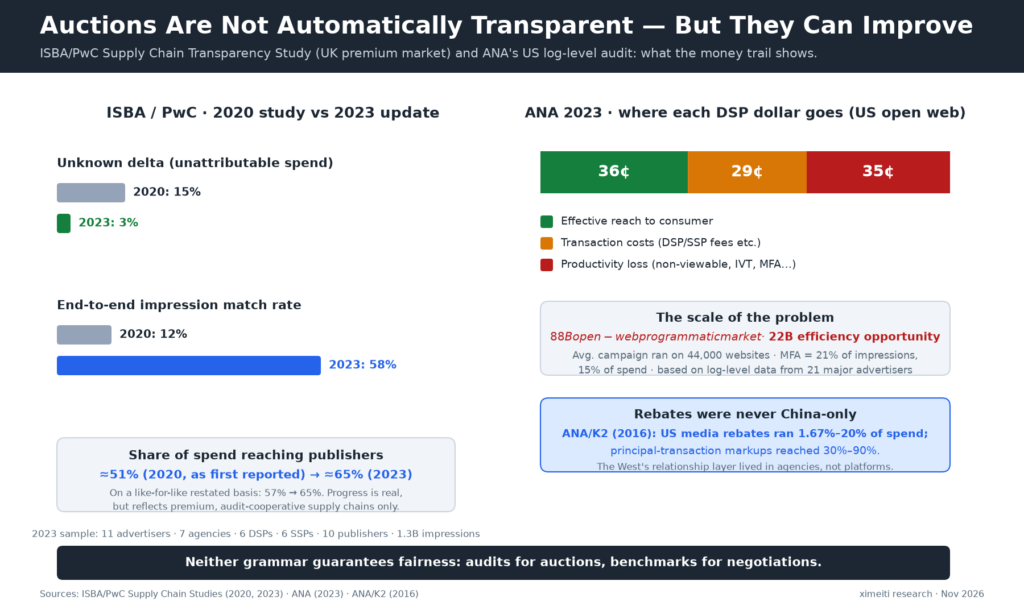
The synthesis is uncomfortable for both camps: an auction can be less transparent than a known broker, and a broker can be more honest than an exchange. Grammar is not reality. Each system needs its own audit discipline.
The Convergence: Software-Wrapped Brokerage
The models are not staying separate. From the Western side, creator advertising became a measurable core channel: IAB/PwC counted $37 billion of US creator ad spend in 2025, projected to reach $44 billion in 2026 — and platforms are productizing the matchmaking that used to happen over email. TikTok folded its Creator Marketplace into TikTok One in April 2025, where creators now set their own starting rates, brands negotiate in-platform, and payment runs through the platform’s rails. That is relationship brokerage with a software wrapper.
From the Chinese side, the same thing happened earlier: Xiaohongshu’s Pugongying platform, launched in January 2021, turned creator booking into an official marketplace — roughly a thousand followers to join, standardized cooperation modes, reference pricing, platform-guaranteed settlement. Algorithmic matching replaced part of the rolodex. The human layer did not vanish; it got productized.
And the auction layer is getting its own AI upgrade. IAB’s 2026 Digital Video Ad Spend & Strategy Report found two in three US digital video buyers live with (21%), testing (20%), or planning (25%) agentic AI, with another 28% investigating. But the July full report added the telling caveat: 40% of buyers insist on human approval before an agent acts. Machines are being invited into both grammars — bidding and brokering — with a human hand on the shoulder.
What Bilingual Buying Looks Like in Practice
So what do you actually do with this? Buy the right object with the right mechanism.
For fungible impressions, apply auction discipline: bid strategy, supply-path hygiene, inclusion lists over endless exclusion lists, direct contracts for log-level data. The ANA’s finding that 36 cents reaches the consumer is not an argument against programmatic — it is an argument for stewardship.
For non-fungible access, apply negotiation discipline: benchmark listed versus paid prices the way R3’s scissors gap teaches, collect multiple MCN quotes, unbundle the total cost into content, rights, amplification, and service fees, and read your Annual framework agreement terms as carefully as your bid caps. With Ocean Engine’s 2027 rebate reset, framework negotiation becomes more important, not less — the discount moves from the agency’s pocket into the contract, and only buyers who negotiate will see it.
And audit both. Verification for auctions; benchmarking for negotiations. The buyer who speaks only one grammar will systematically overpay in the other market.
The Counterargument, and Its Limit
Fair pushback: Western buying is relational too — upfronts, PMPs, agency deals. True. The claim here is about default grammar and inventory mix, not absence. The West auctions the fungible majority; China negotiates the non-fungible premium. Second pushback: AI will automate the brokerage layer entirely. Partly — matching, quoting, and settlement are already software. But pricing trust and scarcity keeps a human judgment residue: brand safety, exclusivity, festival politics, the read on whether a creator’s audience will actually believe this product. The layer shrinks; it does not vanish. The broker becomes a software-assisted negotiator.
Conclusion: Two Objects, Two Disciplines
Two ad models, two objects of purchase. Auction-everywhere prices fungible impressions through impersonal discovery; relationship-led brokerage prices non-fungible access — creator trust, festival scarcity, super-app real estate — through negotiation, with hyper-programmatic auctions humming underneath. Neither model is more advanced. Each fits its inventory structure, and each carries its own opacity: the unknown delta on one side, the price scissors on the other.
The durable skill is bilingual buying: auction discipline for impressions, negotiation discipline for access, and audit discipline for both. As AI wraps both grammars in software, the buyers who speak both languages will price the next decade of attention correctly — whether it is bid or brokered.