Ask ChatGPT for the best running shoes under $100, and you get a tidy comparison, a few cited links, and an invitation to click somewhere else. Ask Qwen — Alibaba’s assistant — to order two lattes, and roughly twenty minutes later a rider hands you the cups. Same chat box. Same fluent prose. Completely different finish lines.
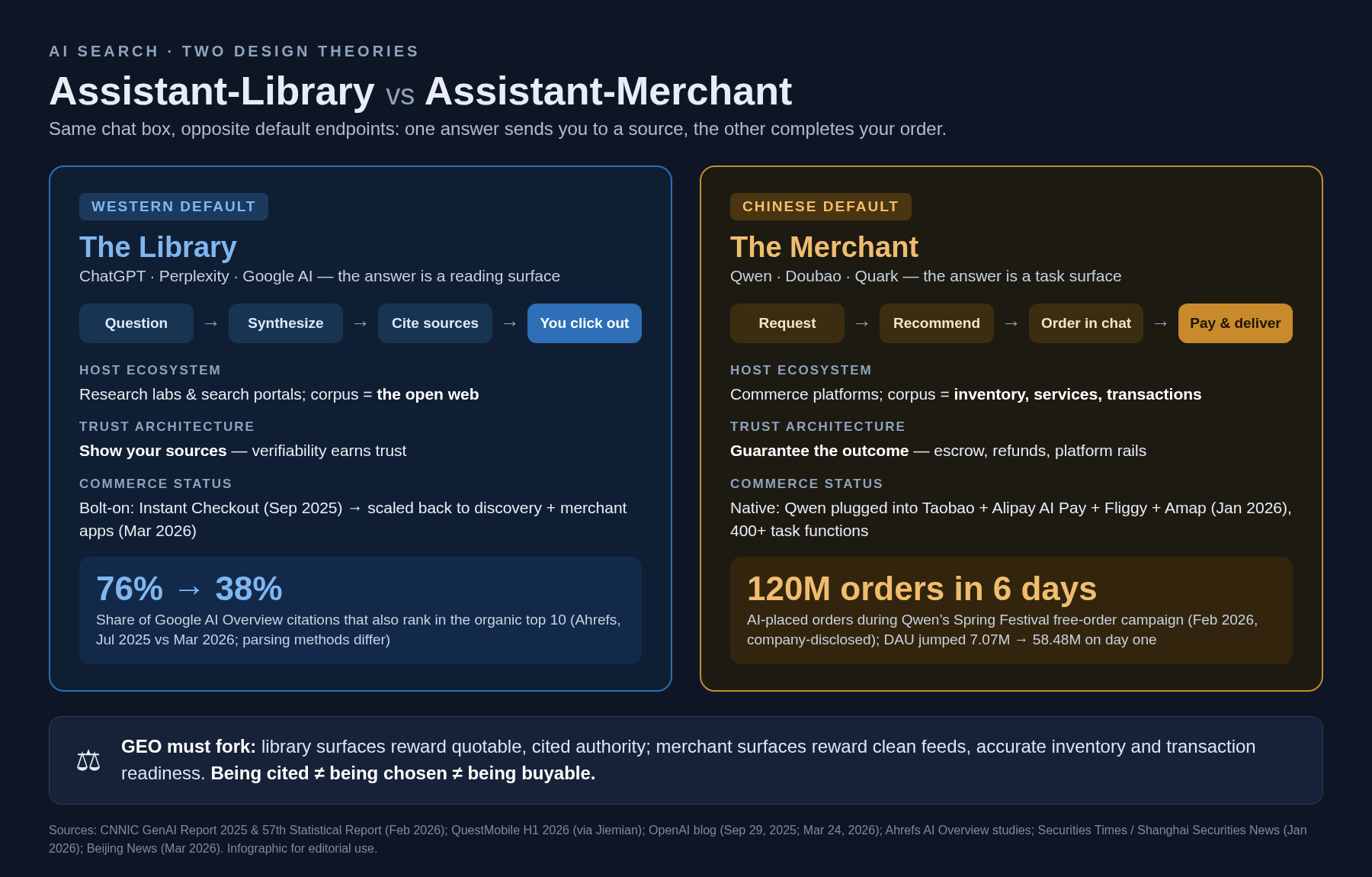
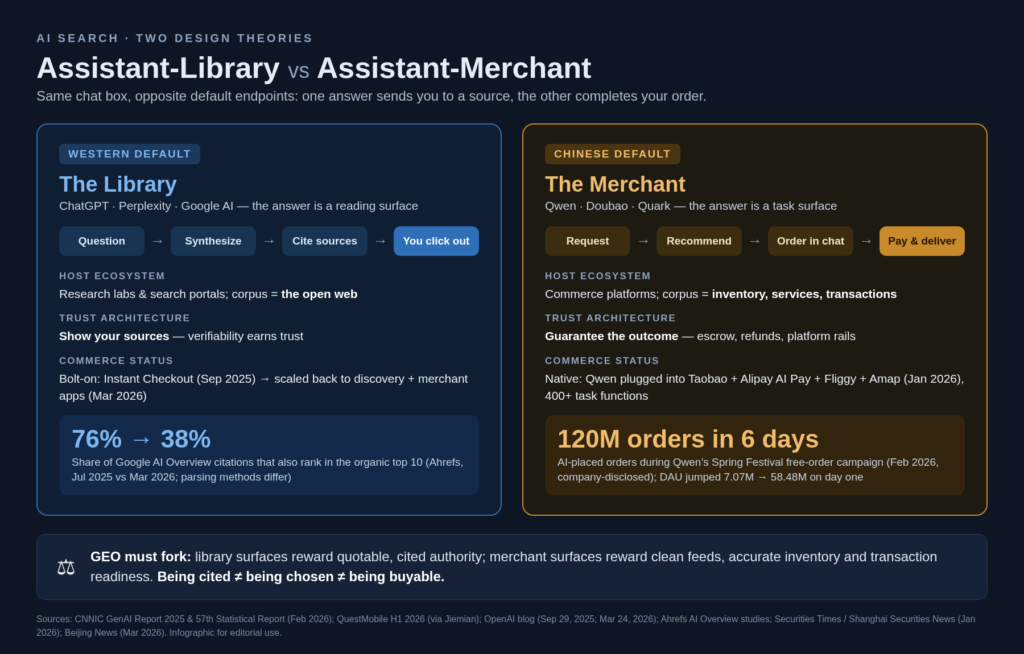
That contrast is not a quirk of product management. It reflects two genuinely different theories of what an AI answer is for. The Western design — ChatGPT, Perplexity, Google’s AI surfaces — behaves like a library: it synthesizes knowledge, shows its sources, and sends you elsewhere. The Chinese design — Qwen, Doubao, Quark — behaves like a merchant: it recommends, orders, and pays inside the ecosystem that hosts it. Call them the assistant-library and the assistant-merchant. Once you see the fork, a lot of confusing headlines suddenly make sense.
Same Interface, Opposite Endpoints
Start with what the user actually sees.
The library’s endpoint is a reading surface. Perplexity built its reputation on citation-first answers. Google’s AI Overviews synthesize a response and attach source links. ChatGPT browses the web and points you to it. The answer is valuable precisely because it compresses the open web into something you can verify — and then leave.
The merchant’s endpoint is a task surface. On January 15, 2026, Alibaba’s Qwen app announced full integration with Taobao, Alipay’s native AI payment capability, Taobao Instant Commerce, Fliggy and Amap, shipping more than 400 task-completion functions. At the launch event, an executive spoke one sentence — order forty cups of bubble tea — and the app placed the order, paid in-chat, and had riders deliver to the stage. No app-switching. No checkout page. The conversation was the storefront.
Doubao, ByteDance’s assistant, moved the same direction from the content side: it connected to Douyin’s mall in October 2025, launched a shopping-recommendation feature in April 2026, and upgraded it that May. One honest caveat: hands-on tests suggest Doubao still leans on recommendation cards and hand-offs for the final purchase steps, while Qwen runs the deeper in-chat loop. The design center is shared; the execution depth differs.
The Western Checkout That Walked Itself Back
Here is the part that makes the library-versus-merchant framing more than a stereotype: the West tried the merchant design, and flinched.
In September 2025, OpenAI launched Instant Checkout. American users could buy from Etsy sellers without leaving the chat, with more than a million Shopify merchants queued up. The plumbing was the Agentic Commerce Protocol, co-developed with Stripe and open-sourced. Merchants paid a small fee on completed purchases. Product results stayed organic — though when several sellers offered the same item, checkout-enablement was one of the tie-breaking factors. Commerce had arrived inside the library.
Six months later, it mostly left. On March 24, 2026, OpenAI wrote that the initial version of Instant Checkout did not offer the flexibility it wanted, so merchants would use their own checkout experiences while OpenAI focused on product discovery. Walmart launched its own in-ChatGPT app with account linking, loyalty and Walmart payments. The verdict from the front line was blunt: Walmart’s AI executive told Wired that items sold directly inside the chatbot converted roughly three times worse than items that required a click out. Shoppers researched in ChatGPT. They bought elsewhere.
Read that again, because it is the cleanest natural experiment we have. The library can bolt on a cash register. It cannot easily make people use it.
Why the Designs Forked: Four Causes
Why did two industries with access to the same model architectures build such different assistants? Four forces, stacked.
The Host Ecosystem Shapes the Corpus
Western assistants grew out of research labs and search portals. Their corpus is the open web, and their native habit is synthesis-and-cite. Chinese assistants grew out of commerce and content platforms. Their corpus includes inventory, service listings and transaction histories — data the open web simply does not have. Qwen’s shopping recommendations draw on Taobao’s product database and two decades of real purchase behavior. When your training signals include what people actually bought and returned, task completion stops being a feature and starts being the point.
The Monetization Gradient Points Different Ways
Western labs face a subscription ceiling and an advertising-trust problem; commerce is the emerging answer, which explains the protocol land-grab — OpenAI and Stripe’s ACP in September 2025, Google’s Agent Payments Protocol the same month with more than sixty partners, including Mastercard, PayPal and Ant International. Chinese platforms already own transaction monetization. The assistant does not need to invent a business model; it routes demand onto rails that exist. By December 2025, China counted 1.017 billion online payment users — 90.3% of all internet users — and 937 million online shoppers, per CNNIC’s 57th statistical report. The cashier was built years ago. The assistant just staffs it.
Users Brought Different Jobs
Western early adopters arrived through developer tools and brought knowledge work: research, coding, writing. Chinese mass adoption arrived through consumer super-apps and brought life tasks. CNNIC’s 2025 generative-AI report found that 80.9% of users turn to these products to answer questions — but the questions skew practical: what to buy, where to eat, which service to book. By December 2025 the user base reached 602 million, up 141.7% in a year, a 42.8% penetration rate. That is not a niche of power users. That is daily life, asking for help.
Trust Is Architected Twice
The library earns trust by showing sources — verifiability you can audit. The merchant earns trust by guaranteeing outcomes — escrow, refunds, platform accountability. Neither is naive; they are different answers to the same question, and each reproduces itself inside the AI layer. Notably, the merchant design is now exporting its trust architecture: Ant International sits among AP2’s founding partners, and Alipay’s AI Pay advertises a theft-compensation guarantee. The guarantee model is going global on the back of a Western protocol.
The Number That Should Worry Every SEO
If the library design were static, you could optimize for it once. It is not static — and the drift is measurable.
Ahrefs tracked the overlap between AI Overview citations and organic rankings across two large studies. In July 2025, analyzing a million keywords and 1.9 million citations, it found 76% of cited pages also ranked in the top ten for the same query. By March 2026 — 863,000 keywords, four million cited URLs — that share had fallen to 38%. About 31% of citations came from pages ranking outside the top hundred entirely. Ahrefs cautions that parsing improved between studies, so the two are not perfectly comparable, and Google’s move to Gemini 3 in January 2026 plus query fan-out — splitting your search into sub-queries — likely widened the citation pool. The direction, though, is unmistakable: the library is decoupling from the ranked web it was built on. Being number one no longer means being quoted. Being quoted increasingly happens somewhere your rank tracker never looks.
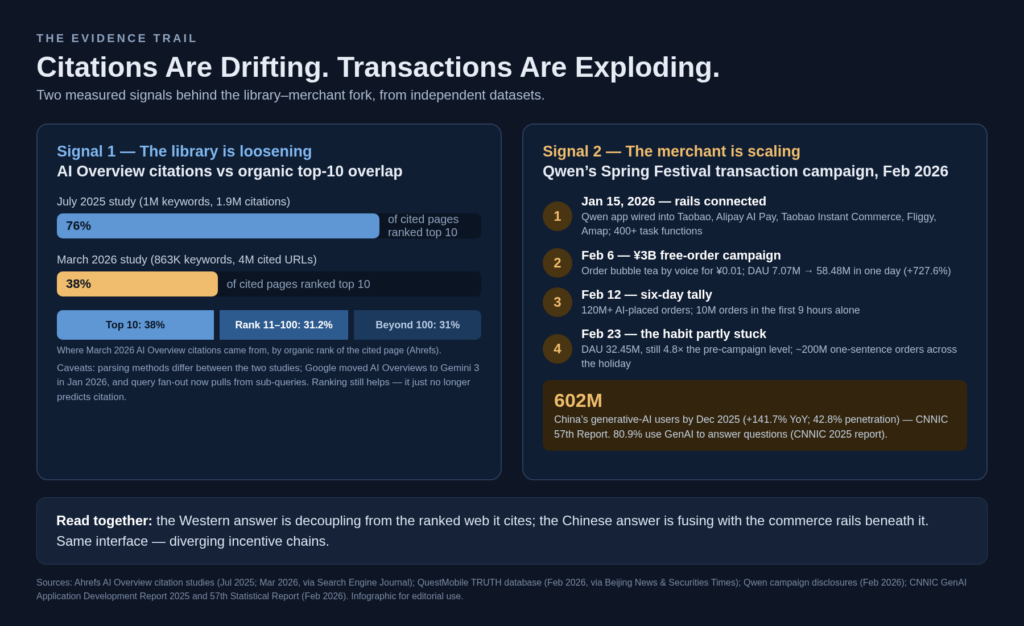
Meanwhile, the merchant design ran its own experiment at scale. During Spring Festival 2026, Alibaba put three billion yuan behind a free-order campaign: ask Qwen for bubble tea, pay a fraction of a cent. QuestMobile measured daily active users jumping from 7.07 million to 58.48 million in a single day — a 727.6% spike. The company disclosed more than 120 million AI-placed orders in six days, ten million in the first nine hours alone. Did it stick? Partly. By February 23, daily actives had settled at 32.45 million — still nearly five times the pre-campaign baseline — with roughly 200 million one-sentence orders across the holiday, including orders from over four million users aged sixty and above. Subsidies bought the spike; the rails kept a chunk of the habit.
What Everyone Gets Wrong
Four errors keep circulating. Each one costs somebody money.
China Is Behind on AI
On open-web synthesis and citation culture, arguably yes. On commerce integration, China is months to years ahead — the checkout, the wallet, the fulfillment network all predate the assistant. Qwen’s monthly actives hit 167 million by June 2026, a 5,792.9% year-over-year jump per QuestMobile. Read that percentage with care: the base was tiny before the relaunch, and monthly actives had eased to 158 million by September. The honest takeaway is not that Qwen won. It is that a merchant-designed assistant can scale on ecosystem rails at a speed subscription-first products cannot match. Different races, different leaderboards.
Western Assistants Will Stay Neutral
The protocol fees say otherwise. ACP charges merchants on completed purchases. Checkout-enablement already appears among the tie-breakers when identical products compete. Google is building a payments standard with the card networks. The library is becoming a merchant under monetization pressure — slowly, with regulatory and trust constraints, but the gradient is real. Expect regulated merchantization, not permanent neutrality.
Chinese Assistants Are Just Chatbots With Plugins
Task completion is the design center, not an add-on. When Qwen’s team describes its edge, it names the combination of the strongest Qwen model and Alibaba’s richest ecosystem. When Doubao connects to Douyin commerce, the content engine feeds the recommendation engine feeds the transaction engine. The assistant is the new storefront of the host platform. Judging it as a chatbot misses what it is for — like judging a supermarket by its lighting.
One GEO Strategy Fits Every Surface
This is the expensive one, and it deserves its own section.
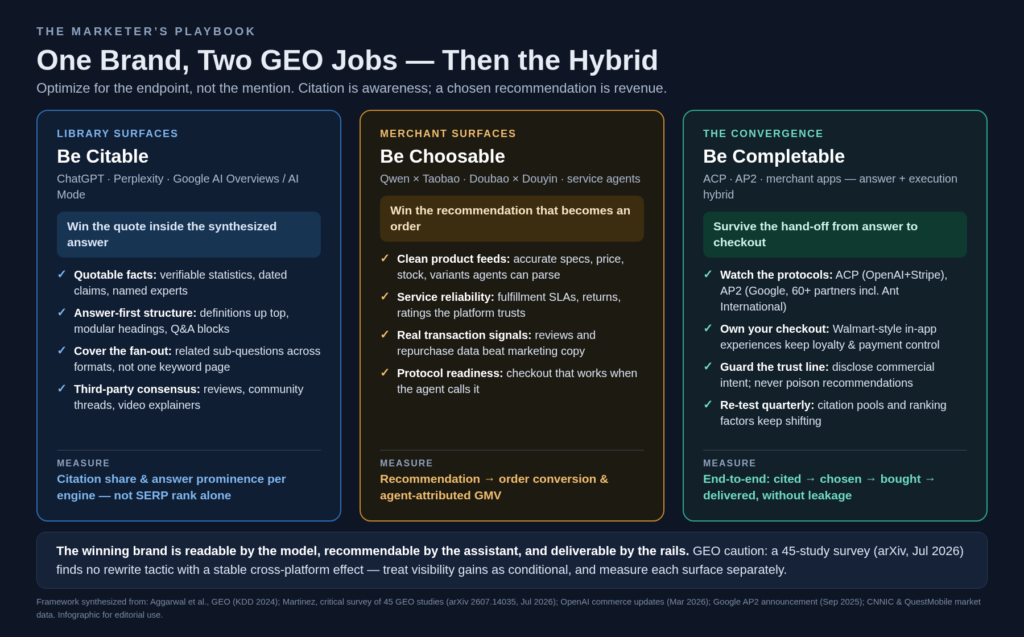
GEO Must Fork: Cited, Chosen, Buyable
Generative engine optimization started as a library science. The foundational paper — Aggarwal and colleagues, published at KDD 2024 — showed that editing content for quotability could raise visibility in generated answers by up to 40%; in one experiment, adding citations lifted visibility by 115.1% for pages originally ranked fifth. Treat those as conditional lab results, not promises: a July 2026 critical survey of 45 studies on arXiv found no rewrite tactic with a stable, cross-platform effect, and noted the famous 40% figure describes a relative maximum on one metric inside one simulator configuration. The library playbook still holds directionally — verifiable statistics, dated claims, answer-first structure, coverage of the sub-questions fan-out actually asks. But measure citation share per engine, and re-test often.
Merchant surfaces reward something else entirely. When the assistant recommends from a product database and settles payment through a platform wallet, your beautifully written brand page is nearly irrelevant. What matters: clean structured feeds an agent can parse, accurate price and stock, fulfillment reliability, return policies, and the transaction signals — reviews, repurchase rates — the platform already trusts. Being recommendable is not the same as being buyable. A citation in the library is awareness. A chosen recommendation in the merchant is revenue. Track them as separate metrics, because they are separate outcomes.
The Counterargument, Taken Seriously
The strongest objection: both designs do both jobs, so the dichotomy is fake. At the capability level, true — ChatGPT can order groceries through partner apps, and Qwen writes essays. But the claim here is about defaults and incentive chains, not exclusive functions. OpenAI’s own retreat from native checkout, on the record, with conversion data attached, is about as direct as evidence gets that the library’s center of gravity remains discovery. And when Chinese platforms describe their assistants, they lead with getting things done. Design centers, not walls.
A second objection: antitrust and user trust will keep Western assistants library-first forever. Possible — but the funding pressure does not disappear because a regulator is watching. The likelier path is commerce through merchant-owned apps and disclosed protocols: merchantization with guardrails. Perplexity, notably, never stopped — its Buy with Pro feature launched in November 2024, and by November 2025 shopping was free for all US users, with PayPal-powered Instant Buy rolling out toward more than 5,000 merchants and the seller staying the merchant of record. The library design tolerates commerce at the edges. It just refuses to own the register.
Prepare for the Hybrid
Both designs are converging on the same destination from opposite ends. Western libraries add execution through merchant apps and open protocols; Chinese merchants add synthesis and research depth — Quark’s deep-search mode reads hundreds of pages before answering, and Qwen shipped an upgraded reasoning-research feature in August 2026. The endpoint is an answer that can also act: recommend, verify, order, deliver.
For brands, the winning position is uncomfortable but clear. You need to be readable by the model — structured, quotable, verifiable. Recommendable by the assistant — feeds clean, service metrics strong, inventory honest. And deliverable by the rails — checkout that works when an agent calls it, returns that do not poison the platform’s trust in you. Citable, choosable, completable. Most teams are optimizing the first and ignoring the other two.
One last warning, because the merchant design has a failure mode the library does not. An assistant that earns on recommendations has a conflict of interest baked into its business model. Chinese platforms have so far said ads will not be prioritized in AI shopping results; industry coverage already documents brands attempting to plant themselves inside AI answers. The citation culture the library built is a trust asset — and the fastest way for the merchant design to burn it is to let paid placement quietly become the ranking function. Demand transparency. Refuse the schemes. Trust is the only inventory neither design can restock quickly.
The Takeaway
Two AI-search designs, two theories of the answer. The Western library synthesizes and cites, sending you elsewhere; the Chinese merchant synthesizes and executes, keeping you inside the transaction. The fork follows the host ecosystem and its incentive chain — open-web corpus and subscription economics on one side, commerce rails and transaction monetization on the other. CNNIC’s 602 million users and 80.9% question-answering share describe the demand; OpenAI’s checkout retreat and Qwen’s 120 million festival orders describe the supply. For marketers, GEO must fork too: quotable authority for the library, structured buyability for the merchant. And as both designs converge on the answer-plus-execution hybrid, the brand that wins will be the one that is simultaneously citable, choosable and completable — readable by the model, recommendable by the assistant, and deliverable by the rails.