Ask two sellers the same question — who is your customer? — and you will get answers from different planets. The Shenzhen seller on Taobao will show you a store dashboard. The Austin brand on Shopify will show you an email list. Same trade, same century, opposite ownership. And as of this year, both answers are winning at the same time, in the same market, at almost exactly the same scale.
That is the story most e-commerce coverage misses. We argue about market share as if Amazon and Shopify were fighting over one pie. They are not. They are two different answers to one question: who owns the customer relationship? China built its commerce on one answer. The West grew a genuine version of the other. In 2025 the two answers converged on roughly half of the world’s richest e-commerce market — from opposite directions.
The Number That Reframes the Map
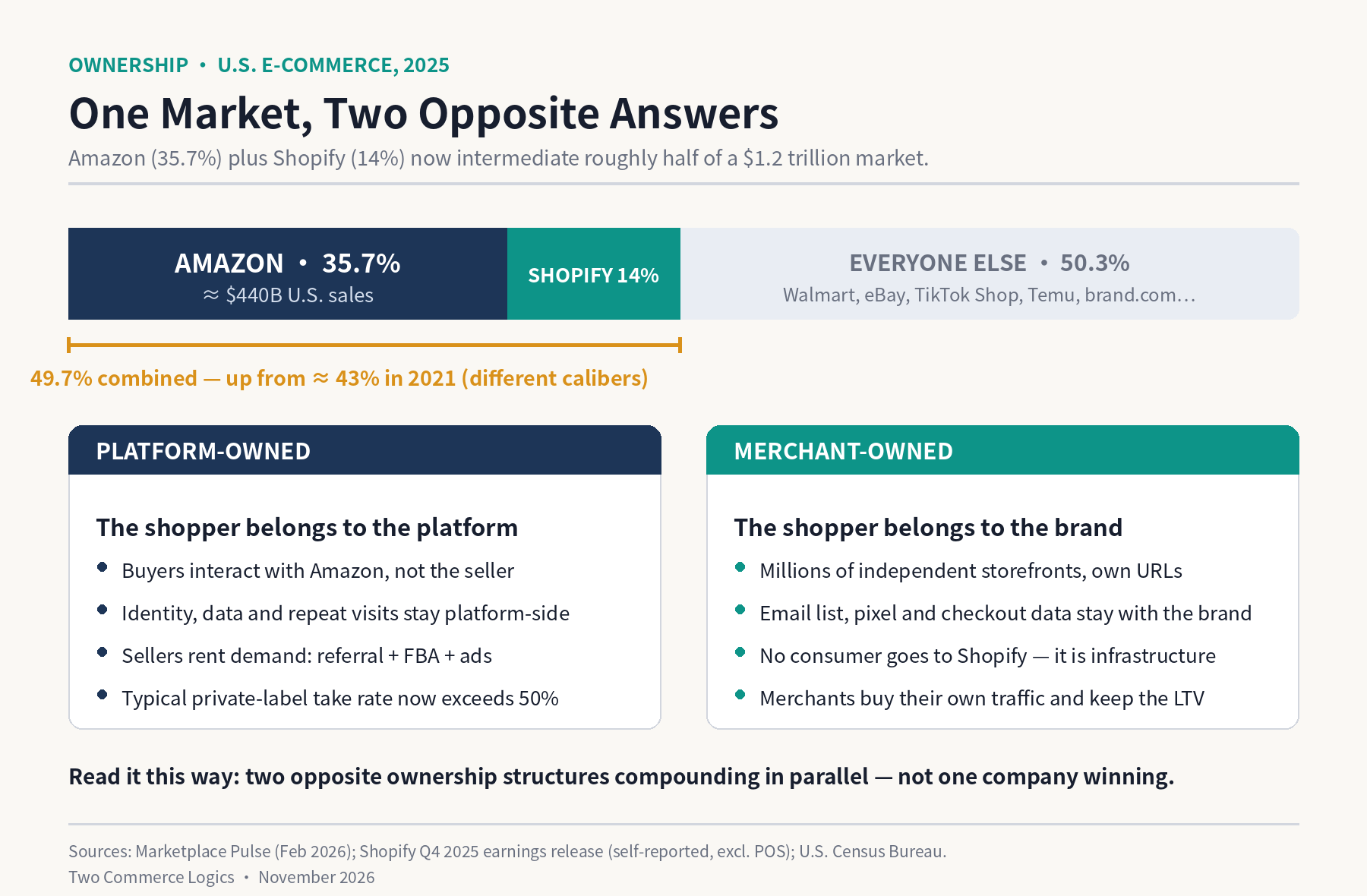
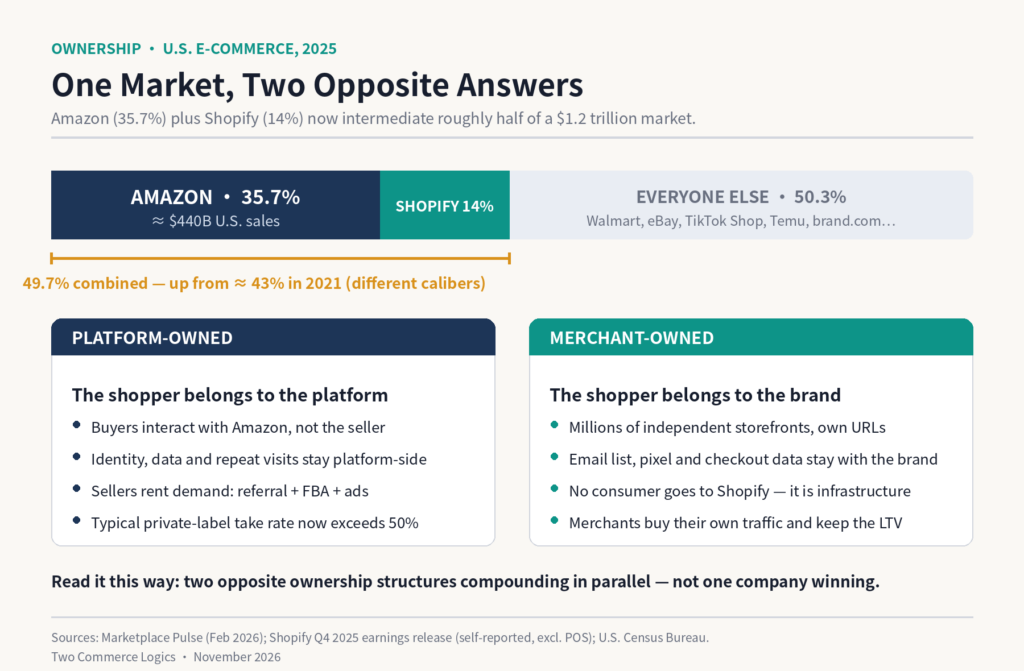
Here is the cleanest evidence we have. Marketplace Pulse estimates Amazon generated about $440 billion in U.S. sales in 2025 — a 35.7% share of the $1.2 trillion U.S. e-commerce market. On its Q4 2025 earnings call, Shopify claimed a 14% U.S. share, up from 12% a year earlier. Add them up and you get 49.7%. In 2021, the pair held roughly 43%.
One caveat before you tweet the number: these are different calibers stitched together. Amazon’s share is a research firm’s estimate covering retail plus marketplace; Shopify’s is a self-reported figure based on its merchants’ U.S. GMV against unadjusted U.S. Census Bureau data. Treat 49.7% as a direction, not a decimal-point truth. The direction is unmistakable: two opposite ownership models now intermediate half of American online retail.
The Ownership Test: Follow the Repeat Purchase
Forget GMV for a second. Run this simple test instead: when the buyer comes back for a second order, whose asset is that relationship?
On Amazon, the shopper returns to Amazon. Prime is the loyalty program. The email is masked. The return goes through Amazon’s system. The seller fulfilled an order; Amazon kept the customer. On a Shopify storefront, the buyer returns to the brand’s own URL, lands in the brand’s retargeting audience, receives the brand’s email, and compounds the brand’s lifetime value. The merchant paid to acquire that customer — and gets to keep them.
This is why the platform-owned versus merchant-owned frame is not the tired marketplace-versus-website debate. A website can be a rented billboard. A marketplace stall can hide a real brand. The dividing line is who holds the repeat relationship and its data — the only asset in commerce that genuinely compounds.
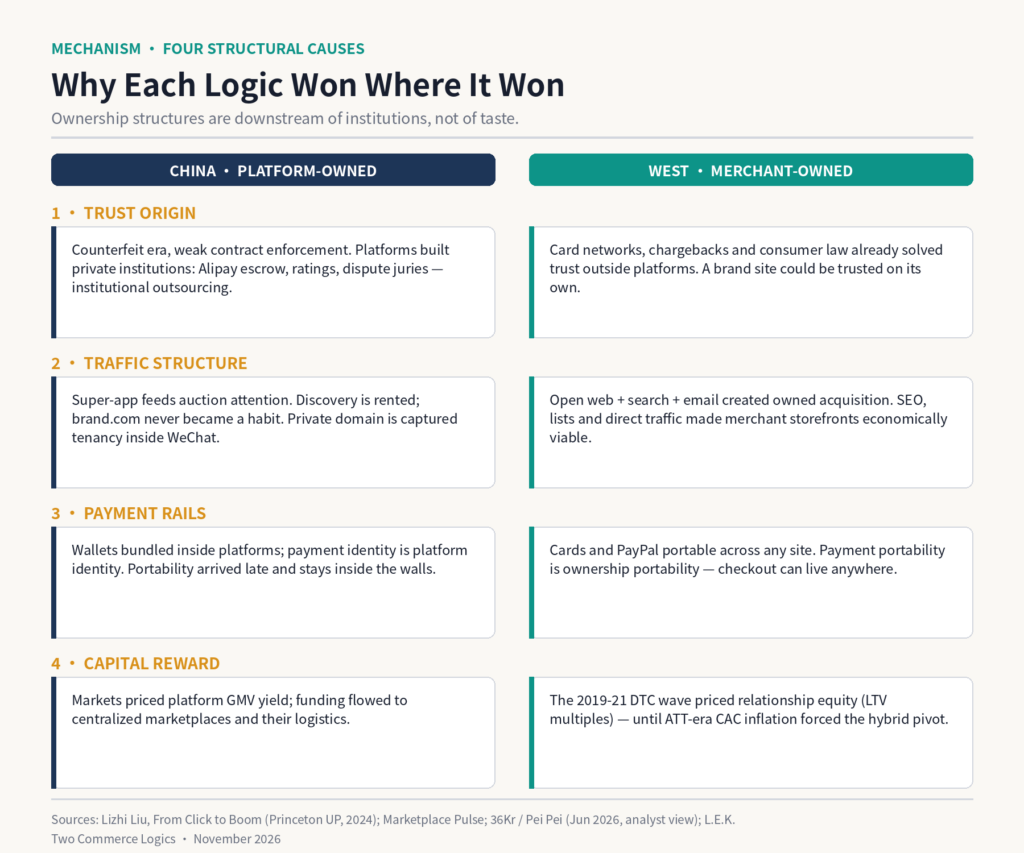
China’s Answer: The Platform as Trust Institution
Why did China go platform-owned so completely? The lazy answer is regulation or consumer habit. The deeper answer is institutional history, and it has been documented with academic rigor.
In From Click to Boom (Princeton University Press, 2024), Georgetown’s Lizhi Liu shows that China’s e-commerce boom happened not despite weak formal institutions but because of them. Contract enforcement was unreliable, credit-card penetration was low, and counterfeits were everywhere. So platforms built private institutions to fill the gap — what Liu calls institutional outsourcing. Taobao deployed Alipay’s escrow, credit-rating systems, return-shipping insurance, even online juries of ordinary users to settle disputes. The platform did not just host the market; it was the trust layer that made the market possible.
Once the platform is the trust institution, ownership follows naturally. Merchants ceded the customer relationship willingly, because the platform’s guarantee was the reason strangers bought from them at all. Even today, a brand flagship store on Tmall sits inside the platform’s identity walls. The shopper trusts Tmall first, the brand second.
The West’s Answer: Trust Was Already Portable
The West ran the opposite experiment, mostly by accident. Card networks, chargeback rights, and consumer-protection law had solved transaction trust outside any platform decades before e-commerce arrived. A stranger’s website could accept your Visa card, and if it cheated you, your bank had your back.
That portability changed everything downstream. Payment identity traveled across sites, so customer identity could too. Merchants could safely own checkout, own the email address, own the remarketing pixel. Shopify did not need to become the trust institution — it rented out the tools and let each brand be its own front door. No consumer goes to Shopify to shop, which is exactly why Marketplace Pulse describes it as closer to a payment network than a retailer. Its 14% share is an aggregate of millions of sovereign storefronts, not one destination.
Traffic Economics: Rented Attention vs Owned Channels
The second divergence is where demand comes from. China’s super-apps auction attention inside closed feeds. Discovery is a metered utility: you pay the platform per visit, forever, and the auction price only ratchets up as more sellers bid. Chinese brands never developed the brand-website habit — analyst Pei Pei’s widely discussed 36Kr column argues that a decade of de-centralization attempts mostly ended with one centralized platform replacing another. (Treat his traffic figures as seasoned estimates, not audited statistics.)
The open web gave Western merchants a different birthright. Search engines indexed anyone’s site. Email worked across every domain. A brand could build SEO equity, a subscriber list, and direct traffic — acquisition channels it owned rather than rented. Pei’s column notes that leading Western independent sites draw an estimated 20–50% of traffic from organic search. That is the quiet subsidy behind merchant ownership: the open web made owning customers economically viable in a way China’s feed auctions never did.
The Convergence Nobody Expected
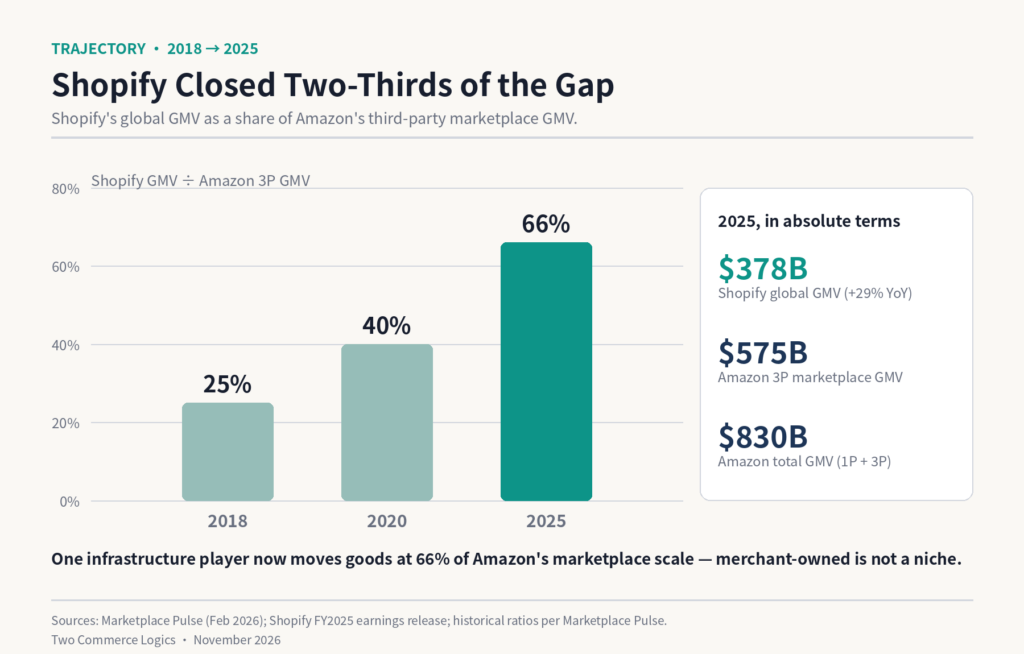
For years the assumption was that merchant-owned commerce was a cute niche next to Amazon’s machine. The 2025 numbers ended that story. Shopify’s full-year GMV hit $378.4 billion, up 29%, on $11.6 billion of revenue — while Amazon’s total GMV reached an estimated $830 billion, of which $575 billion was third-party marketplace sales.
Do that ratio: Shopify now moves goods at 66% of Amazon’s marketplace scale, up from 40% in 2020 and 25% in 2018. And on the Q3 2026 earnings call, Shopify president Harley Finkelstein claimed the company had captured nearly half of all incremental U.S. e-commerce since the start of 2025 — despite holding only a 14% share. Self-reported, yes. But the direction matches the independent estimates: the merchant-owned layer is taking the growth, not just surviving.
What Everyone Gets Wrong
Three errors keep circulating, and each one costs someone money.
Error one: Shopify is a marketplace. It is not. Nobody browses Shopify. Counting its share alongside Amazon’s is a category trick — useful precisely because it exposes the ownership difference. One number measures a destination; the other measures infrastructure under millions of destinations.
Error two: platform-owned is inferior. Tell that to a Chinese consumer who bought from a stranger because Alipay held the money, or a Southeast Asian shopper whose entire trust in delivery came from Shopee’s guarantee. Platform ownership delivers institutions — trust, logistics, demand — that no independent merchant could build alone. The question is never whether the platform adds value. It is what the merchant pays for it.
Error three: merchant-owned is free. Ownership means buying your own traffic, building your own trust, and running your own retention operation forever. The DTC graveyard of 2022–2024 is full of brands that confused owning the customer with owning cheap acquisition. Which brings us to the bill.
Two Bills, Two Currencies
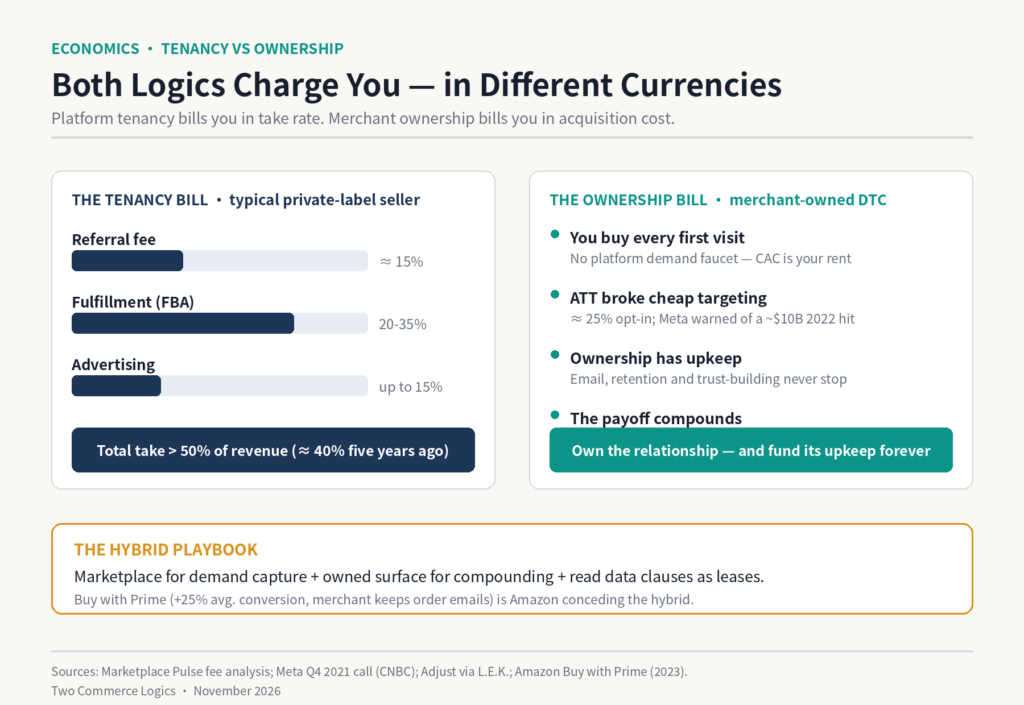
Platform tenancy bills you in take rate. Marketplace Pulse’s analysis of seller P&Ls found a typical private-label Amazon seller now pays over 50% of revenue to Amazon — roughly 15% referral fees, 20–35% fulfillment, and up to 15% advertising that is effectively unavoidable because the best screen space is sold, not earned. Five years ago that total was around 40%. The services are real; so is the ratchet.
Merchant ownership bills you in acquisition cost. When Apple’s App Tracking Transparency arrived in 2021, only about a quarter of users opted into tracking (per Adjust, cited by L.E.K. Consulting), targeting degraded, and Meta’s CFO estimated a $10 billion revenue headwind for 2022. Downstream, DTC brands watched their customer acquisition costs balloon while their attribution dashboards lied to them. Owning the relationship survived; owning cheap traffic did not.
The Payment-Rail Tell
If you want to predict where merchant ownership becomes viable next, watch the payment rails, not the marketing blogs. Payment portability is ownership portability. The West’s card-and-PayPal rails let checkout live anywhere, so brands could live anywhere. China’s wallets were bundled into platform identity, so commerce stayed inside the walls.
The interesting motion now is in markets building new rails. Where portable payment infrastructure matures — think of India’s UPI or Brazil’s Pix — the institutional preconditions for merchant-owned commerce appear for the first time. Infrastructure shifts precede strategy shifts. Always.
The Hybrid Is Already Here
Purity was a 2018 concept. Look at what the giants actually do now. Amazon built Buy with Prime so merchants can offer Prime benefits on their own sites — Amazon’s internal data claims a 25% average conversion lift, and crucially, the merchant receives the shopper’s order information including the email address. Read that again: the arch-tenant platform now sells a product whose pitch is customer ownership. That is a concession dressed as a feature.
Meanwhile Shopify merchants list on Amazon, Chinese brands run private-domain capture inside WeChat, and Western platforms keep closing their loops. Southeast Asia shows how far platform concentration can go — Momentum Works counts Shopee, Lazada and TikTok Shop at 98.8% of the region’s platform GMV in 2025 — yet even there, non-platform channels quietly moved $27.8 billion, 15% of the total market. The merchant-owned impulse survives every wall.
The AI Agent Renegotiation
Now the ownership question is being reopened by a third party. When OpenAI launched Instant Checkout in September 2025, built on the open Agentic Commerce Protocol with Stripe, the design deliberately kept merchants as the merchant of record — payments, fulfillment, and customer relationships stayed with the seller. Then, by March 2026, OpenAI wound the feature down, telling CNBC it would let merchants use their own checkout experiences while it focused on product discovery.
The lesson is not that AI commerce failed. It is that the model layer tried to own the transaction and retreated to owning the recommendation. Shopify, meanwhile, reports AI-referred traffic up 2.6x year over year and orders up 3.3x, with those shoppers converting 64% better than organic-search visitors. The agent mediates discovery; the merchant still closes. For now, ACP-style protocols preserve merchant sovereignty — but whoever ends up owning the post-transaction relationship will compound, and that seat is being renegotiated in real time.
What Brands Should Actually Do
Four moves, in order of leverage.
First, choose ownership deliberately per market. In platform-owned systems, negotiate the terms of tenancy: take rate, data access, private-domain capture rights. In merchant-owned systems, budget the full cost of ownership: traffic, trust-building, retention ops. Never import one market’s defaults into the other.
Second, run the hybrid portfolio on purpose. Marketplace for demand capture, owned surface for relationship compounding. The pattern is now the global template, not a Western quirk.
Third, read the data clause before the fee clause. Customer-data ownership is the real price of platform tenancy. A 15% referral fee with full email access can be cheaper than a 10% fee with none. Read every platform contract as a data lease.
Fourth, watch rail portability and the agent protocols. Where payments, identity, and checkout become portable, merchant ownership becomes viable — and the brands that pre-positioned their catalogs and first-party data will capture the shift first.
Conclusion
Two commerce logics answer one question differently: who owns the customer? China traded merchant sovereignty for institutional trust and demand at scale. The West’s merchant layer kept the relationship and paid for its own traffic. The 49.7% figure proves both answers can win simultaneously — they are not competitors but opposite ownership structures compounding in parallel. The strategic move is deliberate hybridity: rent demand where platforms own trust, own relationships where rails allow it, and treat every data clause as a lease. The next renegotiation — AI agents as relationship intermediaries — will test both logics again. Own the repeat purchase, whoever intermediates the first one.