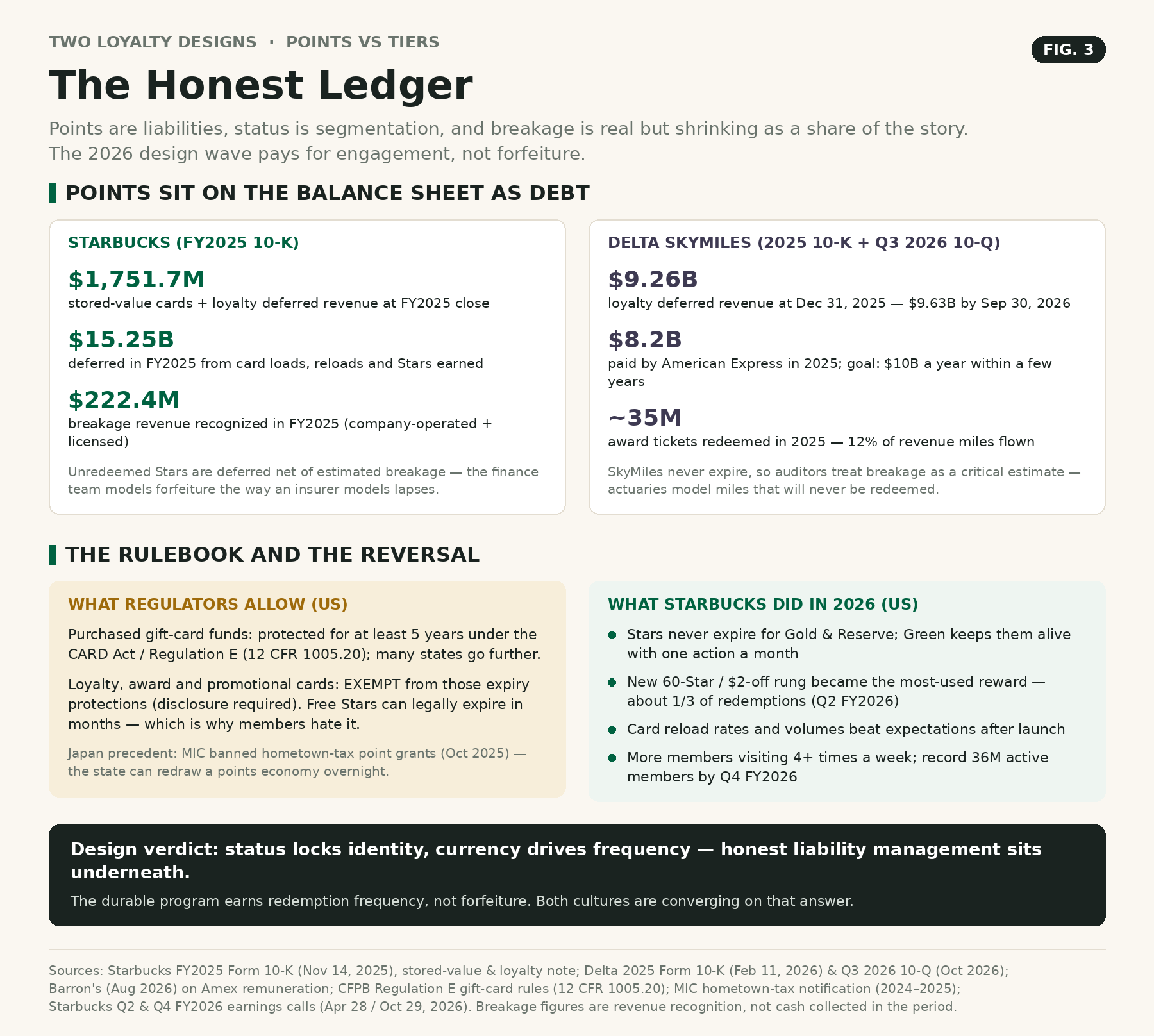
Loyalty programs come in two load-bearing designs: points-as-currency, which optimizes the transaction, and tiers-as-status, which optimizes the relationship. Both tools exist in every market — the difference is which one carries the strategic weight. Starbucks ran the cleanest natural experiment in modern marketing: a tierless points program in the US from 2019 to 2026, and a four-tier status ladder in China throughout. In March 2026 the US brought tiers back — not because membership was collapsing (it was at a record), but because a flat points system could not tell a 200-visit-a-year devotee from a once-a-year tourist. Membership then set new records: 35.6 million in Q2 FY2026 and 36 million by Q4. Meanwhile Rakuten pushed points to their logical extreme — 5.6 trillion cumulative points functioning as a national quasi-currency. The winning architecture, now visible on both sides of the Pacific, is dual-track: status to lock identity, currency to drive frequency, honest liability management underneath.
The Tale of Two Programs
Picture two Starbucks customers in the same week of 2025. In Seattle, a woman buys her daily latte, earns two stars per dollar because she pays with a preloaded card, and holds no rank whatsoever. Her stars expire in six months. In Shanghai, a man buys the same latte, earns one redeemable Star plus one unit of “growth value” per ¥50 spent, and watches that growth value push him from Gold toward Diamond — a rank that gets his order made first, hands him a birthday gift, and lets him claim free airport coffee before a China Eastern flight. Same brand. Same beans. Two different theories of what loyalty is for.
The American program was a wallet. The Chinese program was a ladder with a wallet attached. And in 2026, America started building the ladder.
What the West Actually Built: Points as Currency
The Western mass-retail default treats loyalty as a private currency. You earn units, you burn units, and the issuer manages the spread. Starbucks Rewards launched in 2009 as a visit-counting scheme with Welcome, Green and Gold levels; in April 2016 it converted to spend-based earning. Then, on April 16, 2019, it did something radical: it abolished status entirely. A company representative told Business Insider at the time that the program would “move to a single-level program where all members can begin to earn Stars toward free Rewards from the day they join.” The logic was frictionless inclusivity — no gatekeeping, redeem from visit one.
It worked, commercially. Active US membership roughly doubled from 16 million in December 2018 to 34.6 million by December 2024. Rewards-linked transactions grew to nearly 60% of US company-operated revenue in fiscal 2025 — more than $13 billion in spend, per the company’s own Investor Day disclosure. But a flat currency has a blind spot, and it is the one global chief brand officer Tressie Lieberman put bluntly to CNBC in January 2026: “Our very best customers are coming 200 times a year, and we were treating them the same as someone who comes once a year. So we’ve introduced tiers.”
What East Asia Built: Status Plus a Universal Currency
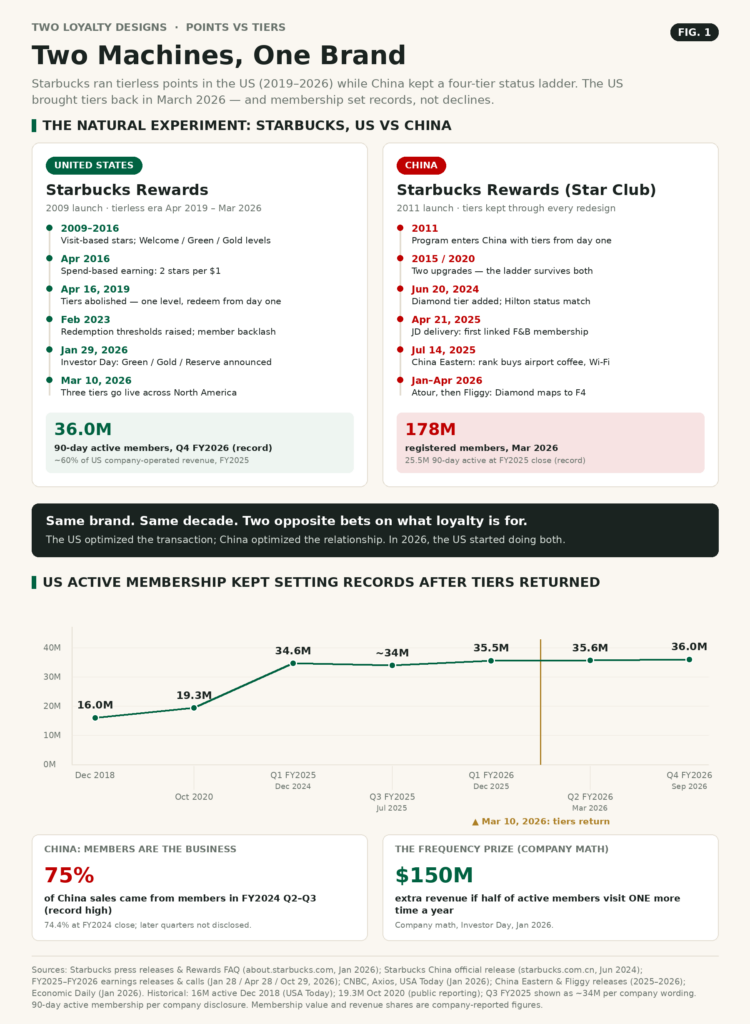
Rakuten took the points idea further than any Western program ever has. By its Q3 FY2026 results (November 13, 2026), the ecosystem had issued 5.6 trillion cumulative points — the 5-trillion mark was crossed on October 13, 2025 — across more than 70 services spanning shopping, credit cards, banking, securities, mobile and travel. Roughly 650 billion points are issued per year. Some 76.7% of active members use points across multiple services (77.3% in December 2025), and the company’s own “membership value” KPI — active users × cross-use × (LTV − CAC) — hit ¥11.0 trillion, up 14.7% year over year, after first crossing ¥10 trillion in Q4 2025. That KPI is company-calculated, not audited, and deserves the asterisk. But the architecture is real: one point, one wallet, dozens of businesses.
This is not a coupon book. Rakuten points swap to ANA and JAL miles at two points per mile. Uber rides in Japan earn them (one point per ¥200, up to 2% with Rakuten Pay, under the December 2025 partnership — the funding split between the companies is not disclosed). FamilyMart pays to join the multiplier scheme as of July 2026. When third parties line up to plug into your loyalty unit, you have printed a currency, not a discount.
Starbucks China chose the other extreme: keep the ladder, attach a wallet. Its program entered China in 2011 with status levels from day one and kept them through every redesign — 2015, 2020, and the June 2024 overhaul that added a fourth rung, Diamond, above Silver, Jade and Gold.
The Natural Experiment Nobody Planned
Here is what makes Starbucks the best evidence available: it is one company, one brand, one product, running two loyalty architectures in its two biggest markets for seven years. The US stripped status out in 2019 to lower the entry barrier. China doubled down on status in 2024, adding Diamond at 100 growth value per year — roughly ¥5,000 of annual spend — with priority order-making, a birthday gift, and a guided tour of the Shanghai Roastery.
The Chinese ladder produced compounding results. Members accounted for a record 75% of China sales in FY2024 Q2–Q3 (74.4% at the fiscal year’s close; the company has not disclosed the share since, so treat any newer number with suspicion). Registered membership passed 127 million in March 2024, 160 million by November 2025, and 178 million by March 2026, per the Fliggy partnership announcement. Active membership hit a record 25.5 million at the FY2025 close. And through China’s brutal coffee price war, the program kept the premium base intact: China comps returned to growth through 2025 and rose 7% in Q1 FY2026, transaction-led.
Then the American verdict arrived. On January 29, 2026, at Investor Day, Starbucks announced Green, Gold and Reserve tiers for North America, live March 10. One correction to the popular telling: this was not a rescue. Membership was already at a record 35.5 million, and the quarter announced alongside Investor Day showed member and non-member transactions growing together for the first time in nearly four years. Tiers were not a lifeboat; they were a segmentation engine installed on a ship already moving.
Why Tiers Carry the Load in Identity-Shaped Markets
Four mechanisms explain which tool ends up load-bearing.
Status as social signal. In East Asia’s face-conscious consumption cultures, a visible rank does work a points balance cannot: it tells other people who you are. Diamond is not just perks; it is a credential. The Chinese program leans into ritual — since December 2025, the 17th of every month is a member day, and the December 17 annual member night drew over 45,000 members across 1,800-plus stores in one evening.
Ecosystem breadth. The wider the ecosystem, the more a universal currency earns its keep. Rakuten needs one unit to stitch 70-plus services together; a single-brand coffee chain does not. Breadth decides whether points become currency or stay coupons.
Two different switching costs. Points lock the wallet: leaving forfeits a balance. Tiers lock identity: leaving forfeits a self. China’s official terms make the psychology explicit — growth value resets at each account anniversary, and Diamond must re-earn 100 points a year or fall back to Gold (16 points) or Jade. Falling from Gold hurts in a way that losing 400 stars never quite does.
Different finance jobs. A points program manages a liability — deferred revenue and breakage estimates. A tier program manages segmentation — the frequency uplift of status-seekers. Starbucks’ FY2025 10-K shows $1,751.7 million of stored-value and loyalty deferred revenue and $222.4 million of breakage revenue recognized in the year. The tier layer’s job is to make sure the most valuable customers never give you a reason to recognize their breakage.
There is academic support for the split, properly scoped. A 2018 Springer study by Xin, Zuo, Iida and Aziz applied game-refinement theory to My Starbucks Rewards and found that points-only motivation decays with repetition — a short-term incentive that fades — while noting that Starbucks pairs points with tiers precisely to acquire customers and then retain them. The study modeled the points layer only; it is evidence for decay, not proof that tiers never fade.
The Dual-Track Template: Rank and Currency, Separated
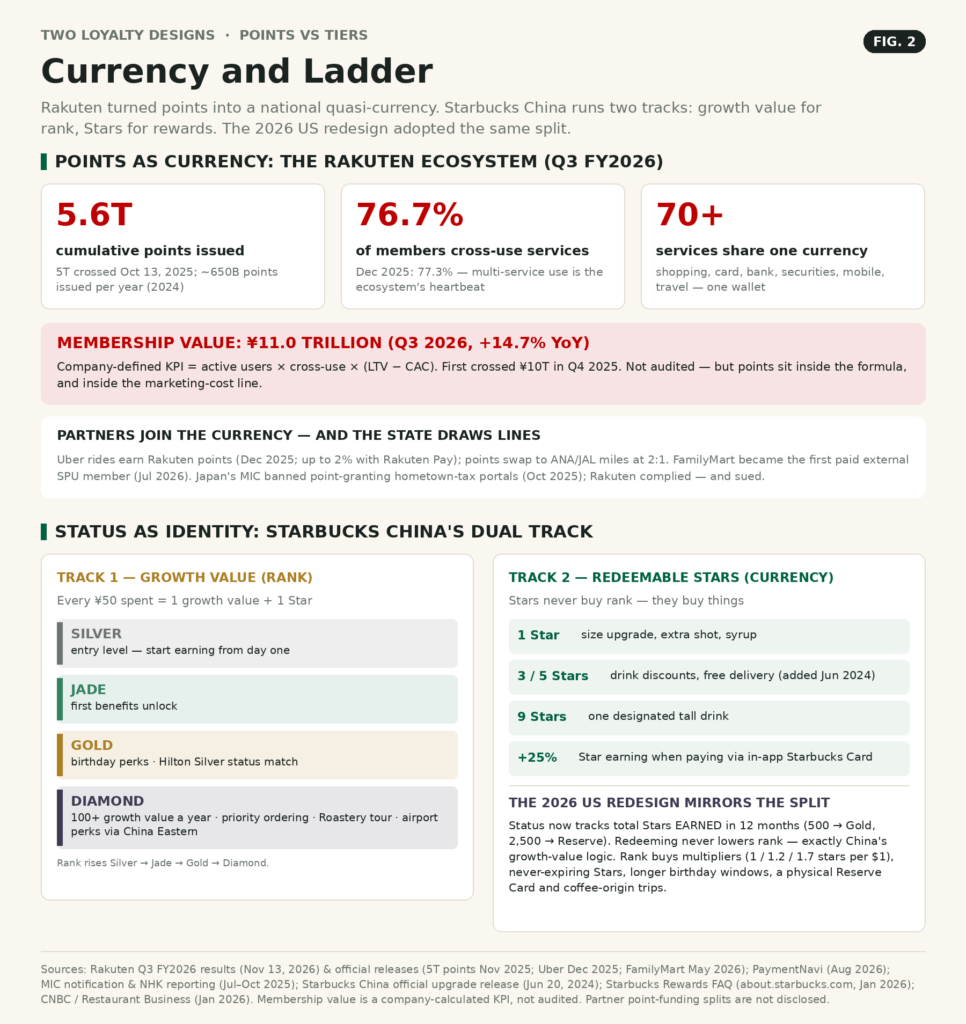
The quiet genius of Starbucks China’s design is the separation of two counters. Growth value determines rank and can never be spent. Stars buy things and never affect rank. You can burn every Star you own and still be Diamond — the official FAQ is explicit that redemption does not touch status. This resolves the classic loyalty conflict: burning currency should not punish identity.
Read the fine print of the 2026 US redesign and you find the same separation, arriving seven years late. Status now tracks total Stars earned in a rolling 12-month window — 500 for Gold, 2,500 for Reserve — and the FAQ states plainly that redeeming Stars does not impact status. Rank buys multipliers (1, 1.2, 1.7 stars per dollar), never-expiring Stars for Gold and Reserve, longer birthday windows (a day, a week, a month), a personalized physical Reserve Card, and lottery access to coffee-origin trips to Tokyo, Milan or Costa Rica. The old payment-type hack — two stars per dollar only if you preloaded the card — is gone; earning now follows engagement, not plumbing.
The early results read like a textbook. The new 60-star, $2-off rung became the most-used reward almost immediately, about a third of all redemptions by Q2 FY2026. Card reload rates and volumes beat expectations. More members started visiting four-plus times a week. And active membership — 35.6 million in Q2, 36 million in Q4 — kept setting records in the very quarter the tiers went live. Lieberman’s Investor Day math explains why the company cares: if half of active members visit just one extra time a year, that is roughly $150 million in incremental revenue. Small behavior changes, enormous base.
Status Is Exportable: The Membership Web
China’s tier ladder does something else Western programs rarely attempt at scale: it exports rank across companies. Since 2024, Starbucks China has stitched its tiers into a travel-and-lifestyle web. Hilton Honors came first (June 2024): Gold and Diamond members receive Hilton Silver, with a fast-track to Hilton Gold. JD’s delivery platform followed in April 2025 — Starbucks became the first food-and-beverage brand with fully linked membership there, so Stars and perks accrue identically on a third-party app. China Eastern joined in July 2025 in a partnership covering nearly 200 million combined members: airline Platinum and Gold members drink free at airport Starbucks on flight days; Diamond members get free in-flight Wi-Fi; by November 2025 over 100,000 free coffees had been claimed. Atour hotels joined in January 2026 (up to 360 days a year of Atour Gold core benefits for top-tier members), and Fliggy in April 2026 mapped Diamond straight to its F4 tier with Marriott Bonvoy Gold matching and 40-plus brand benefits attached.
Notice what is being traded: not points, but rank. Status matching works because tiers are legible credentials — a Diamond is a Diamond whether the reader sells coffee, hotel nights or flight seats. A points balance cannot do this; balances are private, ranks are portable. This is the ecosystem logic of Rakuten applied to identity instead of currency, and it is why the Chinese design keeps compounding even as the market cheapens around it. Context matters here: in April 2026 Starbucks closed the sale of 60% of its China retail business to Boyu Capital at roughly a $4 billion enterprise value, keeping 40% and licensing the brand — a bet that the membership machine, not the real estate, is the durable asset, with an ambition of growing from about 8,000 stores to as many as 20,000.
The Liability Ledger Nobody Puts in the Pitch Deck
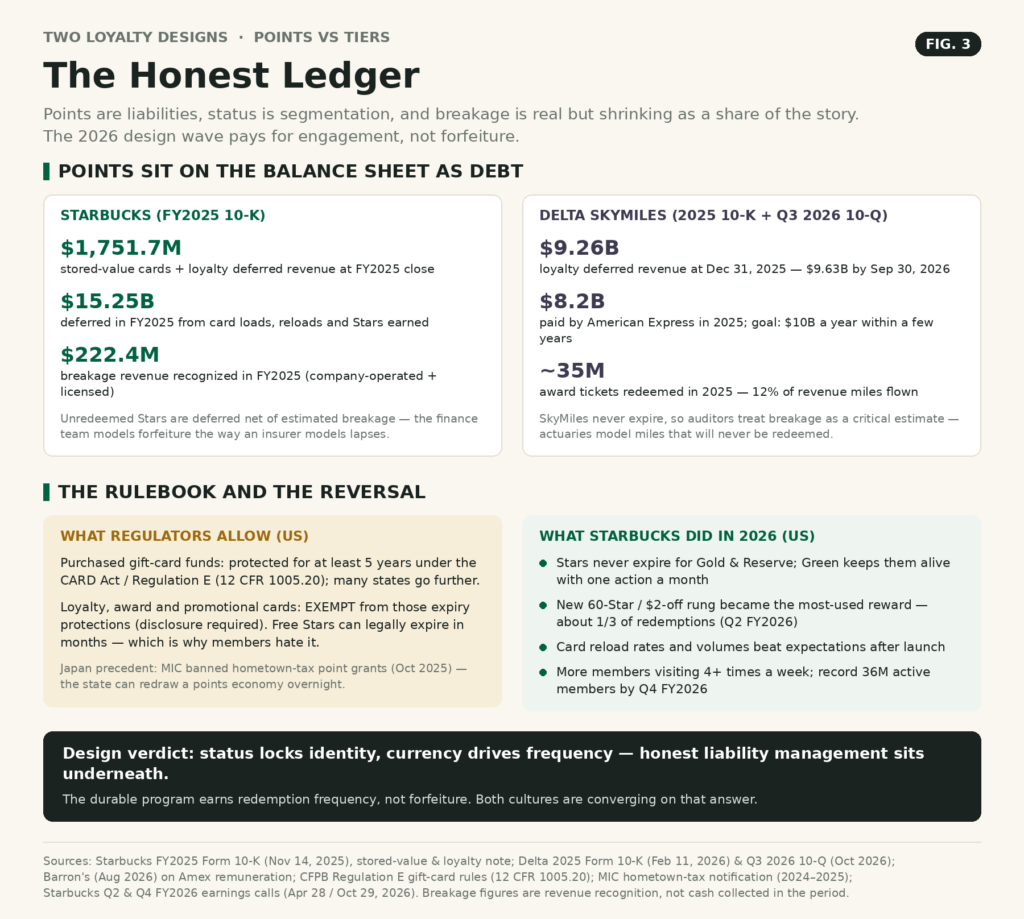
Points outstanding are debt. Delta’s 2025 10-K shows $9.26 billion of loyalty deferred revenue at year-end — $9.63 billion by September 2026 — against $8.2 billion paid by American Express in 2025 for miles and brand usage, with a stated goal of $10 billion a year within a few years. SkyMiles never expire, so auditors treat breakage — miles that will simply never be redeemed — as a critical accounting estimate requiring actuarial modeling. Members redeemed about 35 million award tickets in 2025, 12% of revenue miles flown. The airline sells currency to a bank and manages the float; the flying is almost the marketing.
The regulatory frame is permissive but moving. Under the CFPB’s Regulation E, purchased gift-card funds are protected for at least five years — but loyalty, award and promotional cards are explicitly exempt, which is why your free Stars can legally evaporate in six months. Japan shows how fast the ground can shift: the internal affairs ministry banned point-granting hometown-tax portals effective October 2025; Rakuten complied and sued. A points economy large enough to be infrastructure is large enough to be regulated.
Which is why the honest synthesis is the 2026 design wave itself. Starbucks made Stars never expire for Gold and Reserve, gave Green members a one-action-a-month lifeline, and added a cheap, fast redemption rung — then watched redemption frequency and visit frequency rise together. Breakage revenue is real accounting, but the durable program earns engagement, not forfeiture. Niccol said it directly on the Q2 call: the program had become “a coupon book,” and it needed to be about engagement, personalization and recognition instead.
What Everyone Gets Wrong
“The West doesn’t do tiers.” Airlines, hotels and credit cards are tier-heavy — Delta’s Medallion ladder is the industry’s template, and Restaurant Business openly framed Starbucks’ 2026 redesign as taking a page from the airlines’ playbook. The dichotomy is about mass-retail defaults, not absence.
“China doesn’t do points.” China is points-saturated — JD’s Jingdou, Tmall points, bank-card points everywhere. The difference is tiers plus points as identity-currency, not points alone.
“Points are just discounts.” At Rakuten’s scale — transferable to airline miles, earned on Uber rides, pluggable by paying partners — points have monetary properties no coupon possesses.
“Tiers are superficial gamification.” The gamification research points the other way: points-only motivation decays; status layers are what the retention literature and now the US redesign itself bet on. And Starbucks China’s member-sales share — three-quarters of revenue at its last disclosure — is the commercial proof.
“The US brought tiers back because members were fleeing.” The record shows the opposite: 35.5 million at announcement, 36 million two quarters later. Tiers were installed to segment strength, not to arrest decline. Getting this wrong reverses the lesson.
The Counterargument, and Its Limit
The dichotomy can be overdrawn, and precision matters. Both tools exist everywhere; the claim is about load-bearing order. Tiers can also alienate casual customers — a ladder that only rewards elites reads as exclusion, and the US design explicitly answers this: Free Mod Mondays and the 60-star rung serve every member, while attainable Gold (500 stars, a few hundred dollars of annual spend) keeps the middle rung within reach. There is a real cost, too: Starbucks’ own history includes the February 2023 redemption-threshold hike that sparked backlash, and the 2026 launch irritated legacy Gold Card holders who had spent seven years believing their retired status still meant something. Status giveth, and status taketh away — devaluation risk is the shadow side of the whole design. The honest reading is that both cultures are being pushed, by members and regulators alike, toward genuine value delivery. The convergence is real; it is not frictionless.
What Brands Should Actually Build
Match the tool to the meaning of loyalty in your market. Identity-shaped categories and status cultures deserve visible, attainable tiers with exportable rank — status matching is the cheapest ecosystem expansion available. Deal-shaped contexts deserve a clean currency with honest earn-and-burn math. Then combine, don’t choose: the dual-track template — rank you cannot spend, currency that cannot demote you — is now proven in both markets by the same company. Where breadth allows, design points as currency others pay to join; where it doesn’t, start with two or three coalition partners and status matching. And instrument the ledger like a CFO: deferred balances are debt, breakage is an estimate under regulatory watch, tier benefits are cost-of-retention. Measure frequency uplift and LTV minus CAC — not enrollment vanity. Starbucks’ $150 million one-extra-visit math is the whole business case in a sentence.
Conclusion
Two loyalty designs, two optimization targets. Points optimize the transaction — currency, frequency, breakage. Tiers optimize the relationship — identity, status, depth. East Asian ecosystems loaded the tier-and-currency combination because loyalty there is identity-shaped and ecosystem-wide; Western mass retail loaded points because loyalty was deal-shaped. Then Starbucks ran the experiment on itself, and in March 2026 the West admitted the relationship layer cannot be skipped — from a position of record strength, not weakness. The winning design is dual-track: status to lock identity, currency to drive frequency, honest liability management underneath. Loyalty was never one tool. It is two — and the cultures just disagreed about which one leads.





