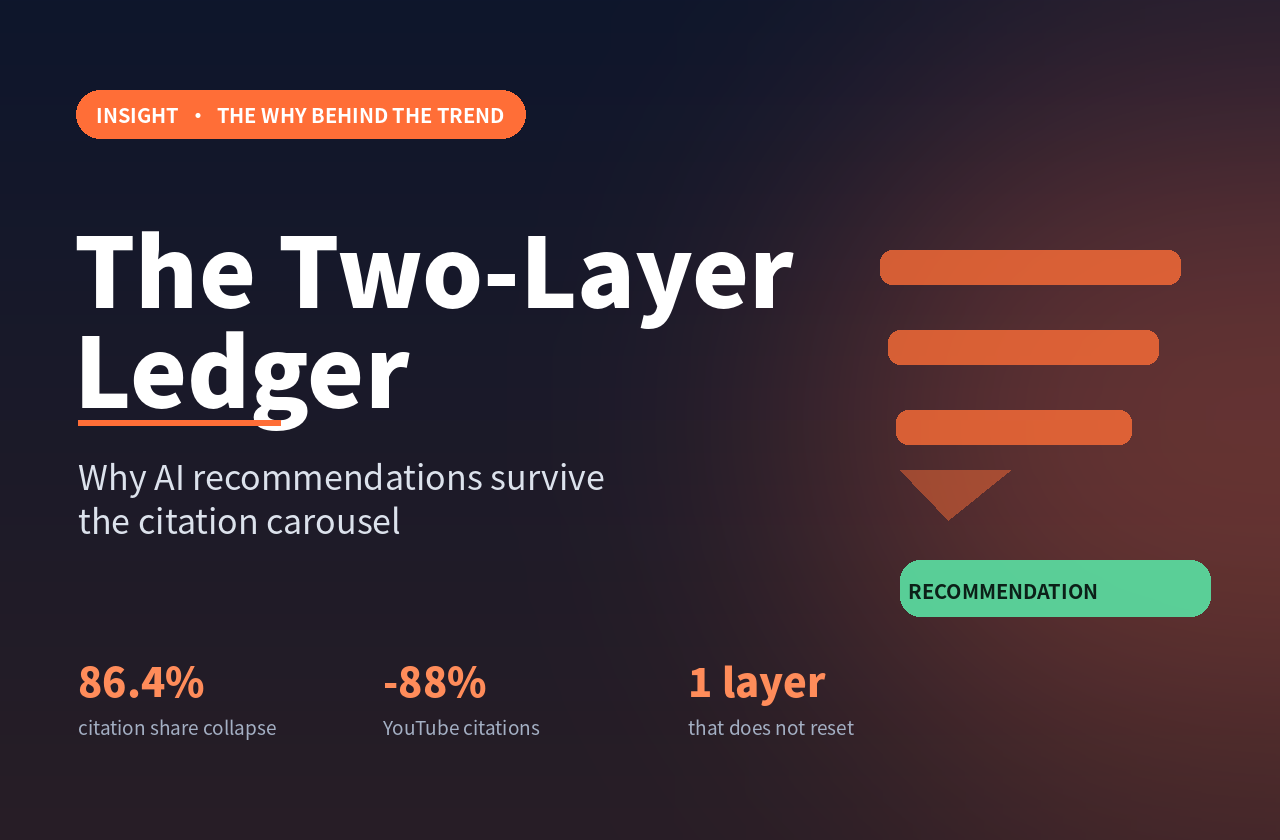
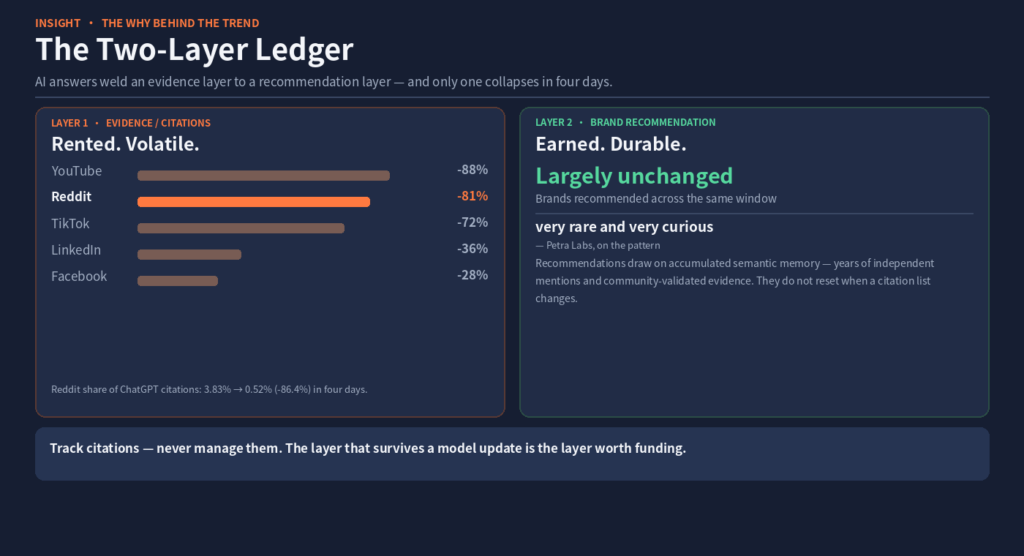
In August 2026, the citation lists inside ChatGPT answers were rewritten almost overnight. Reddit’s share of ChatGPT Search citations fell from 3.83% to 0.52% in four days. YouTube citations dropped 88%, TikTok 72%, LinkedIn 36%. If you were watching a GEO dashboard, it looked like the ground had moved.
Then something strange showed up in the same data. The brands ChatGPT recommended barely changed.
Petra Labs, the visibility firm that analyzed 126,500 ChatGPT responses between August 9 and 18, called the pattern “very rare and very curious.” Cited sources were swapped out wholesale. Recommended brands stayed put. That gap is not a glitch. It is a window into how these systems actually decide.
An AI Answer Is Two Answers Welded Together
Here is the mechanism worth internalizing. Every generated answer is built from two distinct layers, and they run on different clocks.
The evidence layer is the citation list — the live URLs the model points to as receipts. It is assembled at response time by a retrieval step that queries a shifting pool of sources. That pool is governed by a handful of engineering decisions: query fan-out logic, source weighting, licensing deals, freshness filters. Change one of those switches and the citations can rotate in days. This layer is rented, not owned. It is the volatile half of the ledger.
The recommendation layer is the brand judgment — which companies the answer names as good options. This draws on something far stickier: accumulated semantic memory built from years of independent mentions, comparisons, reviews and community-validated discussion. Reddit threads, Wikipedia entries, earned coverage. That base does not recompile when a citation filter flips. This layer is earned, and it is durable.
Why the Split Is Structural, Not Temporary
The August event looked like a Reddit problem. It was almost certainly a retrieval-routing problem. Promptwatch flagged that the first slip coincided with a change in ChatGPT Search’s query fan-out behavior, and its own team cautioned that the data shows when the shift happened, not why — with a collection artifact not fully ruled out. Petra Labs saw every major social domain fall together, while Gemini and Claude showed no comparable move. One engine’s plumbing changed. Not one platform’s reputation.
That is the discovery hiding inside the noise: citations measure the model’s current sourcing behavior, not the market’s judgment of your brand. Recommendations measure the accumulated record. The two decoupled in August, and they can decouple again.
What This Means for Your Strategy
Treat citations as diagnostic telemetry, not a scoreboard. Track them because sudden rotation tells you a retrieval change happened — but never set a short-term citation-share KPI, because a number that can fall 86% in four days for reasons no vendor can fully explain is not a number you can manage.
Fund the layer that survived. Independent mentions across many sites, community-validated conversations, a defensible Wikipedia presence, genuine participation where your buyers deliberate — that is the ledger that persists through a model update. When the evidence layer reshuffles, the brands with deep semantic memory are the ones the system keeps recommending. The layer that does not reset is the only one worth compounding.