Two years ago, picking an AI video tool meant watching demo reels and hoping. Today it means reading earnings reports. Kling, Kuaishou’s video model, booked more than 650 million yuan in the first quarter of 2026 alone. ByteDance’s Seedance is reportedly running at an annualized two billion dollars. MiniMax, the lab behind Hailuo, nearly quadrupled its revenue year over year. This is not a toy market anymore. It is production infrastructure, and your competitors are already budgeting for it.
So which tool should your team actually pay for? The honest answer: it depends on the job, the volume, and how much control you need. This guide gives you the decision matrix, the real cost math (including the costs vendors never put on the pricing page), a quality-control workflow, and the compliance layer you cannot skip in China.
AI Video Just Crossed the Revenue Line
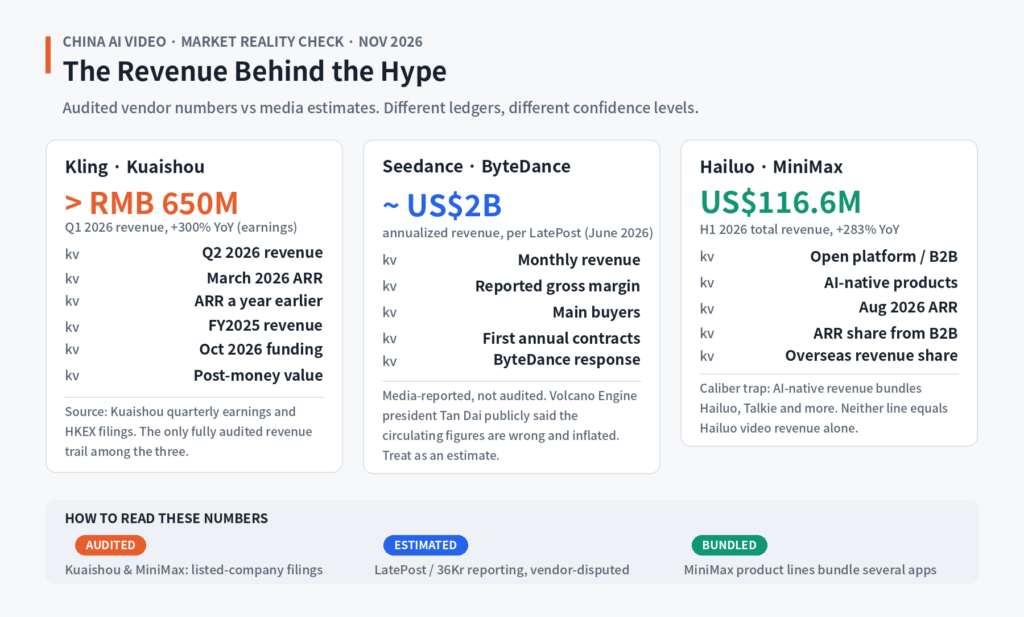
Let’s start with why this matters now. Kuaishou’s quarterly filings show Kling revenue above 650 million yuan in Q1 2026, up more than 300 percent year over year, and above 850 million yuan in Q2. Its annualized recurring revenue hit roughly 500 million dollars in March — about five times what it was a year earlier. In late October, Kling closed a financing round of about 2.9 billion dollars at a post-money valuation near 18 billion dollars, with Kuaishou keeping roughly two-thirds of the unit.
When a video model gets spun out at that valuation, the message to buyers is simple: this vendor will be around, the roadmap is funded, and enterprise support is a real business line. Tool risk — the fear that your workflow evaporates when a startup dies — has dropped sharply for the top three.
Three Tools, Three Very Different Ledgers
Before the matrix, you need to understand what you’re buying from each vendor — because the business model shapes the product.
Kling: The Audited Overachiever
Kling is the only one of the three with a fully audited revenue trail, because Kuaishou is a listed company. Its full-year 2025 revenue was about 1.1 billion yuan, and back in December 2025 the Economic Observer reported that roughly 70 percent came from paid subscriptions — professional creators, not enterprises. That creator-first DNA shows in the product: motion control, reference locking, multi-keyframe direction, native 4K. The Kling 4.0 generation, fully live since mid-October with a global API opening two weeks later, pushes native 30-second takes and a cheaper Flash variant aimed squarely at short-drama and marketing volume. One caveat from the November earnings: Kuaishou stopped disclosing Kling’s revenue as a separate line in Q3, saying only that billings rose after the 4.0 launch. Audited, but less granular than before.
Jimeng and Seedance: The Ecosystem Machine
ByteDance runs a two-story shop. Upstairs is Jimeng, the consumer creation app; downstairs is Volcano Engine, selling Seedance API calls to enterprises. When Seedance 2.0 exploded around Spring Festival, demand outran the GPUs: a clip barely fifteen seconds long could sit in a ten-hour queue. Jimeng promptly launched paid priority queuing — its first real revenue. Media estimates put Jimeng at roughly 140 million yuan in March and 210–220 million in April. Then the money switched downstairs: LatePost reported in June that Seedance was running at about two billion dollars annualized, over a billion yuan a month, mostly enterprise API, at roughly 70 percent gross margin.
Here’s the credibility flag you must carry: Volcano Engine’s president publicly disputed those figures, calling the circulating numbers wrong and inflated. ByteDance is private and does not break out Seedance. Treat the two-billion number as a disputed media estimate, not a fact — the direction (enterprise-led, very large) is corroborated; the precision is not.
Hailuo: The Motion Specialist With a Caliber Trap
MiniMax’s first interim report as a listed company showed 116.6 million dollars of H1 2026 revenue, up 283 percent. But read the lines carefully: 73.9 million came from the open platform and enterprise services — that’s all models, including language models — and 42.6 million from AI-native products, which bundles Hailuo with Talkie and other apps. Neither line equals Hailuo video revenue. Anyone quoting either number as “Hailuo’s revenue” is mixing ledgers. Management said total ARR passed 800 million dollars by August, roughly 80 percent from B2B, with 60.8 percent of revenue from overseas.
The strategically interesting move: MiniMax open-sourced its H3 video model’s base weights in August. Within a month it had over 24 million downloads and 300-plus public derivative models; fal’s optimized H3 Max generates a five-second clip in under three seconds, and even NVIDIA and Pika shipped models built on H3. The catch for Western teams: the open-weights license excludes use in the US, EU, UK and Korea. The hosted API has no such restriction.
The Runway-Menu Effect: Why Model Loyalty Is Dead
Here’s the structural insight that changes how you should buy. Seedance 2.0 appeared on Runway’s API in April, Seedance 2.5 in August — alongside Kling models. Jimeng itself now offers Hailuo’s H3 and Alibaba’s Wan next to Seedance. The models have become menu items on each other’s platforms.
What does that mean for you? Switching costs between models are collapsing. Your loyalty should attach to your workflow — prompts, references, review gates, editing pipeline — not to any single model. The vendor lock-in that remains is contractual (more on those annual commitments below), not technical.
The Use-Case Decision Matrix
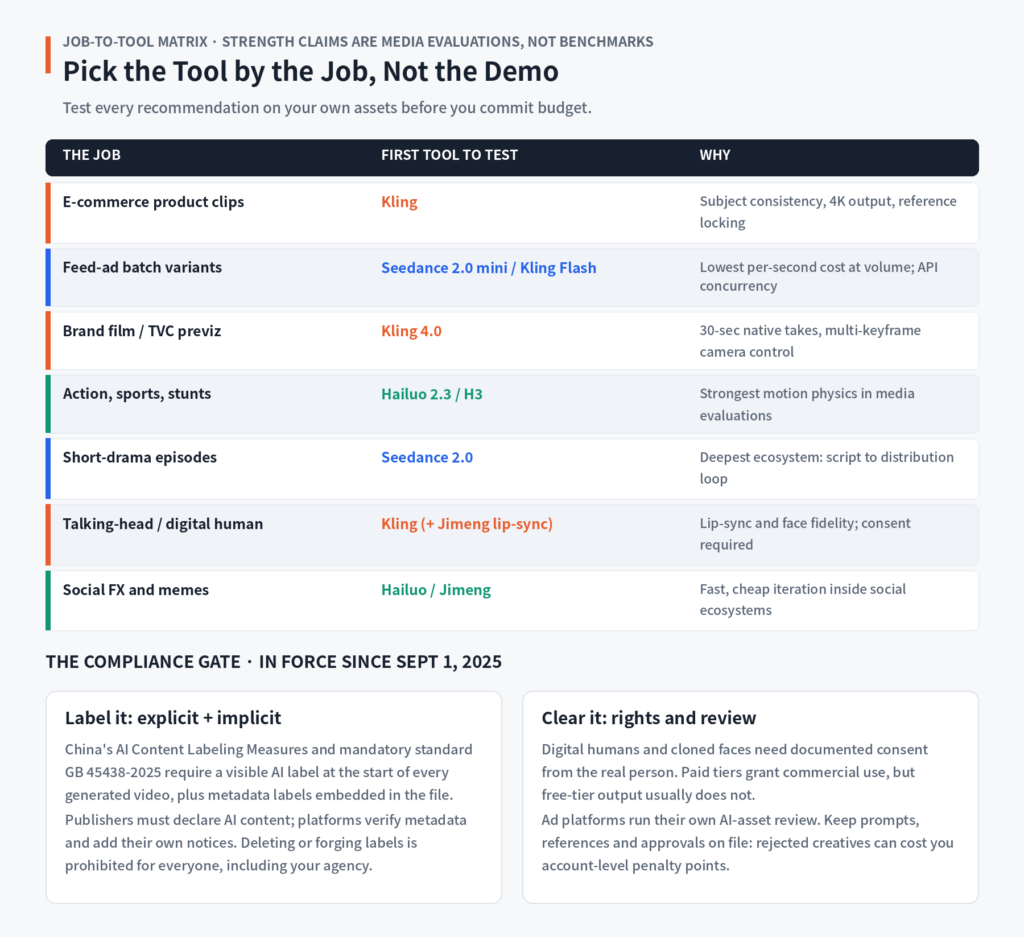
Strength claims below come from media evaluations and creator testing, not controlled benchmarks. Test on your own assets before committing — the bake-off protocol at the end tells you how.
| Job | First tool to test | Why |
|---|---|---|
| E-commerce product clips | Kling | Subject consistency, 4K, reference locking |
| Feed-ad batch variants | Seedance 2.0 mini / Kling Flash | Lowest per-second cost at volume |
| Brand film / TVC previz | Kling 4.0 | 30-second native takes, multi-keyframe control |
| Action, sports, stunts | Hailuo 2.3 / H3 | Motion physics repeatedly praised in evaluations |
| Short-drama episodes | Seedance 2.0 | Deepest ecosystem, script-to-distribution loop |
| Talking-head / digital human | Kling; Jimeng lip-sync | Face fidelity and lip-sync; consent required |
| Social FX and memes | Hailuo / Jimeng | Fast, cheap iteration inside social ecosystems |
Volume Jobs Versus Control Jobs
Notice the split. Batch ad creative is a cost-led job: you need forty variants by Thursday, and a cheaper model with a higher retry rate can still win. A hero brand film is a control-led job: you need the camera to move exactly there, the product to stay on-model, and the client to approve frame twelve. Buying one tool for both jobs is how teams end up overspending on volume and under-delivering on hero work.
Context for why volume matters: China’s regulator disclosed in October that micro-drama audiences exceed 800 million users, over 600 million monthly. Kuaishou says its daily active short dramas grew more than 350 percent between January and September, and content-consumption ad spending doubled year over year. The appetite for generated video assets is industrial.
The True Cost Math
Pricing pages tell you the sticker. Production tells you the truth.
Subscriptions: You’re Buying Credits, Not Videos
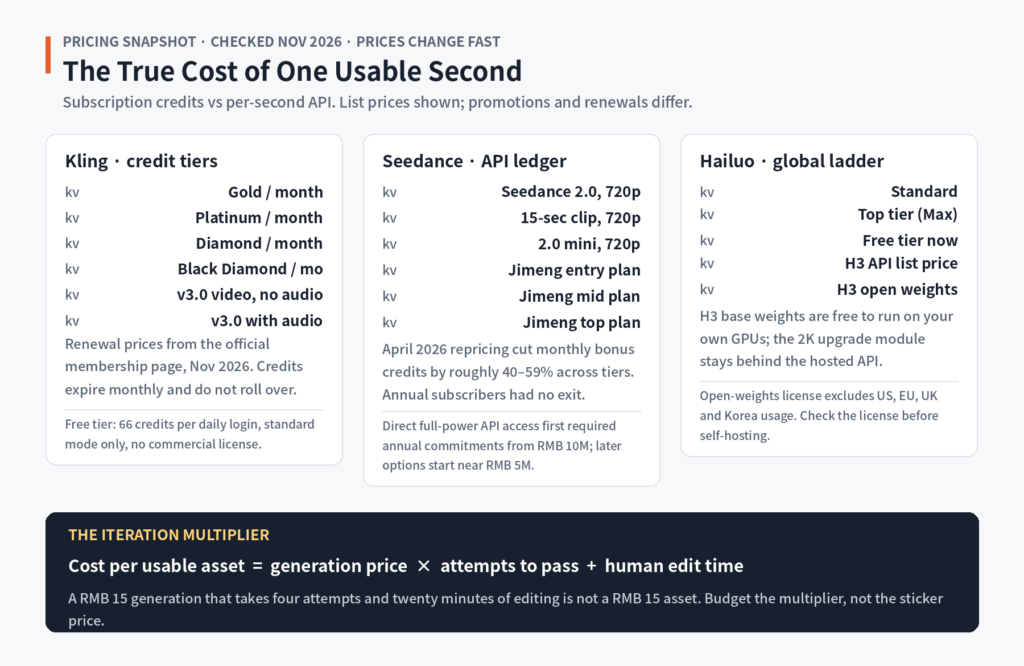
Kling’s official membership page, checked this month, lists renewal prices of 58 yuan for Gold (660 credits), 234 for Platinum (3,000), 586 for Diamond (8,000, with larger packs selectable), and a new Black Diamond tier at 4,049 yuan for 57,000 credits. On the 3.0 model line, video without audio burns 6–8 credits per second, with audio 9–12. Do the division and a ten-second clip with sound costs roughly 8 yuan on Platinum — before retries. Credits expire monthly and do not roll over; the free tier’s 66 daily credits are standard-mode only and carry no commercial license.
Jimeng sells annual plans at 659, 1,899 and 5,199 yuan. But here’s the cautionary tale: in April, amid compute scarcity, it cut monthly bonus credits by roughly 40 to 59 percent across tiers — the top plan fell from 15,000 credits to 6,160. Annual subscribers had no exit. Lesson: default to monthly until a vendor’s pricing has been stable for two quarters.
API: Per-Second Honesty, With a Catch
Volcano Engine’s list price for Seedance 2.0 works out to about one yuan per second at 720p — a fifteen-second clip runs 14–15 yuan. The mini variant halves that to roughly 0.5 yuan per second, capped at 720p. MiniMax lists H3 around 0.8 yuan per second. Clean, predictable numbers.
The catch is access. Full-power Seedance 2.0 initially required annual commitments starting at ten million yuan; later options came down toward five million, still serious money for a mid-size team. Smaller buyers reach the same models through middleware platforms or aggregators at a markup. Global teams can also call Seedance through Runway’s API, which sidesteps the domestic contract structure entirely.
The Iteration Multiplier
Now the number that actually decides your budget: cost per usable asset equals generation price times attempts-to-pass, plus human edit time. An illustrative example — label it as such, your rates will differ. A 15-yuan API generation that takes four attempts is 60 yuan. Add twenty minutes of an editor at 150 yuan an hour, and your “cheap” clip costs 110 yuan. A subscription clip at 8 yuan with three attempts and ten minutes of editing lands near 49. The cheaper sticker lost. Track usable-rate per tool on your own briefs; it swings wildly by content type, and it matters more than list price.
The Quality-Control Workflow Nobody Shows You
Demo reels are curated survivors. Your pipeline needs gates: brief, storyboard, generate, select, edit, compliance check. Lock characters with reference images and subject-reference features before generating a single frame of a series. Generate in batches, select ruthlessly — a 30 percent usable rate is normal, not failure. Then do the human edits that make AI video brand-safe: fix hands and text artifacts, color-match to brand palette, replace warped logos with real assets in post, and add sound design where the model has none. Budget these steps as production, not overhead. Teams that skip the edit gate are the ones whose AI ads get mocked in comment sections.
Compliance: The Gate You Cannot Skip
Labeling Is Mandatory, Not Optional
Since September 1, 2025, China’s AI Content Labeling Measures and the mandatory national standard GB 45438-2025 require two layers on generated video: an explicit, viewer-visible AI label at the start of the clip, and implicit labels embedded in file metadata. Publishing platforms verify that metadata and add their own notices; users must declare AI content when posting. Deleting, tampering with, or forging labels is prohibited — for everyone, including your agency. An industry testing institute’s spot-check that September found about 91 percent of tested text-to-video services fully compliant, so the major vendors’ outputs already carry labels. Your job is to not strip them and to declare correctly at upload.
Faces, Consent and Ad Review
Digital humans and cloned faces need documented consent from the real person — China’s personality-rights regime treats face and voice as protected. Paid tiers generally grant commercial use of outputs; free tiers generally don’t, so never ship free-tier assets in campaigns. And ad platforms run their own review of AI creatives: rejected assets can accumulate account-level penalty points that throttle delivery long after the individual ad is gone. Keep prompts, reference licenses and approvals on file.
The Stack Pattern: Primary Plus Batch Plus Human
Mature teams don’t pick one tool. They run a stack: a primary tool matched to their dominant job, a cheap batch lane (mini or Flash models, or an aggregator API) for variants, and a human edit suite as the final common path. Use platform-native creation tools when your distribution lives inside one ecosystem — the integration savings are real — but keep an external lane so a single vendor’s repricing or queue meltdown can’t halt your production. Given the Runway-menu effect, the stack is cheaper to maintain than ever: the same workflow can swap models underneath.
Run a Five-Asset Bake-Off Before You Commit
Don’t evaluate on vendor demos. Pick five assets that represent your real mix — say, a product spin, a talking-head, an action shot, a lifestyle scene, and a text-heavy offer card. Run identical briefs and references through each candidate. Score four numbers: consistency across takes, usable rate, cost per usable asset, and edit minutes per asset. One afternoon of testing beats a month of reading comparisons, because usable-rate is specific to your content, your brand tolerance, and your prompts. Re-run the bake-off quarterly; model versions move fast enough that today’s loser is next quarter’s default.
Honest Boundaries
Three limits on everything above. Revenue figures for Seedance and Jimeng are media estimates, one of them publicly disputed by the vendor — directionally useful, not audit-grade. Strength claims are evaluations, not benchmarks; your mileage will vary by prompt discipline. And versions churn: the pricing snapshot here was checked against official pages in November 2026, and Jimeng’s April repricing proves how fast the ground moves. Finally, remember the MiniMax caliber trap: neither reported revenue line isolates Hailuo video.
The Verdict
Buy Kling when control is the job — hero films, product fidelity, anything a client will pause and scrutinize. Buy into the Seedance ecosystem when volume is the job and you can live with retries, or when your content pipeline already runs through ByteDance’s distribution. Test Hailuo first whenever the brief says jump, fight, sprint or flow — and consider its hosted H3 API for cheap, fast iteration, since the open weights carry regional license restrictions. Then wrap whichever you choose in the same armor: monthly commitments until pricing stabilizes, a five-asset bake-off, a human edit gate, and labels you never strip. The tools are ready. The question is whether your workflow is.