Western marketers scroll Xiaohongshu and see the same thing: every lifestyle note somehow ends at a product. A skincare routine becomes a review. A review becomes a link. Too commercial, they conclude. Inauthentic.
They’re describing the symptom and missing the cause. Chinese content isn’t commercial because creators sold out. It’s commercial because the checkout was born in the room.
The architecture did it
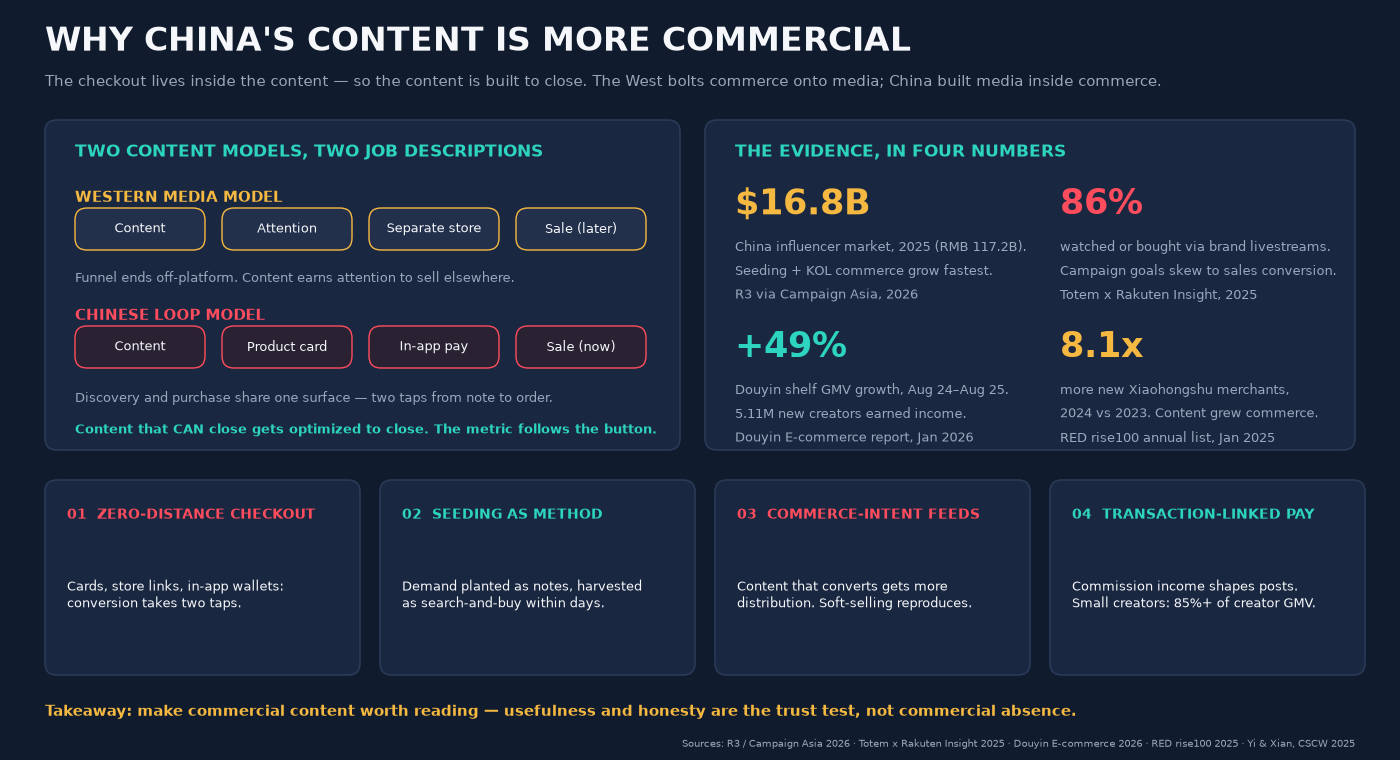
In the Western media model, content earns attention on one surface and sells on another. A blog post feeds an email list; the email feeds a store. The funnel ends somewhere else, later.
Chinese platforms collapsed that distance. Douyin videos carry product cards. Xiaohongshu notes link to stores. WeChat articles open mini-program checkout. Worldpay’s 2026 Global Payments Report puts payment apps at 92% of China’s e-commerce transaction value — the rails were already there. When a post can convert in two taps, it gets optimized to convert in two taps. The metric follows the button.
The economics followed the architecture
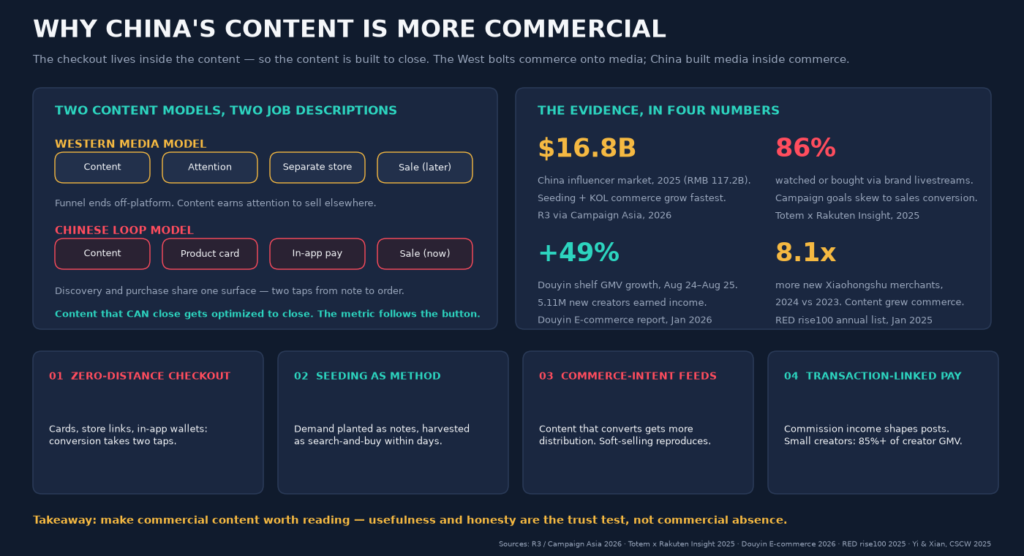
R3’s 2026 governance whitepaper, reported by Campaign Asia, sizes China’s influencer market at RMB 117.2 billion (about US$16.8 billion) — the largest marketing line for consumer and beauty brands after e-commerce itself. The fastest-growing slices? KOL seeding and KOL-led commerce. Not reach plays. Harvest plays.
Totem and Rakuten Insight’s 2025 survey of 575 Chinese consumers and 42 brand managers found campaign goals skew toward sales conversion more than any other Asian market, with 86% of consumers having watched or bought from a brand livestream. Meanwhile, Douyin’s official 2025 report shows shelf-scene GMV up 49% year over year, with 5.11 million new creators earning income — and small and mid-sized creators taking over 85% of creator-driven GMV. When your paycheck is transaction-linked, your content is transaction-shaped.
Four forces, one direction
Zero-distance checkout, seeding as method (plant demand as notes, harvest it as search-and-buy within days), feeds that reward converting content with more distribution, and commission-based creator income. Each force independently selects for commercial content. Together they make it the default, not the exception.
The misread worth fixing
Western observers treat commerciality as an authenticity deficit. Chinese users treat useful commercial content as service — a real review with a price and a link saves them work. The trust test is usefulness and honesty, not commercial absence; platforms police undisclosed ads precisely to keep commerce disclosed, not to remove it. And the gap is closing anyway: as TikTok Shop and YouTube Shopping mature, Western content gets more commercial by architecture.
The durable lesson isn’t make content commercial. It’s make commercial content worth reading.