Somewhere in your P&L, there is a line item that your finance team files under “cost” and your customers treat as entertainment. It ships with every order. It costs you money whether you design it well or badly. And in China, a growing number of brands have figured out that this line item — packaging — can be booked a second time, on the marketing side of the ledger, where it earns impressions you never have to buy.
That is the core reframe of this piece: packaging is a media channel you already pay for. The cost is sunk the moment you decide to ship a physical product. The question is whether the box works only as protection, or also as a broadcast.
Chinese brands answered that question earlier and more aggressively than most of their Western peers. They did it by designing packaging for a specific moment — the opening — and for a specific audience: not just the buyer, but the buyer’s camera. The result is an industrialized unboxing culture in which the customer becomes the advertiser, the reveal becomes the content, and the box becomes the billboard.
Let’s unpack how that works, what the numbers actually say, and where the whole thing hits its legal and environmental limits.
Why the Opening Became Content
Unboxing did not begin in China. Google’s own researchers were documenting the genre’s pull more than a decade ago: in a 2014 Google Consumer Surveys study, 62% of people who watched unboxing videos did so while actively researching a product they were considering buying, and views of videos with “unboxing” in the title grew 57% between 2013 and 2014. By the 2017 holiday season, Think with Google reported that time spent watching unboxing videos on mobile phones in the US alone was equivalent to watching the film “Love Actually” more than 20 million times.
So the appetite is universal. What is distinctive about China is the industrialization. On Xiaohongshu (RedNote), Douyin and WeChat’s ecosystem, unboxing is not a quirky YouTube subculture — it is a standard content format with its own production grammar: the slow peel of a seal, the layered reveal, the close-up of texture, the gasp at a hidden variant. Brands design for that grammar deliberately. Chinese marketers even have a name for the design goal: yishigan, roughly “a sense of ritual.” The opening should feel like a ceremony, not a chore.
Why does ritual matter commercially? Because ordinary experiences don’t get posted. Rituals do. Consumer surveys have tracked this for years. Dotcom Distribution’s 2015 study of 524 online shoppers found that 60% said they would be more likely to share a product photo or video on social media if the order arrived in a gift-like box rather than a plain brown one. By its 2018 wave, 79.66% of Gen Z respondents — and 58.4% of Millennials — said they had watched an unboxing video. The audience is not niche. It is the young consumer base itself.
And the viewing converts. In the same 2015 study, 35% of respondents had watched an unboxing video, and 55% of those viewers said it convinced them to buy the product. An unboxing video is not just entertainment; it is a product demo, a trust signal and a purchase trigger rolled into one — created by a customer, distributed for free.
The Four Mechanisms That Turn a Box Into a Broadcast
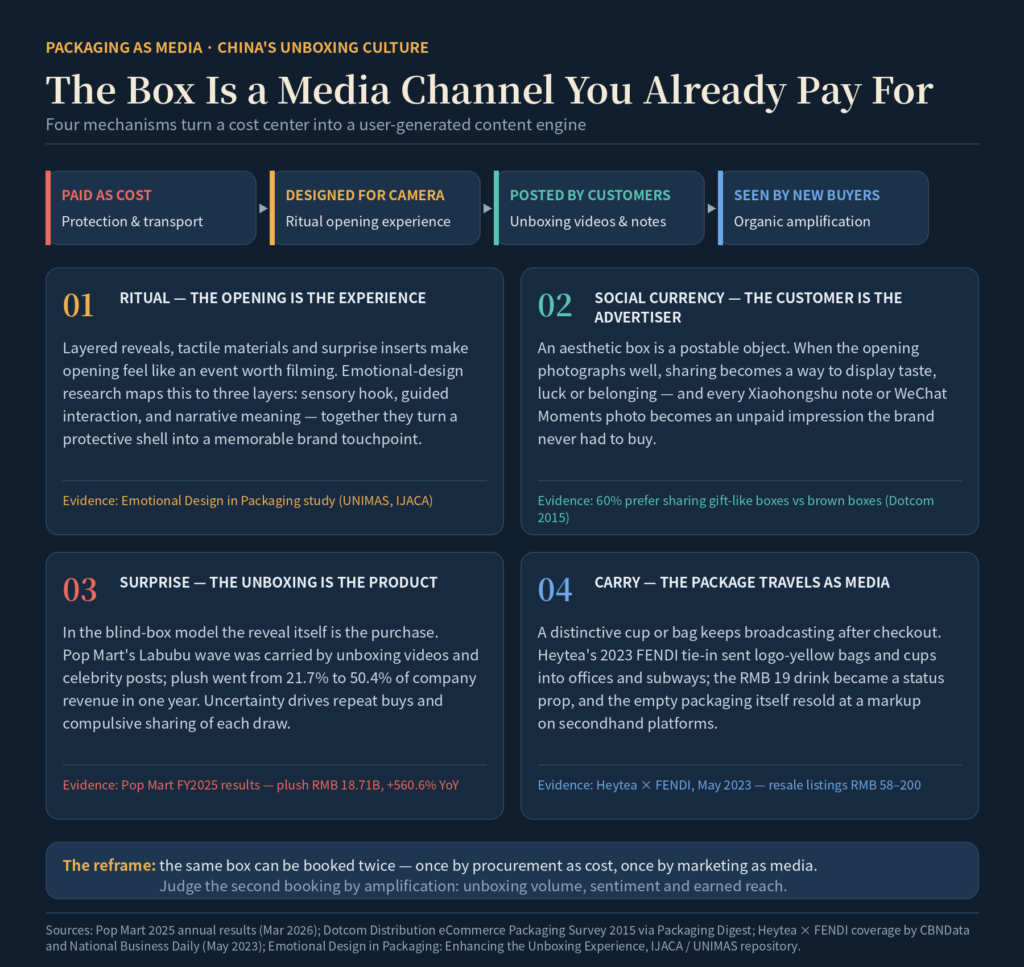
Chinese packaging-as-media strategies run on four distinct mechanisms. Most great cases combine at least two.
Mechanism 1: Ritual — the opening is the experience
Layered structures, tactile materials, magnetic closures, surprise inserts: these design choices slow the opening down and turn it into a sequence worth filming. Academic work on emotional design in packaging, applying Donald Norman’s three-level framework, describes exactly this stack: a visceral layer (materials, color, form) that hooks the senses, a behavioral layer (the guided opening sequence) that sustains engagement, and a reflective layer (story, symbolism, meaning) that converts satisfaction into attachment. The researchers’ conclusion is blunt — packaging designed this way stops being a protective shell and becomes a medium of experience and identity.
The commercial translation: a ritualized opening gives the customer a reason to reach for the phone. The brand supplies the stage; the customer shoots the ad.
Mechanism 2: Social currency — the customer is the advertiser
A beautiful box is a postable object. Sharing it displays taste, luck or belonging — the same social logic that drives any flex. On Xiaohongshu, an aesthetic unboxing note is a unit of social currency; in WeChat Moments, it is a recommendation wrapped in lifestyle signaling. The brand’s media buy is zero. The customer’s motivation is entirely their own.
Florasis is the cleanest example of packaging engineered as social currency. The Hangzhou brand, founded in 2017, builds traditional Chinese craft — Miao silverwork, Su embroidery motifs, relief carving — into its compacts and lipsticks. The product is beautiful, but the packaging is the argument: this is culture you can hold. When Xinhua profiled the brand’s global rise in early 2026, a Spanish consumer named Selena described the phoenix-engraved compact as “more a work of art than a cosmetic.” That is the sentence every packaging designer should want a stranger to say on camera.
The design travels. Florasis launched on Amazon Japan in March 2021, where several products sold out shortly after debut, and has since expanded into Ulta Beauty in the US, shipping to more than 100 countries. Jing Daily, citing Bloomberg, reported in late 2025 that the brand had built a TikTok following of over a million and was partnering with roughly 1,500 US-based influencers a year — but the organic layer underneath that paid layer is customers filming carved lipstick bullets they can barely bring themselves to use.
Mechanism 3: Surprise — the unboxing is the product
The blind box takes the logic to its endpoint. When you don’t know which variant you’ll get, the opening is not the prelude to the product. The opening is the product. The reveal is the payload, and it is inherently filmable because it contains genuine suspense — for the buyer and, vicariously, for the viewer.
No case proves the economics better than Pop Mart’s Labubu. And no case is better documented, because the company’s financials now read like a media report.
The Labubu Ledger: What Happens When the Reveal Sells
Pop Mart’s 2025 annual results, published in March 2026, are staggering: revenue of RMB 37.12 billion, up 184.7% year-on-year, with adjusted net profit of RMB 13.08 billion and a gross margin of 72.1% — territory normally occupied by luxury houses, not toy companies.
Inside those numbers sits the packaging story. The plush category — dominated by the Labubu bag charms and pendants — generated RMB 18.71 billion in revenue, up 560.6%, and its share of total revenue jumped from 21.7% to 50.4% in a single year. Plush overtook traditional figures as the company’s largest category for the first time. THE MONSTERS, the IP family Labubu belongs to, alone contributed RMB 14.16 billion, or 38.1% of everything the company sold.
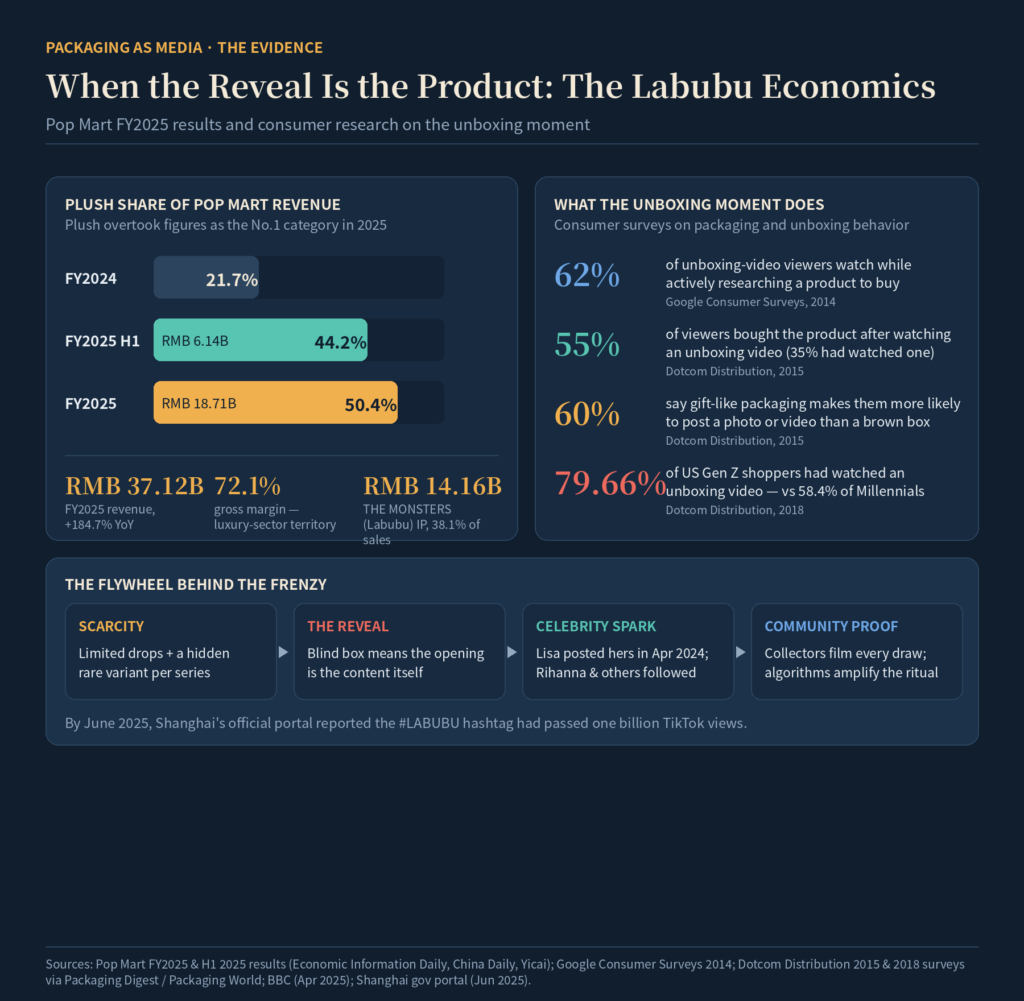
How did a snaggle-toothed plush gremlin do that? The BBC’s April 2025 account names the ingredients plainly: celebrity endorsement, social media unboxing videos, and nostalgia. BLACKPINK’s Lisa was photographed with a Labubu on her bag in 2024; Rihanna and a parade of other stars followed. The toys sell primarily in blind-box format — roughly £25 for one, £153 for a box of six at UK retail — so every purchase ends in a filmed reveal. By June 2025, Shanghai’s official government portal reported that the #LABUBU hashtag had passed one billion views on TikTok, with more than 11,000 related listings on eBay.
Marketing academics watching the phenomenon describe a status ladder. Laura Chamberlain, professor of marketing at Warwick Business School, told Big Issue in December 2025 that celebrity attention moved Labubu “from being seen as a toy to fashion accessory and then a status symbol.” Fellow marketing academic Kirsten Cowan, of the University of Edinburgh Business School, notes that toy fads are old — what TikTok changes is the speed and scale of the spread.
But here is the structural point most coverage misses: the frenzy is not just celebrity magic. It is a packaging architecture. Scarcity (limited drops plus a hidden rare variant), suspense (you cannot know until you open), and shareability (the draw result is a social statement) are all properties of the box. Pop Mart’s mainland membership data shows what the loop compounds into: 72.58 million registered members by the end of 2025, a 55.7% member repurchase rate, and members accounting for 93.7% of sales. The unboxing is the acquisition channel; the community is the retention engine.
The category context matters too. Frost & Sullivan’s analysis in Pop Mart’s 2020 IPO prospectus sized China’s pop-toy retail market at RMB 20.7 billion in 2019, growing at a 34.6% CAGR since 2015, and noted that around 70% of pop-toy consumers would buy blind boxes three or more times to land a specific design. Repeat purchase was baked into the format from the start. Labubu did not invent the loop. It globalized it.
Mechanism 4: Carry — the package keeps broadcasting after checkout
The fourth mechanism is the simplest and the oldest: a distinctive bag or cup is a mobile ad. Luxury houses have known this for a century. What Chinese consumer brands added was velocity — turning the carry into a same-week social event.
The canonical case is Heytea’s May 2023 collaboration with FENDI. For RMB 19 — about the price of a sandwich — buyers got a mango-passionfruit drink in a FENDI-yellow cup. A RMB 38 two-cup set added a co-branded badge or coaster and, crucially, a yellow paper bag with the FENDI logo. The launch melted the ordering mini-program, sold out stores within the first hour, and stacked multiple entries onto Weibo’s hot-search list. On secondhand platforms, the packaging itself — badges, coasters, even the cups — listed for RMB 58 to 200.
Read that again: the empty packaging resold at a multiple of the drink’s price. The medium had become the merchandise. Consumers joked that their “first FENDI” cost nineteen yuan, and every one of those jokes, posted with a photo of the yellow bag on an office desk, was an unpaid impression for both brands. The drink was the delivery vehicle. The bag was the campaign.
For fragrance brand To Summer, the carry works differently but the principle holds. Founded in Beijing in 2018, the brand built its early business entirely inside WeChat, releasing limited stock at 8 p.m. every Thursday — drops that routinely sold out in minutes, as Jing Daily documented. Minimalist packaging, single-character product names drawn from Chinese botanical memory, and an octagonal-window bottle cap make every unboxing note look like a page from an art magazine. GrowthBox data cited by Jing Daily put 2021 sales at roughly RMB 143 million — achieved with essentially no paid traffic, before the brand even opened a Tmall flagship in August 2022. Customers were the channel. The packaging was the creative.
What Everyone Gets Wrong About Packaging-as-Media
Error 1: “Packaging is a cost center”
Only half true. The protection function is a cost. The media function is upside on an asset you already own. WestRock’s 2018 Packaging Matters study of 5,000 US adults found that 81% of consumers had tried something new because the packaging caught their eye, 63% had repurchased because of a package’s aesthetics, and 52% had switched brands because of new packaging. The box is already influencing revenue. Chinese brands simply decided to aim that influence at a camera.
Error 2: “Unboxing is a Western import”
The genre’s early growth data is American, yes. But the ritual-design discipline — yishigan as an explicit brief, layered openings engineered for short-video pacing, packaging co-developed with content teams — is where Chinese practice ran ahead. When a Florasis compact is described by a Spanish buyer as art, or a Labubu draw trends in London and Los Angeles, the export has reversed direction.
Error 3: “More elaborate means more shareable”
Not necessarily, and increasingly not legally. Which brings us to the guardrails.
The Guardrails: Designing Ritual Without Waste
China did not let packaging-as-media grow unregulated. Two rulebooks now bound the practice, and any serious brand strategy has to internalize both.
The first is GB 23350-2021, the mandatory national standard restricting excessive packaging for food and cosmetics, in force since September 2023. It covers 31 food categories and 16 cosmetics categories, and it caps three things: void space, layers, and cost. Grain products, mooncakes and zongzi are limited to three packaging layers; other covered goods to four. All packaging beyond the layer touching the product must cost no more than 20% of the sale price. Breach any one of the three tests and the product cannot legally be sold.
Amendment No. 2, effective March 1, 2025, tightened the screws on the gift-heavy categories: tea dropped to a three-layer maximum, premium tea (over RMB 200) and mooncakes or zongzi (over RMB 100) face a 15% packaging-cost cap, tea packaging mass cannot exceed eight times the mass of the contents, and precious metals or rosewood are banned outright for those goods. The regulator’s message is unmistakable: ceremony yes, extravagance no.
The second rulebook is the State Administration for Market Regulation’s June 2023 guidelines for blind-box operations. No blind-box sales to children under eight; verified guardian consent for older minors; draw rules and probabilities must be publicly disclosed; drugs, medical devices and live animals are banned from the format entirely. The surprise mechanic survives — but as a transparent, adult-oriented one.
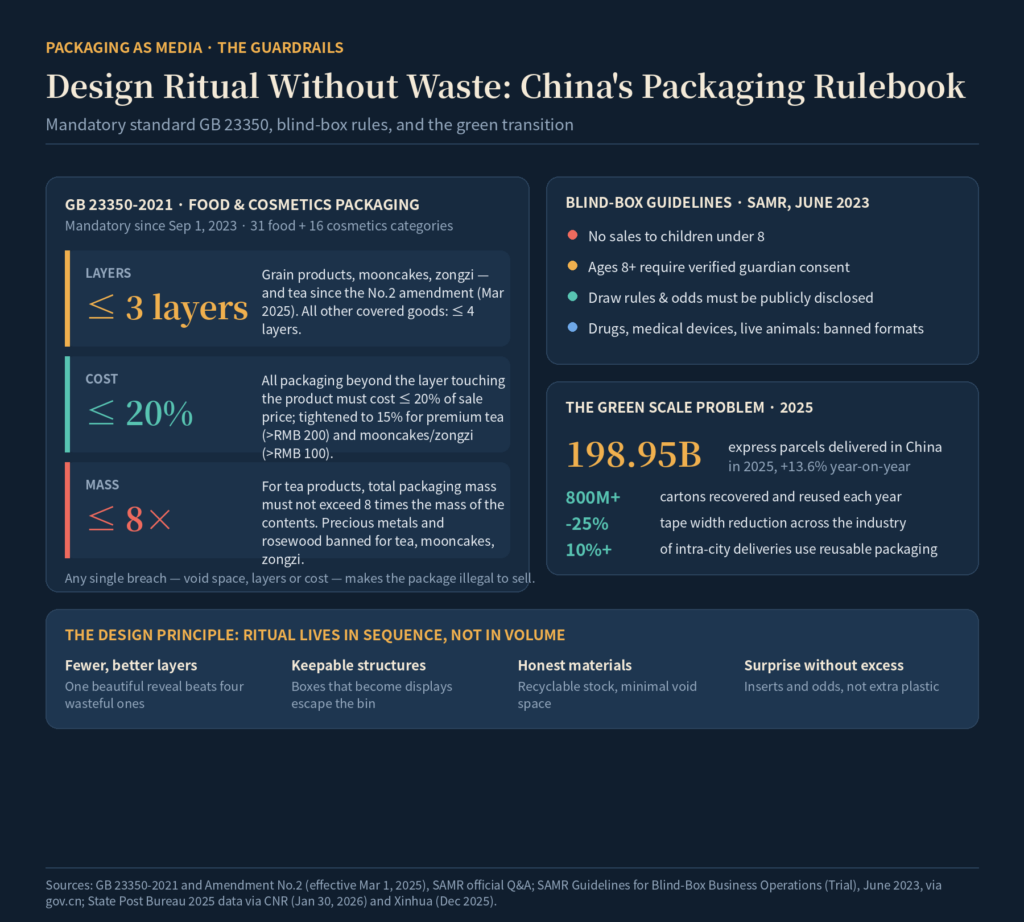
The environmental math explains the regulatory urgency. China delivered 198.95 billion express parcels in 2025, up 13.6% year-on-year. Every one of them involves packaging. The State Post Bureau’s December 2025 briefing reported real green progress — more than 800 million cartons recovered and reused annually, tape width cut by 25%, reusable packaging in over 10% of intra-city deliveries — but the scale means even small per-parcel excess compounds into mountains. And consumers everywhere are watching: Ipsos research for EDF, published in 2023, found that the accumulation of waste, packaging and plastic is the third-biggest environmental concern globally, cited by 41% of respondents across 28 countries, behind only climate change and extreme weather.
The design answer is not less ritual. It is ritual relocated — from volume to sequence. One beautifully engineered reveal beats four wasteful layers. A box that converts into a display stand escapes the bin. A surprise insert adds drama without adding plastic. The brands that win the next phase will treat the standard’s caps not as a ceiling on creativity but as a brief: make the opening memorable inside the limits.
The Counterarguments, Taken Seriously
“Unboxing UGC is uncontrolled.” True — and that is precisely why it works. Paid content is discounted by viewers; a customer’s genuine gasp is not. But the same authenticity amplifies failures. A crushed box or a disappointing draw becomes content too. The design cannot control the message; it can only stack the odds toward delight. Treat packaging QA as brand-safety work, because it is.
“Packaging media is unmeasurable.” Mostly false, lazily repeated. You cannot click-track a cardboard box, but you can track what it generates: unboxing-content volume by SKU, sentiment, hashtag growth, secondhand-market activity for your packaging (a strange but real signal — Heytea’s resold badges were a measurement), and member repurchase rates. Pop Mart’s 55.7% member repurchase figure is, in part, a packaging metric. What is genuinely missing is standardized platform-level data on unboxing content volume — the platforms don’t publish it consistently, so brands must build their own listening stacks.
“It’s a fad.” Some of it is. Big Issue’s December 2025 retrospective noted the Labubu frenzy had already cooled from its peak, and Pop Mart’s own share price fell sharply on results day despite the record numbers — markets worry about single-IP concentration. But the underlying mechanism is not a fad. The prospectus-era data showed 70% repeat purchasing before Labubu existed; Dotcom’s surveys showed packaging-driven sharing a decade ago. Fads rotate through the loop. The loop persists.
The Playbook: Five Moves for Brands Outside China
- Audit the opening, not just the box. Film your own unboxing at arm’s length, on a phone, in one take. If nothing in the first fifteen seconds rewards the viewer, you have protection, not media. Redesign the sequence: one tactile moment, one visual reveal, one surprise.
- Book packaging twice. Keep the procurement line for protection cost. Add a marketing line for amplification value, and judge it with content metrics — unboxing volume, sentiment, earned reach per thousand units shipped. What gets measured gets designed.
- Use surprise honestly. Random inserts, variant designs, hidden editions — the uncertainty drives both repeat purchase and shareable moments. But follow the Chinese regulatory direction even where it isn’t law: publish your odds, protect minors, cap the spend. Transparent surprise is durable; opaque surprise invites a crackdown.
- Design the carry. The bag leaves the store before the product is consumed. Give strangers a reason to look and the carrier a reason to be seen. Heytea proved a paper bag can outperform a media flight.
- Build ritual inside the limits. Fewer layers, better materials, keepable structures. Sustainability is not the enemy of unboxing culture — in China it is now the design constraint that forces creativity, and globally it is where consumer sentiment is heading.
Summary
Packaging is the only media channel every physical-product brand already owns. China’s unboxing culture shows what happens when you design that channel deliberately: ritualized openings turn customers into content creators (Florasis), engineered surprise turns the reveal itself into the product (Pop Mart’s plush business hit 50.4% of a RMB 37 billion company), and distinctive carry turns every order into a mobile ad (Heytea’s nineteen-yuan FENDI bag). The mechanism is a loop — design for the camera, customers post, viewers buy, buyers post — and the financials now prove it compounds. The limits are real too: mandatory caps on layers and cost, blind-box transparency rules, and a 199-billion-parcel waste problem that makes sustainable ritual the only viable brief. The box is the billboard. The customer is the advertiser. The only question left is whether you designed for it.