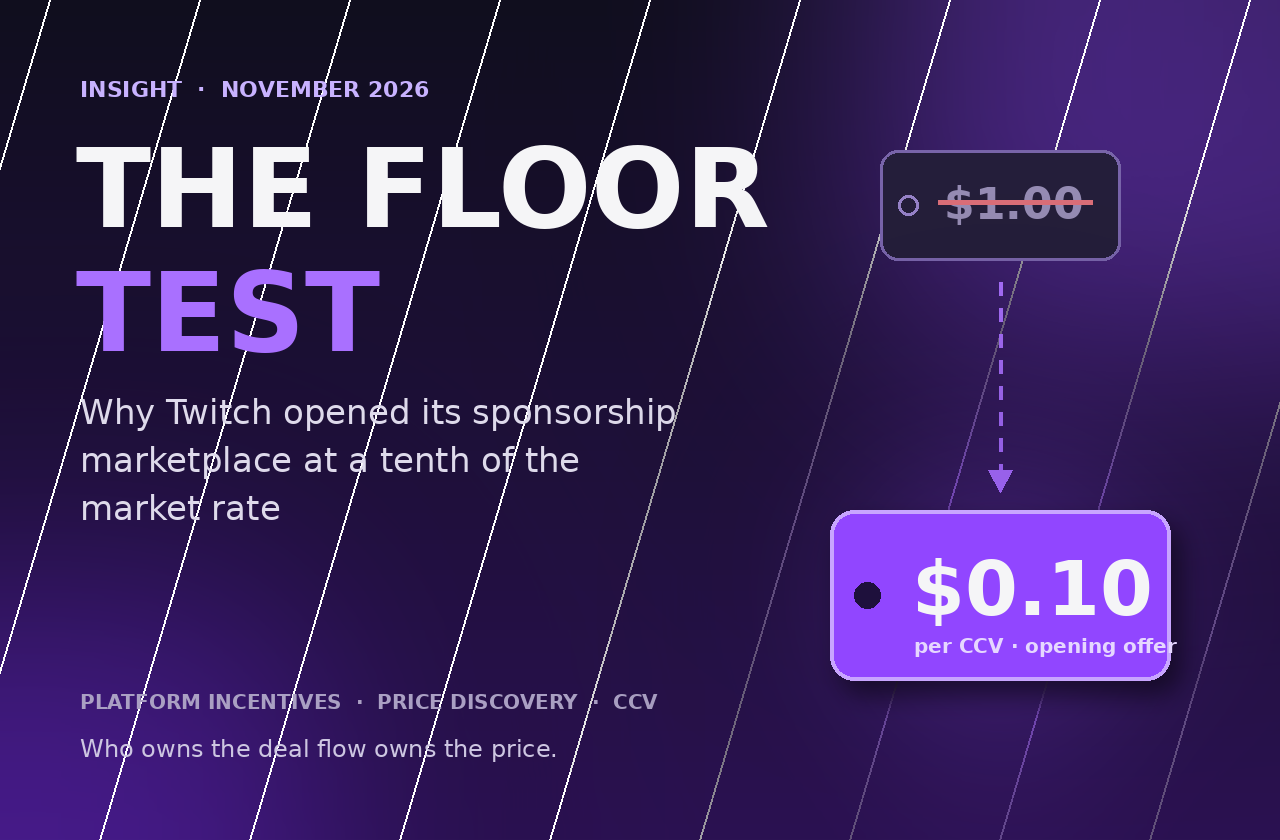
Every marketplace has a founding question: who sets the first price? When Twitch launched its Sponsorship Dashboard after nearly three years of testing, the reported answer was startling — opening offers around $0.10 per average concurrent viewer, roughly a tenth of the $0.80–1.50 per CCV per hour that agency and creator benchmarks put on the open market. A 75-viewer Partner was offered $7.50 for work the market prices at $75–150.
Was that incompetence? Unlikely. The more interesting explanation is arithmetic.
Look at Twitch’s cut of each revenue stream on its own platform. Subscriptions: roughly 50% under the standard split. Ads: 45% when creators run three or more minutes per hour. Sponsorships — the single biggest income line for channels above roughly 200 concurrent viewers — exactly 0%. Every brand dollar flowed through email threads and off-platform invoices that Amazon’s streaming giant never touched. The dashboard isn’t a creator benefit that happens to earn Twitch a fee. It’s the capture of the one revenue stream that escaped.
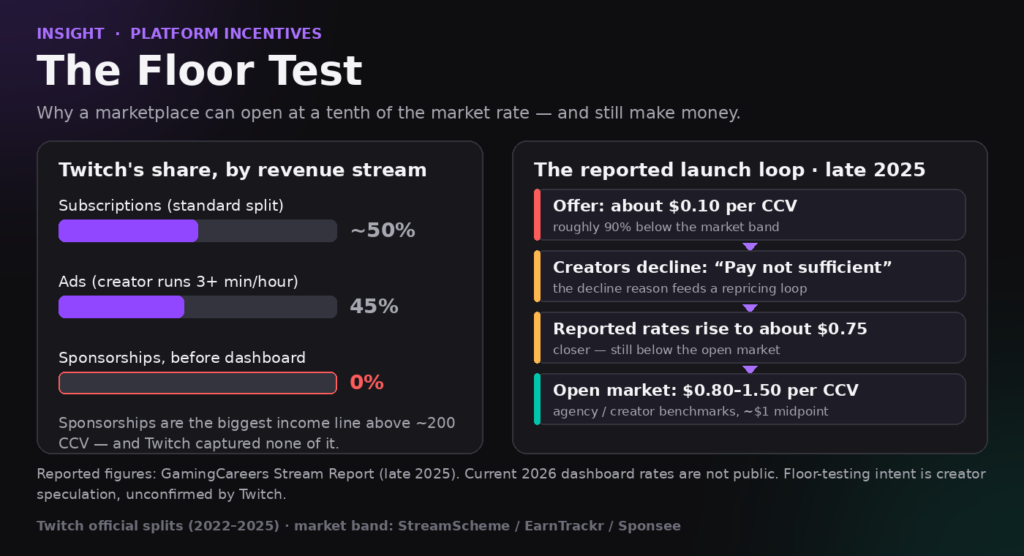
Once you see that, the lowball reads differently. If you’re building a marketplace where the incumbent price is set elsewhere, your opening offer isn’t really a payment — it’s a probe. How much will creators discount for guaranteed payouts from a trusted platform instead of chasing invoices from unknown agencies? Every decline tagged “Pay not sufficient” feeds the answer back. And the answer came fast: reported rates climbed roughly sevenfold to about $0.75 per CCV. That’s not a broken pricing team; that’s a price-discovery instrument working exactly as designed. To be fair, Twitch never confirmed floor-testing intent — but the loop’s structure makes the speculation almost irresistible.
There’s a demand-side twist that makes the floor test rational, too. Peer-reviewed work by Huang and Morozov in Marketing Science tracked some 60,000 streamers and found the median sponsored game stream returned about −95% on investment. Brands, in aggregate, have been overpaying for exposure they can’t convert. A platform that standardizes deal flow, matches demographics and guarantees delivery has a genuine argument that its inventory should clear at different prices than bespoke agency deals. The floor test is, in a sense, Twitch asking whether the old market rate was ever real.
The unresolved tension is trust. Streamers whose audiences became stakeholders through years of gamified monetization — the mechanism Johnson and Woodcock documented — notice when the platform that hosts their community opens by bidding a tenth of their worth. The August 2026 expansion to Affiliates widens the supply side, but supply doesn’t fix a belief problem.
The lesson generalizes beyond Twitch: whoever owns the deal flow owns the price. Platforms entering a brokerage business will always test the floor first. Creators who know their CCV math — and brands who know the research — are the ones who make the floor rise.