Every ad platform you know sells the same thing: a profile of a person. Telegram sells something else entirely — a seat inside a conversation people already chose to join. That distinction sounds philosophical until you try to run a campaign, and then it becomes the most practical fact in your media plan.
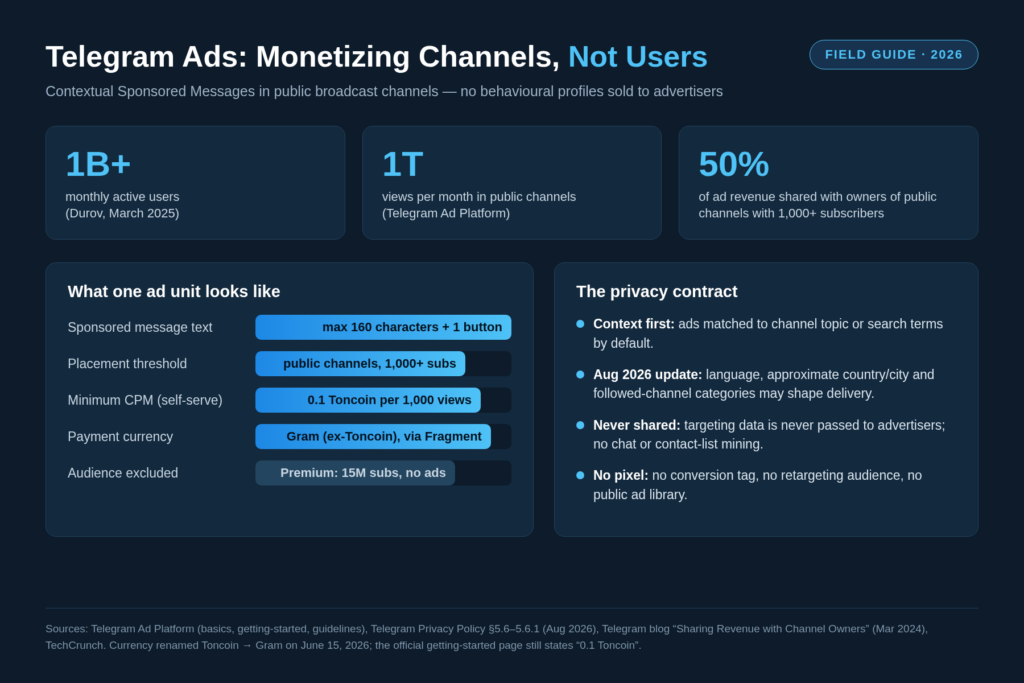
Here is the anomaly that should make any performance marketer sit up. Telegram has more than a billion monthly active users, a milestone Pavel Durov announced in March 2025. Its public broadcast channels generate roughly one trillion views every month, according to the company’s own ad platform. And yet the official ad product has no pixel, no retargeting audiences, no behavioural profiles handed to advertisers, and a text limit of 160 characters — shorter than the paragraph you just read. Ads are paid for in cryptocurrency, half the revenue goes to channel owners, and the currency itself changed its name in June 2026.
If that sounds like a platform built by people who never read a marketing textbook, well, it kind of was. This field guide walks through what actually works in late 2026: the three buying routes, the privacy trade-off after a major policy update, the creator economics, and the measurement workarounds you will need because Telegram refuses to do your attribution for you.
The Model: Monetizing Channels, Not People
Start with the structural choice, because everything else follows from it. Telegram’s Sponsored Messages appear in large public one-to-many channels with at least 1,000 subscribers — plus, per the current privacy policy, in bots, public stories and public search. They never appear in your private chats, your chat list or your groups. If you use Telegram purely as a messenger, you will never see one.
By default, an ad is matched to the topic of the channel or the search terms where it shows. A markets channel gets markets advertisers. Every reader of that channel sees the same sponsored message; nobody gets individually stalked across the app. And Telegram Premium subscribers — 15 million paying users as of May 2025, double the count a year earlier — see no platform ads at all. Your addressable audience is the free tier, which happens to be the overwhelming majority of a billion people.
The business logic is worth pausing on. Meta monetizes what it knows about you. Telegram monetizes what you chose to read. One model scales with data extraction; the other scales with the quality of its creator ecosystem. That is why the revenue share exists, and why understanding channel economics matters even if you never plan to own a channel yourself.
Privacy, With an Asterisk: What Changed in August 2026
Here is where most articles about Telegram ads are quietly out of date. The purist claim — “zero signals, pure context” — stopped being the full story on August 21–22, 2026, when Telegram updated its privacy policy with a new section on additional advertising tools.
The updated policy says ads in large public channels and search may now be shaped by the language of the content, by an approximate country and city derived from your phone number’s area code or IP address, and by the categories of channels you follow. Follow enough finance channels, and you may see finance ads in other large channels or bots too.
Before you cry betrayal, read the second half of the clause: this targeting data is never passed to advertisers — advertisers included, as the policy drily puts it. No precise location tracking. No mining of private chats or contact lists. Premium users are excluded from all of it. So the honest 2026 description is this: Telegram now does light, on-platform audience inference, but it still refuses to sell or share the profile. You buy context and broad relevance; Telegram keeps the person behind the glass. For brands, that is both the brand-safety pitch and the targeting ceiling, in one clause.
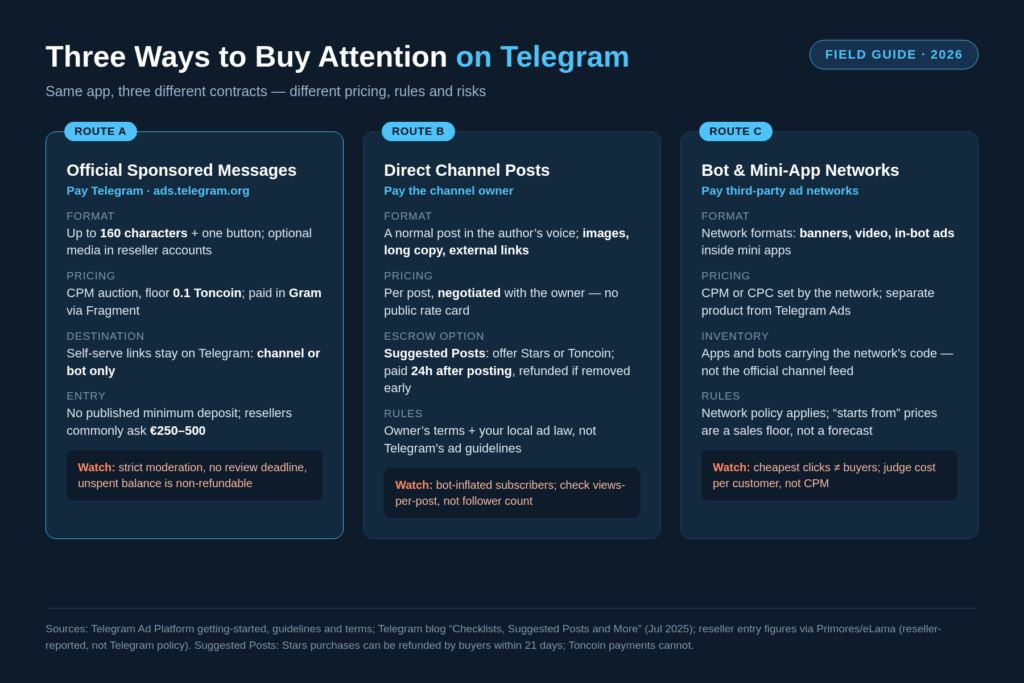
Route 1: Official Sponsored Messages
The self-serve platform lives at ads.telegram.org. You log in with your Telegram account, write up to 160 characters, attach one button, pick the exact public channels where the ad should run, and set a CPM — the price per thousand views. The published floor is 0.1 Toncoin, which at recent coin prices is roughly ten to fifteen US cents. Telegram publishes no minimum deposit at all; the scary numbers circulating online (two million euros, seven-figure commitments) describe legacy direct contracts as reported by resellers, not the self-serve door.
Three rules will save you money and frustration. First, links on the self-serve account must stay on Telegram — a channel or a bot, in t.me format. Your website is not a valid destination there; you promote a channel or bot, and that asset sends people onward. Second, targeting is frozen once an ad is created; to change it you clone the ad. Third, and this one stings: unspent balance cannot be withdrawn or refunded, per the platform terms. Top up what a test needs, not what a quarter needs.
Reseller-run euro accounts are a different animal: they add country and interest targeting, allow external website links, and have supported image and video attachments since September 2024. Entry is typically a few hundred euros plus commission — resellers commonly quote €250 to €500 — and minimum bids are higher. Reseller-published floors as of September 2026 sat around €0.60 for topic targeting, €0.75 for specific channels, €0.90 for image ads and €1.02 for video. Treat those as reseller price lists, not Telegram policy, because they move.
And moderation is famously strict. The guidelines ban line breaks, list formatting, gimmicky capitalization, emoji floods, superlatives, and direct personal questions like “Looking to pay off high debt?” Gambling — including tips and odds services — political campaigns, dating services, predatory finance and follower-inflation services are all prohibited categories. Your destination channel needs a post within the two weeks before review. Telegram commits to no review deadline in its terms, though resellers report most decisions land within hours. Plan for variance.
Route 2: Direct Channel Posts and the Escrow That Fixed Them
The older market never died: you pay a channel owner, and they publish your post in their own voice, like any other message. Images, long copy, external links — all allowed, because this is ordinary channel content, not a Sponsored Message. Premium subscribers see these posts too, which quietly makes direct buys the only way to reach the paying audience.
The historical problem was trust. Wire money to an anonymous admin and hope. Since July 2025, Telegram’s Suggested Posts feature has formalized the deal: you submit your post to the channel with an offer in Telegram Stars or Toncoin, the owner can negotiate the content and price, and payment settles automatically 24 hours after publication. Remove the post early, and the payer is refunded in full. One asymmetry to respect: Stars bought through Apple can be refunded by the buyer for up to 21 days — Telegram itself warns owners that Toncoin payments are safer because they cannot be clawed back.
Pricing is negotiated per post with no public rate card, so do the only math that matters: price divided by realistic views, not subscribers. A channel with 100,000 subscribers and 800 views per post is mostly air. Telegram’s own guidelines even prohibit services that inflate followers — the platform knows the problem exists.
Route 3: Bot and Mini-App Networks
The third route is not Telegram Ads at all, although vendors blur the line constantly. Networks like RichAds and PropellerAds sell their own banner, video and in-bot formats inside mini apps and bots that carry their code. Pricing is CPM or CPC set by the network, often with tempting “starts from” fractions of a cent per click.
Two cautions. These inventories are separate from the official channel feed, with the network’s own policies and quality controls. And a cheap click in a tap-to-earn game is not a customer. If your buyers genuinely live in mini apps, test it — but judge the route on cost per converted customer, never on the headline click price.
The 50% Split: Why Channels Became Real Businesses
Since March 2024, owners of public channels with at least 1,000 subscribers receive 50% of the revenue from ads displayed in their channels, withdrawable through Fragment with no Telegram-side fee. For context, YouTube’s long-standing partner share is 55% — Telegram walked in at nearly the same number with a fraction of the ad load.
Read the creator terms, though, and you will find the fine print the announcement left out: the share is a voluntary commitment that Telegram can change or discontinue, it depends on valid impressions, and it is unavailable in some regions. Rewards accrue in the platform’s currency, with Gram balances withdrawable two days after accrual and Star balances after 21 days.
Does the money actually flow? The Financial Times reviewed Telegram’s investor documents in May 2025: revenue of $1.4 billion in 2024, up from $343 million, with roughly $250 million from advertising, $292 million from Premium subscriptions, and about half from what the company calls partnerships and ecosystem — largely the mini-app and TON economy. First annual profit: $540 million, against a $173 million loss in 2023. Advertising is still the smallest of the three pillars, which tells you the ad market here is early, not saturated. When Durov announced the revenue share in February 2024, he said only about 10% of channel views were monetized. The gap between a trillion views and a quarter-billion in ad revenue is the opportunity — and the reason CPMs can still look absurdly cheap next to Meta.
Stars and Paid Subscriptions: The Owned-Audience Layer
Beyond ads, channels can charge their own readers. Since August 2024, any channel can create invite links that require a monthly payment in Telegram Stars — a Patreon-style gate with no follower minimum. Star Reactions let readers tip individual posts, with owners receiving 100% of the Stars sent. Paid posts hide a photo or video until the reader unlocks it with Stars; Telegram’s creator terms peg the reward at roughly $0.013 per earned Star.
The economics come with a tax. Stars purchased in-app carry Apple’s and Google’s store fees, which is why bulk purchases through Fragment or the PremiumBot are cheaper. And when owners reinvest earned Stars into ads for the same channel, Telegram subsidizes them with a 30% discount — a closed loop that turns tips into reach.
For a brand, this layer is the “own” option: a free public channel for discovery, a paid tier for your most engaged followers, exclusive research or early access behind the gate. No ad platform required.
The Currency Formerly Known as Toncoin
On June 15, 2026, the coin you pay with changed its name. TON’s community vote passed with 81.22% approval, renaming Toncoin to Gram — the token’s original name from the 2018 white paper, before the SEC lawsuit forced Telegram to abandon the project in 2020. The blockchain keeps the name TON; balances converted one-to-one with no migration. Amusingly, Telegram’s own ad homepage now says you pay “with Gram” while its getting-started page still says “0.1 Toncoin”. Same coin, two labels.
For budgeting, the practical point is volatility: a floor fixed at 0.1 coin floats in dollar terms as the token moves. Your dollar CPM is a daily exchange-rate decision. Also treat any message asking you to “migrate TON to GRAM” as a scam — the official notice is explicit that no such process exists.
Measurement: Where the Data Goes Dark
Now the part your analytics team will hate. Telegram’s native statistics cover views, clicks, and the joins or bot starts that follow an ad view. That is where the platform’s gift ends. There is no conversion pixel, no retargeting audience, no view-through attribution, no cross-device graph, and no public ad library for competitor research.
The bridge you build yourself rests on one documented mechanism: bot links may carry start parameters. Give every ad its own deep link — t.me/yourbot?start=ad_spring — and the bot receives that parameter when the user arrives. Log it with the date and the first meaningful action, and you have deterministic per-creative attribution inside your own database. Mini apps get the same treatment through startapp parameters. If you run website ads through a euro account, tag your landing links and read them in your own analytics like any paid source.
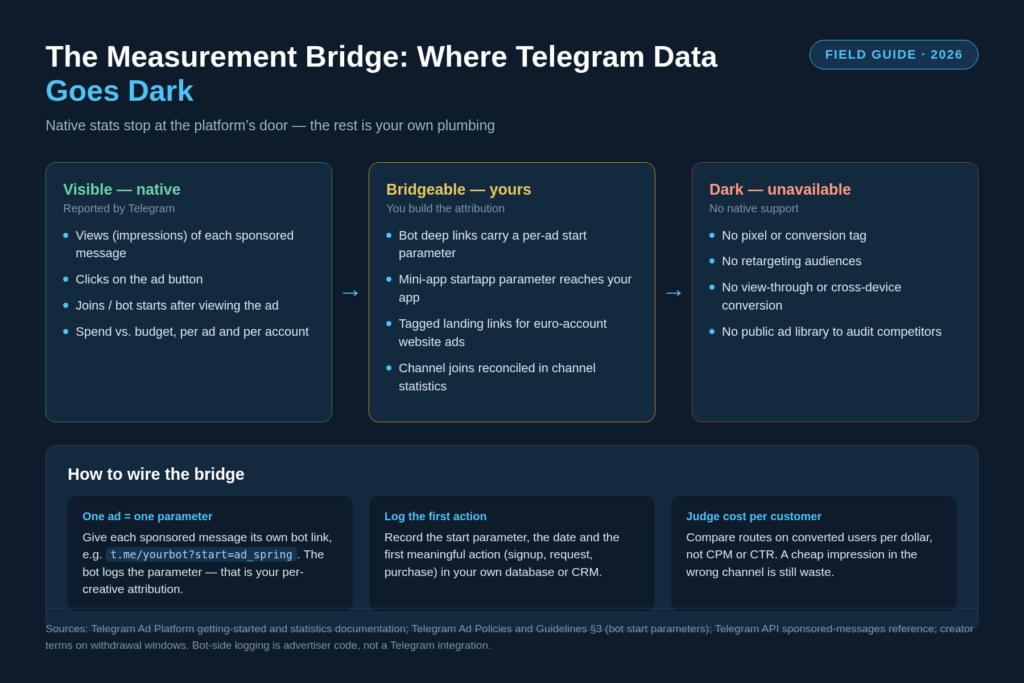
What you cannot recover: the reader who saw the ad, never clicked, and bought a week later. View-through simply does not exist here. Accept the blind spot, judge routes on tracked cost per customer, and resist anyone selling you a “Telegram pixel” — they are selling you their own script, not a platform feature.
The Risks Nobody Puts in the Media Kit
Three risk classes deserve separate lines in your plan. Platform risk: Russia throttled Telegram from February 2026, and by April 10 the OONI measurement project logged failed access attempts at 95% — worse than WhatsApp or Signal. Durov says around 65 million Russians still reach it daily through VPNs, and Reuters covered the April crackdown after anti-VPN blocking triggered a nationwide payment outage. Vietnam ordered ISPs to block the app in May 2025, per a government document seen by Reuters. If your audience concentrates in restricted markets, your reach is a policy variable, not a media variable.
Legal risk: French authorities charged Durov in August 2024 over moderation failures; the investigation has shadowed the company’s IPO ambitions since. Telegram has since tightened cooperation, including sharing IP addresses and phone numbers of criminal suspects on valid legal requests — a reminder that “privacy-first” describes the ad model, not immunity from law.
Market risk: impersonation and scam channels thrive in exactly the finance and crypto niches where Telegram is strongest. Some hardware-wallet brands have shut official channels because moderating fakes cost more than the channel returned. Budget for the operational tax, not just the media.
Sponsor or Own? The Brand Decision
The strategic fork is simple. Sponsor existing channels when your audience is already concentrated there — crypto, trading, tech, regional news — and you want reach this month. Build your own channel when you want a durable, direct line to opted-in subscribers: every post delivered, no algorithmic throttle, but growth from zero is slow and earned. And if what you actually need is dialogue — community, support, two-way conversation — a broadcast channel is the wrong structure entirely. Use a group, or honestly, use Discord.
Geography decides more than category. Telegram’s strength is uneven: dominant in parts of the CIS, MENA and South Asia, thin for mainstream Western consumer brands. A billion users is not a billion reachable customers; your reachable slice is the intersection of language, topic and channel quality. Scout it before you scale it.
A 30-Day Pilot That Doesn’t Burn the Budget
Week one: build the channel list. Find twenty-plus public channels your buyers actually read, in their language, and check views-per-post against subscriber counts. Week two: launch a small self-serve test — a channel or bot destination, one start parameter per ad variant, a budget you are content to never see again. Week three: run one direct buy through Suggested Posts escrow on your best-performing channel, with its own tracked link. Week four: compare the routes on converted users per dollar, not CPM, and put next month’s budget behind the winner. If nothing converts, you learned it for a few hundred dollars instead of a quarter’s spend.
Summary
Telegram is the rare billion-user platform that monetizes context instead of identity: 160-character Sponsored Messages in public channels, a published 0.1-Toncoin CPM floor, payment in the coin now called Gram, and half the ad revenue flowing to creators. The August 2026 policy update added light on-platform inference without ever sharing profiles with advertisers. Three routes exist — official ads, direct posts with escrow, and third-party mini-app networks — and they obey different rulebooks. Measurement stops at Telegram’s door, so wire your own bridge with bot start parameters. Buy it for concentrated niche audiences in the right geographies, respect the regulatory map, and choose sponsor-versus-own by whether you need reach this month or a relationship for years.