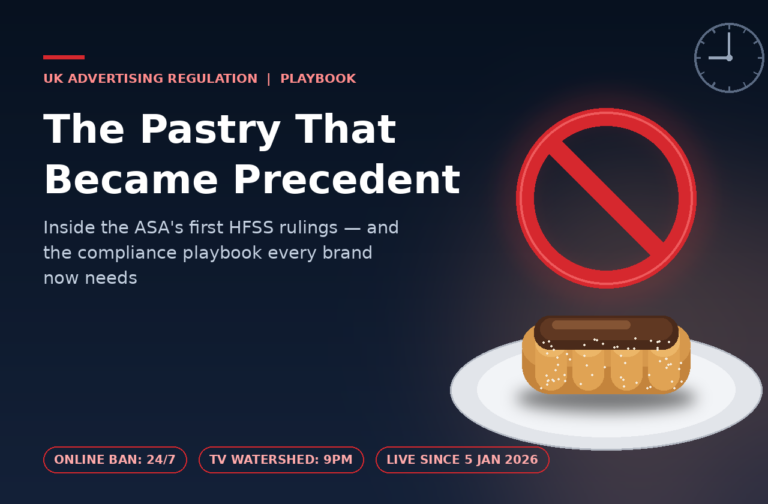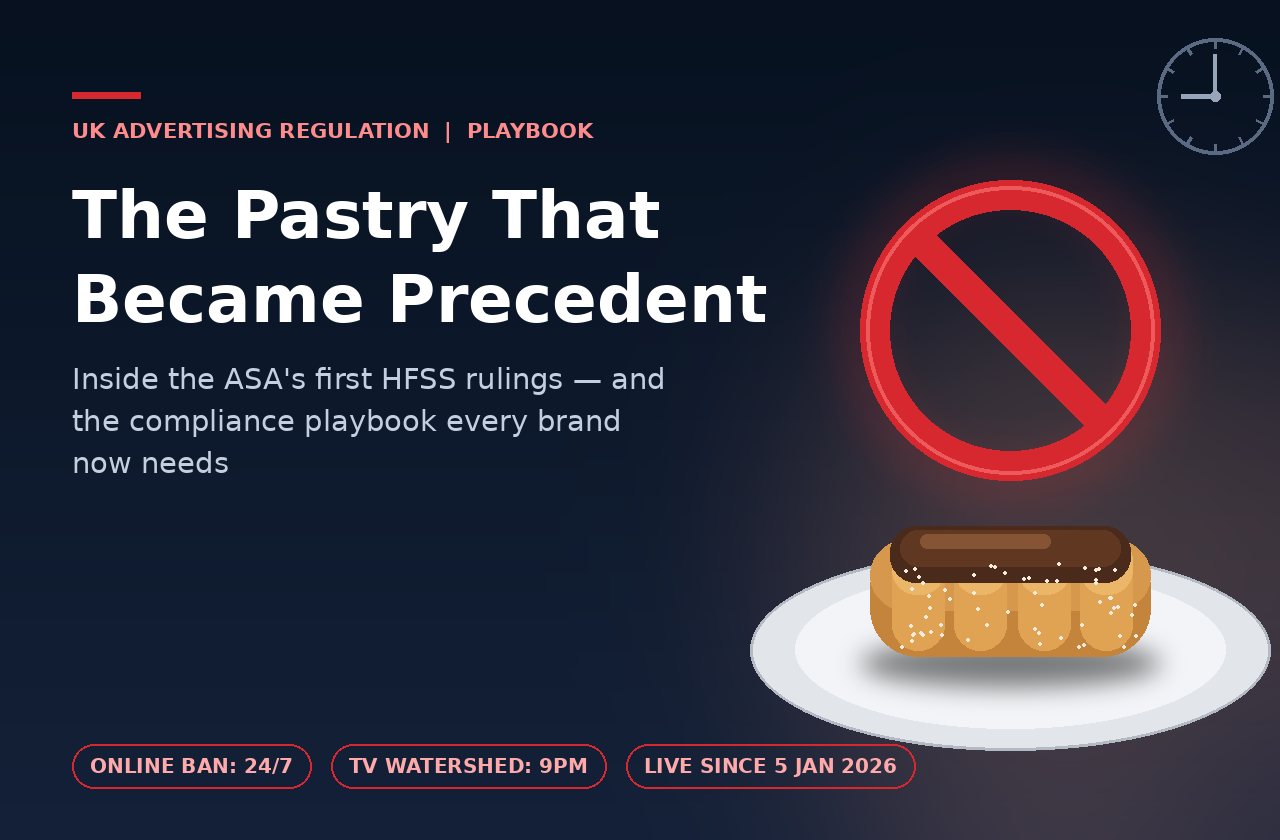
Three days after Britain switched on the toughest food-advertising regime on the planet, an influencer walked into a Lidl in Northern Ireland, filmed a tray of pastries, and delivered the line that would cost her client a published ban: “they came out so fresh. They were warm, they were absolutely stunning.” The pastry in question — a pain suisse — was high in fat, salt and sugar. The post was paid for. And on 15 April 2026, the Advertising Standards Authority turned that close-up into the first precedent of a new era.
If you advertise anything edible in the UK — or, as we will see, almost anything at all — the rules changed on 5 January 2026. The rulings that followed did not just enforce the new regime; they drew its real boundaries. Those boundaries now sit inside your creative process, not your legal department’s inbox. Here is what the first cases actually decided, and how to build campaigns that survive them.
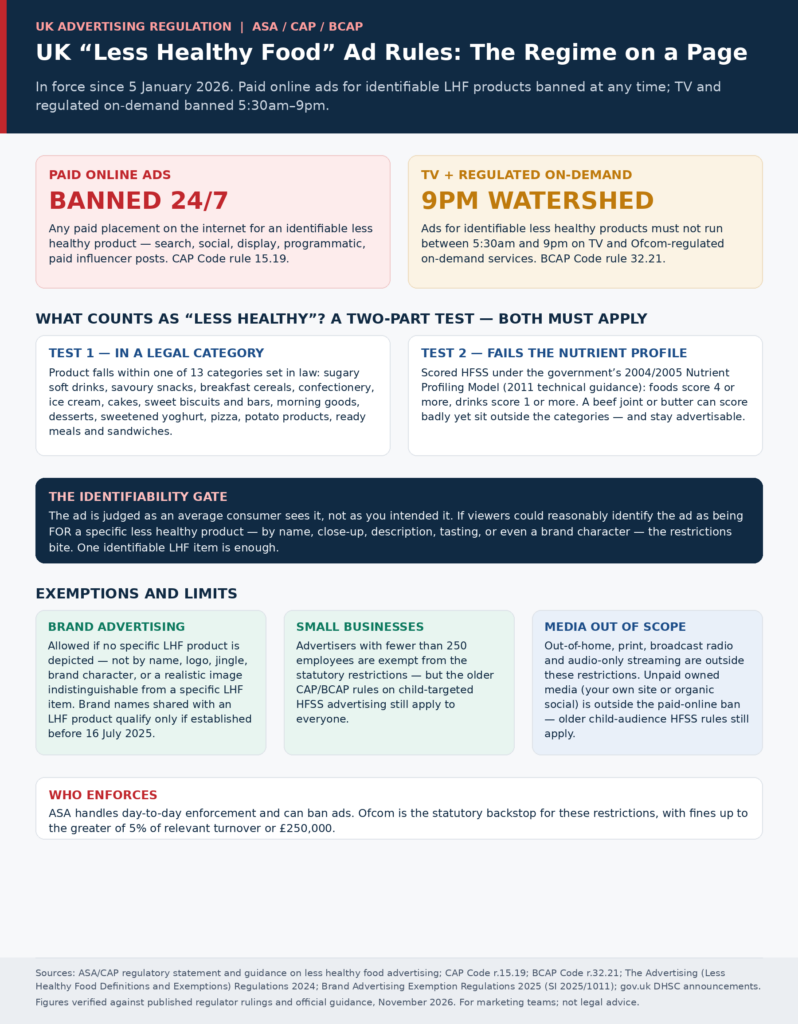
The UK System in One Page
The ASA is, technically, a self-regulator. It administers two rulebooks: the CAP Code for non-broadcast advertising and the BCAP Code for broadcast. Historically its weapons were reputational — published rulings, withdrawn ads, non-compliers named in dedicated search ads. Do not let the polite framing fool you.
The less healthy food restrictions arrive with statutory scaffolding. The Health and Care Act 2022 amended the Communications Act 2003, and the ASA now enforces those statutory rules day to day through CAP Code rule 15.19 for online placements and BCAP Code rule 32.21 for TV scheduling. Behind it stands Ofcom, the statutory backstop for these restrictions, with the power to impose fines of up to the greater of 5% of relevant turnover or £250,000. In other words: a self-regulatory front door with a statutory enforcement engine behind it. Treat every ruling as case law in the making, because that is exactly how the ASA publishes them.
The 2026 Regime: Two Tests, Two Clocks
A product is “less healthy” (LHF) only if it passes — or rather, fails — two gates at once. First, it must fall within one of 13 categories set in law: sugary soft drinks, savoury snacks, breakfast cereals, confectionery, ice cream, cakes, sweet biscuits and bars, morning goods, desserts, sweetened yoghurt, pizza, potato products, and ready meals through to sandwiches. Second, it must score as HFSS under the government’s 2004/2005 Nutrient Profiling Model, using the 2011 technical guidance: foods scoring 4 or more, drinks scoring 1 or more.
Both gates matter. A beef roasting joint can be nutritionally unremarkable and still advertisable because it sits in no listed category. A croissant that scores 4 is caught, because morning goods is category 8.
The media rules then split into two clocks. Paid online advertising for an identifiable LHF product is banned at any hour — search, social, display, programmatic, paid influencer posts, all of it. On TV and Ofcom-regulated on-demand services, the ban runs from 5:30am to 9pm. The trigger word is “identifiable”: could an average consumer reasonably understand the ad as being for that specific product? Intent is irrelevant. Perception is everything.
There are exits, but they are narrower than headlines suggest. Brand advertising is exempt only if no specific LHF product is depicted — not by name, text, imagery, logo, audio cue, jingle, brand character, or a realistic image visually indistinguishable from a specific LHF item. Brand or range names that double as a product name qualify only if established before 16 July 2025. Advertisers with fewer than 250 employees are exempt from the statutory regime, though the older CAP and BCAP rules on child-targeted HFSS advertising still bind everyone. Unpaid owned media — your own website, organic social — sits outside the paid-online ban, and out-of-home, print, radio and audio-only streaming are outside the regime entirely. Most major advertisers and platforms had already been complying voluntarily since 1 October 2025.
Ruling Anatomy I — Lidl: The Death of “Brand-Led” Intent
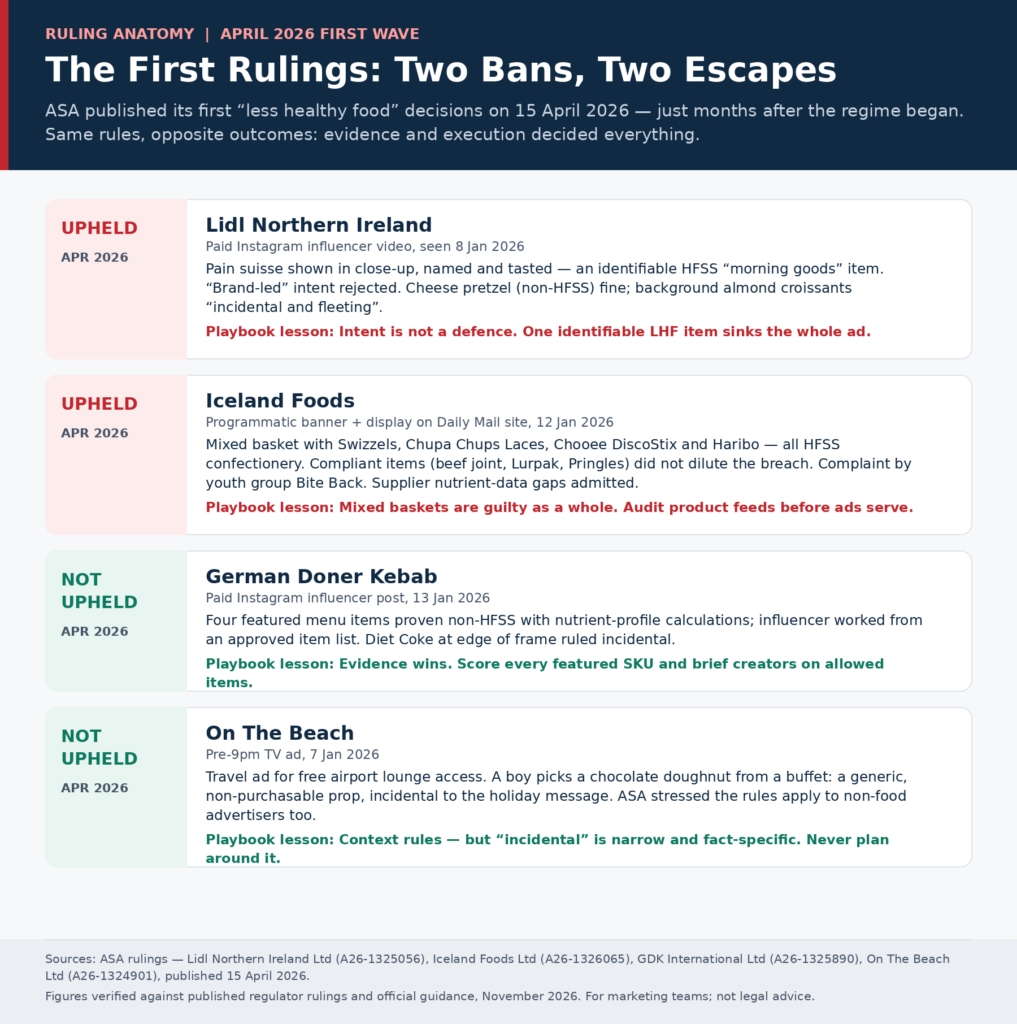
Lidl Northern Ireland paid influencer Emma Kearney to promote its rotating bakery specials on Instagram. The strategy was, on paper, defensible: a brand-led celebration of the bakery, not an ad for any one product. The ASA disagreed — and Lidl itself conceded the point. Close-ups of the pain suisse, a voice-over naming it, footage of Kearney tasting and describing it: together, these made the ad identifiably for that product. The pain suisse was HFSS and sat in category 8, morning goods. Ban upheld.
The nuances matter as much as the headline. The cheese pretzel, featured just as prominently, was not HFSS — perfectly legal to promote. Almond croissants, also HFSS, appeared briefly on a labelled tray in the background, never mentioned, never noticed: “incidental and fleeting,” and therefore fine. One identifiable LHF item sank the post; two other products, handled differently, did not.
The July escalation: characters and words count too
The second wave of rulings, published on 8 July 2026, pushed identifiability further than most creative teams expected. An M&M’s Instagram ad showed no product at all — just the green and yellow characters. The ASA found that the oval yellow character depicted Peanut M&M’s specifically, because only that variant is oval. The brand exemption failed. Meanwhile, YO! Sushi was banned over the words “Made with KITKAT Cream Puff”: text alone identified a single LHF product. Your copy line and your mascot are now compliance surfaces, not just brand assets.
Ruling Anatomy II — Iceland: The Mixed-Basket Trap
Iceland’s breach came from the least glamorous corner of marketing: retargeting. Programmatic banner and display ads, served via an ad network on the Daily Mail website to people who had visited Iceland’s site without buying, showed mixed baskets of products with prices. Some items were fine — the beef joint, spring rolls, chicken skewers and Lurpak sat outside the legal categories; Pringles Sour Cream & Onion was not HFSS. But Swizzels Sweet Treats, Chupa Chups Laces, Chooee DiscoStix and Haribo Elf Surprises were all HFSS confectionery, category 4. The compliant products did not dilute anything. The ads were guilty as a whole.
Two details deserve attention. The complainant was Bite Back, a youth-led campaign group that systematically uses the ASA complaints process — an enforcement engine that never sleeps and never gets bored. And Iceland admitted gaps in the nutrient data it received from suppliers, even while describing its remediation work. The ASA was unmoved: data gaps are not a defence. The publisher, for its part, confirmed it had no role in selecting or approving the creative. If you buy retail media or run dynamic product ads, the feed is now a compliance document.
Ruling Anatomy III — German Doner Kebab: Evidence Wins
Here is the mirror image, and the most encouraging ruling of the wave. GDK paid influencer John Fisher to promote a new Romford restaurant. The post featured an Inferno OG chicken kebab, a chicken rice bowl, a chicken doner burrito and a Junior OG Kebab promotion — all shown, named and tasted, exactly like Lidl’s content. The difference: GDK had scored every item in advance, given the influencer a whitelist of non-HFSS menu choices, and produced the nutrient-profile calculations when challenged. Complaint not upheld. A Diet Coke drifting at the edge of frame was ruled incidental — and was not LHF anyway.
The lesson cuts both ways. In a separate July ruling, Domino’s had treated a Sausage & Bacon pizza as non-HFSS based on incorrect nutritional information; once the data was corrected, the product was HFSS and the complaints were upheld. Evidence is outcome-determinative in both directions. The per-SKU calculation file is now the single highest-leverage compliance asset a food marketer can own.
Ruling Anatomy IV — On The Beach: The Narrow Escape
Not every advertiser in this story sells food. On The Beach, an online travel agent, ran a pre-9pm TV ad selling free airport lounge access with five-star holidays. A boy lifts a chocolate ring doughnut from a buffet; the voice-over says “Fill your boots, son.” Complaint? Inevitably. Ban? No.
The ASA accepted that the doughnut was a generic, non-purchasable prop — visible for under a second, part of a wider buffet scene, illustrating a perk rather than promoting a product. Crucially, the ASA also stated that being a travel company did not put the ad outside the rules’ scope; it simply was not an ad for the doughnut. Read that twice. The rules apply to any advertiser — banks, airlines, fashion, tech — whose creative makes an LHF product identifiable. “Incidental” is a fact-specific escape hatch, not a planning strategy. Never build a campaign that depends on it.
Influencers: Two Obligations, One Post
The September ruling against San Carlo sharpened the influencer picture in a way every brand team should absorb. A creator was invited by the restaurant’s PR agency to a menu launch, given complimentary food and drink, and asked — in exchange — for a minimum number of posts, tags, and content based on a press release. No contract, no fee, no #ad label. The ASA held that the gifted experience constituted payment, the brand exercised sufficient control, and the post was therefore a paid ad that failed disclosure rules. It then identified seven specific HFSS menu items in the content and upheld the LHF breach too. General references to “brunch” or the “deli counter” were fine under the brand exemption; the specific croissants and crepes were not.
So one post can break two separate rules: disclosure and product restriction. Compliant influencer programmes need both — clear #ad labelling and a product whitelist enforced through briefs, contracts and pre-publication review. GDK’s approach is the template; San Carlo’s is the warning.
Beyond HFSS: The ASA’s Wider 2026 Agenda
Do not file the ASA under “food regulator” and move on. Its refreshed strategy and 2026 mid-year report list proactive projects across finance and gambling ads, pricing practices, environmental claims, AI product advertising, weight-loss medicines, children’s exposure on social media, and health claims. The CMA, armed with direct enforcement powers under the DMCC Act since April 2025, is separately pursuing drip pricing, fake reviews and pressure selling — and green claims face scrutiny from both regulators. On AI-generated creative, CAP’s position is simple: the codes contain no AI-specific rules because none are needed. The same misleadingness tests apply however an image was made. If your holiday campaign uses synthetic food photography, every question in this playbook still applies — plus the question of whether the imagery itself misleads.
The Compliance Workflow: Five Gates Before Publication
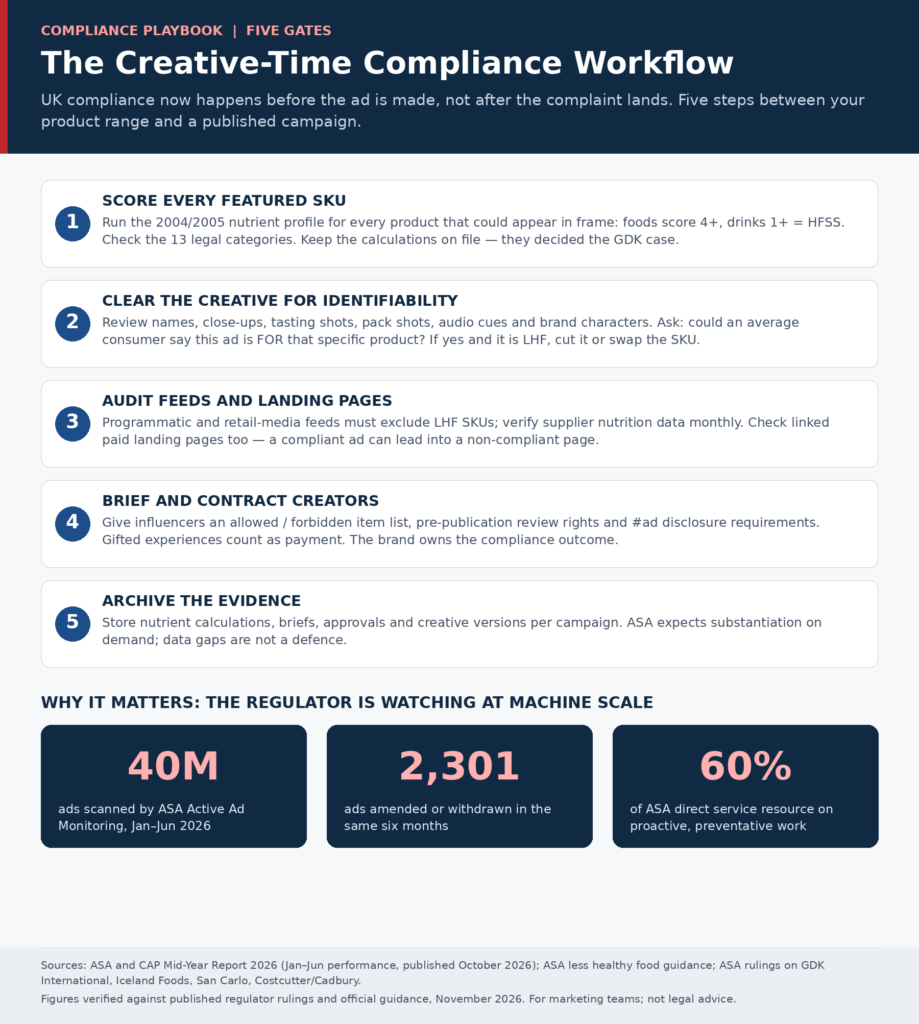
UK compliance now happens at creative-development time. Run every campaign through five gates. One: score every SKU that could appear in frame — nutrient profile plus category check, calculations archived. Two: clear the creative for identifiability — names, close-ups, tasting shots, pack shots, audio cues, characters, even copy lines that name a collaboration product. Three: audit feeds and journeys — programmatic and retail-media feeds must exclude LHF SKUs, supplier data must be refreshed and verified, and linked paid landing pages must be checked, because a compliant ad can lead into a non-compliant page (the ASA has already ruled on exactly that). Four: brief and contract creators with allowed-item lists, disclosure requirements and review rights. Five: archive everything — briefs, approvals, calculations, creative versions. Substantiation on demand is the price of admission.
Retail Media and Programmatic: The Feed Is the Ad
Supermarket own-site promotions are not a safe harbour: paid placements on retailer websites and apps fall squarely within the online ban, even when the retailer is both seller and publisher. Only genuinely unpaid owned content sits outside it. For retail-media buyers, three operational rules follow. Build LHF exclusion flags into the product feed itself, not into a manual blocklist someone maintains on Fridays. Treat supplier nutrition data as a live dependency — Iceland’s monthly data-provider arrangement is a reasonable model, but the Domino’s ruling shows what happens when the underlying numbers are wrong. And review dynamic creative templates: a layout that auto-inserts six products with prices is, by design, an identifiability machine. The mixed-basket trap is not an edge case; it is the default output of an unaudited feed.
How Enforcement Actually Works
The romantic picture of a regulator waiting for complaints is dead. Between January and June 2026, the ASA’s Active Ad Monitoring system scanned 40 million ads and potential ads, secured the amendment or withdrawal of 2,301 of them, and the organisation put 60% of its direct service resource into proactive and preventative work. Data science alone flagged 168 cases for investigation, yielding 40 published rulings. For scale: the system scanned roughly 60 million ads in all of 2025, up from 28 million in 2024, and 22,383 ads were amended or removed that year. Add activist complainants like Bite Back, and the sanctions ladder runs from quiet amendment requests through published bans and search-ad callouts to Ofcom referral and statutory fines. Every published ruling becomes searchable precedent — which is why the April and July waves matter far beyond the four brands named in them.
The View from Outside Britain
If you run global campaigns, resist the urge to port one compliance framework across borders. France has been tightening food marketing aimed at children through its own nutritional-geometry approach; the United States leans on FTC disclosure and deception rules rather than nutrient-scored media bans; Germany’s system runs on unfair-competition enforcement and industry trust codes; China’s Advertising Law polices food and health-food claims — disease-treatment claims, approval requirements — rather than nutrient profiles. The UK is currently the outlier in mechanism: it restricts the media placement of an identifiable product based on a government scoring model. A creative asset that is compliant in Atlanta, Paris or Shanghai can be unlawful in London at 2pm on a Tuesday. Localise the compliance review, not just the language.
The Bottom Line: Compliance Is Now a Creative Discipline
Step back and the government’s motivation explains why none of this will soften. Ministers project the restrictions will remove up to 7.2 billion calories a year from children’s diets, mean around 20,000 fewer children living with obesity, and deliver roughly £2 billion in health benefits — against a backdrop where 22.1% of children in England live with overweight or obesity at the start of primary school, rising to 35.8% by the time they leave. A regime with those stakes does not blink at a bakery video.
The strategic response is not retreat; it is precision. Reformulation now carries a media dividend: products that score below the threshold regain full advertising freedom, and the rules explicitly reward promoting them. Brand advertising remains viable for those who treat “no identifiable LHF product” as a hard creative constraint rather than a vague aspiration. And the winners of the first rulings — GDK with its whitelist, Domino’s and Papa John’s with their carefully distinguishable non-HFSS pizzas, On The Beach with its generic perk imagery — all did the same thing: they made compliance decisions before the camera rolled. Score your SKUs, brief your creators, audit your feeds, and keep the receipts. In Britain’s new regime, the evidence file is the campaign.