Here is a strange fact about one of the most quietly important shifts in marketing measurement. The tool that became the industry’s default was never designed to be anyone’s first choice.
Meta’s own GeoLift documentation admits as much in a single dry sentence. GeoLift is a research tool for running geo-based experiments in cases where people-based measurement “is not feasible — for example, Healthcare advertisers.” Then comes the part that should make every performance marketer pause: Meta explicitly recommends people-based experimentation where possible, because it carries higher statistical power than geo-based work.
Read that twice. The winning instrument in 2026 is the one its own maker labels less powerful. So why did it win?
Because the thing that broke was never the tracker
The obvious story — cookies died, so we retreated to geography — is simply wrong. Google walked back third-party cookie deprecation in Chrome in July 2024, abandoned the planned standalone consent prompt in April 2025, and retired most Privacy Sandbox APIs that October. The cookie is still there.
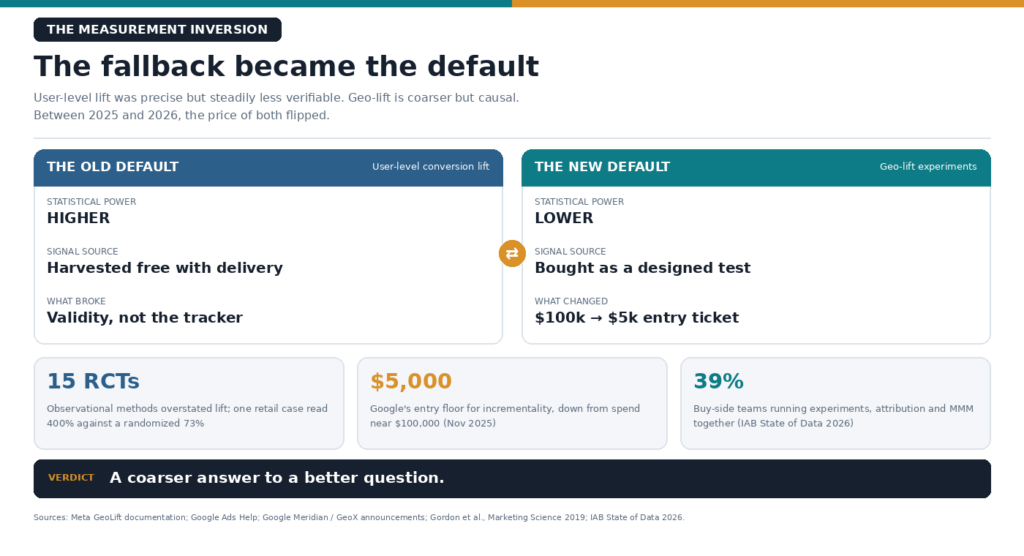
What actually degraded was something subtler and much harder to repair: the validity of user-level measurement. Gordon, Zettelmeyer, Bhargava and Chapsky tested this directly in Marketing Science in 2019, comparing observational methods against 15 large randomized Facebook experiments. Their finding was severe. Observational approaches frequently failed to recover the true effect and generally overstated it. In one retail case, an exposed-versus-unexposed comparison produced a lift above 400 percent where the randomized experiment measured 73 percent.
So user-level lift did not lose its precision. It lost its right to be believed. And that is a very different problem — one that better tracking cannot solve.
The polite word for “we cannot check”
Notice what the industry did with that. It renamed the problem. “Signal loss” sounds like a plumbing issue, something a CDP upgrade might fix. It is not. It is an epistemic problem: the entity doing the measuring also owns the media being measured, and its users are increasingly unreachable or unconsented.
Geo-lift sidesteps this not by measuring better but by measuring differently. It never needs to identify anyone. Split regions, withhold spend in a matched control, compare outcomes, and the gap is causal by construction rather than by assertion. Coarser resolution, cleaner logic.
The second half of the explanation: the price collapsed
Here is the part most write-ups miss, and it is the reason the shift happened now rather than five years ago. Causality became cheap at almost the same moment it became necessary.
Google cut its minimum incrementality experiment budget from spend levels approaching $100,000 to $5,000 in November 2025. Meridian GeoX arrived as an open-source library in 2026 — previewed in May, generally available in September — and its defining move is a loop: geo results become Bayesian priors inside the marketing mix model, and the model nominates which channel deserves the next test. Meanwhile Meta’s GeoLift sits on GitHub with power calculators and a market-selection function that simulates interventions on your own history before you commit a dollar. No minimum spend at all.
Two curves crossed. The cost of asking a causal question went down sharply. The credibility of the free answer went down too. When those two lines meet, the fallback stops being the fallback.
What this actually costs you
Be clear-eyed about the trade. You are buying truth with resolution. A geo test will miss small effects that a user-level test could resolve, which is exactly why Meta’s guidance asks for 25 pre-treatment periods across 20 or more geo units, 4 to 5 times the test duration in stable history, and a minimum of 15 daily or 4 to 6 weeks of weekly data. You are trading statistical power for something the dashboard could never give you: a counterfactual that survives scrutiny.
And notice who is now grading the exam. Google supplies both the experimentation library and the model that consumes its output; the code is auditable, which is a real difference from a black box, but open source is not independent. The discipline that matters is architectural: if a lift study will move a nine-figure budget, run the design in-house or alongside an independent one.
The uncomfortable conclusion
IAB’s State of Data 2026 found 76 percent of buy-side teams running incrementality tests, 73 percent attribution, 67 percent MMM — and only 39 percent running all three together. Most teams still read the world through one lens. The geo test is the cheapest second lens available, and the reason it is available is not that it got better.
It is that everything else got less certain. The fallback became the default because the default stopped being defensible. That is not a happy story about progress. It is a story about honesty getting cheaper than confidence — and brands discovering, somewhat reluctantly, that they would rather have a coarse true number than a precise fictional one.