An operator’s playbook for paid-social buyers and DTC growth teams.
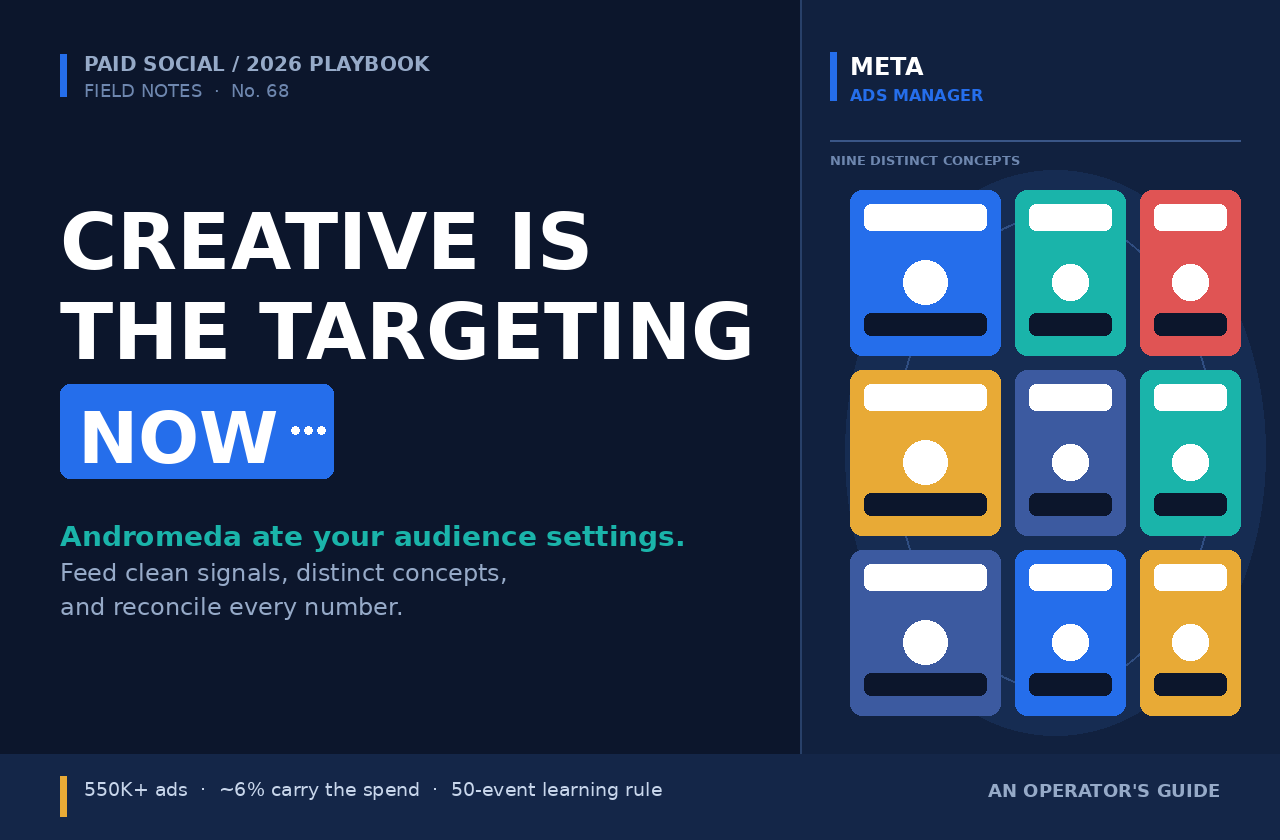
Open Ads Manager on a Monday and your instinct still goes to the same place it went five years ago: the audience column. You nudge an interest stack, carve out a lookalike, split a few ad sets by age band, and feel like you are steering. Here is the uncomfortable part. You are not steering anymore. You are rearranging deck chairs on a ship that Meta is now piloting, and the thing actually deciding who sees your ad is not your audience settings at all. It is your creative.
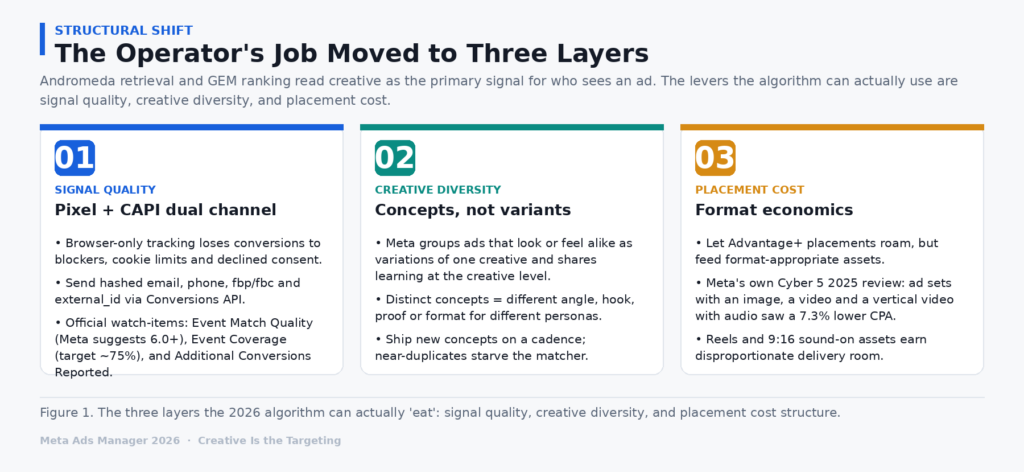
This is not a stylistic shift. It is a structural one, and it comes with receipts. Meta’s own engineering teams rebuilt the ad-delivery stack around retrieval and ranking models that read the visual, the hook, the format and the language of an ad as the primary signal for who should see it. Once you accept that, the 2026 operator’s job collapses into three layers the algorithm can actually eat: clean conversion signal, genuinely differentiated creative at volume, and a placement cost structure you stop fighting. Then there is the fourth, quieter job — refusing to let the dashboard flatter you.
Let’s walk through all four, with the numbers that survive scrutiny and a clear-eyed burial of the ones that don’t.
The Targeting Tab Was Replaced by a Retrieval Engine
To understand why your audience controls lost their bite, you need two names: Andromeda and GEM.
Andromeda is Meta’s retrieval engine. When someone opens Facebook or Instagram, the system has tens of millions of eligible ads to choose from and a few milliseconds to pick a shortlist. Andromeda does that first pass. Meta introduced it in late 2024 and reported an 8% lift in ad quality on the objectives it tested; by its October 2026 engineering update, the next-generation system was scoring more than a billion ads per second, roughly a hundred times the throughput of the 2024 version. That speed matters less as a bragging right than as a design statement: the system can now afford to evaluate far more creative combinations per impression.
Then comes GEM, the Generative Ads Recommendation Model, a foundation model trained at the scale of a large language model to teach the smaller ranking models that serve each surface. A 2026 addition called GenRecs pushes this further. Instead of tying performance to a fragile ID for each ad, campaign or product — identifiers that change every time you launch something new — the model reads an ad’s text and images and describes it in shared semantic tokens: brand, color, fit, style, the underlying concept. A brand-new product with zero engagement history now inherits what the system already knows about similar things.
Follow the logic and the conclusion is hard to escape. If the machine predicts who will respond from the concept embedded in the creative, then the creative is the targeting. Detailed interest targeting becomes a starting hint that a confident retrieval engine quickly overrides. Broad targeting plus Advantage+ is not a lazy default; it is the configuration that gives the matcher room to work.
Meta rebuilt ad delivery around retrieval and ranking models that read the creative itself as the primary signal for who sees an ad.
Why Near-Duplicate Ads Quietly Waste Your Budget
Meta published the single most useful sentence for creative strategists in December 2025, in a post called Demystifying Creative Diversification. It said, plainly, that when multiple ads look or feel alike, they are seen as variations of the same creative — and that learning and delivery optimization are shared at the creative level, not the individual ad level. The system also groups ads by shared visual and thematic attributes, and it warns that creative similarity can itself drive fatigue.
Read that twice. Ten ads built from one hero video with ten different captions are, to Andromeda, one ad wearing ten hats. You have not bought ten lottery tickets; you have bought the same ticket ten times. This is why the old one-winner-plus-a-few-resizes playbook now starves the matcher. The unit of planning is no longer the ad. It is the distinct concept — a different angle, a different hook, a different proof, a different buyer persona, a different format.
So what counts as distinct? A problem-agitation cut, a founder story, a side-by-side comparison, a creator partnership aimed at new parents, a static before-and-after, a meme. These give the engine separate hypotheses about who might respond. A recolored background does not.
The Six-Percent Evidence: Winners Are Rare, Volume Buys Tickets
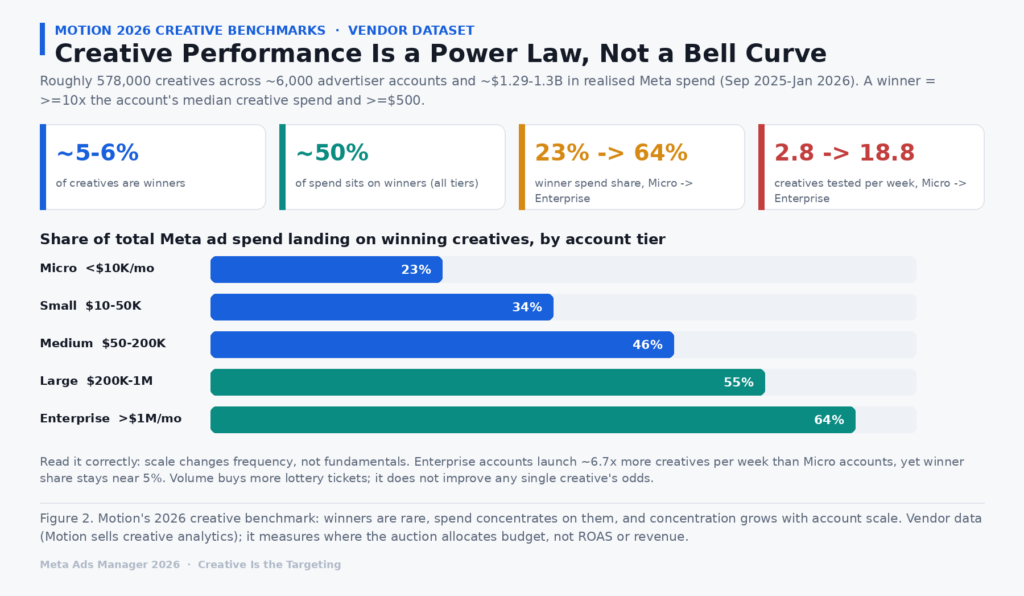
The most-quantified consequence of all this comes from Motion’s 2026 Creative Benchmarks, a large vendor dataset of roughly 578,000 creatives across about 6,000 advertiser accounts and around $1.3 billion in realised Meta spend between September 2025 and January 2026. One caveat up front, because it changes how you read everything below: Motion sells creative analytics, and this study measures where the auction allocated budget, not ROAS or revenue. It describes the shape of a portfolio, not the profitability of one.
With that label attached, the findings are unusually clean. Motion defines a winner as a creative that spends at least ten times its account’s median creative spend and clears a $500 floor. By that strict definition, only about 5% of creatives qualify — roughly half get little or no spend at all. Yet those few winners absorb about 55% of total spend, and the concentration climbs with scale: from roughly 23% of spend on winners at micro accounts spending under $10,000 a month, to about 64% at enterprise accounts spending over $1 million.
Here is the part operators tend to misread. Enterprise accounts launch around 18.8 new creatives a week versus 2.8 at micro accounts — about 6.7 times the volume — while their hit rate only roughly doubles, from 4% to about 9%. Scale changes frequency, not fundamentals. More volume does not make any single creative more likely to win; it simply buys more chances for a rare outlier to appear. The strategic lesson is almost boring: stop trying to predict winners, and build a system that ships enough genuinely different concepts for probability to do its work.
Layer One — Signal: Feed the Model Something True
A smarter delivery engine is still only as good as the feedback it receives. If your conversions are missing or misattributed, you are training a very expensive model on a distorted picture of reality.
Browser-only tracking is fragile. Ad blockers, Safari’s tracking prevention, iOS consent choices and cookie limits all hide conversions before the pixel ever fires. Note also that Chrome reversed its plan to fully remove third-party cookies in 2025 — so this is not the death of cookies, it is a browser-layer leak, and the fix is structural: send the event from your own server through the Conversions API alongside the pixel, deduplicated by a shared event ID.
Now the discipline that most guides get wrong. You will see confident claims that pixel-only setups lose 15–30% of conversions, that CAPI recovers 18–30%, and that you must push Event Match Quality above 7.0. A 2026 server-side tracking benchmark report reviewed these and removed its own earlier versions of exactly those claims: no Meta publication supports numeric recovery percentages, and Meta publishes no score band that maps EMQ to cost per result. What Meta does publish is a definition and a modest target. EMQ is a 0–10 score for web events sent through CAPI, computed from which customer parameters arrive, their quality, and the share of events matched to a Meta account, using the last 48 hours. Meta’s verification guidance says it typically recommends aiming for 6.0 or higher where possible.
So work from the official instruments instead of folklore. Send high-quality hashed identifiers — email, phone, name — plus click and browser IDs (fbc, fbp), external ID, IP address and user agent: hash the contact fields, never hash the IP or user agent, include country codes on phones, and send in near real time. Track Additional Conversions Reported, Meta’s own estimate of conversions measured because of your CAPI setup. Watch Event Coverage — the share of pixel events also arriving through CAPI — against Meta’s 75%-plus target. And verify deduplication in Events Manager, because an undeduplicated pixel-plus-server setup double-counts and performs worse than either channel alone.
Then there is the event ladder. Meta’s learning phase wants about 50 optimization events per ad set within a rolling seven-day window of the last significant edit; fall short and you land in Learning Limited. If a low-volume account cannot feed 50 purchases a week, optimize for a higher-frequency upstream event such as Add to Cart or Initiate Checkout to build signal, then switch back to Purchase once the account has history. That is a structural fix, not a bid tweak.
One more myth worth retiring while we are here: the any-budget-change-over-20%-resets-learning rule is practitioner guidance, not a documented Meta threshold. Meta lists significant edits — audience, creative, optimization event, bid strategy — and recommends avoiding them for a week after a reset. Scale in gentle steps for stability, but do not present the 20% figure as platform law.
Layer Two — Creative: Concepts, Cadence and the Format Multiplier
If creative is the targeting, creative production becomes a media-buying function. That reframes the whole calendar.
Plan in concepts, not variants. A useful working cadence for cold prospecting is a fresh concept every two to three weeks per active ad set, shipped before the current ad breaks — and shipped in pairs, one new concept plus one variation of a current winner, so you get a fatigue replacement and an incremental test in the same launch. Judge a new creative on delivered impressions rather than elapsed days: three days means completely different exposure at $50 a day than at $2,000.
Formats are where Meta gives us its own number. In its Cyber 5 2025 review of purchase-optimized ads from October 1 to November 30, 2025, ad sets that included at least one image, one video and one vertical video with audio delivered a 7.3% lower cost per action than ad sets missing one or more of those formats. The platform’s broader creative playbook points the same way: keep 9:16 sound-on assets in the mix, put key elements inside the safe zone, and lead with a hook in the first two seconds. Whether you call the lever creative diversity or format economics, the mechanism is identical — more distinct assets give retrieval more matching surface per impression.
AI production tools change the cost side of this equation, not the odds side. Generating fifty clips for the price of one used to be the bottleneck; now the bottleneck is the review desk that has to tag, judge and kill the ninety-five percent that will not scale. Build that review loop before you celebrate the render farm. And keep a running hook library and an angle map — a one-page inventory of every persuasion route your product supports — so a refresh draws from a shelf rather than a panic brainstorm.
Layer Three — Placement: Stop Arguing With the Auction
The third layer is smaller but real. Let Advantage+ placements roam across Feed, Stories, Reels and the rest, but supply assets that fit each surface instead of forcing one square crop everywhere. Vertical, sound-on video is structurally advantaged in Reels; a crisp static still earns its keep in Feed; carousels still do consideration work. You will find confident claims that Reels CPC runs about 26% below Feed and that static images still drive 60–70% of conversions. Those specific percentages trace back to vendor syntheses we could not verify at source, so we are leaving them out — the directional advice stands on Meta’s own format-diversity evidence, not on a number we cannot stand behind.
The operator’s move is simple: give each placement an asset designed for it, then read the placement breakdown rather than rebuilding your account into placement-specific campaigns. Slicing by placement divides your conversion data, and divided data is exactly what this system punishes.
Account Structure 2026: Consolidate Until It Almost Feels Wrong
Here is where experienced buyers feel the most resistance. The muscle memory of a dozen tightly-defined ad sets is hard to unlearn — but fragmentation is now actively expensive.
Do the arithmetic. Every ad set needs about 50 optimization events a week to exit learning. At a $40 cost per purchase, one ad set needs roughly $2,000 a week to get there; split the same $2,000 across four ad sets and none of them reach the threshold. Worse, overlapping audiences end up bidding against each other in the same auction, so you compete with yourself and push up your own CPMs.
The 2026 default is almost comically simple: one consolidated prospecting campaign, one retention or retargeting campaign if you have the volume and a genuinely different message, and one controlled creative-testing structure where new concepts graduate into the main campaign. Campaign-level budget (formerly CBO) lets spend chase winners; ad-set budgets belong in tests. Separate campaigns only when the objective or the economics truly differ — different countries with different margins, a lead campaign versus a purchase campaign, or special ad categories that carry legal targeting restrictions. Separate by gender or a single interest to see what works? No. You can read that in the breakdown without dividing your data.
Single-source case studies report large gains from this — one documented merge of three small ad sets into one Advantage+ campaign lifted ROAS from 1.8 to 3.2 — but treat those as illustrations, not guarantees. The reliable proof is the 50-event arithmetic, not anyone’s before-and-after screenshot.
Advantage+ Controls That Actually Still Exist
This is the section most 2026 guides get factually wrong, so read carefully.
What used to be Advantage+ Shopping Campaigns (ASC) is now the Advantage+ sales campaign — a Sales campaign with campaign budget, Advantage+ audience and Advantage+ placements switched on. And the control everyone still teaches, the existing-customer budget cap that let you say spend at most 15% on past buyers, has been removed. Meta’s documentation now says the existing_customer_budget_percentage field is not available for new Advantage+ campaigns; legacy Shopping campaigns could no longer be created through the API from v25.0 in February 2026, and from v26.0 in July 2026 legacy campaigns were blocked from edits and paused.
Why does that matter? Because a campaign optimizing for purchases rationally buys the cheapest purchases available, and those are almost always people who already bought from you. Without a guard, the dashboard posts a beautiful ROAS while net-new customer acquisition quietly flattens — you are paying to reach people your email list would have brought back for free.
Meta’s official replacement is built from parts, not a single dial. Define who counts as an existing customer in advertising settings with a custom audience (customer list plus purchase-event website audience). Then either (a) exclude that audience hard — exclusions are rules, not suggestions — so prospecting spend goes only to new people, or (b) run two ad sets under one campaign budget: one targeting existing customers with a percentage-based maximum spend limit, and one that excludes them. Report the split with the Audience Segments breakdown and keep the customer list fresh, because an exclusion only covers people on the list.
Two smaller controls are worth keeping clean: sync your catalog daily and use custom labels for margin or season so the system is not optimizing toward your least profitable SKUs, and toggle Advantage+ creative enhancements deliberately — text variations and music are usually harmless, but auto-generated visual crops can quietly turn your distinct concepts back into near-duplicates.
Fatigue Management: Refresh on Economics, Not on a Frequency Rule
Creative fatigue is real, but the popular thresholds around it are shakier than they look. A well-documented 2026 first-party benchmark — 368 creatives across 15 DTC brands, 48.45 million impressions, April to August 2026 — found that 80% of creatives never reached 100,000 lifetime impressions at all; the median creative saw about 10,665. Most ads people call fatigued never had enough exposure to wear out.
Among the minority that did scale, the pattern was not a smooth decline. Click-through stepped down roughly 5.5% early and then broadly flattened; CPM stayed within about three points of baseline; the signal that actually hit the P&L was cost per acquisition, running about 19.6% above baseline in the 500,000-to-1-million-impression bucket. The authors’ conclusion is the one to tape to your monitor: trigger refreshes on CPA against your target, not on a fixed frequency like 2.5 or a one-week CTR wobble. Frequency and first-time impression ratio are useful directional context — an FTIR below roughly 50% means you are re-serving ads to the same people — but they are not the trigger.
When the trigger fires, escalate cheaply before you rebuild. First swap the hook on the same body; if that fails, swap the visual while keeping proven copy; only then change the offer. Most decay is hook fatigue, and a new opening re-creates the pattern interrupt without throwing away a converting message. And never refresh everything at once — a full-account creative swap is a full-account learning reset. Stagger it, so proven delivery always coexists with new tests.
Bidding and Scaling: Boring Beats Clever
Bid strategy is the last place to look for an edge. Meta’s default — highest volume, spend the budget for the most results — is the right starting point because it feeds the system the most data. Cost-per-result goals and bid caps add a constraint, and a constrained ad set often under-spends, which halves its effective learning volume. If you use a cost cap, set it close to the CPA you are already achieving rather than an aspirational target, and keep it consistent across ad sets sharing a campaign budget so the system compares like with like.
Scaling is patience dressed as process. Raise budget in gentle steps once cost per acquisition is stable and inside target, give the account a week between significant edits, and test new creative in a separate structure so your best ad sets keep learning undisturbed. If performance sags, resist the urge to change five things on a Tuesday — group your edits, because every significant edit restarts the clock.
Retargeting Segmentation Without the Self-Competition
Retargeting still earns its place, just not as thirty warm ad sets. Keep it small and separate, with clear suppression so prospecting does not pay for people who already converted. Three tiers are enough: high-intent (checkout or cart abandoners on a short window), engaged (video viewers, page visitors, social engagers), and broad content audiences. Exclusion windows are the whole game here — suppress recent purchasers, and refresh warm audiences faster than cold ones because small pools saturate quickly.
On lead generation, Instant Forms and landing pages are a trade, not a ranking. Forms buy you cheap, high-volume leads with weak qualification; landing pages cost more per lead but filter intent and give the pixel a richer signal. For considered B2B purchases, optimize on qualified-lead stages or lead value via offline conversions and CRM uploads, not on raw form fills — otherwise GEM diligently finds you the cheapest, least valuable people on the platform.
Measurement Honesty: Your Dashboard Is Grading Its Own Homework
Now the part that decides whether any of the above makes you money.
Platform-reported ROAS is an observational number. Independent and peer-reviewed work keeps showing that observational attribution and marketing mix models can overstate causal return by multiples. A 2026 preprint from a Zalando researcher, using synthetic data with known parameters, had a conventional MMM report a ROAS of 10.61 against a true 4.20, while a structural method calibrated on four geo-experiments recovered 4.14. It is a demonstration, not a field estimate — but the direction is consistent with a September 2026 analysis of Facebook’s own measurement tests, which concluded standard ad measurement is often off by roughly three times.
Meta itself has been unusually candid about this. Its suite of truth framework puts randomized Conversion Lift experiments at the top of the evidence ladder, and it rolled out Incremental Attribution globally in June 2025 — a setting trained on lift data to optimize for conversions that would not have happened anyway. Across 37 Conversion Lift studies in 2024, Meta reported an average 46% performance lift for advertisers using the setting. Independent incrementality firm Haus found that across experiments run since July 2025, optimizing toward Incremental Attribution beat standard attribution on incremental return by a pooled geometric mean of about 1.26x.
So build the ritual. Govern scale on MER — total revenue divided by total spend — the macro number that no attribution window can game. Reconcile platform-reported purchases against backend orders carrying the click ID, over a window at least as long as your longest conversion window. Classify every number entering a decision as experimental (randomized, powered, reconcilable) or observational (useful telemetry, inadmissible as proof). A Kantar survey of 1,935 decision-makers cited in Meta’s 2025 paper found the average advertiser already uses 3.8 measurement solutions and 55% have seen contradictory results across tools; the answer is not more dashboards, it is a pecking order. And run a real holdout or geo-lift test at least quarterly, pre-registered and powered, to calibrate the whole stack against reality.
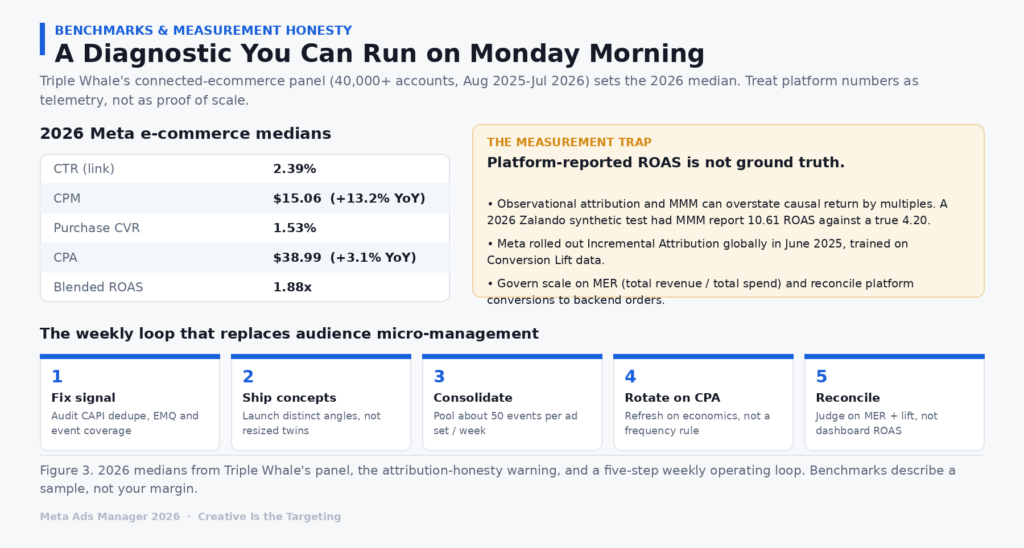
For context, here is where the 2026 median sits. Triple Whale’s connected-ecommerce panel — 40,000-plus accounts, August 2025 to July 2026 — puts median CTR at 2.39%, CPM at $15.06 (up 13.2% year over year), purchase conversion rate at 1.53%, CPA at $38.99 (up 3.1%) and blended ROAS at 1.88x, against a median AOV near $73. A different cut of the same panel, covering full-year 2025, reads 2.19% CTR, $14.19 CPM, $38.19 CPA and 1.86x ROAS. The samples and windows differ, so treat it as a range around roughly 1.9x, not a scoreboard — and compute your own break-even ROAS from your margin before comparing yourself to anyone. One useful split from a separate 2026 dataset: retargeting campaigns showed a median ROAS around 3.6x versus about 2.1x for prospecting, which is exactly why un-capped automation loves warm audiences.
Compliance and Provenance: The Part Nobody Puts in the Case Study
Two 2026 developments belong in your pre-launch checklist.
First, provenance. Since July 2026, Meta automatically adds an AI info disclosure to the About this ad panel of Facebook and Instagram ads created or significantly edited with its own generative AI features — Background Generation, Image Generation, Add Animation — or with third-party tools, which it detects through C2PA Content Credentials in the file. Second, regulation. Article 50 of the EU AI Act (Regulation EU 2024/1689) became applicable on 2 August 2026: providers must make synthetic content machine-readable and detectable, and deployers must give clear, human-readable disclosure for deepfakes, with a grace period to 2 December 2026 for marking obligations on systems already on the market. Penalties reach €15 million or 3% of worldwide turnover. Note that the Commission reads deepfake disclosure broadly — content accessible to EU audiences can trigger it regardless of where it was made.
The practical line is about realism, not tooling. AI-written captions, scripts and light color correction generally do not trigger a label; a photorealistic synthetic person, voice or event does. Disclose at upload rather than hoping detection catches it, keep a record of which tool generated which asset, and never let an AI avatar pose as a named verified buyer — that is a deceptive testimonial under FTC rules whether a human or a model wrote it. Special ad categories (housing, employment, credit, social issues) still carry hard targeting restrictions and belong in correctly declared campaigns. Disclosure is not a performance penalty; an undisclosed synthetic testimonial is an account risk.
The Bottom Line: Stop Steering, Start Feeding
The audience-targeting era ended structurally, not stylistically. Andromeda retrieves, GEM ranks, and the concept inside your creative decides who sees the ad. Your job is no longer to out-guess the audience picker; it is to keep the inputs honest.
So here is the whole playbook in one breath. Fix the signal — pixel plus deduplicated CAPI, hashed identifiers, watch EMQ against Meta’s 6.0-plus guidance and Event Coverage against 75%, optimize on an event the account can actually feed. Ship differentiated creative at volume, in formats Meta has shown lower cost per action, and refresh on CPA rather than a frequency superstition. Consolidate the account so each ad set can reach fifty events a week, rebuild the removed existing-customer cap with exclusions or a two-ad-set spend limit, and let Advantage+ placements roam. And reconcile every number against real revenue with MER, CRM and a powered lift test before you believe a single ROAS figure.
Do that, and the dashboard stops being a flattering mirror and starts being an instrument. That is the entire edge left in 2026 — and it is still a fairly large one.