Why brand became measurable the moment nobody was looking
The odd coincidence nobody noticed
Line up the three breakthroughs behind 2026 brand measurement and a pattern appears. Share of search came from Les Binet playing with a free Google tool. Ghost ads came from three ad-platform economists cutting the cost of experiments. The AI-visibility evidence came from an SEO vendor and a media-monitoring firm counting citations. Not one set out to build a brand tracker. All three found one.
Brand did not become measurable because marketing science got cleverer. It became measurable because three large systems, built for other purposes, started leaking a residue that contained the thing we had spent decades asking people about.
The name for it is exhaust
Data people already have a word: data exhaust. InterPARES Trust defines it as data captured as a by-product of, but secondary to, an activity, with real value for mining, and lists search terms and log files as examples. Binet’s entire metric is search terms; ghost ads are log files. A survey is an instrument you commission. Exhaust is an instrument you overhear.
Three streams, one mechanism
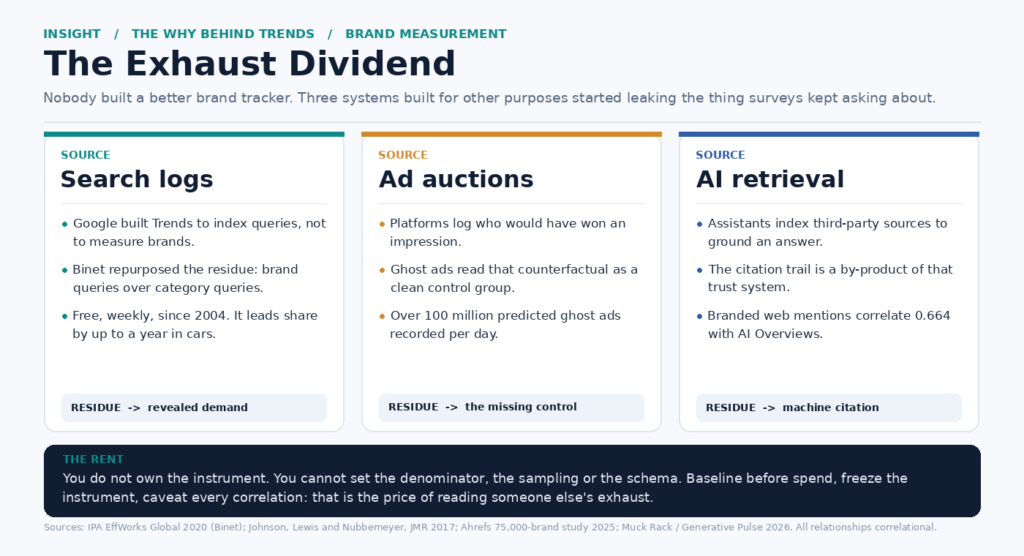
Google built Trends to index queries; nobody there was thinking about share of market. Binet saw the residue was revealed demand. His verdict after thirty years of tracking: the link between tracking metrics and purchase behaviour is often surprisingly weak. The exhaust beat the instrument.
Ad auctions are neater. Real-time optimisation creates the bias that wrecks exposed-versus-unexposed comparisons, because the platform decides who is worth showing an ad to. Yet that same engine logs who would have won the impression. Ghost ads read that counterfactual as a clean control; the published system records over 100 million predicted ghost ads a day. The bias and its fix sit in one file.
Then AI retrieval. Assistants index journalism, academic work and third-party sources to ground an answer before naming a brand. The citation trail is exhaust from a trust system, not a ranking system. Ahrefs found branded web mentions correlating 0.664 with AI Overview visibility; Muck Rack Generative Pulse found roughly 84 percent of cited links earned or third-party and 0.3 percent paid. Neither was designed as a brand KPI. Both now are.
So why now
Three conditions lined up. Behaviour moved online and got logged. Those logs were stored cheaply for years; Trends reaches back to 2004. Then a new reader arrived that needs evidence rather than links, and leaves its own audit trail. Brand memory was always there; what changed is that the world grew a listening surface. We stopped asking and started transcribing.
The rent on borrowed instruments
This explains the discipline in the main playbook. You do not own the instrument, so you cannot set its denominator, sampling or schema. Trends is a normalised 0 to 100 index from a sample, with noise Google adds deliberately; that is why the 83 percent figure is an average correlation, not a law, and why a scandal looks like demand. A methodology lock on your own survey is the one thing you control. The exhaust dividend is real, but rented: use it as the pulse, keep an owned instrument as the anchor, caveat every time. Brand was measurable all along. We just had to wait for the machines to start talking to themselves, and learn to read the transcripts.