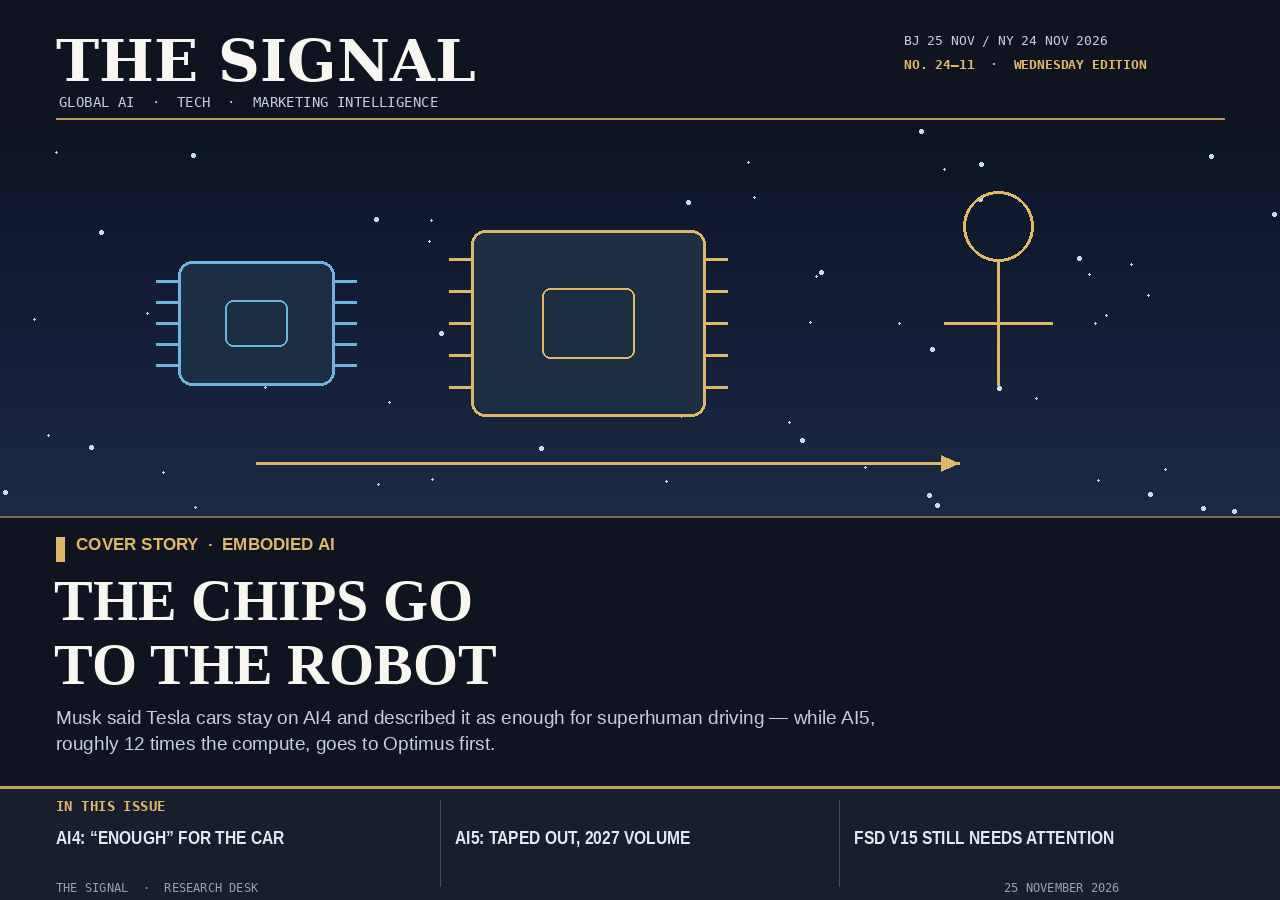
Replying to an owner asking when AI5 would reach new vehicles, Musk said it wouldn’t: the cars stay on AI4, and the newer silicon goes to Optimus.
A Tesla owner on X asked whether to wait for a car with the AI5 chip. Elon Musk’s reply on November 22 was blunt: “It’s going to Optimus. Cars will remain at AI4. That’s enough to solve superhuman driving.” The exchange resurfaced in Chinese and Korean tech media on November 25, and it is consistent with what he said on Tesla’s first-quarter earnings call — that AI4 already has enough compute for unsupervised driving at safety levels well above a human’s, so AI5 should go first to Optimus and to the company’s AI training clusters.
The numbers behind the split explain it. AI4 (also called HW4) is the current in-car computer: two custom SoCs, six neural-network accelerators, roughly 32GB of GDDR6. AI5 has been taped out and is in pilot production, with volume manufacturing targeted for 2027; Musk has put its compute at roughly 12 times AI4, with memory planned around 96GB. A general-purpose humanoid has to handle unstructured contact — grasping deformable objects, force-control loops under occlusion — which is a heavier real-time inference load than lane-keeping. Directing the best silicon to the robot is an admission that the car side has, for now, hit a plateau.
There is a caveat worth keeping in the same paragraph. “Enough” is a claim about headroom, not a statement that the job is done. FSD version 15 still requires driver attention; its new Reality View visualization runs on spare compute on the second SoC and currently shows noticeable latency, which Musk said could be cut about 35% by improving the model hierarchy. Tesla also acknowledged in April 2026 that older HW3 hardware cannot support unsupervised self-driving, and has discussed a modest AI4.5 refresh driven largely by memory costs. The gap between “the hardware is sufficient” and “the software is finished” is where this story actually lives.
The capital-allocation signal is the sharper read. Tesla has been shifting Fremont capacity toward Optimus, and AI5’s tape-out-to-volume window lines up with the robot’s production ramp. If AI5 slips, what gets stuck first is not a car’s over-the-air update but the robot’s bill of materials. For anyone valuing Tesla as more than a car company, that is the dependency to watch.