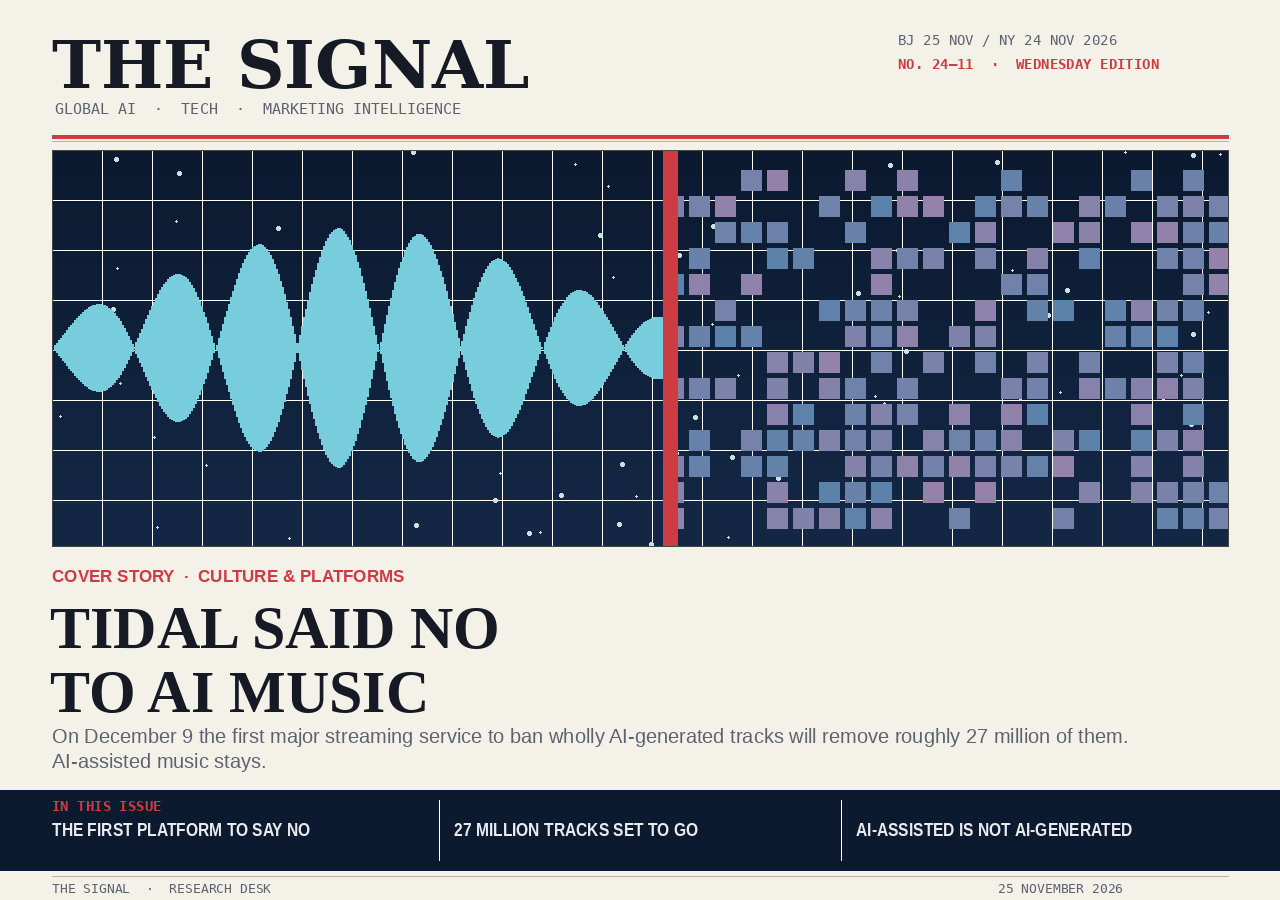
Wholly synthetic tracks go; AI-assisted recordings stay. The platform says the purge begins December 9.
On Tuesday, November 24, Tidal said it will reject and remove “any wholly AI-generated track” submitted to the service, starting December 9. Billboard called it the first outright ban by a major streaming platform. Most of its competitors have gone the other way, opting to label synthetic content and adjust royalties rather than refuse it.
Estimates of how much leaves the catalog vary by source: Ars Technica put it at about 27 million tracks, while other reporting cites roughly 29 million by early 2027. Trade coverage notes the service had already been removing synthetic uploads in the tens of thousands and had demonetized them over the summer. One figure circulating in coverage — that AI music accounted for more than 43% of recent uploads — explains the timing better than any mission statement does. Tidal says AI-assisted music, where a human made the record and used AI tools, is not affected.
The distinction is the whole policy. “Wholly AI-generated” is a category the platform can act on; “AI-assisted” is a spectrum it cannot. Whether detection is reliable enough to tell them apart at upload scale is the open operational question, and Tidal has not published how it will adjudicate disputes. That is where this either works or turns into a very public mess.
It also lands in the middle of a broader turn against the synthetic look. Coca-Cola pulled back from AI-generated holiday creative last week after a divisive reception. Chewy this week ran a stop-motion holiday ad — handmade, low-frame, deliberately tactile. David Fincher spent part of the week being accused of using AI on a new film. None of these are coordinated, but they point the same way: for brands and platforms, visible human effort is becoming a thing you advertise, not a cost you hide.
The interesting test is economic, not aesthetic. If a mid-sized platform can remove a large chunk of its catalog without denting retention, other services will notice. If listeners barely register the change, the labeling consensus gets harder to defend. Expect the first read on that in the new year.