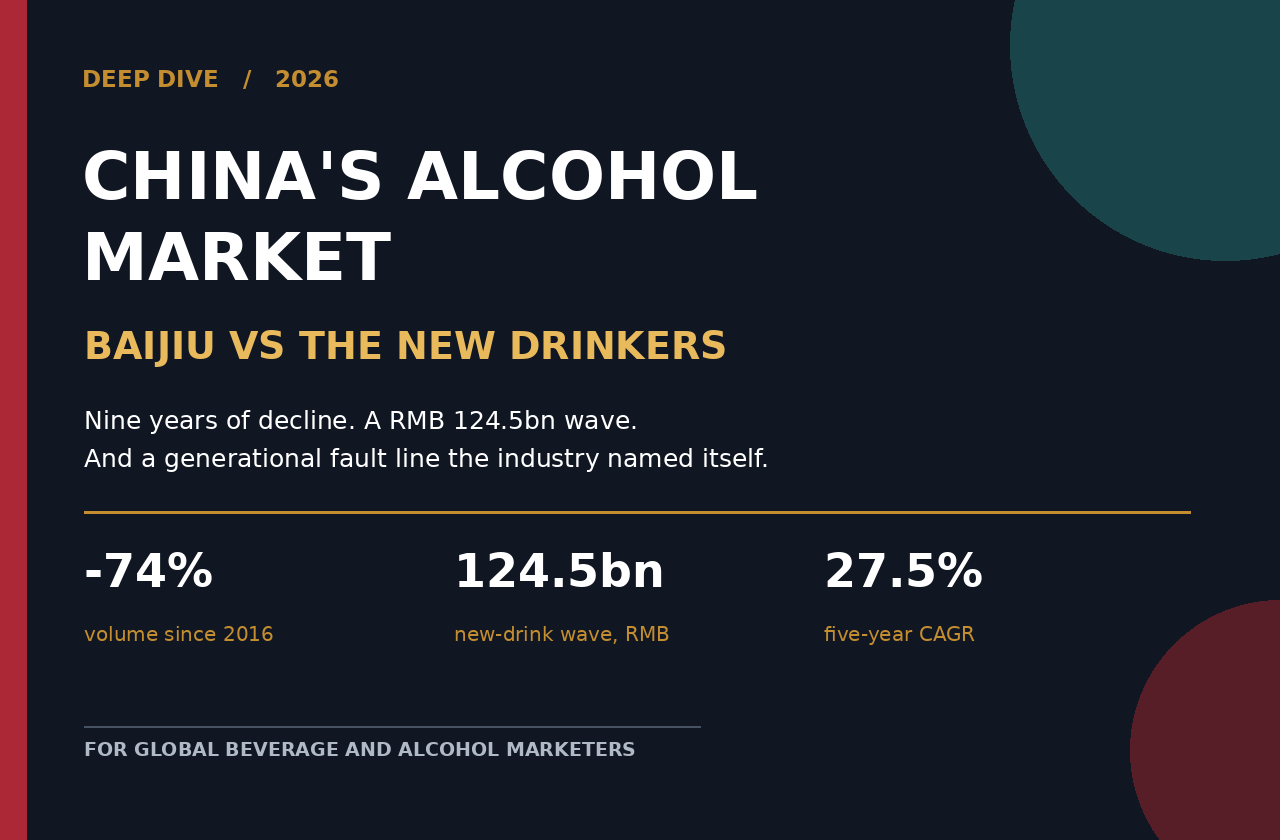
“The old cannot drink, the young do not want to.”
That line, delivered by the chairman of China’s alcohol industry association, does more work than a hundred PowerPoint slides. It is not a complaint. It is a market map. On one side sit the people who built the baijiu business — banquet tables, toasts, hierarchy, face — and who are now, quite literally, drinking less. On the other sit people who never signed up for that ritual at all, and who are buying drinks in entirely different ways.
Here is the part that should make any marketer sit up: this split is not a blip in one category. It is a structural rewiring of when, why, and with whom China drinks. Once you see the occasion change, the marketing brief writes itself differently.
The nine-year slide
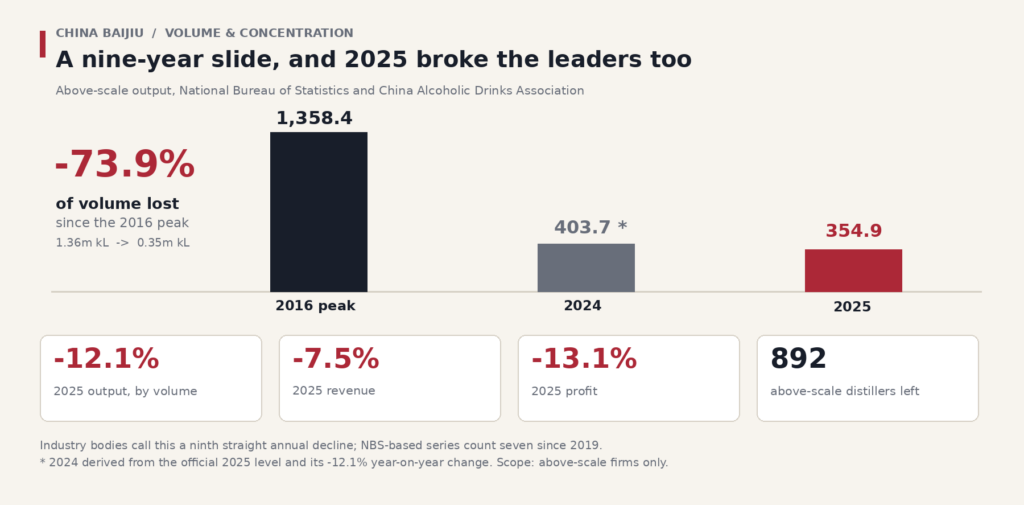
Start with the hard numbers. The National Bureau of Statistics reports that above-scale baijiu output reached 3.549 million kilolitres in 2025, down 12.1% on the year. Against the 2016 peak of 13.584 million kilolitres, that is a loss of roughly 74% — more than ten million kilolitres of capacity that simply evaporated. One caveat worth keeping in your back pocket: industry bodies call this a ninth straight annual decline, while the official statistical series counts seven consecutive drops since 2019. The figures agree; the starting line differs.
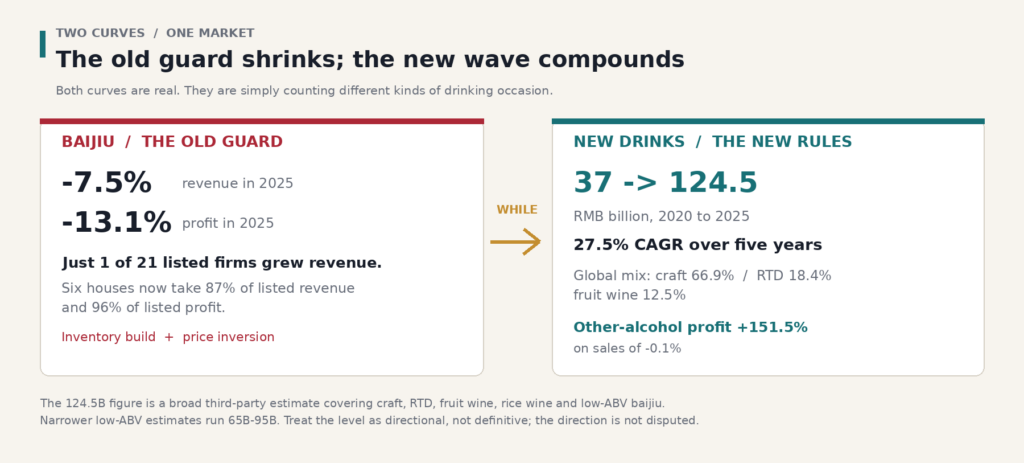
The China Alcoholic Drinks Association, in its 2025 annual report presented by chairman Song Shuyu in May 2026, filled in the rest. Across the above-scale brewing industry, total output fell 1.4%, revenue fell 5.8%, and profit fell 10.1%. For baijiu specifically, revenue dropped 7.5% and profit 13.1%. There were 892 above-scale distillers left, down sharply from roughly 1,600 a decade earlier.
Why 2025 finally broke the leaders
For years, you could comfort yourself with a reassuring story: the small players were dying, but the giants were fine. In 2025 that story stopped working. Of the 21 mainland-listed alcohol firms tracked across A and H shares, only Shanxi Fenjiu grew revenue — up 7.52% to about 38.7 billion yuan. Everyone else contracted.
And the concentration is almost absurd. The six largest — Moutai, Wuliangye, Fenjiu, Yanghe, Luzhou Laojiao and Gujinggong — took 87% of listed-sector revenue and 96% of listed-sector attributable profit. Read that again: six companies captured almost all the money in a public market that was itself shrinking. This is not a healthy oligopoly so much as a survival cluster. Baijiu still contributes 74% of the industry’s revenue and 86% of its profit while producing just 8.5% of its volume — an enormously lucrative category that has stopped growing.
The dumbbell
The market has not flattened. It has split into a dumbbell, and the middle is where the bodies are buried.
At one end, ultra-premium proved surprisingly resilient. Moutai’s inventory climbed to roughly 340,000 tonnes, up 9.67% by volume, and the book value of its stock rose even faster — evidence that the brand kept making product even as sell-through slowed. At the other end, value brands kept moving because people still drank at home and at informal gatherings.
The killing field is the sub-premium band — the 300 to 800 yuan bottles that once defined the business dinner. It is too expensive for everyday use and too ordinary to signal status. The association’s own reporting notes that price inversion, where the market price sits below the wholesale price, was most severe in the 800 to 1,500 yuan band. When a gift bottle cannot hold its price, the whole status logic of the category wobbles.
Inventory, price inversion and the death of push
The old baijiu machine ran on a beautifully simple trick: ship case goods to distributors, book the revenue, let the channel worry about the rest. That is channel stuffing. It works brilliantly in a rising market and turns poisonous in a falling one.
By the first half of 2025, 58.1% of distributors and retailers surveyed in a joint China Alcoholic Drinks Association and KPMG study said their inventory had grown further, and more than half reported worsening price inversion. The association puts average inventory turnover at about 900 days. Wuliangye’s finished-goods inventory rose 45.18% by volume while its sales volume fell more than 30%. You do not need an economics degree to see the problem: you cannot push your way out of a demand problem forever.
For marketers, the consequence is subtle but huge. Your brief is no longer about moving units into a warehouse. It is about creating actual reasons to open a bottle — genuine sell-through. Those are completely different campaigns.
The generational fault line
Now the interesting part. Why did demand change? Because the occasion changed.
A survey from CBNData, the commercial research arm of Yicai, found that 63% of respondents aged 18 to 35 leaned toward low-alcohol, slightly tipsy or naturally brewed drinks, and that consumption of high-strength baijiu fell 12% year on year in that group. Two honest caveats: the report measures preference, not exclusive purchase, and it also found premium baijiu holding up among some young buyers. This is a shift in how often and where people drink, not a mass conversion.
From pleasing others to pleasing self
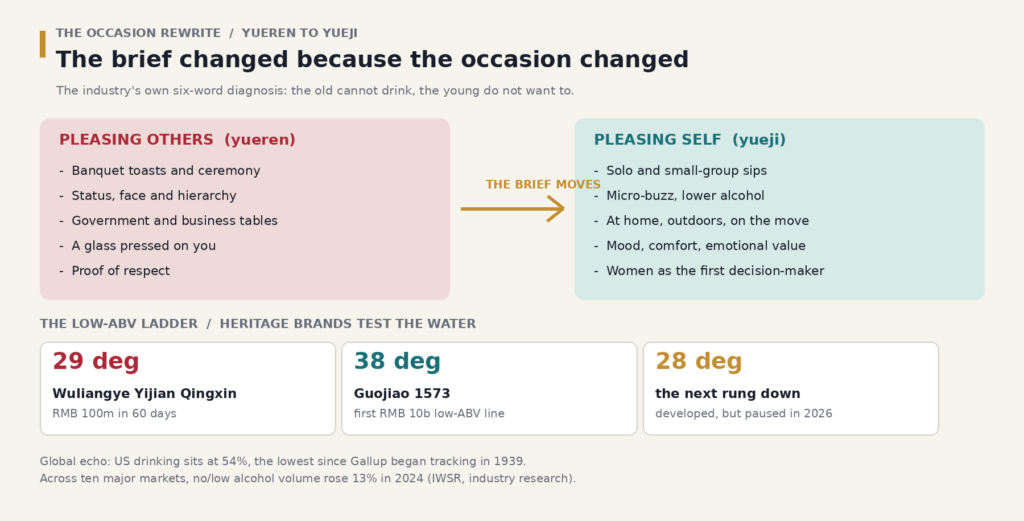
The industry has a neat pair of words for it. Yueren — pleasing others — is the banquet logic: you drink to show respect, to close a deal, to honour a guest. Yueji — pleasing self — is the new logic: a small pour at home after work, a low-alcohol can at a picnic, a drink chosen because it fits your mood.
Map the two and the marketing implications fall out immediately. The first is public, ceremonial, hierarchical and often involuntary. The second is private, casual, egalitarian and entirely voluntary. One sells obligation. The other sells permission.
The new-drink wave
Commercial research firm sgpjbg estimates China’s broad new-drink market — craft beer, ready-to-drink cocktails, fruit wine, rice wine and low-alcohol baijiu lumped together — at 124.5 billion yuan in 2025, up from 37 billion in 2020, a compound annual growth rate of 27.5%. Its global equivalent is about 1.35 trillion yuan, with craft at 66.9%, ready-to-drink at 18.4% and fruit wine at 12.5%.
Be careful with that headline number. It comes from a commercial report, not an official statistic, and the boundaries are porous: the China Alcoholic Drinks Association’s narrower low-alcohol estimate is 74.2 billion yuan, and IWSR has projected more than 95 billion yuan for 2026. Different definitions produce different levels. What they all share is the slope.
The segment nobody was serving
Official association data for 2025 shows the category labelled “other alcohol” — fruit wine, whisky, infused liquor and ready-to-drink products — posting sales of essentially unchanged, down 0.1%, while profit exploded 151.5%. And infused liquor brought more than ten million new female consumers into the drinking fold, according to the same association report. Note the number: over ten million, not tens of millions. It is still a big deal, and it is a segment the old baijiu playbook largely ignored.
If you are a brand planner, this is the unlocked door. For decades alcohol marketing in China assumed a male host buying for a group. The new drinker is often a woman buying for herself, in smaller quantities, more often, at odd hours, through a phone.
The low-ABV counterattack
The heritage houses did not watch from the sidelines. They chased the wave with their own products, and the results are instructive.
Wuliangye’s 29-degree Yijian Qingxin reportedly passed 100 million yuan in sales within 60 days, though the figure came from internal company information shared with media rather than a formal disclosure. Luzhou Laojiao’s 38-degree Guojiao 1573 became the first low-alcohol baijiu line to pass 10 billion yuan — a company investor-relations filing confirms it accounts for roughly half of the Guojiao 1573 series rather than being a standalone product.
The 28-degree version is a cautionary footnote. It had already been developed and was slated for release, yet in 2026 the company’s investor relations office signaled a more cautious stance and no immediate launch. Technology can lower the alcohol content. Convincing a heritage audience that low means refined rather than weak is a slower job.
Huangjiu’s second wind
The most elegant reinvention may come from the oldest category. Kuaijishan, a yellow-rice-wine producer, launched a sparkling huangjiu in 2023 and turned it into a 100-million-yuan product by leaning on unlikely channels: cross-boundary livestreams pairing a younger influencer with a veteran movie star, rather than the customary liquor trade circuit.
The caveat matters. That single product is only about 12% of company revenue, and the push required years of heavy marketing spend. Still, it is a usable template: take an old category, change the format and the serving occasion, and let an unexpected face carry the story.
The whisky long game
Domestic whisky is the patience play. Longzhou, a subsidiary of Baiyun Shares, has been building what it calls China’s largest whisky distillery in Qionglai since 2021. Company filings disclose 600,000 ageing casks filled as of early 2026, with plans for one million over the next four to five years and roughly 3.44 billion yuan raised since 2020 to fund the barrel stock.
Here the marketing challenge is time itself. Single malt needs at least three years, and premium positioning needs a decade of story. You cannot buy patience with media spend. What you can do is start building the narrative while the liquid sleeps — provenance, landscape, craft, the quiet confidence of a product that refuses to hurry.
The channel rewrite
The route to market is changing as fast as the product. Instant retail has become the growth channel for alcohol, with platform data showing a large majority of flash-delivery alcohol orders going to residential addresses rather than restaurants. That single statistic tells you everything: the drink has left the banquet and entered the living room.
Direct-to-consumer operations, of which Moutai’s iMoutai is the most discussed, give brands first-party demand signals they have never had before. Content commerce brings discovery and purchase into the same scroll, though it operates inside a tight compliance cage. Meanwhile, new recommended national standards for alcohol distribution bring livestreaming and instant retail under formal supervision for the first time.
The compliance cage
And that cage is real. Article 23 of China’s Advertising Law prohibits alcohol ads that induce or encourage drinking or glorify immoderate drinking, depict the act of drinking, show driving a vehicle, vessel or aircraft, or claim that drinking relieves stress or anxiety or boosts physical strength. Two common additions — no minors and no drunk driving — are interpretations drawn from other regulations rather than the literal text of Article 23, but they are enforced in practice.
Layered on top are broadcaster conduct rules and platform regulations. Douyin’s 2026 alcohol category rules, for instance, restrict which shop types may sell alcohol and apply to influencers promoting it, and explicitly bar drinking on camera.
So what is left for creative? Plenty, if you stop selling the swallow. You can sell provenance, craft, flavour, pairing, design, the setting, the company, the moment after the glass is set down. You can show a bottle, a place, a person, a mood. You just cannot show the drink going down.
Global mirrors
China is not alone. Gallup’s July 2026 survey found 54% of US adults say they drink, tied with the previous year for the lowest reading since tracking began in 1939 — roughly 87 years, not a century. The decline ran 62% in 2023, 58% in 2024, 54% in 2025 and held there. Some 13% said they sometimes drink too much, also a record low, and 17% had tried a nonalcoholic substitute.
Across ten major markets, IWSR — a commercial drinks researcher, not a government body — reported no-and-low alcohol volumes up 13% in 2024, with 61 million new no-alcohol and 38 million new low-alcohol consumers between 2022 and 2024. Japan’s ready-to-drink segment has become the global reference case for substitution, though analysts warn it is maturing. The pattern rhymes: fewer people drinking, those who do drinking less, and a new middle path taking shelf space.
The playbook
Four moves worth making
If you take one thing from this analysis, make it this: stop briefing the bottle and start briefing the moment.
Occasion first. Decide whether you are selling a toast or a Tuesday evening. They need different products, different prices, different voices and different channels. A banquet brief dressed up as a solo brief will read as fake immediately.
Proof over posture. When the occasion is self-chosen, the drinker wants reasons. Show the raw material, the age, the process, the people. Evidence, expertise and authenticity matter as much in a bottle as they do in a search result.
Build the ladder. Low alcohol is not a discount. It is an on-ramp. Give people a reason to step down in strength without stepping down in pride, and let the tech story carry the dignity.
Community over ceremony. The banquet was a broadcast to a room. The new occasion is a conversation in a group, a comment thread, a club, a late-night message. Budget for belonging, not applause.
Conclusion
The baijiu industry’s six-word diagnosis sounds like an obituary. It is actually a set of instructions. The old drinker is leaving, and the young drinker is not rejecting alcohol — they are rejecting the terms under which it was previously offered. They do not want to be assigned a role at a table. They want a drink that fits a life.
Nine years of decline, 74% of volume gone and a shrinking field of 892 distillers tell you the old machine is finished. A 27.5% growth curve, ten million new female consumers and a low-alcohol counterattack from the oldest houses tell you something else is starting. The marketers who win the next decade will be the ones who stopped asking “how much can we ship” and started asking “why would anyone open this.”
The brief changed because the occasion changed. That is the whole story.