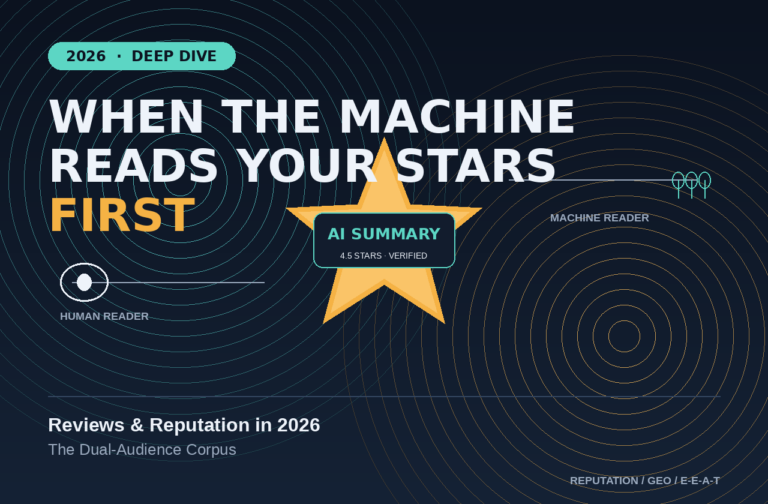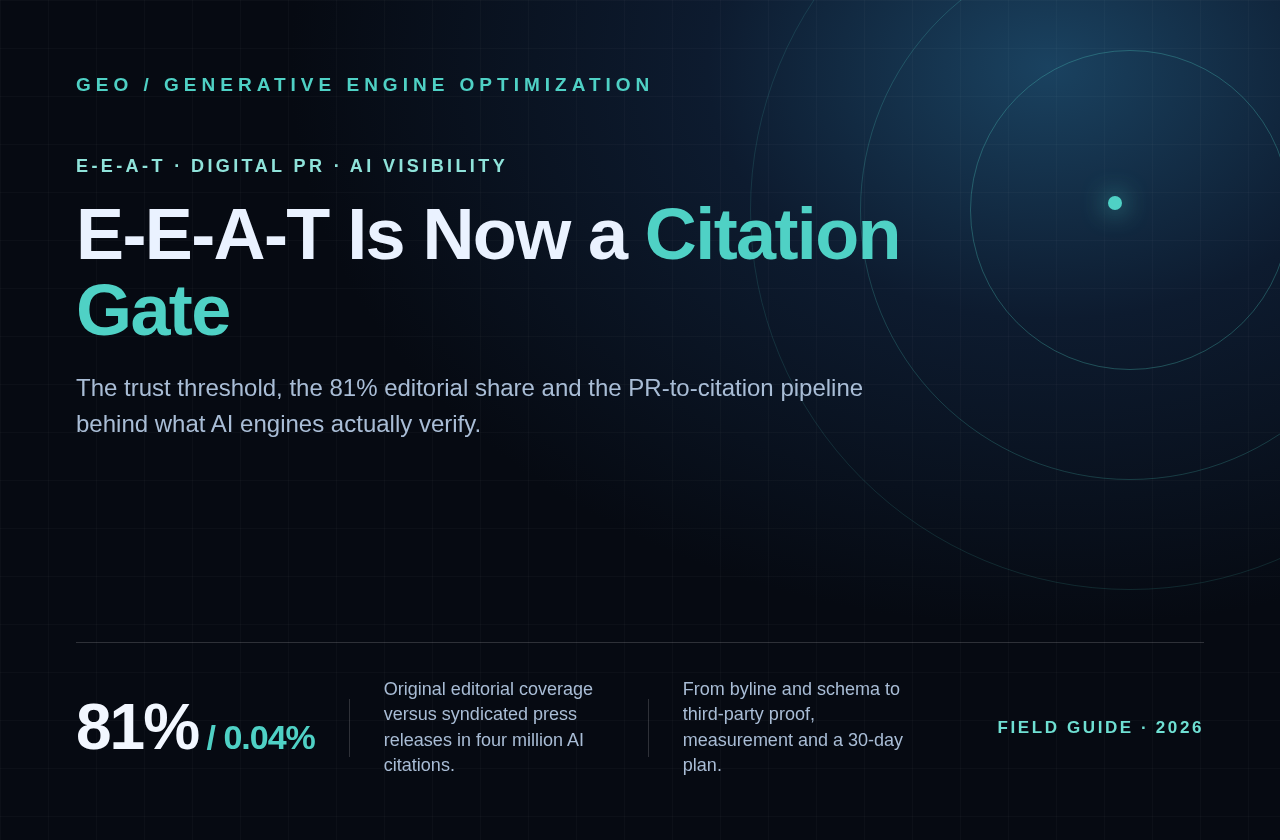
Ask an AI assistant to recommend a vendor in your category and watch what happens. It does not browse your homepage and grade your adjectives. It reconstructs a verdict from everyone else — the trade press, the comparison articles, the practitioner forums, the videos. Your own website is a witness, not the judge. Which raises an uncomfortable question: if an engine cannot verify who you are and who vouches for you, does it rank you lower, or skip you entirely? The evidence increasingly points to the second. Below the trust line, you are not badly rated. You are invisible.
The Trust Threshold Is a Gate, Not a Spectrum
Think of AI trust as three crossed axes: who is speaking (a named expert with a verifiable identity), who corroborates them (independent mentions and earned coverage), and whether the story holds together everywhere the engine looks. Fail any axis badly enough and the engine does not argue with your claims. It simply never surfaces them.
The 9.5 Gate Before the Trust Gate
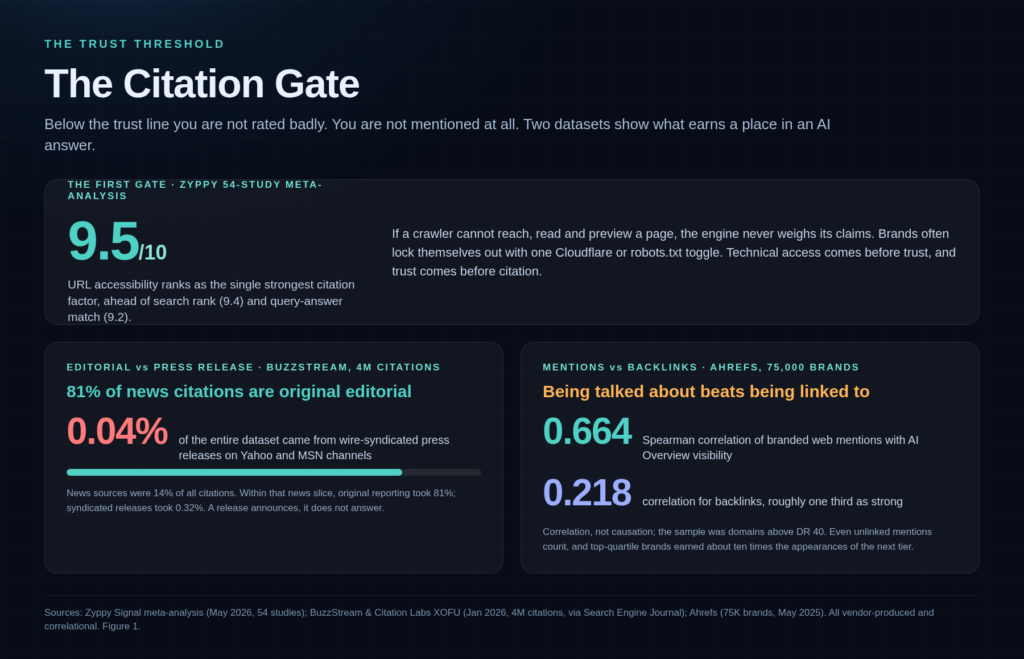
Before any of that, there is a mechanical gate. In May 2026, Cyrus Shepard of Zyppy reviewed 54 published studies, experiments and patents, scored 23 citation factors, and put URL accessibility at the top with 9.5 out of 10 — ahead of search rank (9.4), fan-out rank (9.3), preview control (9.2) and query-answer match (9.2). At the bottom of the list, LLMs.txt scored 2.0. Plenty of brands block AI crawlers without realising it, one Cloudflare toggle at a time. You cannot be cited from behind a locked door.
The trust layer sits right behind it. OtterlyAI, a GEO monitoring vendor, analysed more than a million citation data points generated between January and September 2025 and reported that roughly 95% of sources behind AI answers were third-party pages rather than brand-owned sites. Vendor data, yes — the company sells visibility monitoring and announced a partnership with a media-outreach firm alongside the release. But it rhymes with everything else in this piece: engines build their answer about you from other people’s words.
0.664 vs 0.218: Why Unlinked Mentions Outweigh Backlinks
Ahrefs studied 75,000 brands and correlated visibility factors with appearances in Google AI Overviews. Branded web mentions — linked or not — showed a Spearman correlation of 0.664. Backlinks managed 0.218. Branded anchor text (0.527) and branded search volume (0.392) also beat Domain Rating (0.326). Brands in the top quartile for mentions earned about 169 Overview appearances against 14 for the next quartile; roughly a quarter of brands never appeared at all.
Read the method before you quote the number. Ahrefs sampled domains above DR 40 with a top keyword of at least 800 monthly searches, and correlation is not causation — the signals are collinear proxies for how well known a company already is. An expanded 2025 analysis put YouTube mentions on top at about 0.737 and found that mention frequency mattered more than reach. Twenty small creators naming your product may register more than one viral video. The direction is blunt even if the coefficient is not physics: being talked about beats being linked to.
81% vs 0.04%: The Editorial Divide in Four Million Citations
BuzzStream ran 3,600 prompts across ten industries for one week in January 2026, tracking four million AI citations on ChatGPT, Google AI Mode, AI Overviews and Gemini using Citation Labs’ XOFU tool. Mind the denominators — they matter more than the headline. News sources made up 14% of all citations. Inside that news slice, original editorial content took 81%. Press releases syndicated through Yahoo and MSN channels accounted for 0.32% of news citations and just 0.04% of the entire dataset. Direct newswire citations reached only 0.21%.
Why the chasm? A wire release announces; it does not answer. Hundreds of verbatim copies mean no single URL owns the content. Releases rarely carry a named expert or a verifiable number. One exception deserves attention: releases hosted on a company’s own newsroom domain took 18% of ChatGPT’s citations, against about 3% on Google’s AI surfaces. The lesson is not “distribute more.” It is that the press release works as a catalyst for earned editorial coverage, not as a citation source in its own right.
The Five-Factor Checklist — and How to Read Conflicting Evidence
Synthesise the research and five factors keep recurring: original data or first-hand evidence; answer-first structure; named, sourced statistics; real expert quotations; and machine-readable identity signals. Notice that none of them is an adjective you wrote about yourself. That is not an accident — every one of them gives an engine something to check.
The Position Effect Is Measurable
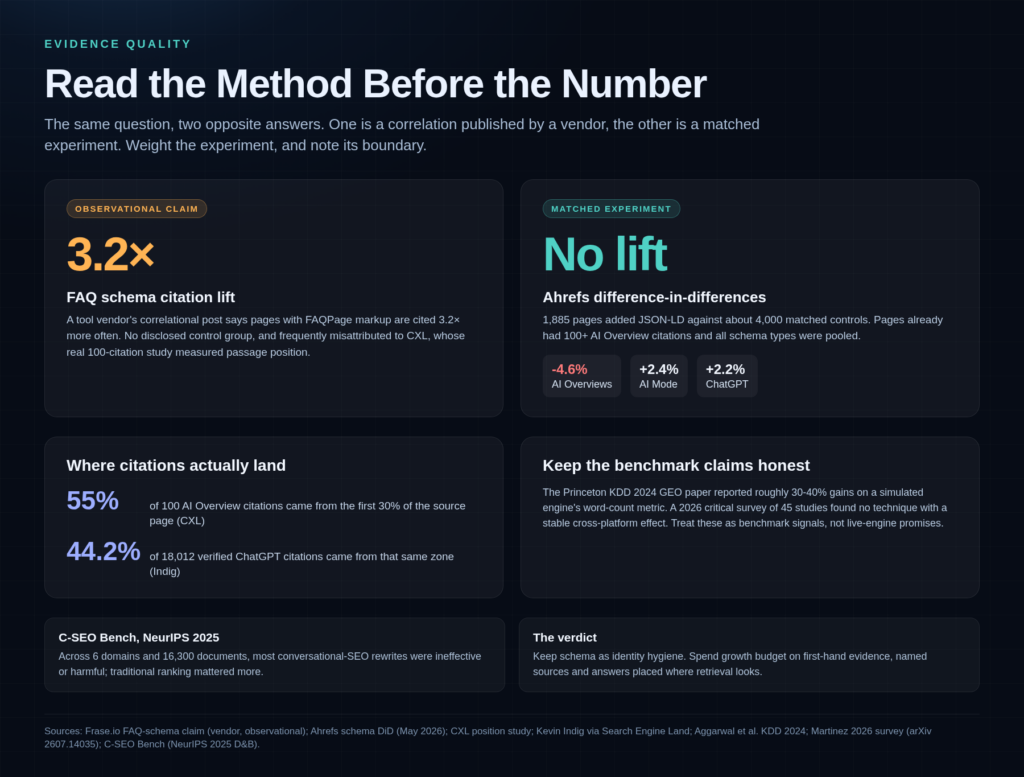
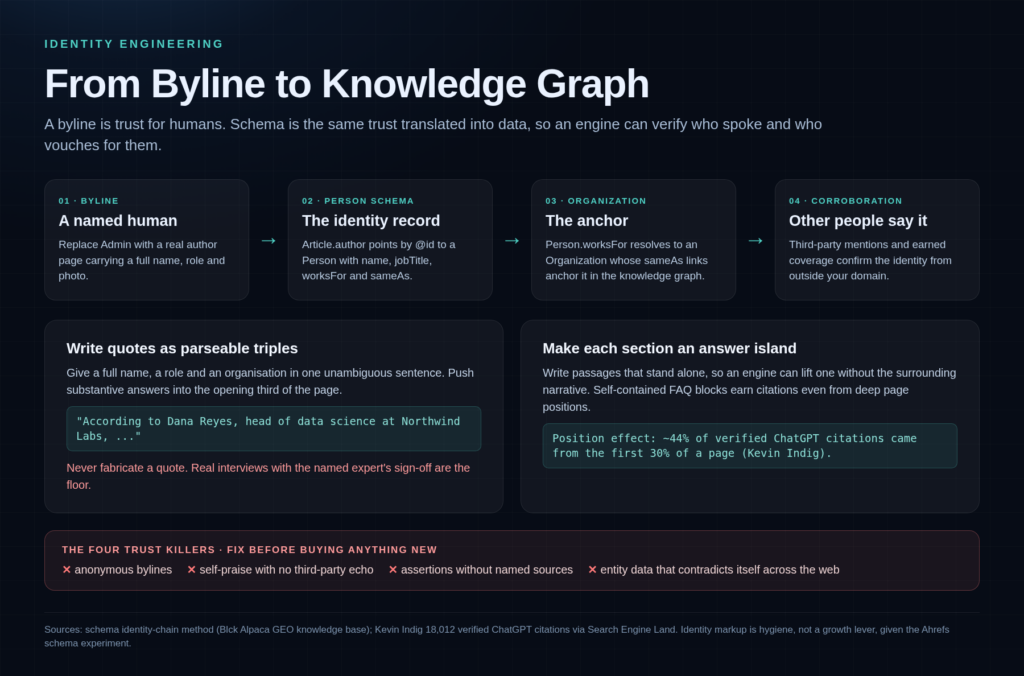
Placement is not folklore. CXL mapped 100 AI Overview citations to their exact position on the source pages and found 55% of cited passages in the first 30%. Kevin Indig’s independent analysis of 18,012 verified ChatGPT citations put 44.2% in the same zone, then 31.1% in the middle and 24.7% in the last third — a “ski ramp” that drops off a cliff after the opening. Bury your answer under three paragraphs of throat-clearing and you have cut your retrieval odds. FAQ blocks are the exception: each question-and-answer pair stands alone, so they can be lifted from deep positions.
What about the famous uplift numbers? The Princeton-led GEO paper (KDD 2024) tested adding citations, expert quotations and statistics in a simulated generative engine. Each lifted the source’s visibility by roughly 30–40% on its word-count metric, with overall gains up to 40%, and the effect was strikingly uneven — pages ranked around fifth gained over 100% while top-ranked pages lost ground. Those are benchmark effects on a simulated engine with a metric that rewards length. You will see “+22%” and “+37%” quoted around the web; neither matches the paper. A 2026 critical survey of 45 studies went further: no reviewed technique produced a stable cross-platform effect, and the celebrated 40% was a relative maximum on one metric in one fixed configuration.
Schema: Vendor Correlation Versus a Controlled Test
Now the conflict, presented honestly. Frase.io, an AEO tool vendor, claims FAQPage schema correlates with 3.2× higher AI citation rates. That is an observational vendor post with no disclosed control group, and it is routinely misattributed to CXL — whose actual study measured passage position, not markup.
Ahrefs ran the closest thing to a controlled test: 1,885 pages that added JSON-LD, matched against roughly 4,000 control pages, analysed with difference-in-differences. AI Overview citations fell 4.6% (small but statistically significant), while AI Mode (+2.4%) and ChatGPT (+2.2%) stayed inside the noise. Two caveats matter: the pages already had 100+ AI Overview citations, and all schema types were pooled. So the experiment shows adding schema did not rescue already-visible pages. Whether it helps an undiscovered one is untested. Add C-SEO Bench (NeurIPS 2025 Datasets & Benchmarks), which tested six domains and 16,300 documents and found most conversational-SEO rewrites ineffective or actively harmful while ordinary retrieval ranking mattered more. The verdict writes itself: keep schema as identity hygiene, spend the growth budget on evidence and answers.
From Byline to Knowledge Graph: Translating Expertise into Machine Language
A byline is trust for humans. Schema is the same trust, translated. The chain has three links: your Article markup points through an author @id to a Person entity carrying name, jobTitle, worksFor and sameAs properties — LinkedIn, your institutional profile, industry directories. That Person’s worksFor points to an Organization whose sameAs anchors it to recognised knowledge bases. When every link resolves to the same verifiable human at the same real company, a model does not have to take your word for anything.
Given the Ahrefs experiment, be clear about what this is: plumbing, not a growth lever. It helps an engine disambiguate who you are. It will not manufacture citations for content nobody references.
Expert Quote Triples and Answer Islands
Write quotes as parseable triples: full name, role, organisation. “According to Dana Reyes, head of data science at Northwind Labs…” is machine-unambiguous; “experts say” is noise with a reputation risk attached. Place substantive quotes and answers early — Zyppy scored answer-near-the-top at 8.8, and the position data above explains why late-page content gets cut. Then make each section an answer island: a self-contained passage an engine can lift without the surrounding narrative.
One red line: never fabricate expert quotes or let a model invent them. Every quote needs a real interview and the named person’s sign-off. Engines and readers both cross-check identities, and a fake quote is a zero-signal with a liability attached.
Three First-Party Assets Worth Mentioning
Earned mentions need something worth mentioning. Three asset types reliably attract them. Original research with proprietary numbers — the State of Marketing model HubSpot has run for years. A flagship guide so useful it becomes the default reference — the Ahrefs model. Free tools or calculators people bookmark and cite — the Shopify calculator model. Each gives a journalist or creator a concrete reason to name you, which, per the mention data, is the currency that actually buys AI visibility.
Why do they work? Because each one plants a checkable fact somewhere you do not control. A number in your report becomes a statistic in someone else’s article. Your calculator becomes a reference in a forum answer. You are no longer asking the engine to trust your self-description; you are giving the rest of the web something to say about you. That is a much shorter path to a citation than another paragraph of brand adjectives.
The New PR Sentence: Expert + Company + Specialty
Digital PR’s objective function has changed. The prize is not a dofollow link; it is your expert-company-specialty triple appearing in the editorial text that engines retrieve and train on. A sentence like “According to Priya Nair, a payments-security specialist at Meridian Systems…” travels into the corpus intact. Pitch data a journalist can verify, target outlets AI demonstrably cites, and publish announcements on your own newsroom first — remember ChatGPT’s 18% newsroom habit — then let PR chase the earned coverage that carries the other 81%.
Sequencing by ROI: Comparison Pages First, Research Later
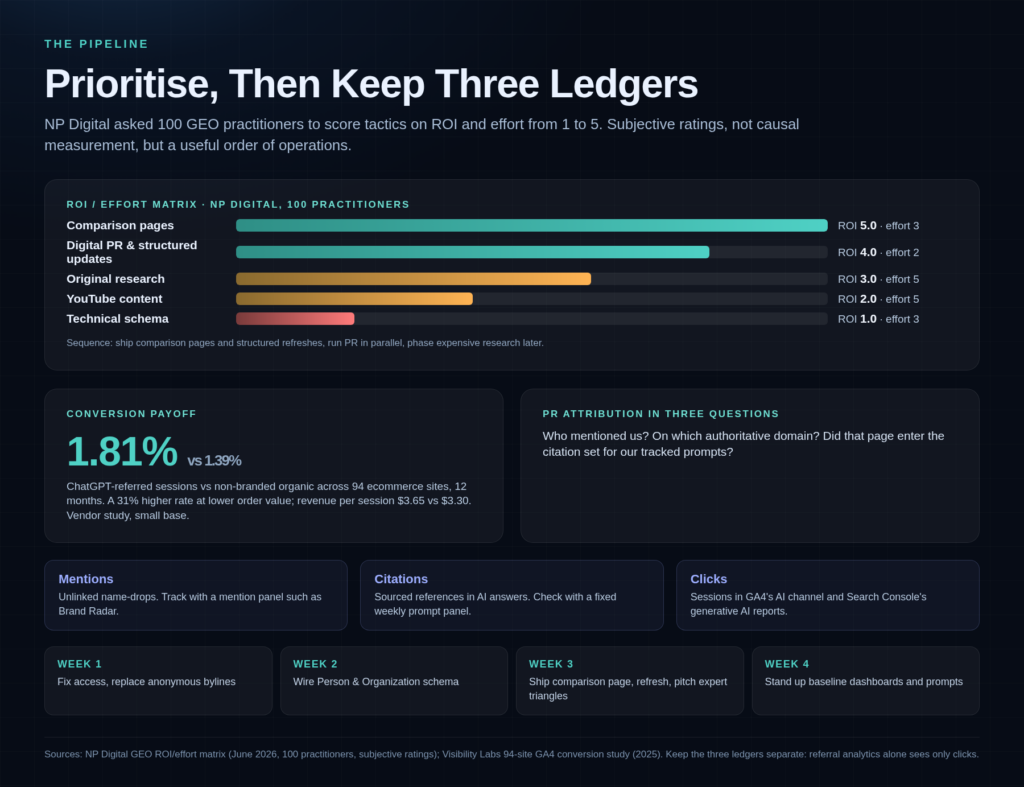
NP Digital surveyed 100 GEO practitioners in 2026 and asked them to score eight tactics on ROI and effort from 1 to 5. Subjective ratings from an agency’s audience, not causal measurement — but useful for sequencing. Comparison pages scored roughly 5 on ROI at effort 3, the best ratio in the set. Digital PR and structured content updates both landed at 4 for effort 2. Listicles came in at 4.8 for effort 3. Original research sat at 3 for effort 5, YouTube at 2 for 5, and technical schema last at 1 for 3. The practical order: ship comparison pages and refresh existing structured content now, run PR in parallel, and phase expensive original research once the quick wins are banked.
The commercial anchor is worth the discipline. Visibility Labs, a GEO services firm, analysed twelve months of GA4 data across 94 ecommerce sites, stripping out homepage and blog traffic. ChatGPT-referred sessions converted at 1.81% against 1.39% for non-branded organic — 31% better — with revenue per session of $3.65 versus $3.30 despite a lower average order value. The caveats are real: ChatGPT revenue was still only 1.48% of non-branded organic in that sample, early months rested on just 15 to 37 conversions, and the study is vendor-produced. High rate, small base. But the direction matches the funnel logic: someone who arrives pre-argued by an AI answer is further down the decision than a cold searcher.
The Four Trust Killers
Four failures account for most invisible brands: anonymous or “Admin” bylines; self-praise published only on your own domain with no third-party echo; assertions with no named source; and entity data that contradicts itself across your site, LinkedIn, directories and coverage. Fix these before buying anything new.
Three-Layer Measurement: Mentions, Citations, Clicks
A mention is an unlinked name-drop. A citation is a sourced reference, usually linked. A click is a session in GA4. Referral analytics sees only the third, so brands doing real PR work look flat in the dashboard while their AI presence compounds. Run all three ledgers: a mention panel (Ahrefs Brand Radar, Semrush or similar), a fixed set of weekly prompts checking whether you enter actual citation sets, and GA4’s AI channel plus Search Console’s generative AI reports, which Google rolled out worldwide by August 2026.
There is also a dark funnel worth accounting for. A user gets a recommendation in an assistant, then searches the brand name on Google and converts. GA4 credits branded organic, and the AI influence disappears. Post-purchase surveys that ask “how did you hear about us” with an AI-assistant option are the cheapest way to see the part of the path your dashboard cannot follow.
For PR attribution, ask three questions of every placement: who mentioned us, on which authoritative domain, and did that page enter our AI citation set? That is the whole loop.
A 30-Day Trust Engineering Plan
Week one: fix access and bylines — audit robots.txt, Cloudflare bot settings and nosnippet directives, then replace every anonymous byline with a named author page. Week two: wire the identity chain — Person and Organization schema with sameAs links, and reconcile every inconsistent fact about your company across the web. Week three: ship one comparison page, refresh two structured articles answer-first, and pitch three expert-triple stories to outlets AI actually cites. Week four: stand up the baseline — a fixed prompt panel, a mention tracker, GA4 AI segmentation — and record day-zero numbers before anything else moves. Thirty days will not make you famous. It will make you verifiable, which is the part fame is built on now.
The Bottom Line
AI engines did not invent trust; they industrialised its verification. The brands that win citations are the ones an engine can check: reachable pages, named humans, consistent identities, third-party corroboration, and answers placed where retrieval actually looks. The 81%-versus-0.04% divide is not a content-quality scoresheet. It is a description of who built a verifiable trail and who kept shouting into their own megaphone. Build the trail. The citations follow the evidence.