The first genuinely new browser engine in years became installable on November 23. Ladybird — HTML parser, CSS engine, layout, JavaScript engine, even WebAssembly, all written from scratch rather than forked from Chromium, WebKit, or Gecko — released its first alpha for macOS and Linux. The same day, the project announced it will no longer accept public pull requests. Both decisions are about the same thing: AI has changed what code contributions mean.
Start with the alpha itself. It is a rolling-release channel with automatic updates, and the project is refreshingly blunt about what you’re getting: some websites won’t work, it will crash sometimes, and — direct quote — “we make no promises about security today.” Simon Willison’s hands-on test found it fast and functional: ffmpeg compiled to WebAssembly ran, his Pyodide Python REPL ran, per-tab process isolation works as in mainstream browsers. Datasette Lite, which leans on a complex service-worker arrangement, failed — he filed the issue and found the matching FIXME in the source. His verdict mirrors the project’s own advice: fine for anonymous browsing and testing, not for logging into Gmail.
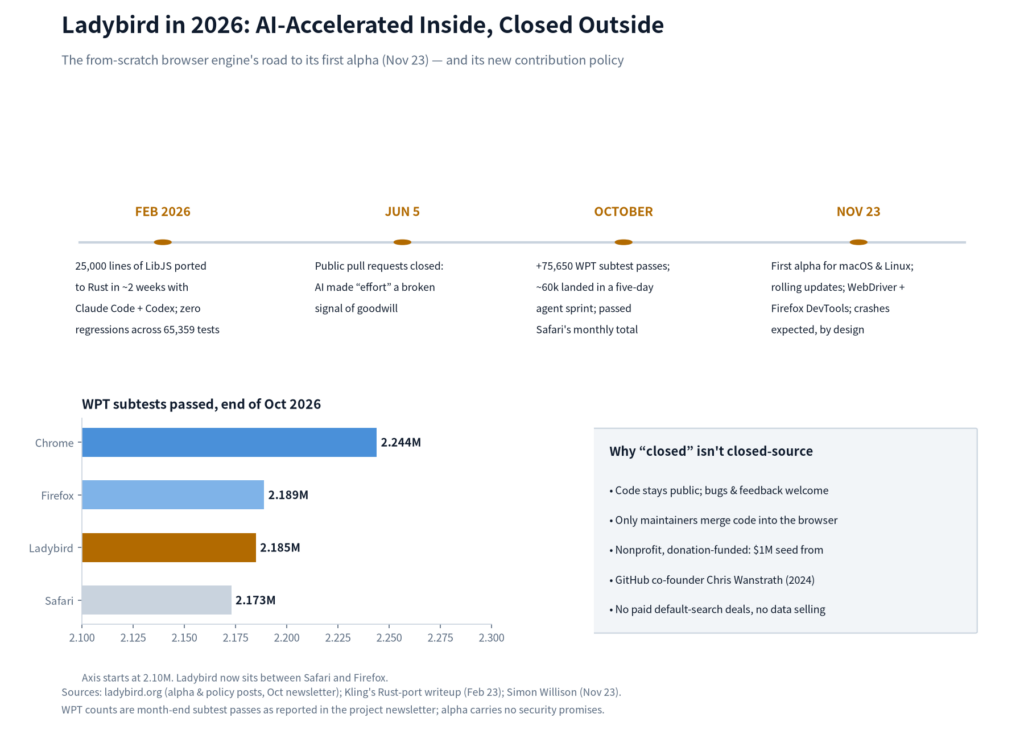
The backstory is where AI enters. In February, founder Andreas Kling described porting 25,000 lines of the LibJS JavaScript engine to Rust in about two weeks using Claude Code and Codex — work he estimated would take months by hand. The bar was byte-for-byte identical output between the C++ and Rust pipelines: 52,898 test262 tests and 12,461 regression tests, zero failures, verified further by browsing the web with both pipelines running in lockstep. Kling is careful about the framing: human-directed, hundreds of small steering prompts, multiple adversarial review passes. Not autonomous code generation.
Then October happened. The project’s newsletter reports 75,650 new web-platform-test subtest passes in one month, most of it — roughly 60,000 — landing in a five-day sprint from October 22 to 27, when the team pointed coding agents at WPT and asked them to fill missing functionality. Month-end totals: Ladybird 2,184,722, ahead of Safari’s 2,172,990 and just behind Firefox’s 2,189,315. An independent-engine nonprofit passed Safari on the web’s standard conformance suite.
Which makes the same-day PR shutdown readable as a coherent position rather than a contradiction. The project’s stated reasoning: a substantial patch used to imply substantial effort, and effort was a reasonable proxy for good faith. AI broke that signal — professional-looking contributions are now cheap to produce, and a browser runs untrusted input from the entire internet, where one well-disguised vulnerability is enough. So code stays open source, bug reports and website testing stay welcome, but only maintainers merge code. The people introducing changes must be the people who answer for them.
Ladybird is funded by donations — seeded with $1 million from GitHub co-founder Chris Wanstrath in 2024, sponsored by the likes of Shopify and Cloudflare — and takes no paid default-search deals. Its bet is that a fourth engine is worth building even when the economics say otherwise. The transferable lesson from its year: AI output scales with the quality of your verifier. Ladybird had test262 and 2.25 million WPT subtests. That’s why the five-day sprint worked — and why “who is responsible for this code” became the only trust signal left standing.