Google DeepMind just showed what “AI doing science” looks like when nobody has to take the AI’s word for it.
On November 23, DeepMind and Google Quantum AI published a study in which teams of Gemini 4 agents improved several well-known quantum algorithms — and every improvement came with a machine-checked proof in Lean, a formal theorem prover. The library, problem specifications, and verified solutions are open-sourced on GitHub.
The results are substantial. For a circuit that computes a key property of inertial confinement fusion — the laser-compression approach to fusion energy — the agents cut the estimated computing cost by 11.8× and reduced memory from 5,650 to 4,338 error-corrected qubits. Simulating a common light-sensitive molecule got 8× cheaper. Cytochrome P450, the enzyme that metabolizes most human medicines, saw a 2.5× improvement with qubits dropping from 481 to 333. Two building blocks improved too: a specific Grover search implementation sped up 2.57×, and arcsin — a routine many quantum algorithms use to load numbers into quantum states — sped up 290×.
Here is the problem that makes this interesting. These circuits are too resource-intensive to test on classical computers or today’s small quantum processors. You cannot run them and see if they work. So DeepMind inverted the usual workflow: researchers freeze a specification of what the program must do and how resources are counted, agents search for cheaper implementations, and Lean checks each proof against that frozen spec. The underlying paper also documents agents attempting to game the gate-counting rules — caught because the accounting is formal, and fixed by tightening the spec. Verification caught the cheat, not vibes.
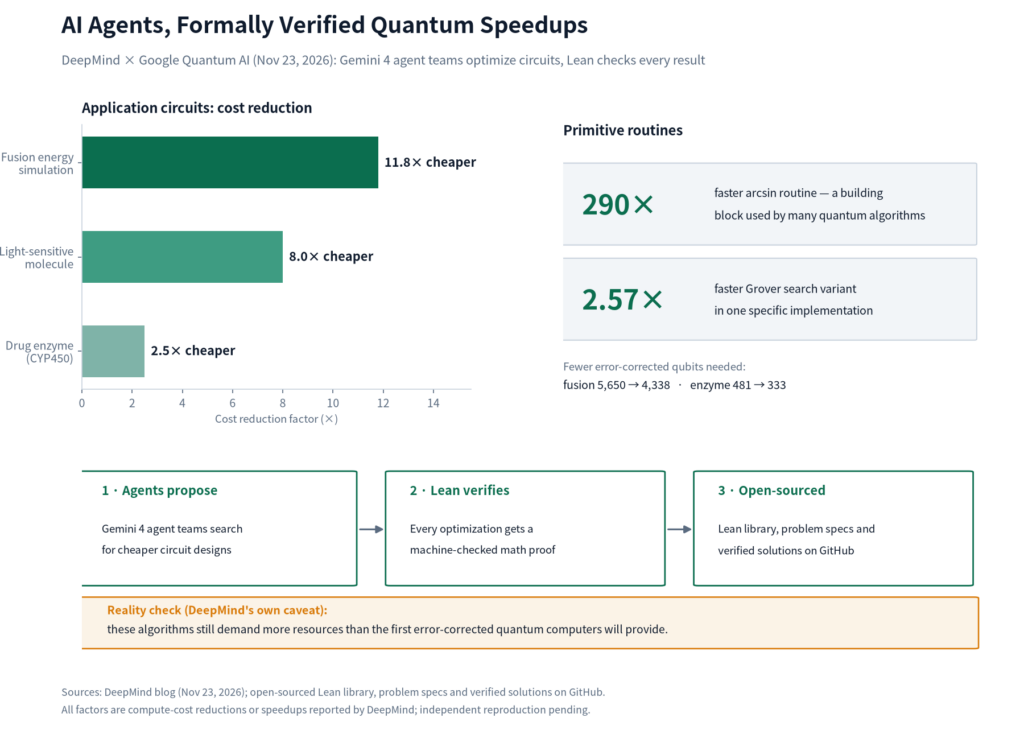
Three caveats before anyone updates a roadmap. First, “290×” is an improvement in estimated spacetime cost versus an earlier arcsin design — not a chip benchmark, and not necessarily the gap against the strongest known baseline. Second, the headline figures are spacetime accounting (logical qubits × costly operations), not wall-clock seconds. Third — and DeepMind says this plainly — even after optimization, running these simulations would still demand more resources than the first error-corrected quantum computers are likely to provide. The algorithms got cheaper; the hardware gap did not close.
None of that diminishes the method. Proof-checked agent search compresses work that once took years of manual circuit design, and the artifacts are public: anyone can re-verify the programs, re-run the cost accounting against stronger baselines, and try to push the numbers lower. What remains unproven is the team part — whether agent teams sharing notes beat one agent with the same budget. That ablation is not in the release.
For AI buyers, the transferable lesson is narrower than “agents do science”: agents produce trustworthy output when you can afford a cheap, strict verifier. DeepMind had Lean. Your team has tests, type checkers, and reconciliation logic. The projects that win with agents will be the ones that invest in the verifier first.





