Gartner’s 2025 survey says marketing teams use 49% of the martech capability they pay for. Read globally, that is a discipline story. Read from China, it is something sharper: an incentive story. Western marketing automation sells freedom — build any journey you can imagine. WeChat’s ecosystem sells permission — send inside a quota, to people who tapped consent, in a voice a human owns. Buy freedom inside a permission economy, and half your purchase has nothing to do.
The quota reprices the journey. WeCom’s official rules let administrators cap broadcasts at one message per customer per day, seven per week, or the days of the month — and staff broadcasts share that pool with company campaigns. Mini Program notifications cost one user tap per message. When every touch is metered, the journey stops being a flowchart and becomes a bidding war for scarce sends. The canvas your vendor demoed — twenty branches, infinite triggers — assumes free touches. In China, touches have a price the platform sets, not you.
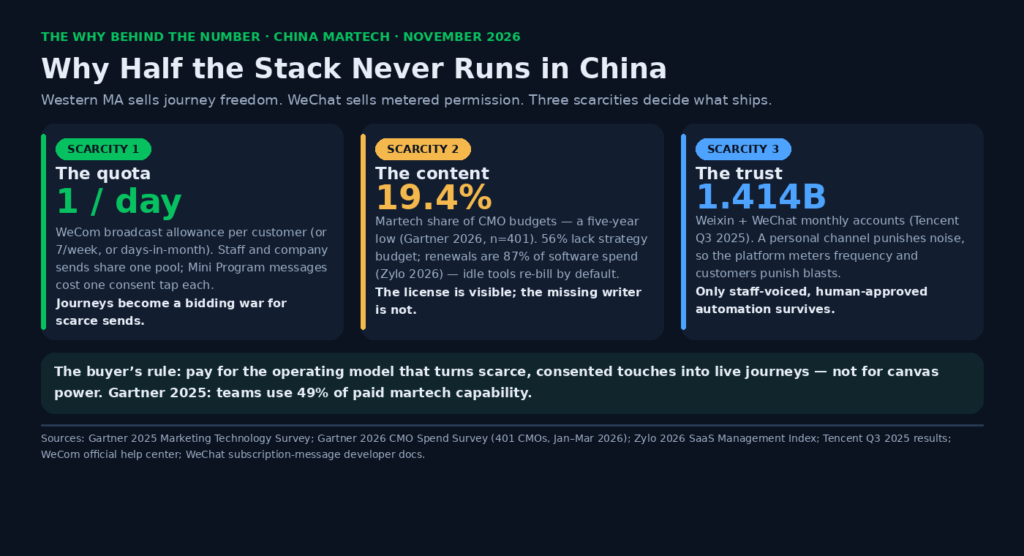
Content is the real license fee. Gartner’s 2026 CMO Spend Survey shows martech’s budget share sliding to 19.4%, a five-year low — while 56% of CMOs say they lack the budget to deliver their strategy at all. Read those together: software is cheap to buy and expensive to feed. Every automated message needs a body, and bodies need writers. The renewal is the visible cost; the content payroll is the invisible one. Zylo’s 2026 index shows why nobody catches this — renewals are 87% of software spend, so the idle journey builder re-bills by default while the missing writer stays off the ledger.
Trust decides what actually ships. WeChat is where 1.4 billion monthly accounts talk to people they know. An automated blast that reads like a blast spends trust the brand cannot rebuy. So the automation that survives is staff-voiced, human-approved, deliberately boring. That is not timidity. It is the mechanism: the platform meters frequency because customers punish noise, and customers punish noise because the channel is personal.
What this means for buyers: the differentiator between Chinese MA tools is not canvas power. It is how cheaply a tool turns scarce, consented touches into operated journeys. Pay for the operating model, not the flowchart — the other half of the stack was never software you could use.