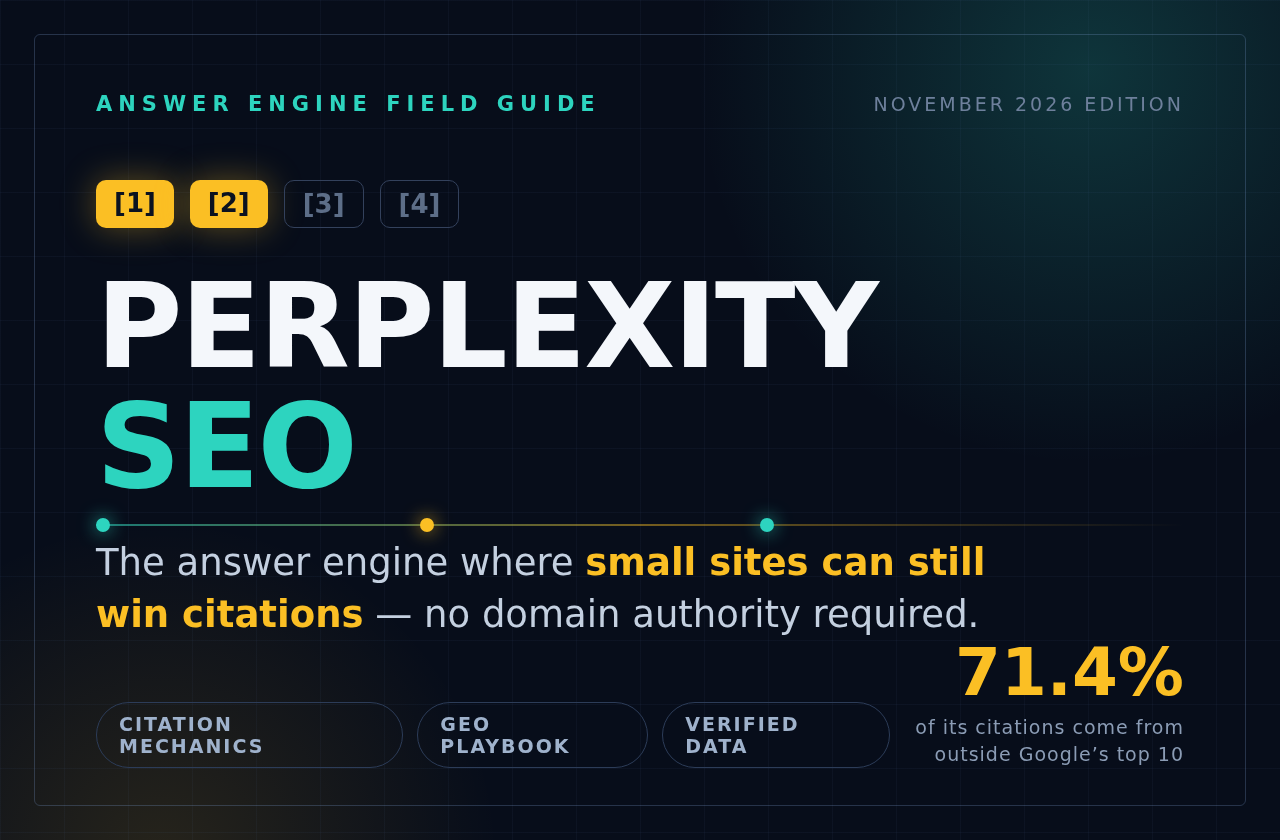
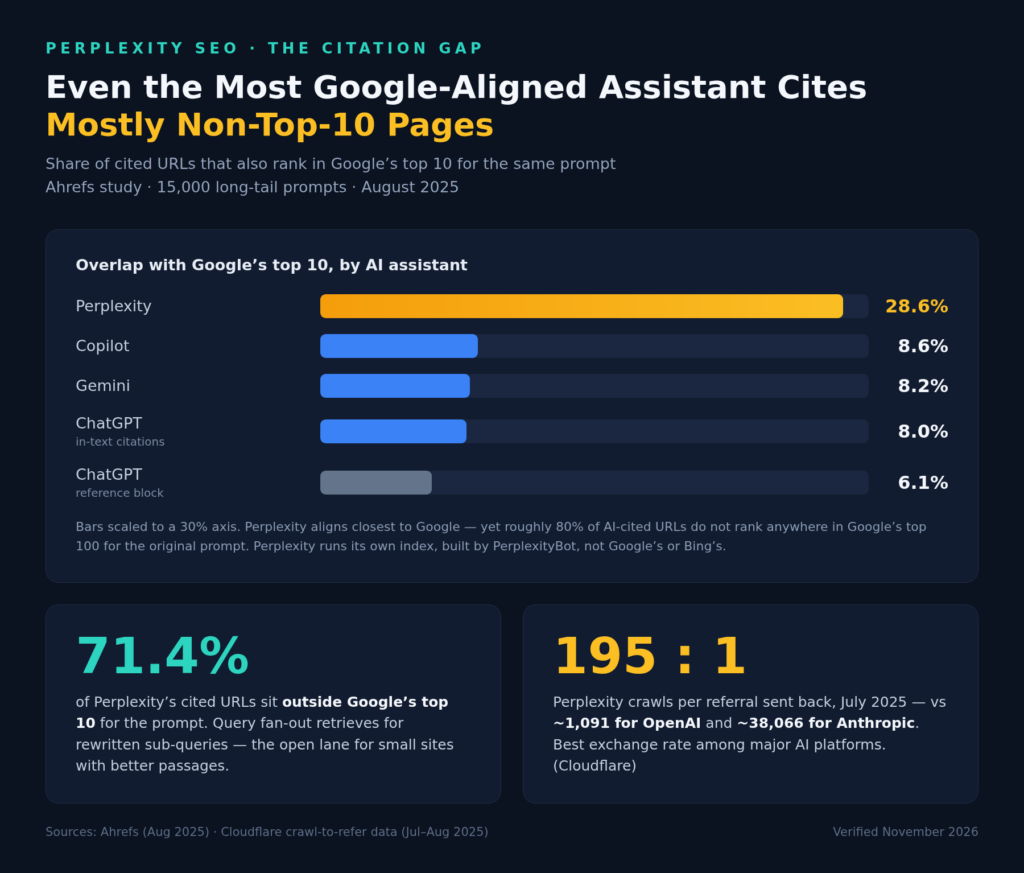
Most advice about AI search assumes you need a big domain to play. Perplexity quietly breaks that assumption. In Ahrefs’ study of 15,000 long-tail prompts, only 28.6% of the URLs Perplexity cites also rank in Google’s top 10 for the same question — and that is the highest overlap of any assistant tested. The other 71.4%? Pages that won a passage, not a ranking. Perplexity also runs the friendliest exchange rate in AI search: Cloudflare measured roughly 195 crawls per referral in July 2025, against ~1,091 for OpenAI and ~38,066 for Anthropic. This guide walks through how the engine actually picks sources, what the only published Perplexity experiment proves, and a five-step test you can run this week.
An Engine Built to Cite, Not to Rank
Perplexity describes itself as an answer engine: it searches the web in real time and attaches a numbered source to nearly every claim. That product shape matters more than any ranking factor. A traditional search engine rewards a whole page; an answer engine rewards a passage it can lift cleanly and attribute.
Here is the part most teams miss: Perplexity does not borrow Google’s or Bing’s index. Ahrefs confirmed it builds its own, fed by its crawler, PerplexityBot. So when your page ranks #14 in Google, you have not been disqualified from anything. You simply have not been retrieved yet.
Why do citations diverge from rankings so much? Query fan-out. The assistant rewrites your question into several sub-queries, retrieves for each, and merges results — methods like reciprocal rank fusion favor pages that show up consistently across variations. A page ranking sixth for three related phrasings can beat a page ranking first for one. Ahrefs found roughly 80% of AI-cited URLs do not rank anywhere in Google’s top 100 for the original prompt.
And the overlap number deserves honest framing. Perplexity is the most Google-aligned assistant in the dataset — ChatGPT, Gemini and Copilot hover around 8%. Being the most aligned still leaves 71.4% of its citations outside the top 10. That is the small-site lane.
Two Bots, Two Rulebooks
Perplexity’s official crawler documentation splits the work between two agents, and confusing them causes most self-inflicted visibility wounds.
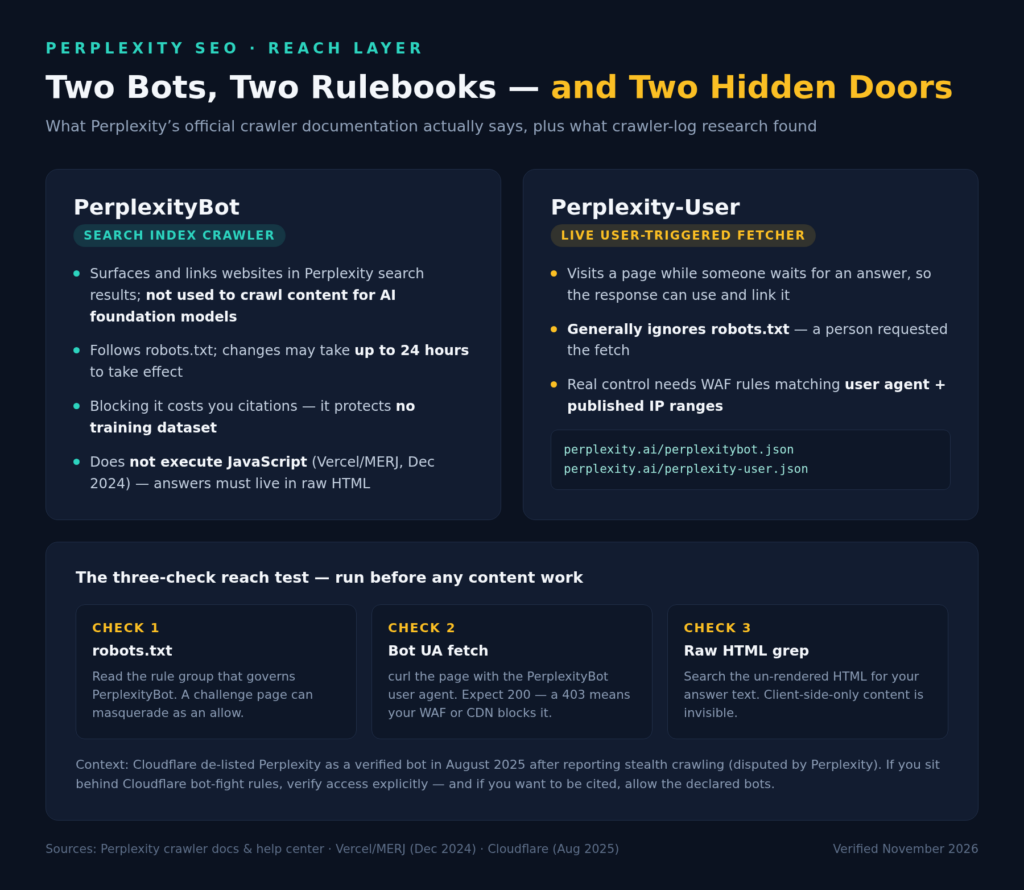
PerplexityBot is the search-index crawler. In Perplexity’s own words, it is designed to surface and link websites in search results, and it is not used to crawl content for AI foundation models. It follows robots.txt, and changes can take up to 24 hours to take effect. Read that again: blocking PerplexityBot to “protect your content from AI training” protects nothing. Perplexity says it does not train foundation models on it. All the block accomplishes is removing you from the results.
Perplexity-User is different. It fetches a page live, while a human waits for an answer, so the response can use and cite that page. Because a person requested the fetch, the documentation says this agent generally ignores robots.txt rules. If you genuinely need to stop it — paywalled research, licensed data — robots.txt will not do the job. You need WAF rules matching the user agent plus Perplexity’s published IP ranges, which it maintains as JSON endpoints for exactly this purpose.
One wrinkle worth knowing: Perplexity’s help center says blocked pages may still get their domain, title and a brief factual summary indexed, that the old summarize-any-URL feature was disabled, and that third-party crawler partners are now contractually required to respect robots.txt, especially for news sites. The docs and the help center do not perfectly reconcile on the user-triggered fetcher. When official sources disagree, trust your own logs.
The JavaScript Door and the Cloudflare Door
Two hidden doors quietly lock small sites out.
Door one: JavaScript. Vercel and MERJ analyzed crawler traffic across Vercel’s network in December 2024 and found that none of the major AI crawlers — PerplexityBot included — render JavaScript. They download script files and never execute them. Gemini inherits Googlebot’s rendering; AppleBot renders too. Everyone else reads your raw HTML. If your answer text only exists after a client-side script runs, Perplexity reads an empty room. The data is from late 2024 and behavior can change, but the safe engineering rule has not: if curl cannot see it, assume the answer engine cannot either.
Door two: the CDN. In August 2025, Cloudflare published an investigation accusing Perplexity of stealth crawling — rotating user agents, IPs and network origins to get around blocks — and de-listed it as a verified bot, adding managed rules that block the pattern. Cloudflare reported 20–25 million daily requests from the declared agent versus 3–6 million from a Chrome-impersonating one. Perplexity disputed the attribution the same day, blaming a third-party cloud-browser provider. Both are company claims; neither is a court finding. The practical takeaway is not about the blame. It is that bot-management layers now sit between your content and this engine, in both directions. If you want citations, explicitly allow the declared bots at the WAF layer. If you run Cloudflare’s AI-blocking rules, know that you may have already opted out without touching robots.txt.
What the Only Published Experiment Actually Proves
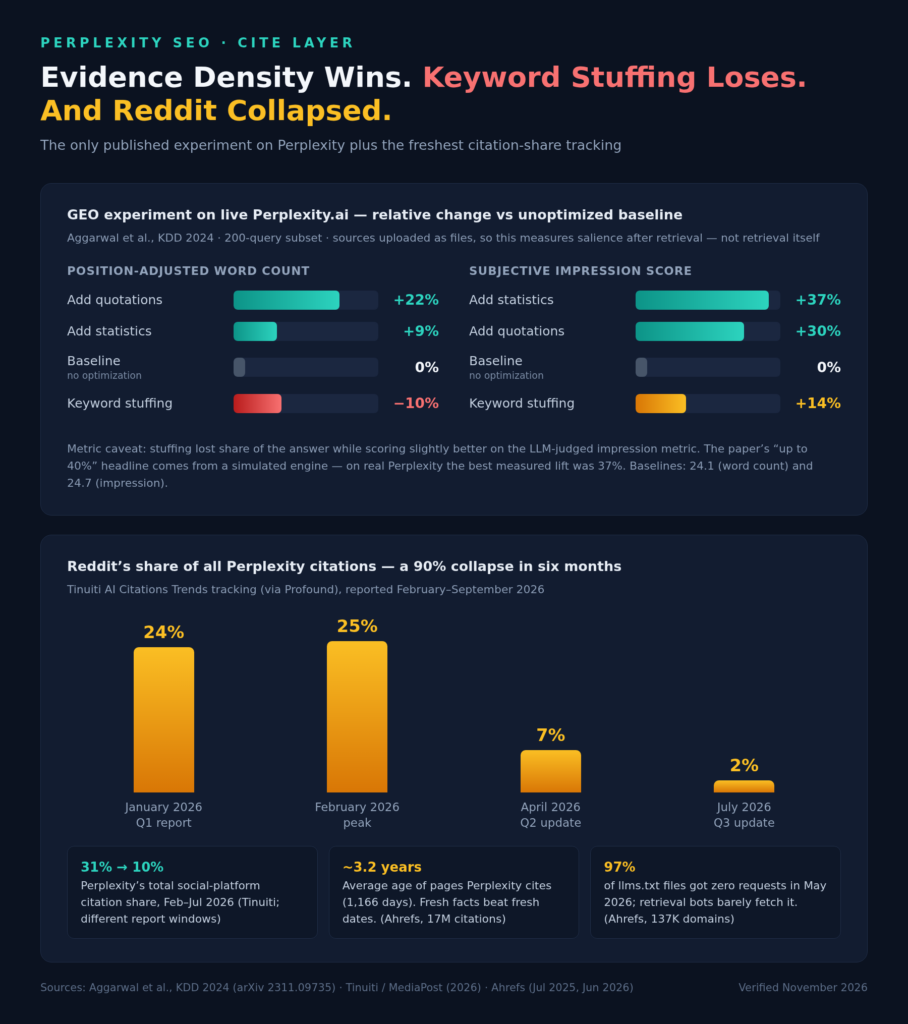
The KDD 2024 paper “GEO: Generative Engine Optimization” (Aggarwal and colleagues, IIT Delhi and Princeton) is the one peer-reviewed study that tested content rewrites on live Perplexity.ai. Know its scope before quoting its numbers. The team built a 10,000-query benchmark, and the famous “up to 40% visibility lift” headline comes from a simulated engine. For the real thing, they ran a 200-query subset on Perplexity.ai — and because Perplexity does not accept source URLs, they uploaded the sources as files. That means the experiment measures how visible your content becomes after retrieval, not how to get retrieved. Two different problems. Do not let anyone sell you the second using evidence for the first.
Within that scope, the results are striking. Adding attributed quotations lifted position-adjusted word count — the share of the answer built from your source, weighted toward early sentences — by 22%. Adding statistics lifted the LLM-judged impression score by 37%. Keyword stuffing, the classic SEO reflex, landed about 10% below the unoptimized baseline on answer share.
One honest nuance most summaries drop: on the subjective metric, stuffing actually scored slightly above baseline. The metrics disagree. The defensible reading is that stuffing may make a source look keyword-relevant to a judge model while shrinking the actual territory your content occupies in the answer. Territory is what earns the click. And every number here is relative visibility inside answers — nobody has published a controlled trial linking these rewrites to traffic or revenue.
Rewrite the Paragraph, Not the Page
What does evidence density look like in practice? Compare two versions of the same product paragraph. (Illustrative example — the company and figures are invented to demonstrate the pattern, not client results.)
Before: “Our platform is built to last. We offer industry-leading reliability and our team is committed to your success.”
After: “Fieldstone Analytics processes 2.1 million events per day at 99.95% measured uptime across Q3 2026, according to its public status page. Unlike tools that sample data, Fieldstone retains every event for 13 months.”
The first version cannot survive being lifted out of context. Who is “our”? What is “industry-leading”? The second names the entity, dates the number, and points to verifiable evidence. When a retrieval system slices your page into passages, pronouns lose their antecedents. Every section-opening sentence should stand alone: named subject, direct answer, dated fact. That is the whole trick — write paragraphs that make sense to a reader who will never see the rest of the page.
Forget llms.txt (for Now). Skip the Schema Panic Too.
Two popular “quick wins” collapse under data. SE Ranking analyzed roughly 300,000 domains in November 2025: 10.13% had an llms.txt file, and there was no measurable relationship between the file and AI citation frequency — removing the variable actually improved their prediction model. Ahrefs went deeper in June 2026, reading server logs across 137,210 domains: 97% of published llms.txt files received zero requests in a month, and retrieval bots like PerplexityBot accounted for about 1% of the requests that did happen. Coding agents fetch the file more than answer engines do.
Schema tells a similar story. Ahrefs tracked 1,885 pages that added JSON-LD against matched controls and found no meaningful citation lift on AI Mode or ChatGPT, and a slight decline in AI Overviews. Keep schema for rich results and machine legibility — just stop budgeting it as a citation lever. The boring wins are still boring: crawlable HTML, clean answers, real evidence.
The Reddit Lesson: Corroboration Matters, Channels Don’t Last
Off-site signals carry unusual weight on Perplexity — and 2026 delivered a brutal lesson in how fast they move. Tinuiti’s AI Citations Trends tracking (with Profound, across nine commercial verticals and seven AI platforms) found Reddit accounted for roughly 24% of all Perplexity citations in January 2026, peaking at 25% in February. Social platforms overall supplied 31%.
Then it fell off a cliff. By April, Reddit was down to 7% of Perplexity citations. By July, Tinuiti’s ecommerce tracking put it at 2%, with total social share down to 10%. A ~90% collapse in six months, with no changelog, no announcement — and Tinuiti itself said it could not identify the cause.
Two lessons here, and they pull in opposite directions. First, third-party conversation genuinely fed this engine: when Profound examined Reddit citations, roughly 99% pointed to individual discussion threads, not brand pages. Real practitioner answers in public threads were citation fuel. Second, any strategy that rented a single channel got wiped out. The durable version of “community presence” is earning mentions across many independent sources — reviews, comparisons, forums, trade press — so no single retrieval-policy change can zero you out. Participate genuinely where your buyers argue in public; never astroturf; and re-measure the source mix quarterly, because the ground moves.
Freshness: Fix the Facts Before You Touch the Date
Does Perplexity want fresh content? Yes and no — and the “no” saves you money. Ahrefs analyzed roughly 17 million cited URLs in July 2025. Assistant-cited pages averaged 1,064 days old versus 1,432 for organic results — 25.7% fresher. But look at the absolute number: the average cited page is still about three years old. Perplexity’s own in-text citations averaged 1,166 days, roughly 3.2 years. This engine happily cites durable, proven content.
The interesting detail: Perplexity and ChatGPT appear to order their in-text references newest-first. Freshness may shape presentation order more than selection itself. So update pages when the facts change, lead with dated numbers, and prioritize refreshing pages that already earn citations — they have proven they can win. What you should not do is republish with a new date and unchanged text. Google’s John Mueller has warned against cosmetic date changes for years, and a fresh timestamp on stale claims is a trust liability with humans and machines alike.
The Five-Step Reach-and-Cite Test
You cannot optimize what you cannot verify. Run this loop before and after any content investment.
Step 1 — robots.txt. Fetch your robots.txt and read the group that actually governs PerplexityBot: its named group if present, otherwise the wildcard group. Watch for CDN challenge pages masquerading as a permissive file.
Step 2 — fetch as the bot. Request the page with the PerplexityBot user agent: curl -A "Mozilla/5.0 (compatible; PerplexityBot/1.0; +https://perplexity.ai/perplexitybot)" https://yoursite.com/page. A 200 means the door is open; a 403 or challenge means your WAF or CDN is the blocker, not your content.
Step 3 — grep the raw HTML. Pipe that same response into a search for your answer sentence. If the text is missing from the un-rendered HTML, you have a rendering problem no rewrite can fix. Server-render the answers.
Step 4 — run a fixed prompt panel. Pick 10–50 questions your buyers actually ask, run them weekly on Perplexity, and log three things per answer: whether your URL is cited, its citation position, and which sentence got lifted. A spreadsheet is enough. Fixed prompts on a fixed cadence turn anecdotes into a trend line — the Reddit collapse would have been invisible to anyone not tracking weekly.
Step 5 — watch the referer. When users click a citation, the request carries perplexity.ai in the Referer header; that is exactly how Cloudflare computes its referral ratios. Build a custom channel group for AI referrers in your analytics instead of trusting default buckets. And know the blind spot Cloudflare itself flags: native-app clicks often send no referrer at all, so measured AI traffic understates reality by an unknown margin.
A 30-Day Plan With Honest Expectations
Week one belongs to access: the three reach checks, WAF allowlisting, server-rendering the answers that matter. Week two belongs to passages: rewrite the opening paragraph of every section on your five highest-value pages using the named-entity, dated-number pattern. Week three belongs to corroboration: find the threads and comparisons where your category gets debated, and contribute genuine practitioner answers under disclosed identities. Week four belongs to measurement: launch the prompt panel and the referer channel group, and record your baseline.
Expect brand-specific questions to move first — when someone asks about your product by name, your own clean pages are the natural source. Category questions move slower, because the engine cross-checks you against sources you do not control. Nobody can promise a timeline; the honest promise is that this loop tells you, week by week, whether the work is landing.
The Mistake List
The greatest hits of self-sabotage, all observed in the wild: blocking PerplexityBot to stop training that Perplexity says does not happen; writing every paragraph around “our platform” so nothing survives extraction; stuffing keywords the experiment shows shrinking your answer share; shipping client-rendered pages that read as empty rooms; refreshing dates without refreshing facts; betting the strategy on one community channel; and skipping the access checks entirely, then blaming the content. Every item on that list is cheap to fix. That is the good news.
Summary
Perplexity is the most Google-aligned answer engine — and even it pulls 71.4% of citations from outside the top 10, on its own index, through a crawler that reads raw HTML and a fetcher that ignores robots.txt. The experiment-backed levers are evidence-dense passages: named entities, dated numbers, attributed quotations. The unproven levers — llms.txt, schema-for-citations, keyword stuffing, cosmetic freshness — have all been tested and found wanting. Off-site corroboration works but expires without warning, as Reddit’s 25%-to-2% year proved. Small sites win here the same way they have always won anywhere: be the clearest, most verifiable answer to a specific question, make sure the machines can actually reach it, and measure weekly. The lane is open. Most of your competitors are still arguing about domain authority.