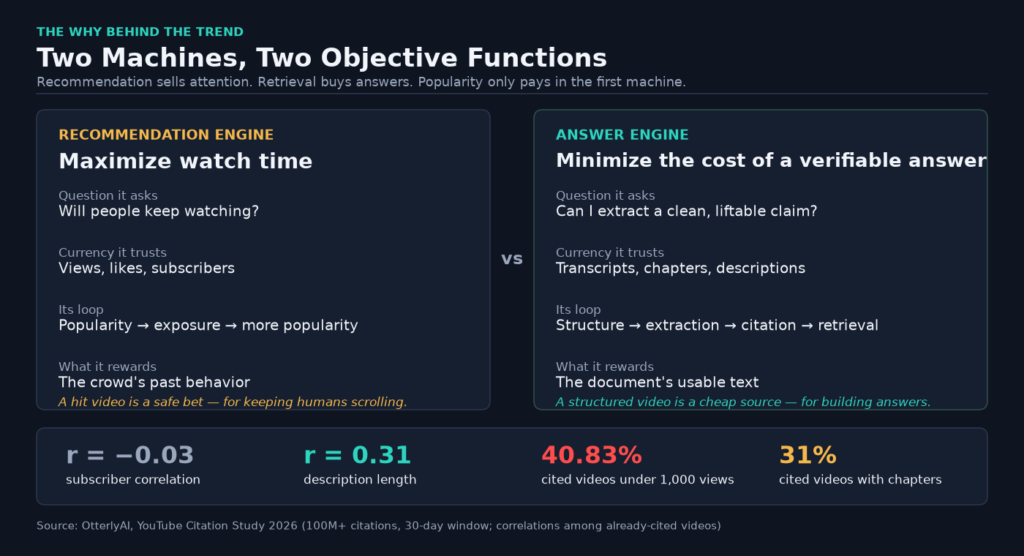
Something strange happens when a video gets cited by an AI answer engine: nobody has to watch it. That single sentence explains the most counterintuitive finding in OtterlyAI’s 100-million-citation study — subscriber count correlates with repeat citations at r = −0.03, statistically indistinguishable from zero, while description length correlates at r = 0.31. Marketers read those numbers as a quirk. They’re not a quirk. They’re the fingerprint of two machines with two different objective functions.
A recommendation engine — YouTube’s feed, TikTok’s For You page — exists to maximize watch time. Every view, like and subscriber is evidence about human behavior: people kept watching, so show it to more people. Popularity is the product. The loop compounds: exposure breeds engagement, engagement breeds exposure.
An answer engine has the opposite economics. It isn’t selling your attention; it’s spending compute to resolve a question. Its cost function is retrieval and verification: find a passage that states the answer cleanly, lift it, attribute it, move on. In that machine, a view count is worthless information — it tells the system nothing about whether a sentence can be extracted. What carries information is the text layer: a transcript that states claims in complete sentences, chapters that label them, a description that restates them. Structure is the product.
This is why the librarian metaphor holds. A librarian doesn’t acquire the most-borrowed book; they acquire the one that answers the reference question. AI citation is reference work, not programming. And it explains the asymmetry practitioners keep bumping into: an eight-day-old video with under 100 views can surface as the first cited source in an AI Overview, because at the moment of retrieval, its chaptered answer was simply the cheapest clean claim available. The crowd never convened. The machine didn’t need it to.
The strategic consequence is uncomfortable for teams raised on growth loops. Popularity compounds through a social feedback loop you must win repeatedly. Structure compounds through an asset: fix the transcript once, and every future retrieval reads the improved document. One is a race; the other is a library. You can lose the race and still own the shelf — which is precisely what 40.83% of cited videos under 1,000 views are quietly demonstrating.
Two honesty flags keep this from becoming gospel. Correlation among already-cited videos isn’t proof of first-citation mechanics, and the engines themselves are moving targets — ChatGPT’s shifting index mix, Google’s fan-out behavior. But the incentive logic is stable even as the plumbing changes: as long as answer engines pay per answer rather than per impression, they will keep buying structure and ignoring applause. Build for the buyer, not the crowd.