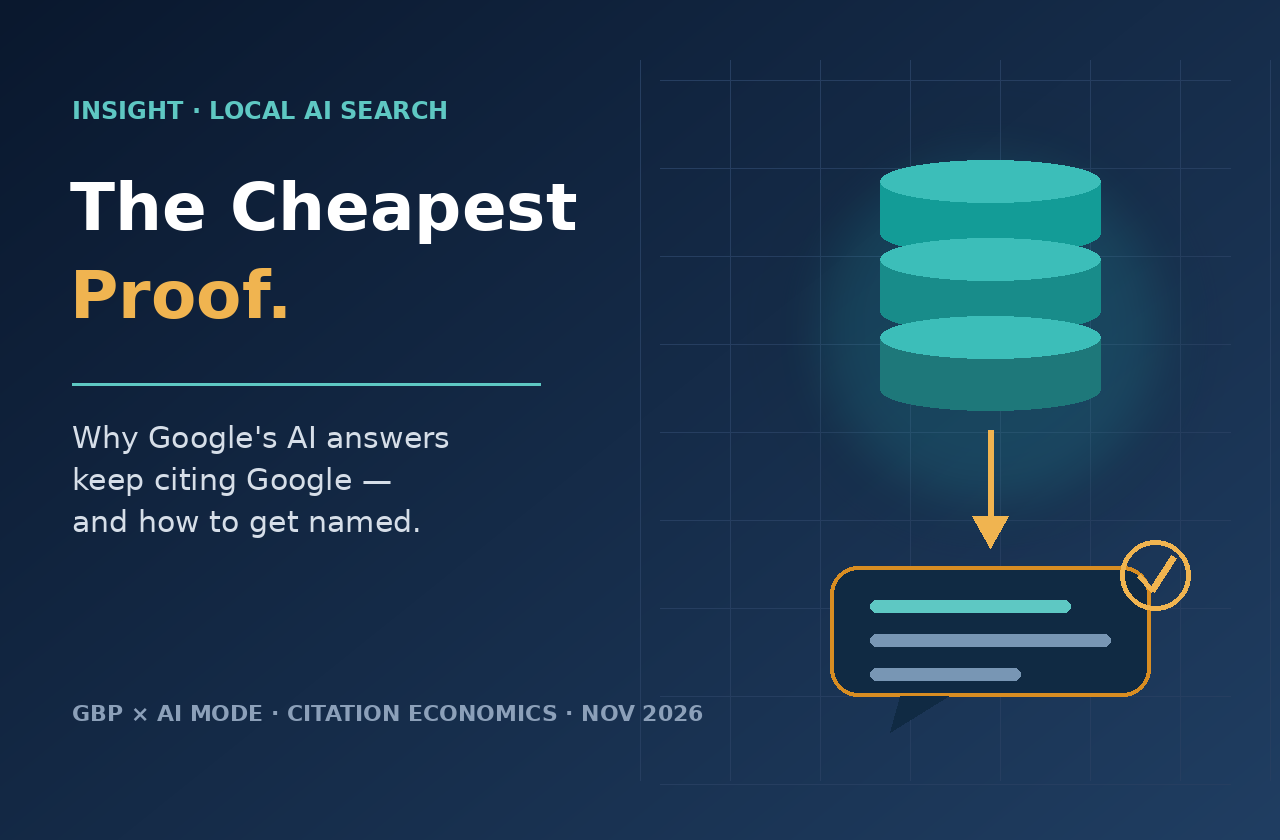
Everyone looks at the same number and reaches for the same word: bias. When Steady Demand classified 86,645 citations from Google’s local AI surfaces in August–September 2026, AI Mode pointed to Google Maps and Business Profile data 79.8% of the time on local-intent queries. Self-preferencing! Antitrust bait! And sure, the incentive is real. But bias is a lazy explanation for what is mostly an accounting story. The AI isn’t loyal to Google. It’s cheap.
The Economics Behind the Self-Citation
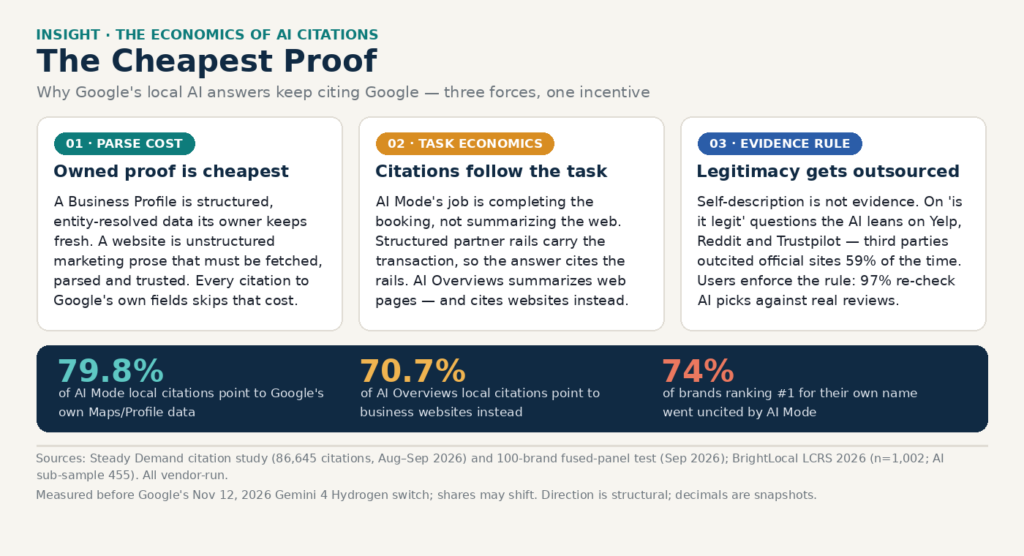
Think about what a citation costs the machine. Your website is prose — unstructured marketing copy that has to be fetched, parsed, deduplicated, and trusted before a single sentence can be quoted. A Business Profile is a database row: category, hours, attributes, review text, all entity-resolved and kept fresh by an owner who is punished for letting it rot. When the system needs to answer “best emergency plumber open now”, Google’s own listing data is the lowest-cost verified evidence available. Citing it skips the entire parsing-and-trust pipeline. That’s not a conspiracy. That’s procurement.
The tell is what happens when the task changes. AI Overviews — whose job is summarizing web pages, not completing transactions — cited business websites 70.7% of the time on the same local queries, and Google’s own properties just 3.1%. Same engine, opposite sourcing. Citations follow the economics of the task, not the identity of the vendor. When AI Mode’s job became booking the table, structured partner rails carried the answer. When the job is explaining a topic, prose wins.
The Evidence Rule Nobody Voted For
There’s a second force, and it comes from outside Google entirely. On “is this business legit” questions, self-description is worthless as evidence — so the AI outsources legitimacy. In a 100-brand test, third-party platforms (Yelp, Reddit, Trustpilot, BBB) outcited official brand sites 59% of the time, and 74% of businesses ranking #1 for their own name still weren’t cited when AI Mode answered about them. Why would the machine bother with your homepage when independent testimony exists?
Because users enforce the same rule. BrightLocal’s 2026 survey found that 97% of consumers who take AI recommendations double-check them against real reviews. The AI has learned to pre-load the evidence its users will demand thirty seconds later. The machine cites what survives verification — and your own website about yourself never does.
What This Means for You
Stop reading the 79.8% as a rigged game and start reading it as a price list. The system buys the cheapest credible proof, and you can lower your price: structured profile fields cost less to consume than prose; fresh, descriptive reviews cost less to trust than star counts; live booking availability costs less to act on than a contact form. The businesses winning AI recommendations aren’t out-shouting anyone. They’re simply the cheapest safe answer to cite.
One caveat, honestly held: every figure here predates Google’s November 12, 2026 switch to Gemini 4 Hydrogen in AI Mode. The percentages are snapshots; the economics are the durable part.