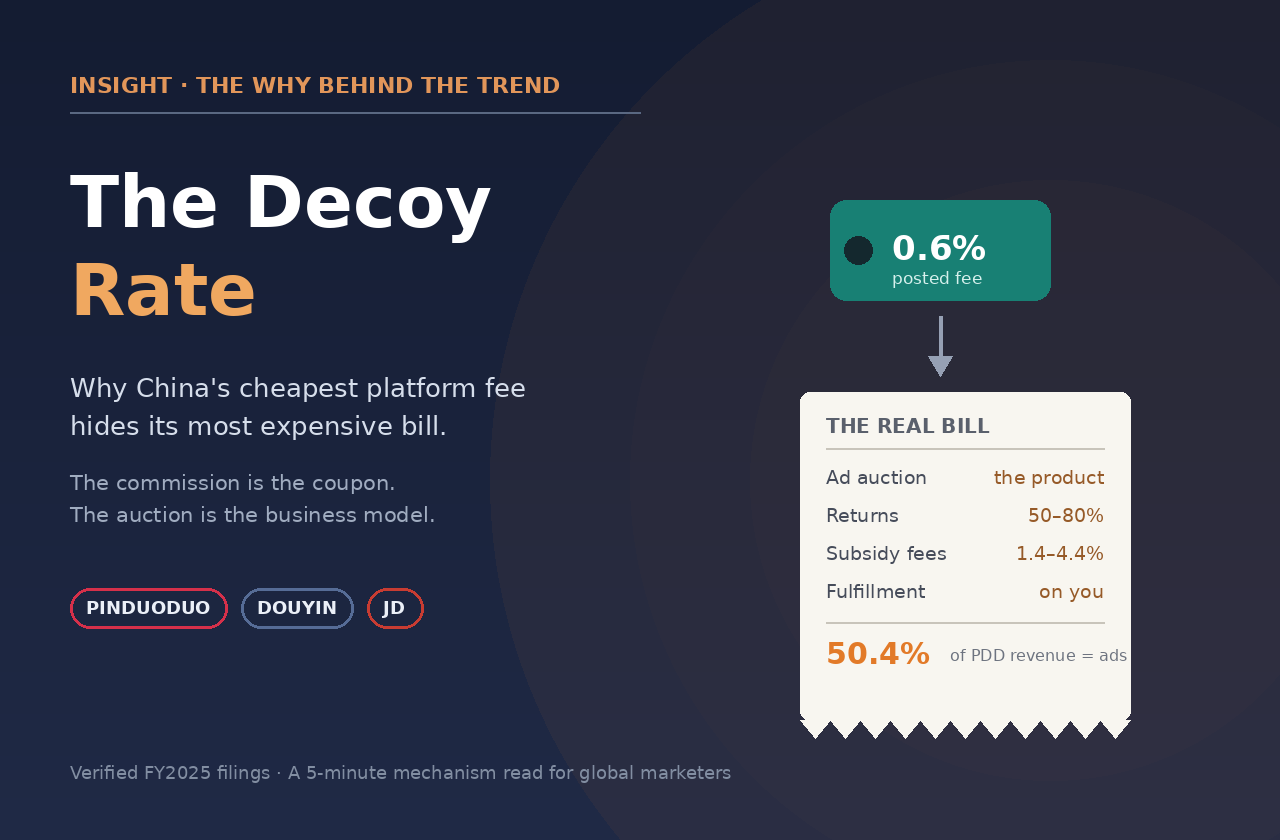
Every comparison chart of Chinese e-commerce platforms has the same trap buried in it: the commission column. Pinduoduo’s posted base fee is 0.6%. Douyin waives entire categories down to the same 0.6%. Tmall charges multiples of that. If you rank platforms by that column, you will confidently choose the most expensive option on the board.
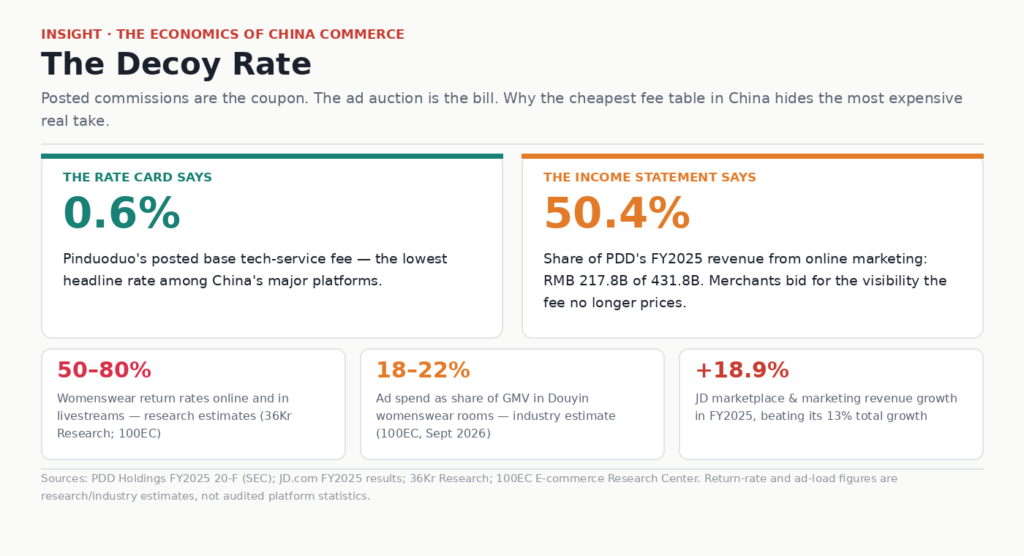
Here is the mechanism nobody prints next to the fee table. When a platform cuts its transaction fee toward zero, it has not decided to earn less. It has decided to earn somewhere else — and the somewhere else is the ad auction. PDD’s own SEC filing makes the switch visible: online marketing supplied 50.4% of its RMB 431.8 billion FY2025 revenue. The 0.6% fee is not the price of the platform. It is the coupon that gets you into the store, where the real price is set by bidding against every other seller for the same screen.
Why the Coupon Works
The economics are elegant and slightly ruthless. A low posted fee lowers the psychological barrier to entry, flooding the platform with sellers. More sellers means more bidders per impression, which raises auction prices. The platform collects less per transaction and more per visit — and visits scale faster than transactions. The fee cut is not generosity; it is customer acquisition for the auction.
This is why fee-waiver announcements arrive with press releases while ad-load increases arrive silently. Douyin’s category cuts to 0.6% made headlines. Meanwhile, an industry estimate reported by 100EC in September 2026 puts ad spend in Douyin womenswear livestream rooms at 18–22% of GMV — roughly thirty times the waived fee. Stack the returns problem on top: 36Kr Research estimates online womenswear returns at 50–60%, and 100EC has documented livestream returns above 80%. The merchant pays traffic costs on orders that come back.
The Tell Is in Every Income Statement
Once you see the mechanism, you see it everywhere. JD — the trust-and-logistics operator, not a feed platform — grew marketplace and marketing revenue 18.9% in FY2025, faster than its 13% total growth. Alibaba merged its ad tools into one AI-run engine. Kuaishou’s online marketing revenue reached RMB 81.5 billion. Every model, whatever its traffic physics, converges on the same revenue engine: selling visibility.
The strategic implication is not “avoid cheap-fee platforms.” PDD’s flywheel is real, and factories with genuine cost advantages win there. The implication is that the fee table is marketing copy aimed at your onboarding decision, while the auction is the business model aimed at your P&L. Compare platforms by total contribution margin at your realistic ad load and return rate. The cheapest number on the rate card is almost never the cheapest platform — it is simply the best-designed invitation.