You did everything the local SEO playbook told you to do. You claimed the profile, stuffed in every category, chased reviews, and climbed to the top of the map pack. Then a customer asks Google’s AI Mode for the best plumber in town — and the AI names your competitor. Your ranking says you won. The answer says you don’t exist.
Here’s the uncomfortable truth behind that gap: ranking and recommendation are now two different selection systems, and most local businesses are only optimizing for one of them. Let’s walk through what the data actually shows, what changed in 2026, and what to do about it in the next 90 days.
Four Out of Five Citations Point Back to Google Itself
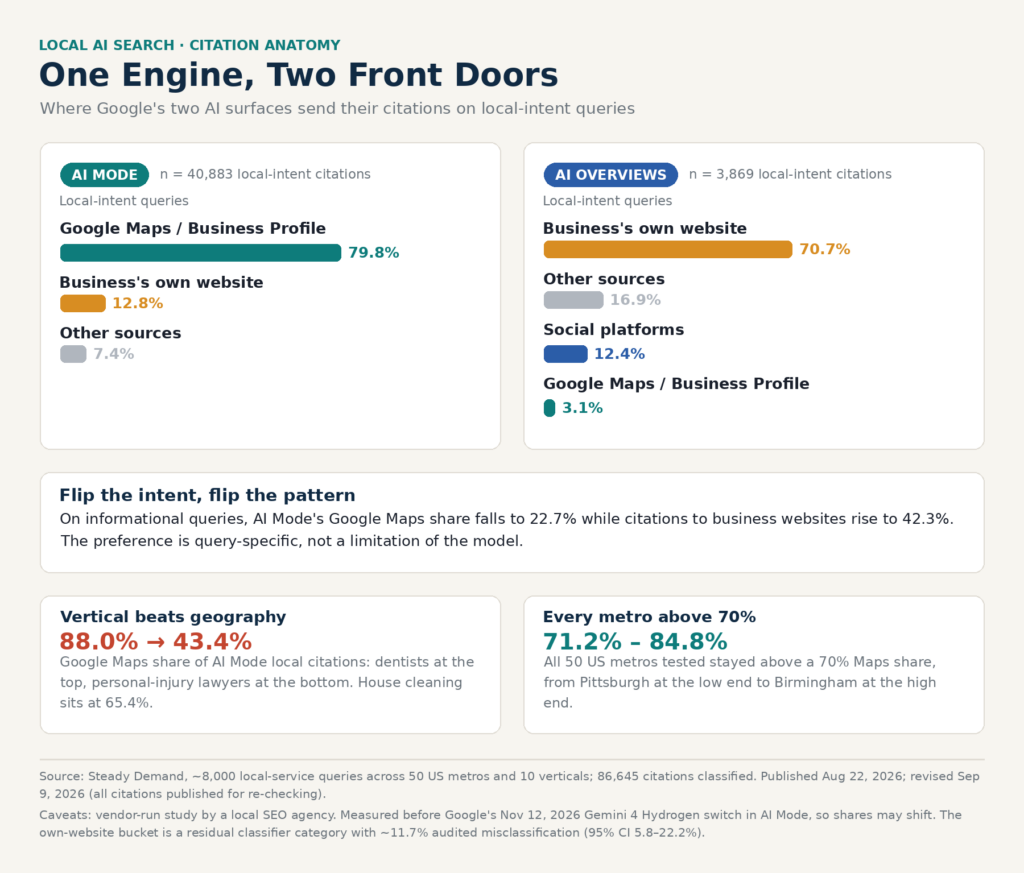
The cleanest evidence comes from Steady Demand, a local SEO agency whose co-founder Ben Fisher is a Google-designated Business Profile Diamond Product Expert. In August 2026 the team ran roughly 8,000 local-service searches — 3,992 through AI Overviews and 3,998 through AI Mode — across 50 US metros and 10 service verticals, then classified all 86,645 citations that came back and crawled the 26,358 unique pages behind them. The study was revised on September 9, 2026 after an independent review, and the full citation dataset is published so anyone can re-check the math. That’s unusually transparent for agency research, though it remains vendor-run work, not a Google disclosure.
The headline: on local-intent queries, 79.8% of AI Mode’s citations point to Google Maps or Google Business Profile data. Only 12.8% point to the business’s own website. Your lovingly optimized service page? For the queries that ring your phone, it’s mostly not being read. The profile is the raw material the answer is built from.
AI Mode vs AI Overviews: Same Question, Opposite Sourcing
Now flip to AI Overviews — the AI summaries inside normal search results. On the same local-intent queries, it cited the business’s own website 70.7% of the time and Google Maps or GBP just 3.1%. Same engine underneath, nearly opposite behavior on top.
And it’s intent-specific, not a model limitation. Ask an informational question — “how much does a plumber cost” — and AI Mode’s Maps share drops to 22.7% while business-website citations climb to 42.3%. AI Mode can cite your site. It just usually chooses Google’s own listing data for exactly the searches local businesses care about most.
The pattern varies more by vertical than by city. Every one of the 50 metros tested sat above a 70% Maps share (71.2% in Pittsburgh to 84.8% in Birmingham), but verticals ranged from dentists at 88.0% down to personal-injury lawyers at 43.4%, with house cleaning at 65.4%. Check your own category before treating the average as your number. One honest caveat from the study itself: the own-website bucket is a residual classifier category with roughly 11.7% audited misclassification, and an earlier mobile-friendliness finding was withdrawn entirely in the September revision. Good research corrects itself; treat the direction as solid and the decimals as one study’s snapshot.
The 74% Warning: Ranking #1 Doesn’t Buy a Recommendation
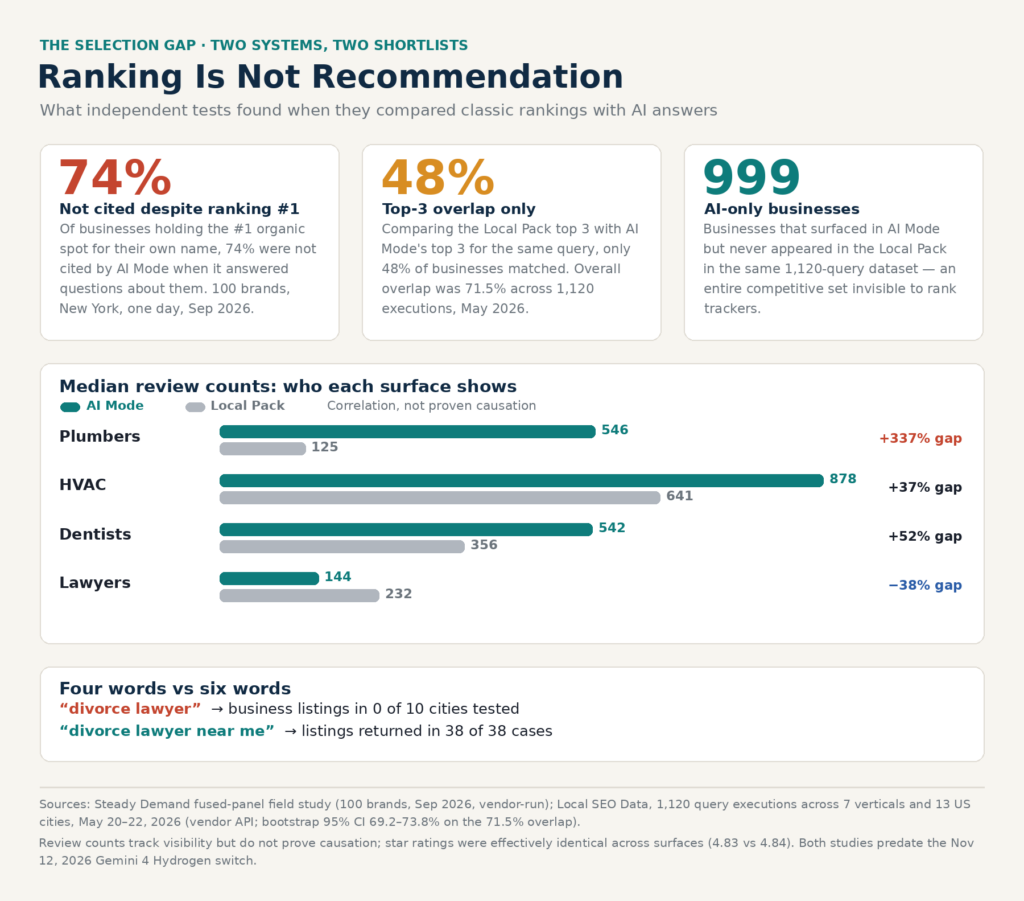
In a separate September 2026 field test, Fisher searched 100 local brands across ten categories from New York, one day, four query formats each: the bare name, name plus “reviews”, “is [name] legit”, and “what does [name] do”. Among businesses holding the #1 organic position for their own exact name, 74% were not cited by AI Mode when it answered direct questions about them — meaning their own website wasn’t used as a source. Not a competitive keyword. Their own name.
Where did the AI look instead? Third-party platforms outcited official brand websites in 59% of citations (a calibrated figure; the raw count was 84% before excluding brands whose names double as generic words). Yelp led with 118 citations across 72 brands, followed by Google reviews and Maps (109 across 60), Reddit (91 across 58), and Trustpilot (77 across 52). When someone asks whether you’re legit, your homepage saying “we’re trusted” simply isn’t evidence. A few hundred independent reviews are.
The same test caught something spookier: four searches returned AI panels for a different business entirely — Fox Pest Control surfaced Fox Wildlife Services; a law firm’s name pulled up a pool company. Generic or shared names carry real entity-confusion risk. Search your own name from outside your service area, logged out, on a phone. More than once — the layouts shifted within hours.
Independent work points the same way. Local SEO Data — a vendor using its own API, worth knowing — ran 1,120 query executions across seven verticals and 13 US cities in May 2026. AI Mode and the Local Pack overlapped on 71.5% of businesses. Compare only each surface’s top three and overlap collapses to 48%. And 999 businesses appeared in AI Mode without ever showing in the pack: an entire competitive set your rank tracker has never seen.
The Official Three Factors Still Hold — the Weights Moved
Google’s documented local ranking guidance hasn’t changed: relevance, distance, prominence. What changed is how prominence gets assembled. AI Mode uses query fan-out — it splits your customer’s question into parallel sub-searches across Maps, the Knowledge Graph, Business Profiles, reviews and ordinary web pages, then synthesizes. Whitespark’s 2026 Local Search Ranking Factors survey of 47 practitioners still puts GBP signals in the largest weight group (roughly a third) with the primary category as the single most influential factor. That’s aggregated expert judgment, not a causal measurement — but it aligns with what the citation data shows.
The practical read: the fundamentals didn’t get replaced. They got stricter.
Review Text Is Fuel for Conversational Answers
Stars got you into the consideration set. Words get you into the answer. When a customer asks “is it good for kids” or “can I make it before the show”, the AI mines review text for those specifics. Sterling Sky’s analysis of 8,186 businesses across 200 cities found reviews with written content correlated more strongly with placement than star-only ratings.
So ask happy customers — compliantly, never incentivized — to mention what they bought, who they brought, and how it went. A review that says “they seated our toddler in two minutes and the gluten-free pizza was actually good” is a paragraph the AI can quote. Forty reviews that say “great service” are wallpaper.
Review Velocity Beats Review Volume: Fund It Like Acquisition
That same Sterling Sky dataset found reviews earned this month correlated more strongly with near-me placement than lifetime totals. They documented a dental client pulling 60+ reviews a month whose rankings dropped sharply after an 18-day pause — while competitors earning 15 to 45 monthly held position. BrightLocal’s 2026 consumer survey (1,002 US adults; a vendor survey from a review-tools company) adds the human side: 74% of consumers want reviews written within the last three months, and 47% won’t consider a business with fewer than 20.
Here’s the reframe worth taking to your CFO: consumers using AI for local recommendations jumped from 6% to 45% in a year, yet 97% of those AI users still double-check recommendations against real reviews, and 42% always visit the native review platform. AI builds the shortlist; your review profile survives — or loses — the verification step thirty seconds later. Reviews are doing acquisition work at two stages of one purchase. Budget them as a channel, not as reputation janitorial work.
Agentic Booking and AI Calls: Your Booking Platform Is the New Shelf
AI Mode doesn’t just name restaurants anymore — it checks live availability and hands the customer a bookable slot. Launched in August 2025 for US Google AI Ultra subscribers, restaurant booking expanded globally in April 2026 with no subscription required, including the UK through partners TheFork, SevenRooms, ResDiary, Mozrest, Foodhub, Dojo, DesignMyNight and OpenTable. US partners named in Google’s announcement include OpenTable, Resy, Tock, Ticketmaster, StubHub, SeatGeek and Booksy.
If your tables live in a paper book, you’re invisible at the exact moment of intent. Connect a supported platform and keep availability honest. Meanwhile, Google’s agentic calling in the US phones local stores to ask about stock and pricing — your staff may already be answering an AI without knowing it. Answer clearly and consistently; that summary goes straight to the shopper. Feature availability moves fast here, so re-check Google’s announcements each quarter. And note the quiet burial: the old Q&A section’s API was retired in November 2025 and the public feature has been phasing out since December, with Gemini-powered Ask Maps answering from your profile, reviews and website instead. Advice to “seed your Q&A” now points at a control panel that no longer exists.
The Completeness Checklist: From Indexable to Recommendable
Treat the profile as the source document, not a directory listing:
- Most specific primary category — it decides which queries you’re eligible for at all.
- Every relevant attribute — accessibility, parking, kid-friendliness, payment options.
- Services and menus as structured data, mirrored on crawlable website pages.
- Photos per location, refreshed monthly — though Sterling Sky found photo impact is category-dependent: strong for restaurants and salons, unmeasurable for garage-door repair.
- Hours including holidays. The AI answers hours questions directly; stale data becomes a confidently wrong answer.
- One contested choice: hiding your address. Google recommends it for service-area businesses, yet Sterling Sky’s controlled tests on two locations showed rankings and calls fell when the address was hidden and recovered when restored. If you’re a SAB, test it on one location before rolling it out everywhere.
Your Dashboard Fell? Diagnose Before You Fix
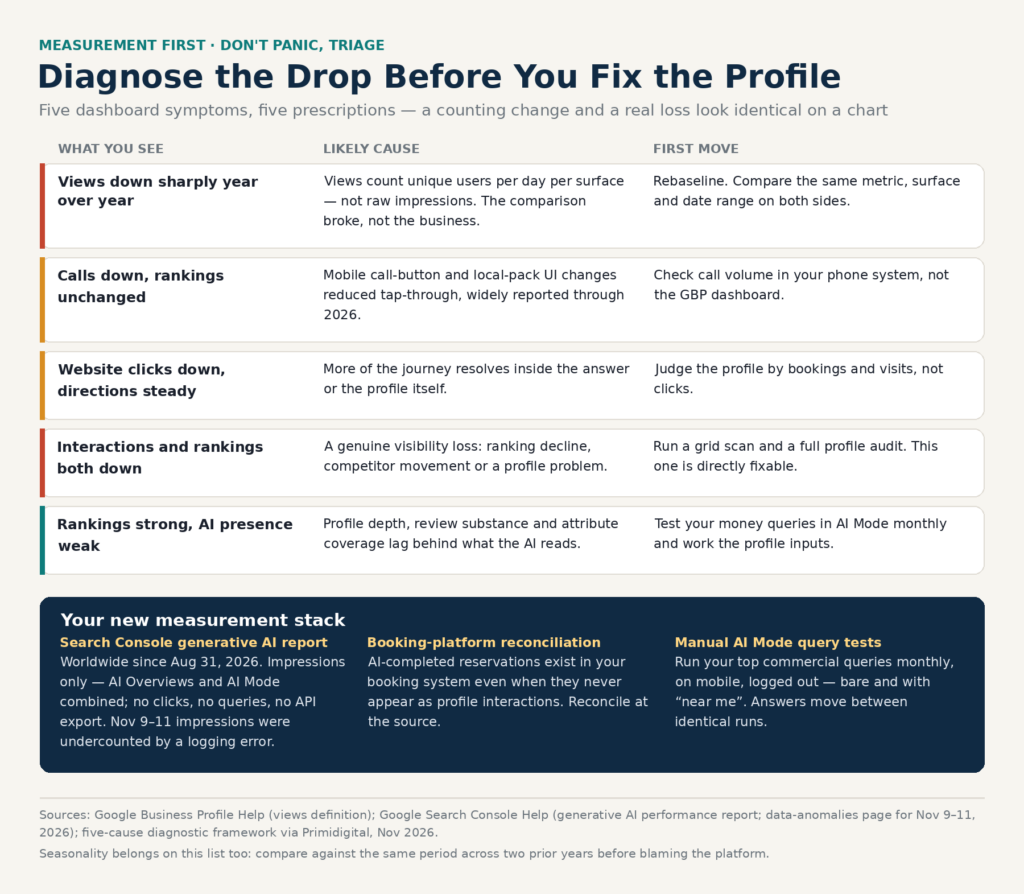
A drop in the performance report can mean six different things, and two of them have nothing to do with AI. Google counts profile views as unique users per day per surface — not raw impressions — which deflated totals industry-wide and breaks any year-over-year comparison spanning the change. Calls can slide because the mobile call button moved, not because demand did: Jepto tracked 179 profiles at 34 US law firms over two years and watched click-to-call decline while website clicks held. Check your phone system before you fire your SEO agency. And seasonality causes more declines than anything on this list — compare against the same period across two prior years first.
Search Console’s Generative AI Report: Official Measurement, With Edges
Announced June 3, 2026 and rolled out to all websites worldwide on August 31, the generative AI performance report finally shows your impressions in AI Overviews and AI Mode by page, country, device and date. Know the edges before you build a dashboard on it: it’s impressions only — no clicks, no CTR, no queries, no API or BigQuery export — and the two surfaces are one combined number. AI clicks still hide inside the standard Web performance totals. There’s no historical backfill, so your baseline starts the day you start looking. And Google’s own data-anomalies page logs a rendering issue: impressions were undercounted November 9–11, 2026 by a logging error. Skip those three days.
Pair it with two instruments Google doesn’t provide: monthly manual AI Mode tests of your top commercial queries (bare and with “near me” — in Local SEO Data’s test, bare “divorce lawyer” returned zero business listings in all ten cities, while adding “near me” restored listings in 38 of 38 cases), and booking-platform reconciliation, because AI-completed reservations exist in your booking system even when they never appear as profile interactions.
Multi-Location Operations: Consistency Is the Price of Admission
Chains have the raw ingredients to dominate AI recommendations — more reviews, more presence, more brand demand — and more ways to sabotage themselves. Inconsistent name formats, addresses, phone numbers, hours, categories or booking links across locations give the AI reasons to hedge or pick someone else. One weak location drags the trust signal for all.
Make location pages recommendable, not merely indexable: NAP and a call-or-book CTA above the fold, this location’s actual services and clientele, a genuinely local FAQ, parking and transit notes, location-specific photos and reviews. Kill the copy-paste template where only the city name changes. Standardize a review-request process and a response SLA per location, and watch reviews per month as a rate — not lifetime totals as a milestone.
The November Wrinkle: the Brain Changed Mid-Measurement
One timing note most write-ups skip. On November 12, 2026, Google made Gemini 4 Hydrogen the default model in AI Mode worldwide and put it on the hardest AI Overviews questions — calling it the biggest model upgrade to Search yet, with explicitly improved query fan-out and broader linking. It landed two days into the November core update. When Gemini 3 took over AI Overviews in January 2026, SE Ranking’s 100,000-keyword tracking measured 42.4% of previously cited domains churning out — almost entirely in the long tail. Every study in this article was measured on earlier models. The structural story — profile as source, two selection systems, verification behavior — is stable. The exact percentages are snapshots of a moving machine. Re-test after the dust settles, and don’t compare across November 10–24 without noting both events.
Your 90-Day Action Plan
- Days 1–30 — data truth. Audit NAP, categories, attributes, hours and booking links across every location and major directory. Search your own brand name on mobile, logged out, from outside your territory. Record a Search Console generative AI baseline.
- Days 31–60 — review flow. Launch a compliant review-request program per location; ask for descriptive detail; reply to everything within 48 hours. Track monthly velocity against the competitors AI Mode actually shows.
- Days 61–90 — bookable + measured. Connect supported booking platforms, keep slots current, reconcile reservations at the source. Run monthly AI Mode query tests and report AI presence separately from pack position.
The Bottom Line
Ranking gets you considered. A complete profile, descriptive review flow and live booking data get you recommended — and a verifiable reputation keeps you chosen when the customer double-checks. There’s no separate “AI optimization” track to buy. There’s the same fundamentals, held to a stricter standard, measured on two surfaces instead of one. The businesses that win the next year won’t be the ones posting most often. They’ll be the ones who can tell, within a week, which system stopped naming them — and know exactly which input to fix.