Ask Amazon’s AI assistant for the best queen mattress, and there’s a decent chance it recommends something your rank tracker has never flagged as a competitor. That’s not a glitch. It’s a new shelf. In one of the first large-scale studies of its kind, roughly two-thirds of the assistant’s picks sat outside the organic top ten for the same query. Meanwhile, Amazon says more than 300 million customers used the assistant in 2025. If your playbook still ends at “rank higher, bid smarter,” you’re optimizing two shelves while a third one quietly decides who gets recommended.
One naming note before we dive in. On May 13, 2026, Amazon retired the Rufus brand and merged its shopping brain with Alexa+ into a single assistant called Alexa for Shopping, as GeekWire and Modern Retail reported at launch. It’s free for signed-in US shoppers, lives directly in the main search bar, carries conversation memory across devices, shows a full year of price history, and can buy automatically when a price hits your target. The engine formerly known as Rufus still does the product thinking underneath. For sellers, the optimization work didn’t change — the surface just got bigger. Below, we say “the assistant” for the unified experience and keep “Rufus” where the underlying research used that name.
The Scale Is Real: 300 Million Shoppers and a $12 Billion Estimate
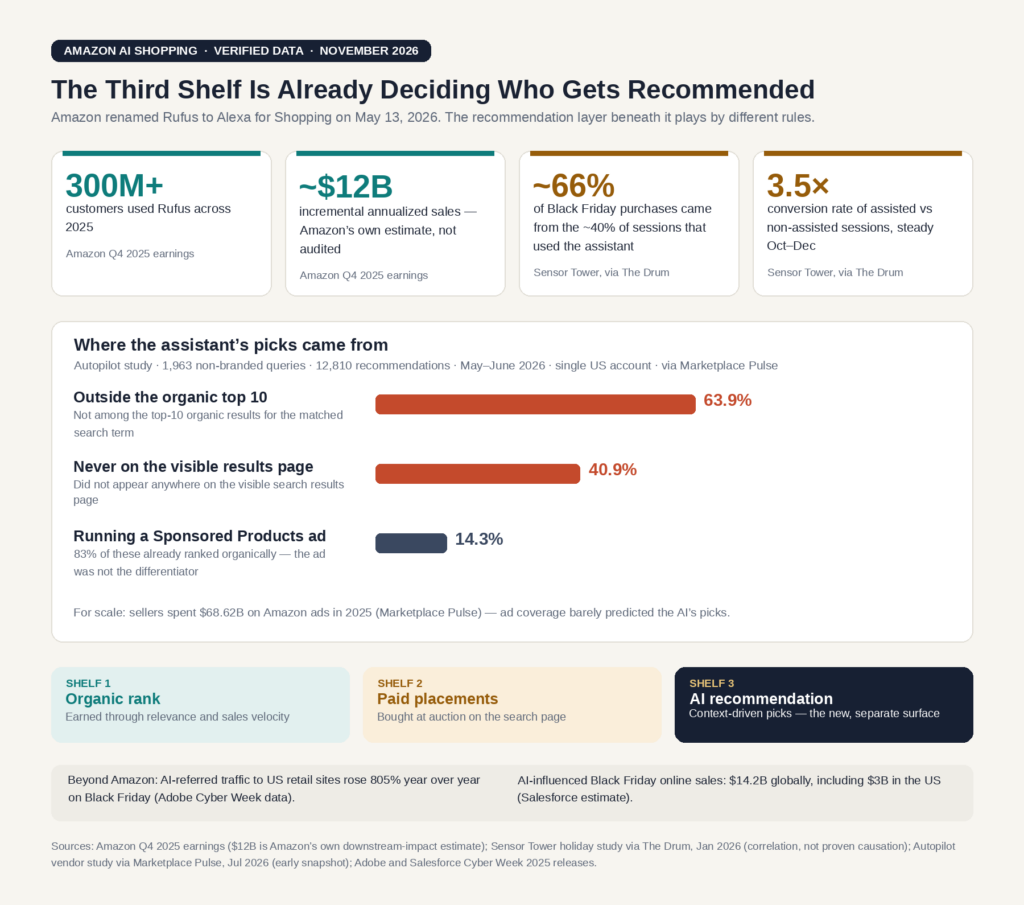
Let’s start with the numbers, because this stops being a thought experiment fast. On its Q4 2025 earnings call, Amazon disclosed that over 300 million customers used Rufus during 2025, and that the assistant helped drive nearly $12 billion in incremental annualized sales. Treat that dollar figure carefully: it’s Amazon’s own downstream-impact estimate, not audited revenue. One quarter earlier, CEO Andy Jassy had put users at 250 million, monthly active users up 140% year over year, interactions up 210%, and said shoppers who engage with the assistant are 60% more likely to complete a purchase — a claim Amazon has repeated since.
Independent data points the same direction. Sensor Tower analyzed more than 100,000 real Amazon shopping sessions across the 2025 holiday season and found that on Black Friday, Rufus-assisted sessions were about 40% of all sessions but produced roughly 66% of purchases. Assisted sessions converted at about 3.5 times the rate of non-assisted ones, a gap that held steady from October through December. And here’s the kicker: assistant sessions grew roughly 90% between early October and Black Friday week, while everything else grew 8%. Nearly all of Amazon’s incremental holiday traffic growth came from AI-assisted shopping. The honest caveat, which Sensor Tower itself flags: motivated shoppers may self-select into the assistant, so this is correlation, not proof of causation.
The wider market confirms the habit is forming. Adobe measured AI-referred traffic to US retail sites up 805% year over year on Black Friday 2025, and up 693.4% across the full holiday season, which set a record $257.8 billion in US online spend. Salesforce, measuring something different — sales influenced rather than traffic — estimated AI and agents touched $14.2 billion in global Black Friday online sales, including $3 billion in the US. Different metrics, same story: the assistant layer is now a demand channel, not a demo.
The Third Shelf: 64% of AI Picks Sit Outside Your Organic Top 10
Here’s the study that should change your dashboard. Autopilot, an AI-optimization vendor, captured 1,963 non-branded queries and 12,810 assistant recommendations on Amazon US in May and June 2026, and Marketplace Pulse published the analysis in July. The method matters: researchers asked the assistant a best-of question — “what is the best queen mattress?” — and compared its picks against the ordinary search page for “queen mattress.”
The results: 63.9% of recommended products were not in the organic top ten for the matching search term. Even more striking, 40.9% never appeared on the visible search results page at all. And only 14.3% of picks were running a Sponsored Products ad on that search page — with 83% of those already ranking organically anyway. In other words, the two levers sellers spent $68.62 billion on in 2025 (Marketplace Pulse’s figure for Amazon ad spend) barely predicted who the assistant chose.
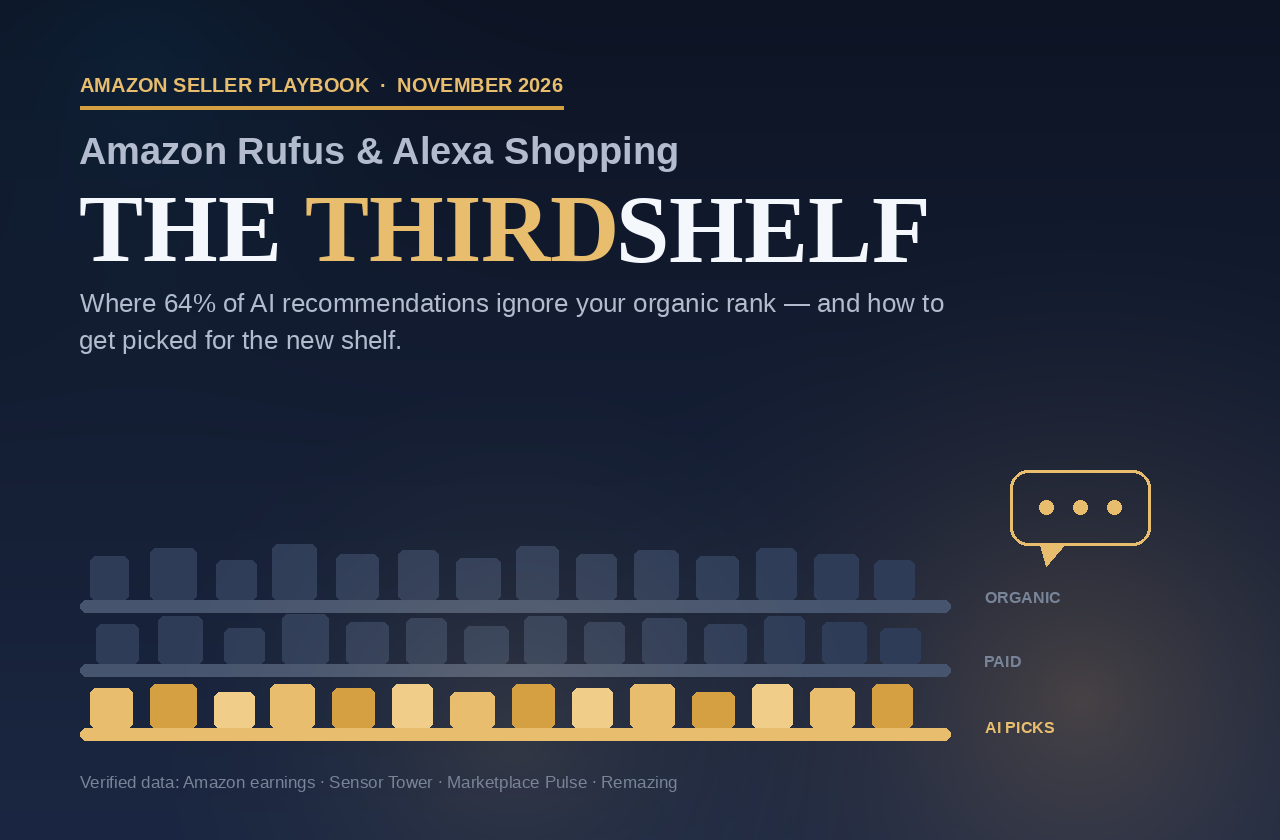
Autopilot’s CEO Christian Umbach calls this the emergence of a “third shelf” alongside organic search and paid placements: brands can’t simply buy or rank their way onto it; they need to give the assistant enough context to understand when and why their product is the right recommendation. The caveats are real — this is a single US account, one early snapshot, from a vendor that sells AI-visibility services. But it matches what the assistant has been visibly becoming: two years ago it mostly handed back links you could have searched yourself; now it reasons over the catalog and picks.
The Long-Tail Window: Four Stars, Sales Velocity, and a Title the AI Can Finish
Dig into Autopilot’s follow-up commentary on The Smartest Amazon Seller podcast and the texture gets more useful. The first recommendation still tilts toward strong organic performers — the head of search isn’t dead. But the deeper recommendations lean hard toward long-tail products that clear a quality floor: ratings of four stars and up, healthy sales velocity, and concise titles the assistant can display without truncation. Category behavior varies, with apparel showing more diversified picks than supplements. Running PPC, by their read, offers only a slim chance of forcing a recommendation for a listing that lacks those underlying signals.
One counterpoint deserves airtime. Similarweb’s analysis has characterized the assistant’s carousel as influenced by sponsored placements and purchase-history personalization — closer to a pay-to-play shelf. Both readings can partly coexist: an assistant that ignores your search-page rank while still weighting some paid signals and personalization is messier than either headline. Which is exactly why you should measure your own products on this surface rather than adopt anyone’s slogan, including ours.
A Controlled Experiment: What the Assistant Will Name as Its Source
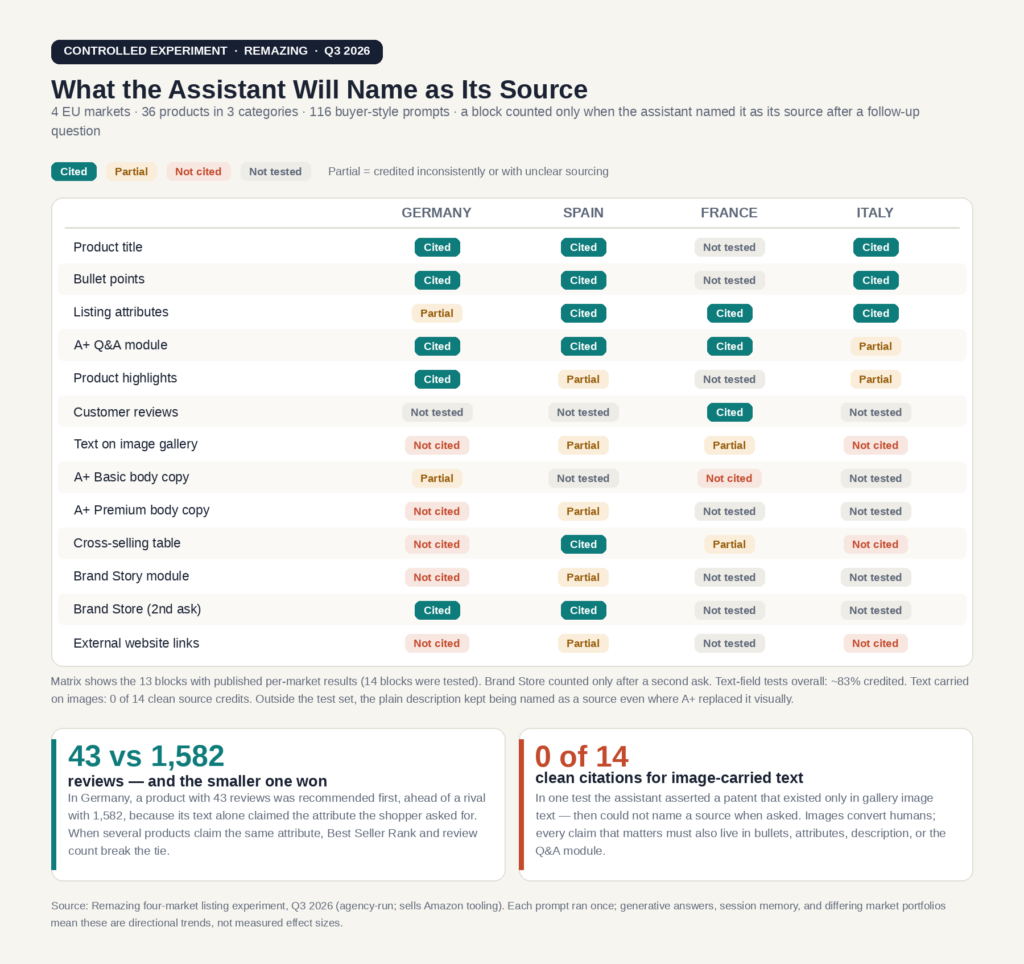
If the Autopilot study tells you the third shelf exists, a clever experiment by the agency Remazing tells you what it’s built from. Across four European marketplaces — Germany, Spain, France, Italy — native speakers wrote 116 buyer-style prompts in Q3 2026: lowercase, local slang, sloppy grammar, the way people actually ask. They tested 36 products across three categories (skincare, adhesives and home care, smart lighting), entering through both the product detail page and search, and scored 85 answers against 14 content blocks.
The methodological twist is the whole point. After every positive answer, they asked a follow-up: where on this page do you see that? A content block only counted when the assistant named it as its source. That one question separates “the model can read it” from “the model will stand behind it.”
The pattern that emerged: text fields were credited as sources in about 83% of tests. Titles, bullet points, listing attributes, and the A+ Q&A module were the reliable citizens. Text carried inside images — gallery graphics and visual A+ modules alike — was never cleanly credited: zero of fourteen. The plain product description kept getting named as a source even on pages where A+ Content had visually replaced it, which means that hidden legacy field still matters. The Brand Store only counted when researchers asked a second time.
Read these as trends, not effect sizes. Each prompt ran once, the assistant is generative, sessions carry memory, and market portfolios differed. But four markets pointing the same way is a signal worth acting on.
43 Reviews Beat 1,582: The Attribute-Monopoly Lever
The single most actionable finding in Remazing’s data comes from Germany. A shopper asked for a specific attribute that only one product’s text explicitly claimed. That product — with 43 reviews — was recommended first, ahead of a competitor carrying 1,582 reviews. Attribute ownership beat review volume by a mile.
The mechanics are logical once you see them. When your text is the only place the assistant can confirm a requested attribute, you’re not competing; you’re the only valid answer. When several products claim the same attribute, the tiebreakers revert to familiar signals: Best Seller Rank and review count. And when your attribute fields are thin, the assistant fills the blanks from review text — meaning customers, not you, write your product’s spec sheet in the AI’s eyes. The playbook writes itself: audit competitor listings for true attributes nobody claims, then claim yours explicitly in structured fields and text. In saturated categories where everyone says the same thing, earn reviews first — the monopoly lever needs an unclaimed attribute to work.
The Image-Text Trap: Reading Is Not Citing
Here’s the trap that catches design-led brands. The assistant is multimodal — it can see your images. In one Remazing test it even asserted a product held a patent, a claim that existed only in gallery image text. But when asked to name the source, it couldn’t. The researchers logged it as a false positive. Across the whole study, image-carried text earned zero clean source credits.
So your gorgeous infographic carousel may inform the model’s impression while contributing nothing it will cite or defend. The division of labor is clean: images convert humans; text feeds the machine. Every claim that matters — certifications, compatibility, materials, use cases — must live in bullets, attributes, description, or the Q&A module. If it only exists in a JPEG, treat it as invisible to the recommendation layer.
COSMO and the New Keyword Stuffing
Why would the assistant behave this way? Amazon’s published research offers the best available clue. At SIGMOD 2024, Amazon scientists presented COSMO, a system that mines commonsense knowledge from shopper behavior — query-purchase and co-purchase pairs — and builds a knowledge graph linking products to human contexts: functions, audiences, events. Their example: a query for “shoes for pregnant women” should surface slip-resistant shoes, even without keyword overlap. In offline tests, adding COSMO relationships lifted a search-relevance model’s macro F1 score by 60% with fixed encoders.
An honesty note: Amazon has never officially said the shopping assistant runs on COSMO. The paper describes deployment in search relevance and navigation; connecting it to Rufus or Alexa for Shopping is practitioner inference, widely repeated by agencies and tool vendors. What we can say without hedging is what Amazon stated at Rufus’s February 2024 launch: the assistant was trained on the product catalog, customer reviews, community Q&As, and information from across the web. Reviews and Q&As are intent data, not keyword data.
That explains the critique you hear from practitioners like ZonGuru: batch-generating polished listings with ChatGPT is the new keyword stuffing. When every water bottle says “premium,” “durable,” and “perfect for any adventure,” a reasoning engine has nothing to tell them apart. Fluency is now free; differentiated, verifiable specifics are the scarce asset. Write claims a skeptical reviewer could confirm — dimensions, certifications, compatibility, measured performance — and let the adjectives go.
The A+ Q&A Playbook: Write Answers the Assistant Can Repeat
Remazing’s data hands you one module with outsized leverage: the text-based A+ Q&A module was the only A+ format consistently credited as a source, cited cleanly in three of four markets. It’s brand-written text the assistant will repeat almost verbatim. Use it deliberately.
Mine your reviews, support tickets, and the questions shoppers actually type — then write Q&A pairs in buyer language, not brochure language. One question, one direct answer, one verifiable claim per answer. “Is this compatible with induction hobs?” deserves “Yes — tested for induction, gas, and electric hobs up to 28 cm,” not a lifestyle paragraph. Mirror each answer in your attributes and bullets so the same fact appears wherever the assistant looks. And keep the plain description updated even when A+ hides it on screen — the experiment showed the assistant still reads and cites it. Think of the Q&A module as your quotable press release inside the listing.
The 360-Degree Ecosystem: Your D2C Content Feeds the Other Engines
The third shelf doesn’t end at Amazon’s walls. Autopilot’s research conversation keeps returning to a 360-degree view: off-Amazon content — your D2C site, deal forums, editorial reviews — feeds the external engines like ChatGPT and Google’s AI surfaces, which increasingly recommend products too. Amazon itself trained the assistant partly on web information, so your owned content is evidence in more than one court.
Practically, this means agent-friendly D2C pages: crawlable HTML rather than script-only rendering, structured spec tables, honest comparison pages, FAQ sections written in question form. The same page that convinces ChatGPT to cite your brand can corroborate the claims your Amazon listing makes. If you read our earlier analysis of how ChatGPT’s shopping answers pull from catalog and retailer data, this is the mirror image: off-platform proof flowing back toward the marketplace. One content investment, two recommendation engines.
Measuring the Shelf: Dual-Entry Prompt Audits and Recommendation Rate
You can’t manage what you don’t track, and your current tools almost certainly don’t track this. Borrow Remazing’s method and industrialize it. Build a fixed set of buyer-style prompts for your top ASINs — the twenty questions your category’s shoppers actually ask. Run them weekly from two entry points: the assistant on the homepage or search page, and the assistant on your product detail page. The two contexts produce different answers, so log them separately.
For each run, record three things: whether your product appears, its position in the recommendation set, and — after asking “where do you see that?” — which content block gets named as the source. That gives you a recommendation rate and a source-credit rate per ASIN, trending over time, sitting beside BSR and ACOS as a third-shelf KPI. Use consistent accounts, because session memory and purchase history personalize results. And keep watching Amazon’s ad console: Sponsored Products prompts and Sponsored Brands prompts went from open beta in November 2025 to general availability in the US on March 25, 2026, with existing campaigns automatically eligible. Reporting on this surface will mature as monetization does — the sellers with months of their own audit data will know what changed the day it shifts.
The 90-Day Checklist: Attributes, Text Claims, Q&A, and Proof
Here’s the sequence we’d run, in order of leverage.
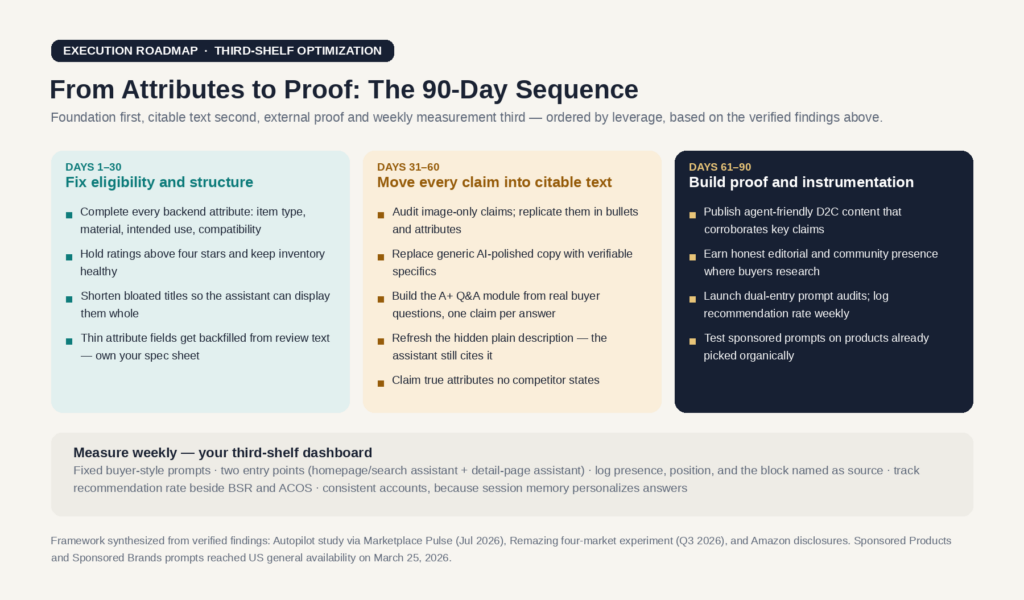
Days 1–30, fix eligibility and structure. Complete every backend attribute field — item type, material, intended use, compatibility. Get ratings above four stars and keep inventory healthy; the long-tail window only opens for products that clear the quality floor. Shorten bloated titles so the assistant can display them whole.
Days 31–60, move every claim into citable text. Audit image-only claims and replicate them in bullets and attributes. Rewrite generic AI-polished copy into verifiable specifics. Build the A+ Q&A module from real buyer questions. Refresh the hidden description. Hunt for true attributes your competitors haven’t claimed, and claim them.
Days 61–90, build proof and instrumentation. Publish agent-friendly D2C content that corroborates your key claims. Seed honest editorial and community presence where your category’s shoppers research. Launch the dual-entry prompt audit and start logging recommendation rate weekly. Test sponsored prompts modestly on products that already earn organic recommendations — and watch whether paid presence changes your organic pick rate.
Summary: Three Shelves, Three Playbooks
Organic rank still pays the rent — most purchases still flow through search. Paid placements still buy visibility there. But the recommendation layer plays by different rules: it reads structured attributes and plain text, weighs ratings and velocity as a floor rather than a ladder, credits sources it can name, and reaches deep into the catalog when shoppers ask for “the best” instead of a list. The 64% figure is an early snapshot, not a law of physics — sponsored prompts are already commercializing the surface. The window where context beats budget is open now. Learn how the assistant chooses while the rules are still being written, and you’ll notice the day they change before your competitors do.