Every hype cycle needs a fuel source. The interesting question about llms.txt is not whether AI crawlers read it — the logs settled that — but why the advice keeps multiplying while the readership stays near zero. Follow the requests, and the answer is uncomfortable: the loudest measurable audience for llms.txt is the industry that recommends llms.txt.
Ahrefs’ May 2026 log study across 137,210 domains broke down who actually fetches published files. SEO audit and scanning tools sent roughly 21.7% of requests. Tools whose entire job is studying llms.txt — research bots, exploratory crawlers, GEO auditors — added another 12%. Coding agents took about 10.5%, training crawlers 5.3%. The AI retrieval bots that could turn a fetch into a citation? 1.1%. Strip out the observers and what remains is a rounding error plus a genuinely useful developer niche.
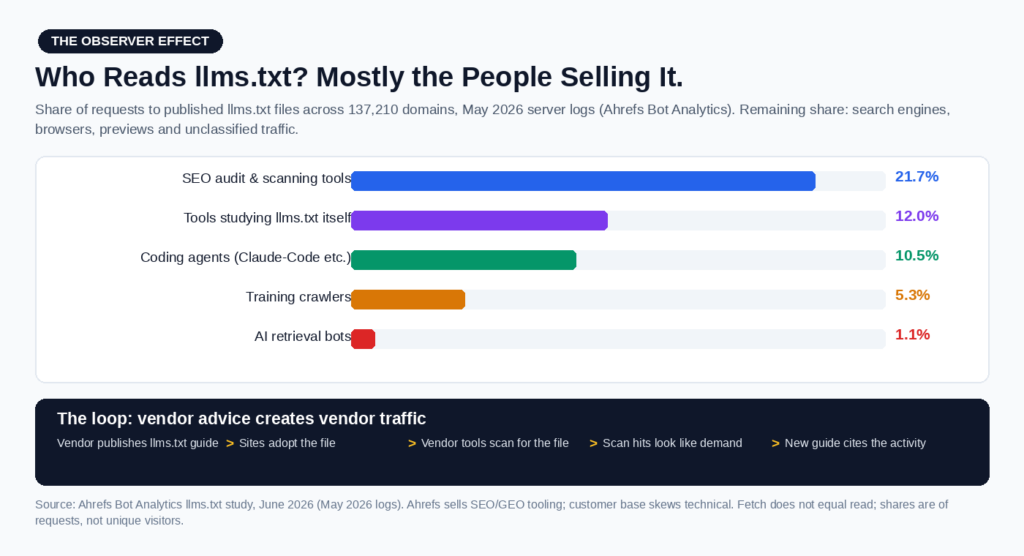
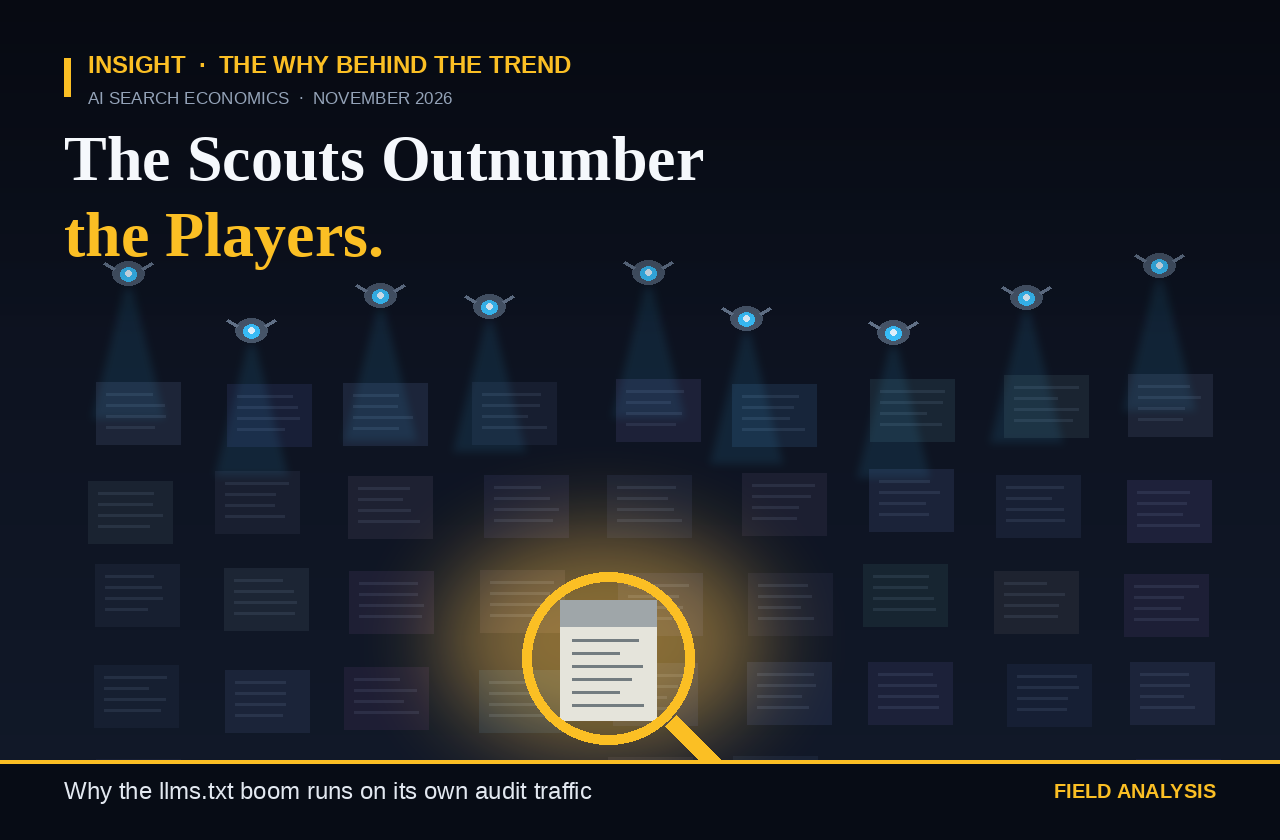
That composition explains the mechanics of the boom better than any conspiracy would. A vendor publishes a guide recommending the file. Sites adopt it because the guide says to. The vendor’s own audit product then scans those sites for the file — generating requests. Those scan hits appear in traffic dashboards as “activity around llms.txt.” The next guide cites the activity. The loop is closed, and at no point did a citation-driving crawler need to participate. Nobody has to lie for this to happen; every actor is reporting real numbers about the wrong population. It is the measurement equivalent of a stadium where the scouts outnumber the players.
Notice what this predicts, because a good mechanism should be falsifiable. If the boom were driven by genuine AI consumption, you would expect crawler fetches of nonexistent files — bots probing for a standard they rely on. Ahrefs found exactly zero AI bot requests to llms.txt paths returning 404. Bots probe for robots.txt and sitemaps constantly; the YinJen hundred-day log captured 1,222 and 2,569 verified fetches of those. Machines vote with their request patterns, and they never voted for this file.
The deeper incentive: for a tool vendor, recommending a cheap, checkable artifact is excellent product design. “Add llms.txt” becomes a line item your software can audit, score and re-check monthly — a recurring reason to open the dashboard. Advice that creates its own measurable checklist creates its own retention. The file’s near-zero citation value doesn’t break this model; it is irrelevant to it.
The practical read is not nihilism. Coding agents genuinely fetch these files, so developer-docs sites keep them. But when you evaluate any GEO tactic, ask who counts the traffic and who benefits from the count. Demand measured by the seller’s own instruments is supply wearing a costume.