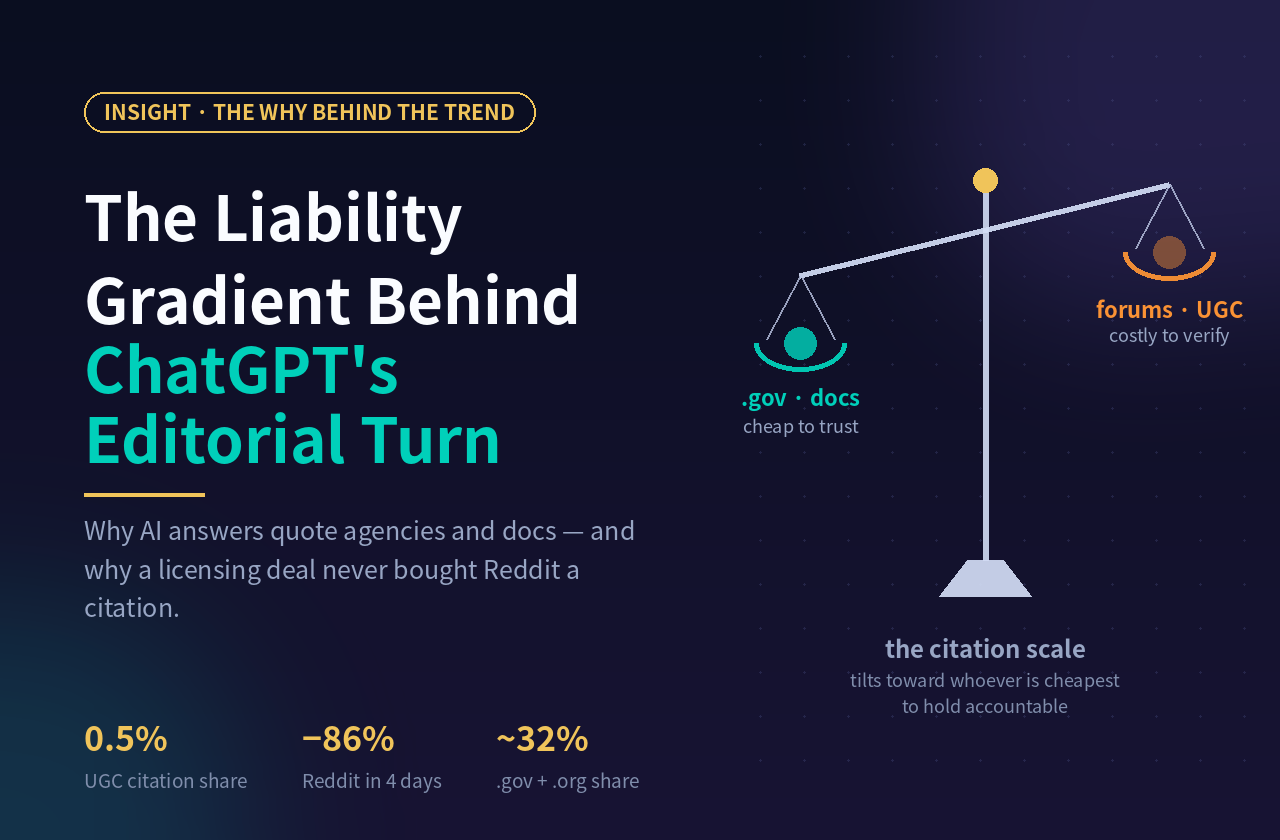
OpenAI never announced a preference for government websites. Yet by late 2026, ChatGPT reads like a formal editorial assistant: user-generated content accounts for just 0.5% of its citations, while .gov and .org domains together supply roughly a third, according to BrightEdge’s cross-engine analysis. Google AI Overviews, drawing on much of the same web, sits near 18% UGC. Same internet, different appetite. Why?
The lazy answer is “quality.” The useful answer is incentives. Three mechanisms, stacked.
Mechanism One: Error-Cost Asymmetry
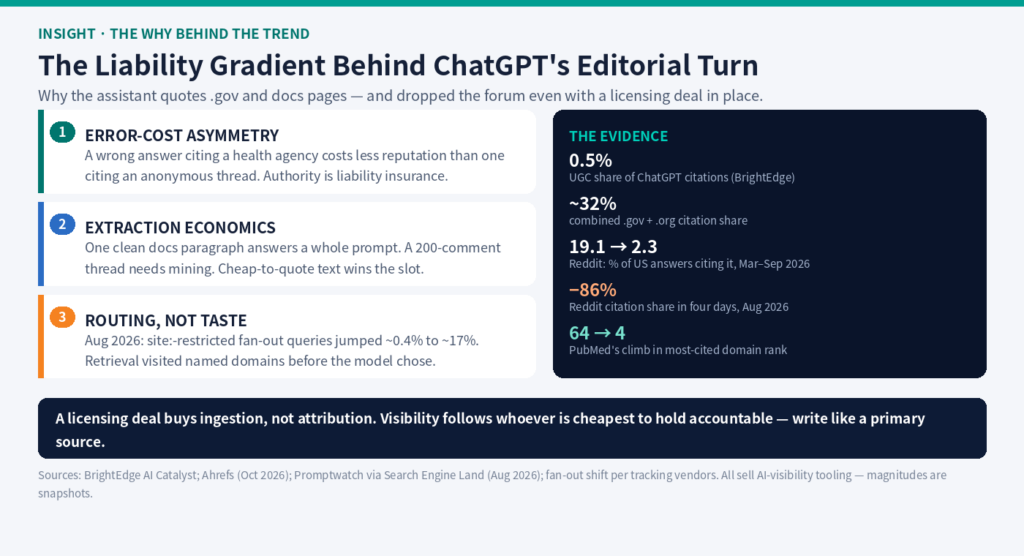
Every citation is a small liability transfer. When an assistant attributes a medical claim to a health agency and gets it wrong, the failure reads as interpretation. When it attributes the same claim to an anonymous forum thread, the failure reads as negligence — and screenshots of negligent AI travel fast. Authority is not a taste preference; it is liability insurance. The gradient runs downhill toward whoever is cheapest to hold accountable, and a .gov letterhead is very cheap to defend.
Mechanism Two: Extraction Economics
A citation slot is scarce; the cost of filling it is not equal across sources. One clean documentation paragraph can answer an entire prompt. A 200-comment thread requires mining, deduplication and risk-weighting before a single quotable sentence emerges. Ahrefs’ 1.4-million-prompt study found pages retrieved via ordinary web search were cited 88% of the time, versus under 2% for the Reddit feed. The model is not ignoring forums out of snobbery. It is buying the cheapest extractable answer.
Mechanism Three: Routing, Not Taste
Here is the part most commentary misses. The decisive shift may happen before the model chooses anything. Tracking vendors reported that around August 8, 2026, ChatGPT’s fan-out queries pivoted hard toward site:-restricted searches — from roughly 0.4% to about 17% of sub-queries — steering retrieval to named, trusted domains. Promptwatch measured Reddit’s citation share collapsing 86% in four days. Ahrefs’ longer view shows Reddit falling from 19.1% of US answers in March to 2.3% in September, while PubMed climbed from the 64th most-cited domain to the 4th. Treat the magnitudes as vendor snapshots; the direction is corroborated across independent trackers.
The uncomfortable detail: Reddit had a signed licensing deal with OpenAI throughout. The deal bought ingestion, not attribution. When routing changed, the contract did not protect the citation. Nobody at OpenAI needed to make a decision “about Reddit” at all.
What It Means for You
Stop reading source-share charts as a popularity contest. They are a map of accountability costs. The winning move is not lobbying the platform or buying mentions; it is lowering your own verification cost: publish primary data, date every claim, answer the question in the first paragraph, and keep your official pages the cleanest version of the truth. In an economy where citations flow to whoever is cheapest to trust, the cheapest source to trust should be you.